
What an NDA does and does not actually do
The document buyers most often sign is the wrong one
The first question a buyer asks is usually "can you get the factory to sign my NDA?" It sounds like the complete answer. It is not. A non-disclosure agreement is a promise between the party who wrote it and the party who signs it. It binds the signer to keep information confidential and sets out what happens if they do not. It does not prevent the information from being used; it creates a claim after the fact.
That distinction matters because of what a buyer is actually afraid of. The fear is rarely that a factory will read the drawing and keep quiet. It is that the drawing will be used to quote the same part to a competitor, or that tooling made from it will be reused on someone else's order, or that the finished product will appear on a marketplace under a different brand. None of those outcomes requires the factory to break a promise in a way that is easy to detect. An NDA gives you somewhere to point afterwards. It is not a lock on the file.
Why a signed promise still leaves you exposed
Three limits show up again and again. First, the promise is only as useful as the identity of the signer. A signature from "Shenzhen Xingtai Precision" means very little if that is a trading name and the entity on the business licence is something else. You cannot enforce a document against a name that does not exist in the registration records.
Second, the scope is often too wide to be useful. Buyers send the master assembly file, the full tolerance stack and the surface-finish specification to a factory that only needs to quote a single machined bracket. The more you send, the more there is to misuse, and the harder it becomes to show later which part was confidential and which part was obvious from the sample.
Third, and most overlooked: a confidentiality clause does not create a property right. In the United States, trade secret protection attaches only if the information has independent economic value from being secret and the owner has taken reasonable efforts to keep it secret. The USPTO's own guidance lists limiting access, marking materials confidential and requiring outside parties to sign confidentiality agreements as examples of those reasonable efforts. Skip the basic controls and you can lose the protection even though somebody signed something.
Identify the entity before you send the first file
A factory name is not a legal identity
The single most useful thing you can do before any drawing changes hands is to establish who will receive it. On invoices and quotes, Chinese suppliers routinely use a short trading name, an English brand or the name of a parent. The legal entity that signs your contract and the entity that runs the workshop can be different companies, and sometimes the workshop is a subcontractor two steps removed from the party you are talking to.
Ask for the business licence and read three fields: the full registered name in Chinese, the Unified Social Credit Code, and the legal representative. The credit code is an eighteen-character identifier that stays with the entity. It is the number you want in the confidentiality undertaking, because it removes the argument about which company actually signed.
We covered the related problem of shortlists that look like four factories but resolve to one owner in are the three factories on my shortlist really three companies. That check answers "who is on the other side." This step answers "who exactly is going to hold my file."
Why the middleman changes the risk calculation
If the party you are dealing with calls itself a service provider or a design services company rather than a manufacturer, assume the drawing will pass through at least one more pair of hands. That is not necessarily bad. It is a fact that changes where the control has to sit. A promise signed by the first company does not automatically bind the workshop that receives the file from them.
The practical response is to map the chain before you send. Ask who will open the file, who will program the machine, and whether any tooling or surface finishing is done outside. Each additional hand is another place where the file can be copied without any single party deciding to betray you. A subcontractor may simply assume the drawing was shared with permission.
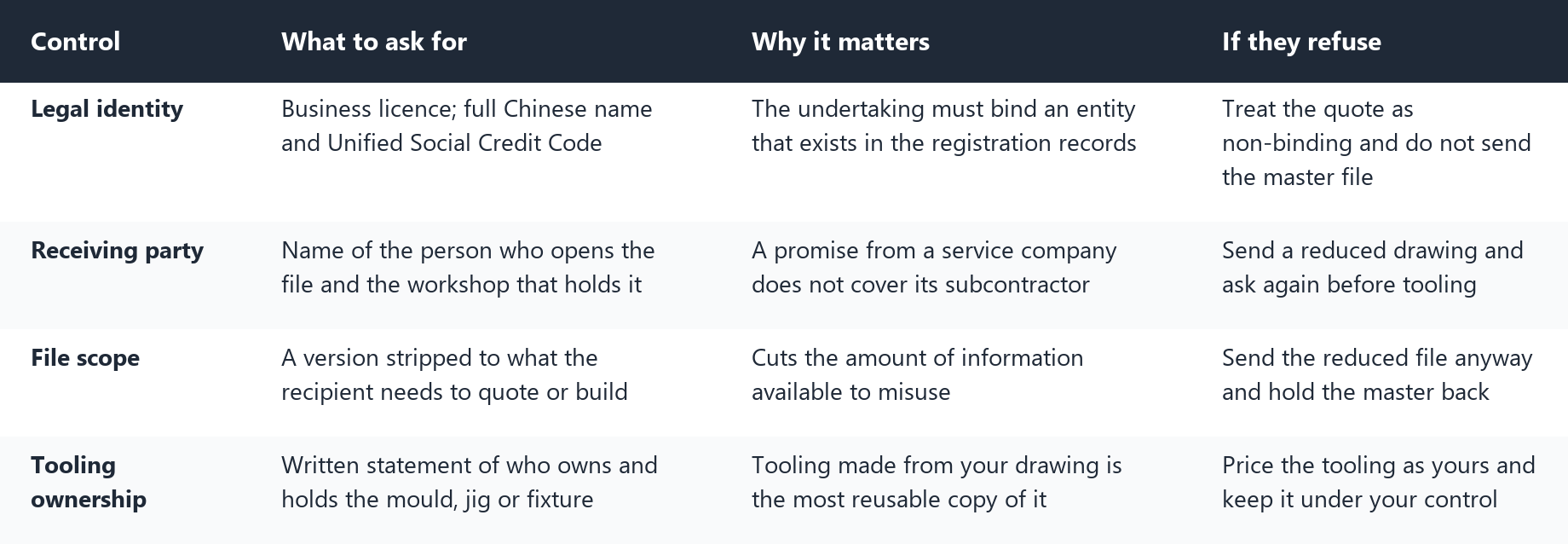
| Control | What to ask for | Why it matters | If they refuse |
|---|---|---|---|
| Legal identity | Business licence; full Chinese name and Unified Social Credit Code | The undertaking must bind an entity that exists in the registration records | Treat the quote as non-binding and do not send the master file |
| Receiving party | Name of the person who opens the file and the workshop that holds it | A promise from a service company does not cover its subcontractor | Send a reduced drawing and ask again before tooling |
| File scope | A version stripped to what the recipient needs to quote or build | Cuts the amount of information available to misuse | Send the reduced file anyway and hold the master back |
| Tooling ownership | Written statement of who owns and holds the mould, jig or fixture | Tooling made from your drawing is the most reusable copy of it | Price the tooling as yours and keep it under your control |

Control the file, not just the promise
Send the smallest drawing that does the job
The most effective control is also the cheapest. Do not send the master. Build a set of reduced files, each tied to one recipient and one purpose. A factory quoting a machined part needs the geometry and the critical tolerances. It does not need the full assembly, the supplier list or the surface-finish development history. A factory doing injection tooling needs the part geometry and the draft and gate information, not the industrial design renderings that show what the finished product looks like on a shelf.
This is a handing-over discipline, the same logic behind how to prevent product design drawing leaks: the fewer complete pictures any one party holds, the less damage a single leak can do. It also makes a later claim easier. If a factory produces a part that matches your reduced drawing exactly, including the tolerances you marked, the question of independent discovery becomes harder for them to answer.
Watermark, number, and keep a register
Put a visible watermark on every sheet naming the recipient and the date. Number each version and keep a simple register: file name, version, date sent, recipient entity and the purpose you stated. This is not bureaucracy. It is the record that turns a suspicion into a claim, and in the United States it is part of what the law calls reasonable efforts to maintain secrecy.
Watermarks do two things. They discourage casual forwarding, because the recipient's name is on the page. And they let you trace a leaked image back to the version it came from, which tells you where in the chain the leak happened. A watermark does not stop a determined person from removing it, and it is not a substitute for a signed undertaking. It is one layer.
Decide what happens before tooling, not after
The highest-risk moment is not when the drawing is sent. It is when the mould or jig is cut, because the tool is a physical copy of your design that can outlive the relationship and run on another buyer's order. Set the rule in writing before that point: who pays for the tooling, who holds it, and whether it can be used on any other product. Get the answer in the quotation, not in a conversation.
What we do when a drawing lands on our desk
The sequence we run
When a customer sends us a design to source, we work through the same steps in the same order. We establish the legal entity first, using the business licence and credit code, and we check whether the party quoting is the party that will hold the file. Then we split the master into recipient-specific versions and log each one. We ask the factory for the name of the person who will receive the file and confirm in writing that no tooling starts before the confidentiality undertaking is signed. Only then do we release the version tied to that factory.
On one custom packaging project, the customer's NDA contained a clause requiring the factory's confidentiality letter to be "no less protective than this Agreement," read literally. The factory we had selected would not sign anything at that level. Reading the clause literally would have meant no quote, no first stage and a signed paper nobody would honour. We stopped trying to get that clause signed as written. Instead we prepared a short side letter that referenced the clause and asked the customer to approve our one-page supplier undertaking as the substitute safeguard. One written approval then covered every factory on the project rather than a fresh argument each time.
The points where a leak actually happens
A drawing does not leak at one dramatic moment. It leaks at ordinary handoffs. Mapping those handoffs is more useful than signing a stronger promise, because each handoff is a point where you can decide what leaves the building.
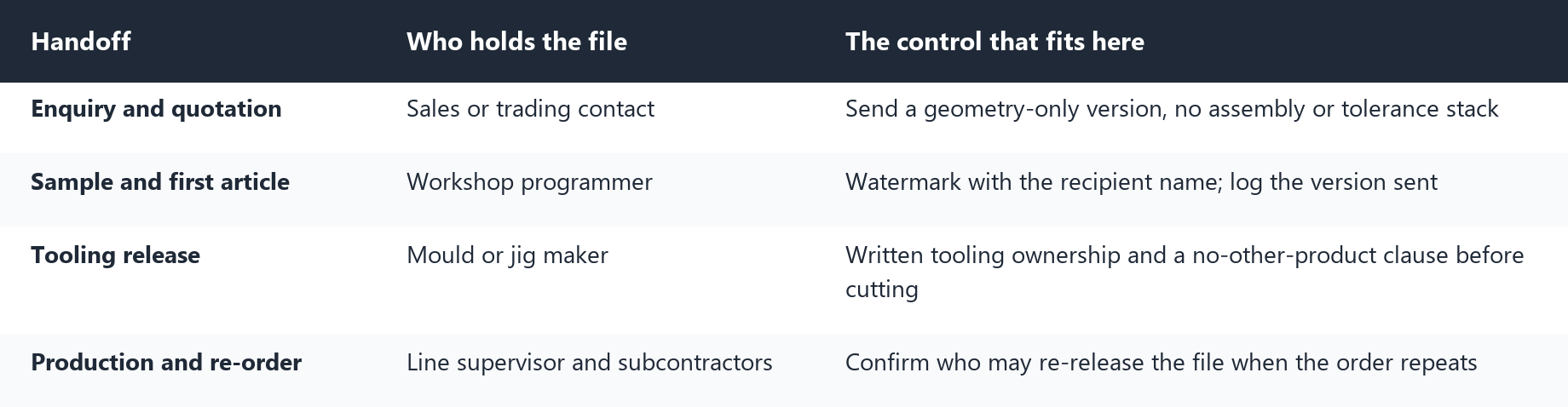
| Handoff | Who holds the file | The control that fits here |
|---|---|---|
| Enquiry and quotation | Sales or trading contact | Send a geometry-only version, no assembly or tolerance stack |
| Sample and first article | Workshop programmer | Watermark with the recipient name; log the version sent |
| Tooling release | Mould or jig maker | Written tooling ownership and a no-other-product clause before cutting |
| Production and re-order | Line supervisor and subcontractors | Confirm who may re-release the file when the order repeats |
The tooling release is the one we watch hardest, because it is the only handoff that turns information into a physical asset. A file can be deleted. A mould that was cut from your drawing sits on someone else's floor and can run a third party's order without any new disclosure taking place.
What we will not promise
We cannot promise that a drawing will never leak. No office can. What we can do is make the chain short, the identity clear and the record complete enough that a leak has a name and a document attached to it. We also will not register a design in a customer's name without instruction, because filing is a legal step with a cost and an owner, and the decision belongs to the owner of the design.
The same restraint applies to the undertaking itself. We will send the one-page supplier letter to the party whose licence and credit code we have checked, and we will not describe a signed letter as if it were a registered right. It is a record of a promise, useful because it fixes the identity and the scope, not because it gives you a licence to stop watching the file.
Register the design where it can be enforced
When a drawing is a process, not a shape
Some designs are not protected by a drawing at all. For a jewellery client working in 316L stainless steel with PVD coating, the valuable knowledge was the finishing process, not the outline of the piece. The drawing shows the shape. It does not show how the coating was made to hold its colour. If the process walks out, the shape is the least of the problem. In that situation, decide which parts of the know-how will be shared at all, and with whom, before you decide how to mark the file.
A design that is visible in the finished product is a different case. If the shape, pattern or colour combination is new and industrially applicable, a design patent may be available. Under China's Patent Law, a design patent runs for fifteen years from the filing date, and an invention patent for twenty. The law also requires that a design not conflict with prior rights, which is why a search before filing is worth the cost.
Filing before you send is the whole point
Registration only helps if it is in place before the disclosure you are worried about. A design disclosed publicly before filing can lose the novelty that the application needs. Article 24 of China's Patent Law gives a six-month grace period in narrow circumstances, including exhibition at a Chinese government-sponsored international exhibition or disclosure against the applicant's will, but relying on an exception is not a plan. File first, then send.
Protection also has to match where the problem is. United States trade secret law and Chinese patent law are different systems with different tests. The USPTO guidance notes that patents require a detailed public disclosure in exchange for the right to exclude, while trade secrets last only while the information stays secret and the owner takes reasonable steps to keep it that way. For a buyer sourcing in China and selling elsewhere, the practical answer is usually a combination: registered rights where the design is visible, secrecy controls where the value sits in the process.
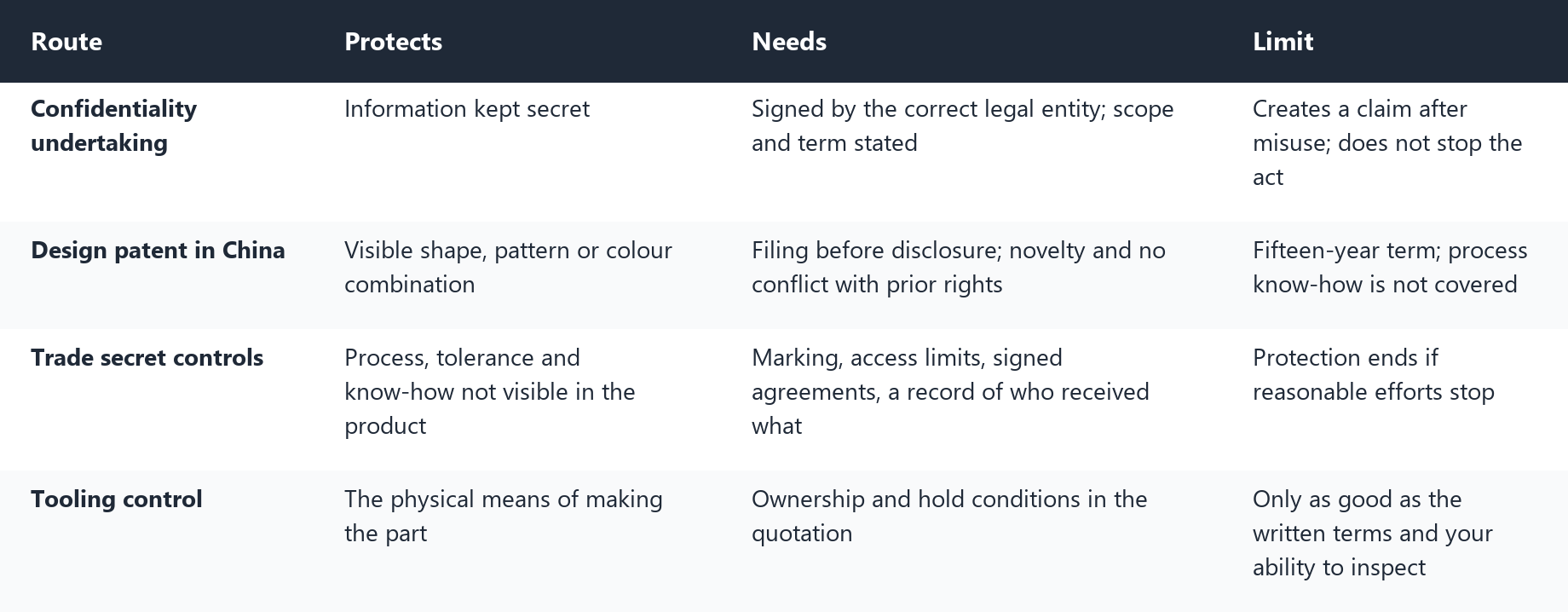
| Route | Protects | Needs | Limit |
|---|---|---|---|
| Confidentiality undertaking | Information kept secret | Signed by the correct legal entity; scope and term stated | Creates a claim after misuse; does not stop the act |
| Design patent in China | Visible shape, pattern or colour combination | Filing before disclosure; novelty and no conflict with prior rights | Fifteen-year term; process know-how is not covered |
| Trade secret controls | Process, tolerance and know-how not visible in the product | Marking, access limits, signed agreements, a record of who received what | Protection ends if reasonable efforts stop |
| Tooling control | The physical means of making the part | Ownership and hold conditions in the quotation | Only as good as the written terms and your ability to inspect |
What is not yet settled in your favour
Two things we could not establish
There is no published figure for how often a signed supplier undertaking is actually enforced against a Chinese workshop. We could not find a public database that tracks outcomes by contract type, and the case reporting that exists is selective. That does not make the undertaking worthless; it means you should treat it as one control in a stack rather than as insurance with a known payout.
Nor could we find an official statement of what counts as reasonable efforts for a cross-border buyer sending files into China. The USPTO lists examples for United States trade secrets, and Chinese law protects trade secrets through the Anti-Unfair Competition Law and related rules, but neither gives a buyer a fixed checklist for a file sent to a contract factory. The practical consequence is that the record you keep matters more than any single form you sign.
Why those gaps change what you should do
Both gaps point the same way. Because you cannot rely on a known enforcement rate, reduce the opportunity rather than strengthening the threat. Because there is no fixed checklist, keep a record that shows what you actually did: who received which version, which undertaking they signed, and when the tooling rule was agreed. That record is useful in a dispute, and it is also the thing that tells you where the leak came from if one happens.
First published at chinagosource.com
Footnotes
1. USPTO, Trade Secret Policy, defining a trade secret as information with actual or potential independent economic value from not being generally known, subject to reasonable efforts to maintain secrecy, all three elements required, and listing the Economic Espionage Act of 1996 and the Defend Trade Secrets Act of 2016: https://www.uspto.gov/ip-policy/trade-secret-policy
2. USPTO, Trade Secret Intellectual Property Toolkit (2023), listing reasonable efforts including limiting access to those who need it, requiring confidentiality agreements from outside parties, marking confidential materials, controlling physical access and controlling digital access by permission level: https://www.uspto.gov/sites/default/files/documents/tradesecretsiptoolkit.pdf
3. National People's Congress, Patent Law of the People's Republic of China (2020 amendment), published by CNIPA, Article 23 on design patents not conflicting with prior rights, Article 24 on the six-month grace period including government-sponsored international exhibitions and disclosure against the applicant's will, and Article 42 setting design patent term at fifteen years and invention patent term at twenty years from filing: https://www.cnipa.gov.cn/art/2020/11/23/art_97_155167.html
4. CNIPA, Reply to Proposal No. 2847 of the 13th National Committee of the Chinese People's Political Consultative Conference, 20 August 2021, stating that China has established civil, administrative and criminal legal rules for trade secret protection through the Civil Code, the Anti-Unfair Competition Law and the Criminal Law, and describing the 2017 and 2019 revisions to the Anti-Unfair Competition Law: https://www.cnipa.gov.cn/art/2021/8/20/art_516_169564.html
5. CNIPA English, Vigorous Legal Protection for IPRs of Foreign-Funded Enterprises, 11 December 2024, reporting equal treatment of domestic and foreign-funded enterprises, the punitive damages provisions in the revised Trademark Law and Patent Law, and the regular consultation mechanism with foreign-funded enterprises: https://english.cnipa.gov.cn/art/2024/12/11/art_2975_196586.html