A buyer has a custom product, a target price, and a supplier who says the mold costs extra. The buyer asks the obvious question: how much is the mold, and is it mine once I pay for it?
The honest answer is that neither question has a number until the specification is fixed. A mold is not an item on a catalog. It is a set of steel, inserts, runners and cooling channels built around one product, and its cost is driven by the product's geometry, tolerance, material and expected volume. Two factories quoting the same drawing can return numbers far apart, and both can be sincere.
What can be settled before any number is agreed is the structure. Who pays, who holds the tool, when ownership moves, and whether you can later move the mold. Those are contract questions, not price questions, and they decide whether a lower quote is a saving or a lock-in.
We are a buying office in Shenzhen. Custom products and tooling are part of what we handle, and we treat the ownership terms as a gate that has to close before a tooling payment is released, not after a dispute starts.
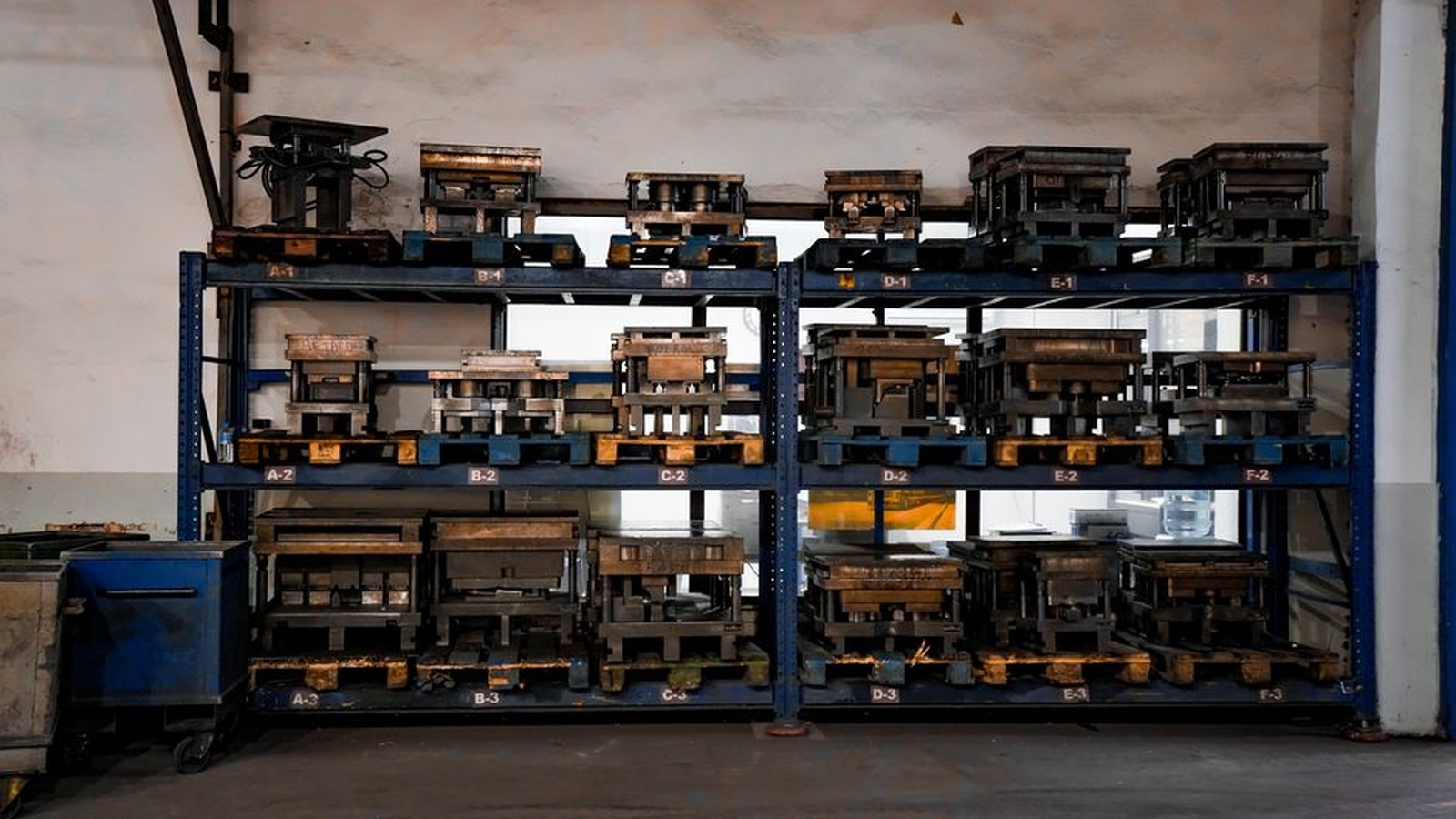
What you are buying when a factory quotes a mold
A mold is a work product, not a product
Chinese law classifies tool-making under the work contract. Article 770 of the Civil Code defines a work contract as one where the contractor completes work to the client's requirements, delivers the work product, and the client pays remuneration; the listed forms include processing, custom-making, repair, copying, testing and inspection. A mold made to your drawing fits that definition directly.
That classification matters because it sets the default relationship. The factory is a contractor producing an output for you, not a seller handing over a shelf item. Article 771 says a work contract generally covers the subject matter, quantity, quality, remuneration, method, supply of materials, performance period, and acceptance standards and methods. Notice what is absent from that list: ownership of the tool is not a default the law hands you. It is something the parties specify.
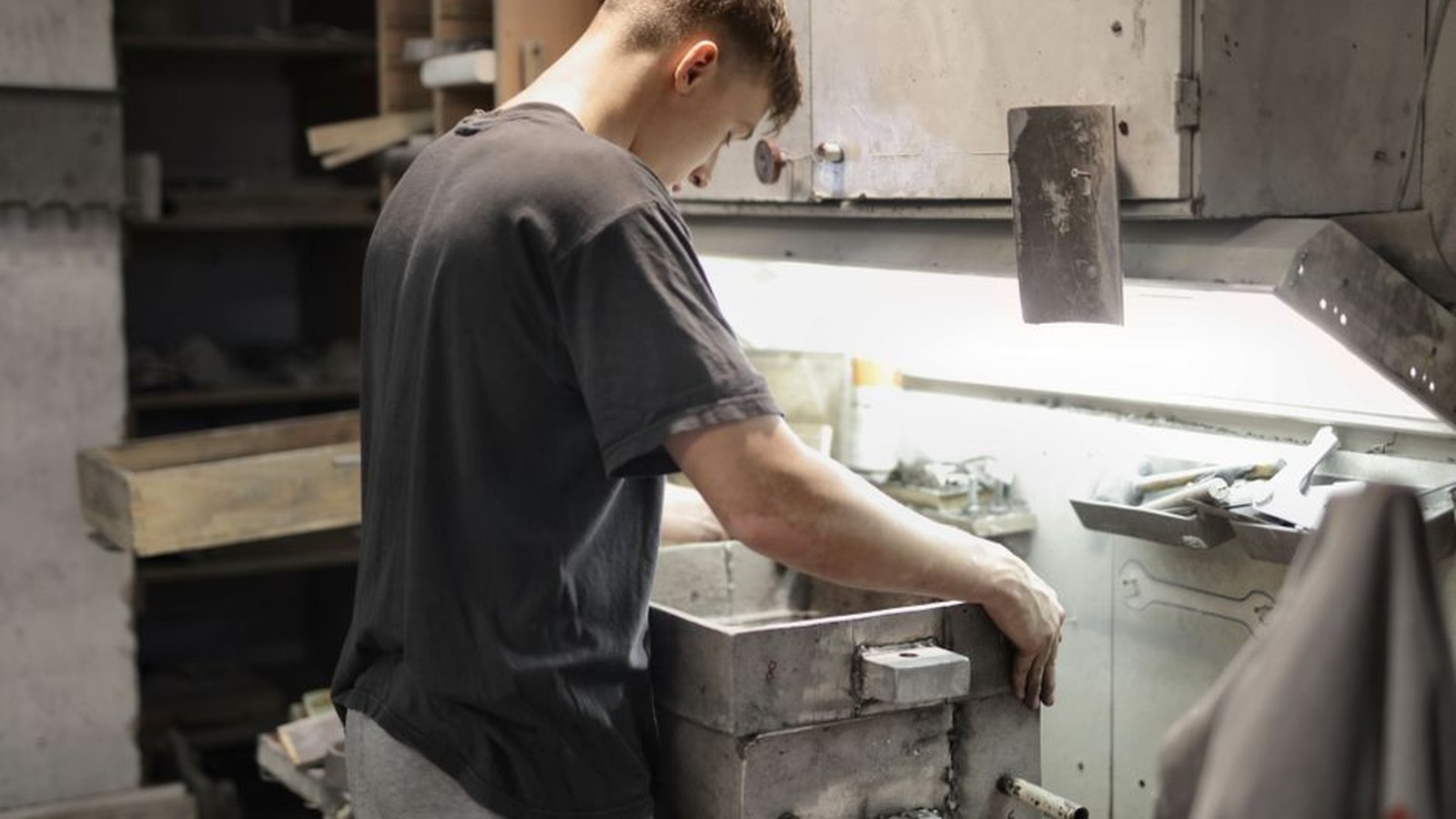
The three costs that hide inside one number
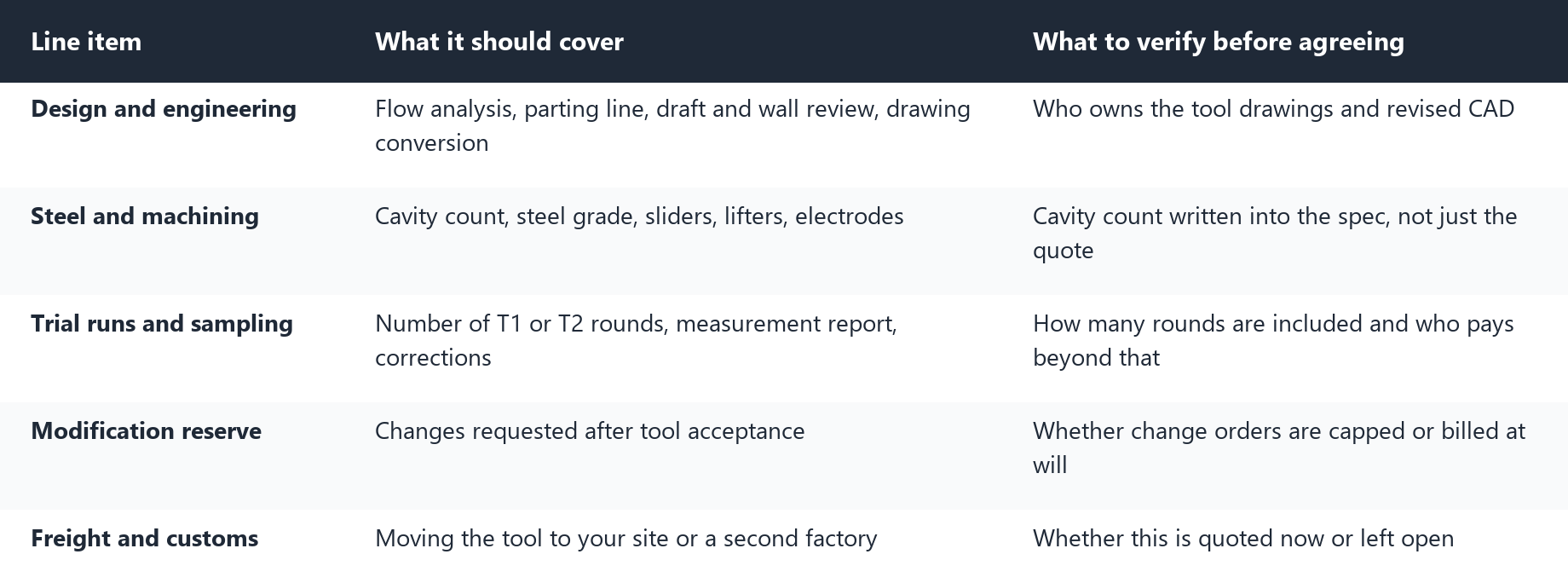
When a supplier says "the mold is USD X", the figure usually bundles work that should be separated. There is design and engineering time, which covers flow analysis, parting line decisions and drawing conversion. There is the steel and machining, which scales with the number of cavities, the slider and lifter count, and the steel grade. Then there is sampling: the first trial parts, measurement, and the corrections made before the tool is accepted.
A buyer who asks only for a total cannot compare two quotes, because each supplier may put different work inside that total.
Make the supplier split the line
The fix costs nothing. Ask for a tooling quotation that lists design, steel and machining, and trial runs as separate lines, with a named deliverable for each. Then ask which lines are refundable, and on what condition. The answer tells you more about the supplier than the total does.
| Line item | What it should cover | What to verify before agreeing |
|---|---|---|
| Design and engineering | Flow analysis, parting line, draft and wall review, drawing conversion | Who owns the resulting tool drawings and revised CAD |
| Steel and machining | Cavity count, steel grade, sliders, lifters, electrodes | Cavity count written into the spec, not just the quote |
| Trial runs and sampling | Number of T1 or T2 rounds, measurement report, corrections | How many rounds are included and who pays beyond that |
| Modification reserve | Changes requested after tool acceptance | Whether change orders are capped or billed at will |
| Freight and customs | Moving the tool to your site or a second factory | Whether this is quoted now or left open |
The three ways tooling is paid for
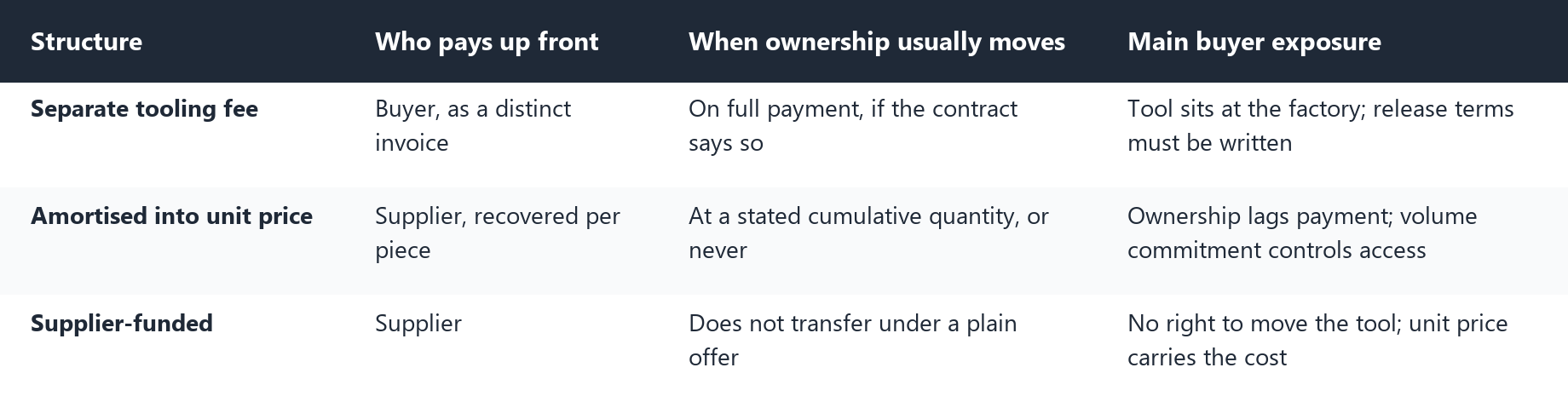
The separate tooling fee
In the cleanest structure, you pay a distinct tooling charge, the supplier invoices it as a separate line, and ownership transfers to you on a stated condition, commonly full payment. The mold is then held at the factory as your asset, used only for your orders. The advantage is that ownership is easy to point at: there is a payment record and a clause that says what the payment bought.
The risk is custody. The tool sits in someone else's plant, and your leverage depends on what the agreement says about access and release.
Amortised into the unit price
Here the supplier absorbs the tooling cost and recovers it through a per-piece charge until a cumulative quantity is reached. You pay less cash up front, which matters when a launch budget is tight. In exchange, ownership is usually delayed until the agreed volume is reached, or it never transfers at all.
A standard amortisation rate has not been published, and we could not find any official schedule that sets one. The percentage depends on volume, category and how the supplier prices risk. Treat a claim that the industry uses a fixed figure as a negotiating position, not a fact.
The supplier-funded mold
At high volumes, a supplier may offer to pay for the tool and call it free. It is not free. The cost is recovered in the unit price and in your commitment to buy, and the supplier keeps ownership. That can be rational when volume is certain and you never intend to move production. It becomes expensive the moment you change factories, because there is no tool to hand over.
| Structure | Who pays up front | When ownership usually moves | Main exposure for the buyer |
|---|---|---|---|
| Separate tooling fee | Buyer, as a distinct invoice | On full payment, if the contract says so | Tool sits at the factory; release terms must be written |
| Amortised into unit price | Supplier, recovered per piece | At a stated cumulative quantity, or never | Ownership lags payment; volume commitment controls access |
| Supplier-funded | Supplier | Does not transfer under a plain offer | No right to move the tool; unit price carries the cost |
Ask which structure the quote assumes
Before comparing totals, ask the supplier to name the structure. A quote that mixes the three is common: a low tooling fee, an amortisation clause buried in the payment terms, and an ownership sentence that says the tool stays with the factory. Read together, that is a supplier-funded mold with an upfront charge attached.
Who owns the mold under Chinese law
There is no automatic transfer by operation of law
This is the point buyers most often get wrong. There is no automatic transfer of mold ownership by operation of law in China, and we could not find a unified public registration system for tool ownership that would record you as the owner. Ownership follows the written agreement and the facts of payment and delivery, not the label on an invoice.
A line that says "tooling fee" on a proforma is evidence of a payment. It is not, on its own, a title document. If you want the tool to be yours, write that the mold becomes your property on a named condition, and identify the tool by number, cavity count and photograph so there is no argument later about which asset is being discussed.
The contractor's lien, and why it matters to you
Article 783 of the Civil Code gives the contractor a lien on the completed work product, or the right to refuse delivery, when the client has not paid remuneration or material costs, unless the parties have agreed otherwise. In plain terms: if you owe the factory money on the tool order, the factory may hold the tool, and the agreement can change that default only if it says so explicitly.
A published Fujian court judgment describes a craftsman who retained a mold after the client failed to pay making charges. The court treated the retention as a lawful lien over the work product, ordered payment of the charge plus interest, and ordered the mold returned within five days of full payment. The same logic applies to a production mold: a payment dispute can turn your asset into a bargaining chip.
The clause worth negotiating hardest is not the purchase price. It is the sentence that says which amounts can trigger a hold and what must happen before the tool is released.
Custody is a separate duty
Article 784 requires the contractor to keep materials and the completed work product properly, and makes it liable for damage or loss caused by poor storage. That gives you a basis to ask for a tool register and a record of maintenance and shot count. A mold stored without a log is harder to value and harder to move.
For product appearance and drawings, ownership of the physical steel is only half the problem. The design file and any revised tool drawings need their own assignment language; we address that separation in our article on protecting design drawings from a Chinese factory.
The clauses that decide ownership and access
Identify the tool, not only the product
The agreement should carry a tool list: mold number, cavity count, steel grade, weight and dated photographs. Without that schedule, "the mold" is undefined, and a supplier can argue that inserts or spare parts were never part of the deal.
State when ownership transfers
Write the trigger as a single, checkable event. Full payment of the named tooling invoice is the usual choice. If part of the cost is amortised through unit prices, the trigger becomes the cumulative quantity, and the agreement should say who certifies it. Avoid "on settlement of all accounts", because a dispute over an unrelated shipment can then block the tool.
Write the release and transfer conditions
This is the clause that decides whether you can leave. It should state where the tool is stored, that the factory holds it as custodian and uses it only for your orders, that you or your nominee may inspect it on notice, and that on request the factory will release it within a stated period with spares, drawings and the tool register. State who pays for disassembly, packing, transport and any customs formalities.
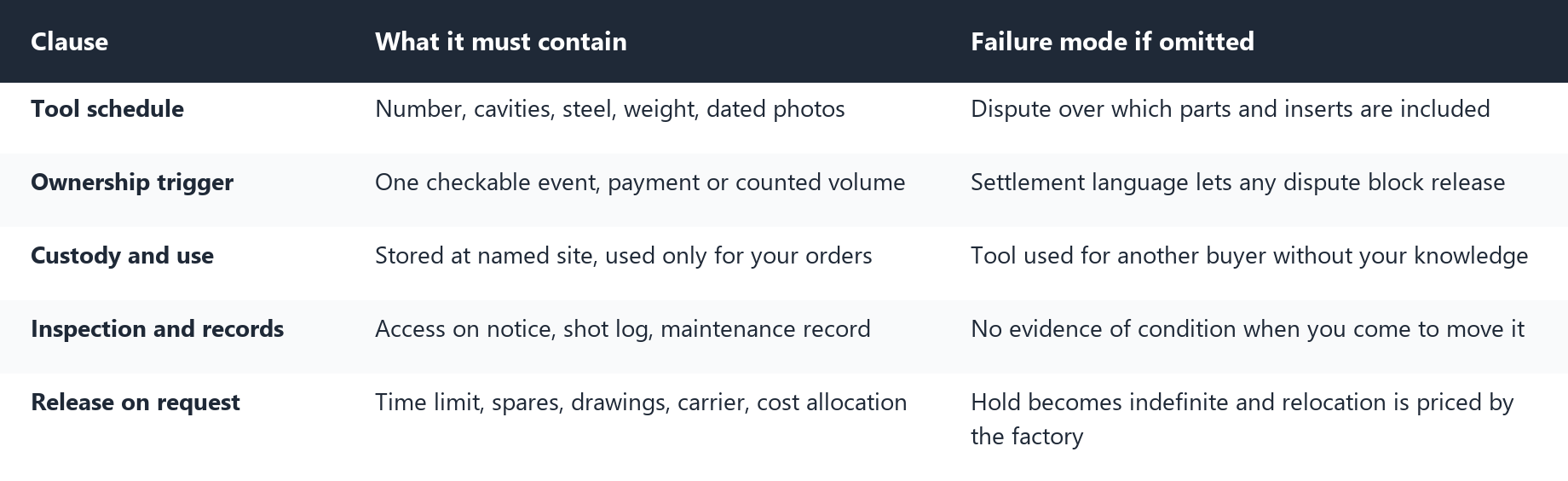
| Clause | What it must contain | Failure mode if omitted |
|---|---|---|
| Tool schedule | Number, cavities, steel, weight, dated photos | Dispute over which parts and inserts are included |
| Ownership trigger | One checkable event, payment or counted volume | "Settlement of all accounts" lets any dispute block release |
| Custody and use | Stored at named site, used only for your orders | Tool used for another buyer's run without your knowledge |
| Inspection and records | Access on notice, shot log, maintenance record | No evidence of condition when you come to move it |
| Release on request | Time limit, spares, drawings, named carrier, cost allocation | Hold becomes indefinite and relocation is priced by the factory |
What we check before a tooling order is confirmed
We separate the fee from the embedded cost
When a quote arrives, we ask the supplier to split the tooling charge from any mold cost already built into the unit price, and to show both lines. The two are often the same money presented differently, and a buyer who sees only one line cannot tell whether a discount on the tool has been added back per piece. We also ask for the quote on the same specification from each candidate, because a comparison across different cavity counts is not a comparison.
We put ownership and exit in the same document
Before a tooling payment is released, we ask for a short written agreement that names the tool, the ownership trigger, the custodian, the inspection right, and the release timetable. We ask for the drawings and the tool register to be listed as things that travel with the mold. If a supplier will not put release terms in writing, we treat the low tooling quote as incomplete rather than attractive.
We check who holds the tool before a factory switch
When a client wants production moved, our first question is not the new price. It is who holds the mold, whether any balance is open, and whether the tool can be moved at all. We settle undisputed balances first, then arrange inspection and a packed handover with the spares listed in the register. Our fee is charged on the production value, and the tooling payment passes through at the supplier's figure, so we have no interest in a higher tool price.
A buyer who negotiates the second factory's unit price before checking tool access can end up with a better quote and no way to fulfil it.
What is not settled, and why it changes your decision
Tool life is a supplier-specific fact
There is no official figure we could find for how many shots a given mold will produce. Life depends on the steel, the material, maintenance and the tolerance the part must hold. Any universal tool-life number is that supplier's estimate for that tool, not a guarantee you can assume.
Refund and amortisation terms are not standard
A supplier may offer to refund part of the tooling cost after a volume milestone. The threshold, the form of the refund and the evidence needed to claim it are all negotiable, and no regulator publishes a default. Write the milestone as a number of accepted pieces, define who certifies acceptance, and state when the refund is paid. An oral promise to refund is not a refund clause.
A sample approval is not tool acceptance
Tool acceptance is a separate event from sample approval. A supplier can produce an approved sample from a tool still incomplete, and a buyer who pays the final invoice then may lose leverage to require corrections. Define acceptance in writing: the dimensional report, the number of consecutive good shots, and the sign-off that releases final payment.
The decision in front of you
At the quote stage, the order of work is short. Fix the specification so the number means something. Split the tooling charge into design, steel and trials. Name the payment structure. Put ownership trigger, custody and release in the same agreement. Then compare totals. A supplier who will not discuss the last three is telling you something about the first one.
The legal default is not on your side. Article 783 lets a contractor hold the work product when payment is disputed, so the terms you write before payment are the terms that will be read later. For more on how price transparency is built into a quote, see how a transparent factory quote is assembled, and on checking the entity behind the quote, see how to verify a Chinese supplier is a real factory.
If you have a custom product with a tooling quote in front of you, send the product description, the annual quantity and the tooling line as written. We will tell you which payment structure it describes and which ownership terms are missing before you release the first payment.
Footnotes
1. National Law Database of China, Civil Code of the People's Republic of China, Book III Contracts. https://flk.npc.gov.cn/detail2.html
2. Civil Code, Book III, Chapter XVII Work Contracts, Articles 770 to 782, full chapter text published by the Baoxing County People's Government. http://www.baoxing.gov.cn/gongkai/show/20a2ddb1deaafd061d7561a4317d3b16.html
3. Yongtai County People's Court, "Who is at fault when a commissioned statue is damaged", published judgment explaining Article 783 lien on work product and the return of a retained mold, 2025. https://fj.ytxrmfy.gov.cn/article/detail/2025/10/id/9017841.shtml
4. Civil Code, Book III, Chapter XVII, Articles 770 and 771, Chengzi District People's Court legal education series. http://qthqzh.hljcourt.gov.cn/public/detail.php?id=1744
5. State Administration for Market Regulation, official site, for verification of the contracting legal entity and its registration. https://www.samr.gov.cn/