A buyer has a container of wooden cabinets due to leave China in a few weeks. The importer has just learned that the United States completed an administrative review of the countervailing duty order on cabinets from China. The buyer wants one number: what will I pay at entry?
There is no single number. There are two trade proceedings, two review periods, two effective dates, and three deposit tiers. Which tier you land in depends on the exact company names on your documents, not on the cabinet or the port. A supplier who is not named in the review does not fall into the lowest tier.
We are a China buying office in Shenzhen. Furniture is a category we work in, and we check which legal entity appears on a packing list before an order is confirmed, not after a container is refused at entry.
What the final results actually set, and from what date
Two notices were published in November 2026, and they are not the same proceeding. Reading them as one combined rate is the most common and most expensive mistake a buyer can make here.
The countervailing duty review is C-570-107
The Department of Commerce, through the International Trade Administration, published the final results of the countervailing duty administrative review for 2024 on 16 November 2026. The notice appears at 91 FR 73553, Federal Register document 2026-23264, docket C-570-107, and is applicable from 16 November 2026. The period of review covered entries from 1 January 2024 to 31 December 2024.
No interested party submitted comments after the preliminary result of 13 July 2026, so the final results carry the July numbers forward with no separate decision memorandum.
The antidumping review is A-570-106
The antidumping final results were published earlier, on 12 November 2026, at 91 FR 72851, Federal Register document 2026-23045, docket A-570-106, applicable from 12 November 2026. Its review period is different: 1 April 2024 to 31 March 2025.
The two orders cover the same merchandise, but the periods do not line up and the deposit instructions do not line up. If a shipment sits inside both windows, you carry two deposit obligations calculated by two different sets of rules. There is no honest way to collapse them into a single percentage, and anyone who quotes you one combined number has skipped a step. If you need background on how an AD/CVD investigation starts and what it covers, that explanation sits in a separate article.
Why the effective date is the date that matters
Both notices state that the cash deposit requirements apply to merchandise entered, or withdrawn from warehouse for consumption, on or after the date of publication. For the countervailing duty side that is 16 November 2026. For the antidumping side it is 12 November 2026.
A container that crossed the earlier date under the old rate is not re-priced at entry. For a purchase order you are confirming now, the operative date is the date your goods enter.
The three deposit tiers that decide your next payment
The countervailing duty review names five companies with their own rates. Everyone else falls into an all-others rate that was established in the original investigation.
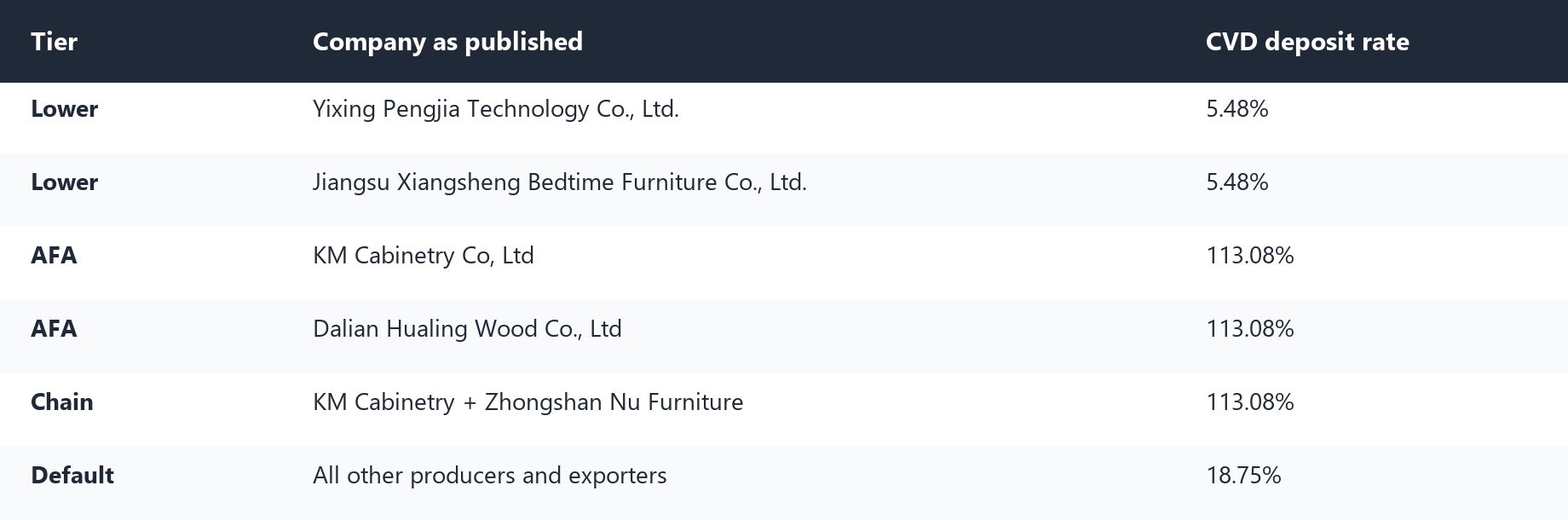
| Tier | Company name as published | Countervailing duty deposit rate |
|---|---|---|
| Company-specific, lower | Yixing Pengjia Technology Co., Ltd. (formerly Yixing Pengjia Cabinetry Co., Ltd.) | 5.48 percent |
| Company-specific, lower | Jiangsu Xiangsheng Bedtime Furniture Co., Ltd. | 5.48 percent |
| Company-specific, adverse | KM Cabinetry Co, Ltd | 113.08 percent |
| Company-specific, adverse | Dalian Hualing Wood Co., Ltd | 113.08 percent |
| Company-specific, chain rate | KM Cabinetry Co, Ltd. and Zhongshan Nu Furniture Co., Ltd. | 113.08 percent |
| All others | All producers and exporters not listed above | 18.75 percent |
These are public company names from the Federal Register notice. They are not our clients, our suppliers, or a recommendation of any kind. They are included because a buyer needs to be able to compare the name on a commercial invoice with a name in a government notice.
The all-others rate is the default, not a penalty
The 18.75 percent figure is the all-others subsidy rate from the original investigation, and it continues to apply to producers and exporters that were not reviewed. A buyer whose supplier is not on the five-company list should plan around 18.75 percent on the countervailing duty side. The number is not a punishment, but neither is it optional.
This is where the phrase "my factory is not on the list" becomes dangerous. Being absent from a list of reviewed companies does not place you in the lowest tier. It places you in the default tier, which is more than three times the lowest reviewed rate.
How Commerce assigns the rate to a shipment
The notice sets out four rules in order. First, a reviewed producer or exporter receives its own company-specific rate, and a rate below 0.50 percent is de minimis, producing a deposit of zero. Second, where both the producer and the exporter have their own rates and those rates differ, the higher rate applies. Third, where only one party has its own rate, that rate applies. Fourth, all other producers and exporters receive the all-others rate.
The second rule is the one buyers miss. A cabinet can be made by a company with a 5.48 percent rate and exported by a trading company with a different rate. The deposit follows the higher of the two. The factory name on a quote is therefore not enough information to price the shipment.
Why the spread runs from 5.48 percent to 113.08 percent
A twentyfold difference inside one product category looks like an error. It is not. The rate is driven by what a company did during the review, not by the thickness of the wood or the style of the door.
Adverse facts available is a procedure, not a product judgment
Two companies received 113.08 percent because the Government of China did not respond to section II of Commerce's questionnaire within the deadline. Commerce applied adverse facts available under the relevant provision of the statute to government-related programs. A third entry, the combined KM Cabinetry and Zhongshan Nu Furniture rate, is a chain rate derived from that same finding.
The practical reading is narrow and useful: a high rate in this notice tells you that a party did not supply information on time. It does not tell you that the factory makes a different product, and it does not tell you that a competing factory with a lower rate makes a better cabinet. Quality and deposit rate are unrelated variables, and a buyer who treats the rate as a quality signal will make the wrong supplier decision.
A name that differs by one word is a different legal entity
The published notice lists "Yixing Pengjia Technology Co., Ltd." and notes that it was formerly "Yixing Pengjia Cabinetry Co., Ltd." The change is recorded at 91 FR 12349. In a trade proceeding, a legal entity is identified by the exact name, not by the factory's location, its brand, or the name the salesperson uses in email.
This is the single most actionable fact in the notice for a buyer. A producer that changed its English registered name, or a shipment exported through a company whose name does not match the reviewed entity, may be treated as an all-others producer at 18.75 percent, even when everyone in the commercial chain believes they are dealing with the 5.48 percent factory.
What we check before a cabinet order moves forward
We work from the document set, not from the supplier's description of itself. When a cabinet order reaches the point of confirmation, we do three things in sequence.
First, we put the producer name and the exporter name from the draft commercial invoice side by side with the names in the notice, character for character. Where a name has changed, we ask for the registered evidence of the change rather than accepting an explanation in a message. Where the producer and exporter differ, we assume the higher rate until a lower one is confirmed in writing.
Second, we check whether a refund or rebate was given on the entries covered by the antidumping review period. Under the regulation, an importer must submit a refund certificate before liquidation of the relevant entries. If it is not submitted, Commerce may presume a refund occurred, assess double antidumping duties, and add countervailing duties on top. A supplier will rarely raise this because the certificate is the importer's obligation, so it has to be asked for by the buyer.
Third, we recalculate the total landed cost with the two deposits as separate lines. Our fee is charged on the EXW value and the trade deposits are never part of that base. Freight and duties are paid by the client and passed through at cost. Keeping the lines separate is what allows a buyer to see which part of a price movement came from a government rate and which part came from a supplier quotation.
None of this requires a long relationship or a large order. It requires asking for the commercial documents early enough that a name mismatch can still be corrected.
The antidumping deposit runs on a different clock
The antidumping final results set their own rates and their own four deposit rules, and the two are easy to confuse with the countervailing duty numbers above.
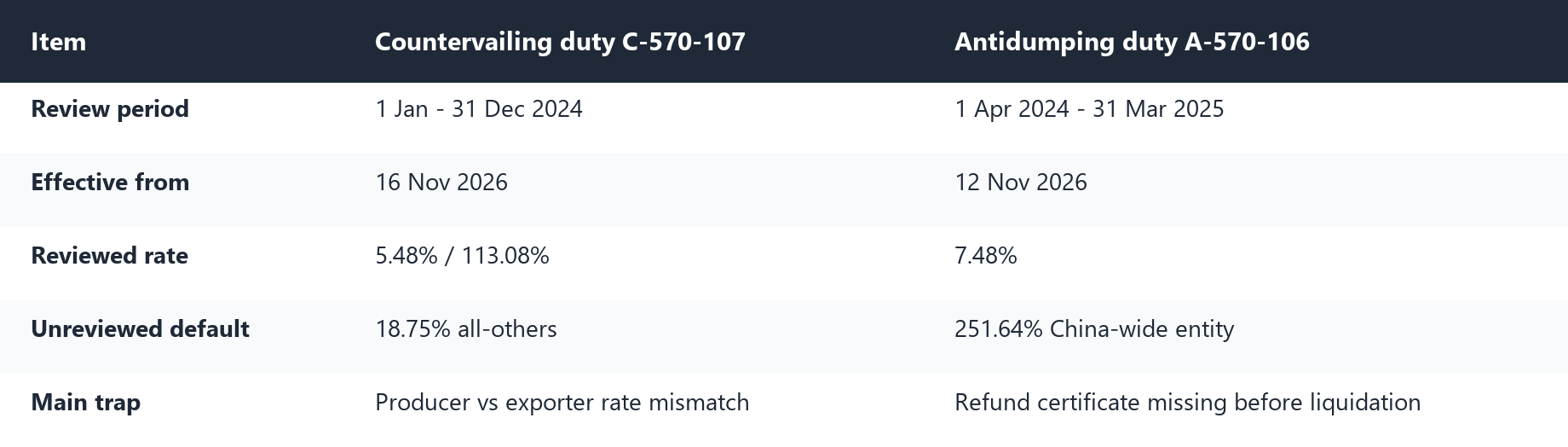
| Item | Countervailing duty, C-570-107 | Antidumping duty, A-570-106 |
|---|---|---|
| Review period | 1 January 2024 to 31 December 2024 | 1 April 2024 to 31 March 2025 |
| Published and applicable from | 16 November 2026 | 12 November 2026 |
| Reviewed company rate | 5.48 percent or 113.08 percent | 7.48 percent |
| Default for unreviewed parties | 18.75 percent all-others | 251.64 percent China-wide entity |
| Main procedural trap | Producer and exporter rate mismatch | Refund certificate missing before liquidation |
The China-wide entity rate is not the all-others rate
In the antidumping review, Yixing Pengjia Technology Co., Ltd. received 7.48 percent. Three exporters that were not individually examined but obtained a separate rate also received 7.48 percent: Jiangsu Xiangsheng Bedtime Furniture Co., Ltd., Xiamen Golden Huanan Imp. and Exp., and Zhongshan NU Furniture Co., Ltd.
A Chinese exporter that did not obtain a separate rate is assigned the China-wide entity rate of 251.64 percent, established in the original investigation. This is a different mechanism and a different number from the 18.75 percent countervailing duty all-others rate. A buyer who uses one default for both calculations will understate the exposure by an order of magnitude.
For a non-Chinese exporter without its own separate rate, the antidumping deposit follows the rate of the Chinese exporter that supplied the goods. The identity of the middleman does not remove the underlying factory rate from the calculation.
The refund certificate obligation sits with the importer
The antidumping notice repeats the importer notification requirement. Before the entries covered by the review period are liquidated, the importer must certify whether any refunds or rebates were received. Failure to file allows Commerce to presume that a refund was received, assess double antidumping duties, and add countervailing duties on the amount.
This obligation attaches to entries from the review period, which runs to 31 March 2025, so it is not a hypothetical for anyone who imported cabinets during that window. It is also an obligation that sits with the importer of record rather than the Chinese supplier. A buyer who assumes the factory has handled it has assumed wrong.
What has not been decided yet, and why it changes your number
Several things that would make this simple are still unresolved. Writing them as settled facts would be wrong, and planning as though they were settled is expensive.
Liquidation instructions have not been issued
Commerce intends to issue assessment instructions to US Customs and Border Protection no earlier than 35 days after publication of the countervailing duty final results. If a summons is filed at the Court of International Trade in time, those instructions will direct CBP not to liquidate the relevant entries until the 90-day injunction period expires.
The deposit rate you pay at entry is therefore settled. The final assessed duty on entries in the review period has not been published and cannot be calculated yet. A quote that promises a final landed cost on the assumption that the deposit is the last word is promising something no one can currently know.
Future reviews will change these rates again
Both proceedings are administrative reviews, and reviews recur. The countervailing duty review covers calendar year 2024; the antidumping review covers April 2024 to March 2025. Later reviews will set rates for later entries, and those rates have not been determined. Anyone who reads this notice as a permanent rate card for wooden cabinets has misread the document.
This is also why we avoid writing a supplier's rate into a long-term price schedule. The rate is a fact about a review period, not a permanent attribute of a factory.
The scope has not been restated in these notices
Both final results point back to the original orders for the description of covered merchandise. They do not reproduce the scope language. A buyer cannot assume that every wooden product leaving China is covered, and should not assume that a product sold as a cabinet is automatically inside the scope described in the original order.
If your product sits near a boundary, the correct step is to read the scope in the underlying order before applying any rate from this article. We have seen buyers pay a deposit on goods that were later found outside scope, and the refund process is slower than the payment.
What to do with a PO that is waiting
For an order being confirmed now, the sequence is short. Confirm the producer and exporter names against the published lists. Establish which of the two effective dates applies to your entry date. Calculate the countervailing duty deposit and the antidumping deposit on separate lines. Check whether a refund certificate is required for any earlier entries. Then price the order.
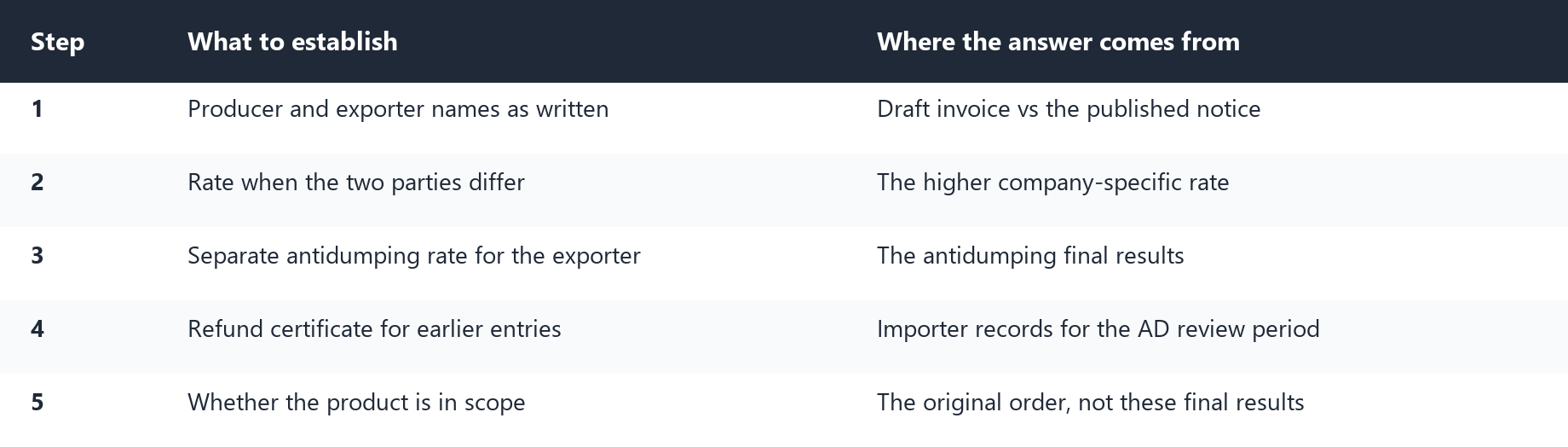
| Step | What to establish | Where the answer comes from |
|---|---|---|
| 1 | Producer and exporter names as written, including any registered name change | Draft commercial invoice against the published notice |
| 2 | Which deposit rate applies when the two parties differ | The higher of the two company-specific rates |
| 3 | Whether a separate antidumping rate exists for the exporter | The antidumping final results, not the countervailing duty notice |
| 4 | Whether earlier entries need a refund certificate | The importer's records for the antidumping review period |
| 5 | Whether the product is inside the order scope | The original order, not these final results |
The five company names in the notice are public facts and carry no recommendation. The rate that applies to your supplier is a question about your documents, and it has an answer you can establish before the container moves. A buyer who works through the five steps in the table is not predicting a rate; the buyer is reading one that already exists.
The reason to do this before the PO rather than after is practical. Once a container is on the water, the producer name and exporter name are fixed on the documents that customs will see. Correcting a name at that point means reissuing the commercial set, which costs time and money that no deposit rate can justify.
If you would like the free first-source check on a specific cabinet or vanity order, send the product description, the target quantity, and the producer and exporter names as they appear on the draft invoice. We will tell you which rate tier the documents point to and where the names need clarifying.
Footnotes
- U.S. Department of Commerce, International Trade Administration, "Wooden Cabinets and Vanities and Components Thereof From the People's Republic of China: Final Results of Countervailing Duty Administrative Review; 2024," 91 FR 73553, FR Doc. 2026-23264, Docket C-570-107, applicable 16 November 2026. https://www.govinfo.gov/content/pkg/FR-2026-11-16/pdf/2026-23264.pdf
- U.S. Department of Commerce, International Trade Administration, "Wooden Cabinets and Vanities and Components Thereof From the People's Republic of China: Final Results of Antidumping Duty Administrative Review, 2024-2025," 91 FR 72851, FR Doc. 2026-23045, Docket A-570-106, applicable 12 November 2026. https://www.govinfo.gov/content/pkg/FR-2026-11-12/pdf/2026-23045.pdf
- 19 CFR 351.402, Notification to Importers of Reimbursement of Antidumping or Countervailing Duties. https://www.ecfr.gov/current/title-19/chapter-III/part-351/subpart-D/section-351.402
- 19 CFR 351.212, Assessment of Antidumping and Countervailing Duties. https://www.ecfr.gov/current/title-19/chapter-III/part-351/subpart-C/section-351.212
- 19 CFR 351.106, De Minimis Net Countervailable Subsidies. https://www.ecfr.gov/current/title-19/chapter-III/part-351/subpart-A/section-351.106