On October 28, 2026, two US companies that make shopping carts and material-handling equipment filed petitions asking the US government to impose trade remedies on Chinese shopping carts and parts thereof. One is Precision Wire Products, Inc. of Commerce, California. The other is Wanzl North America of Denver, North Carolina. On November 2, the International Trade Commission published the notice opening parallel antidumping and countervailing duty investigations on the subject merchandise.
If you import carts, wire baskets, or parts of them from China, the headline is that a new case exists and your supplier may soon be named in it. The more useful headline is what the case does not do yet, and how much room you have before it starts doing something.

What was actually filed, and what it covers
The case is narrow in product scope and specific in legal basis. The subject merchandise is shopping carts and parts thereof, classified under subheading 8716.80.50 of the Harmonized Tariff Schedule of the United States. The statutory basis is sections 703(a) and 733(a) of the Tariff Act of 1930, which are 19 U.S.C. 1671b(a) and 1673b(a), the initiation provisions for antidumping and countervailing duty cases respectively.
Two cases, one product, two separate legal theories
The two tracks run in parallel but answer different questions. The antidumping case asks whether the merchandise is sold in the United States at less than fair value. The countervailing case asks whether a countervailable subsidy is provided by the government of China. A company can lose one and win the other, and the two rates are calculated separately and collected together on the same entry. That is why a supplier's answer to "will my goods be affected" is usually incomplete.
Who filed, and what that tells you
The applicants are the parties with the most direct interest. They make the product in the United States and they can show injury from Chinese imports. That does not mean the outcome is settled. It means the record gets built around their testimony and their data, and the respondent side of the case is whoever the Commission names as representing the Chinese industry. Once the Commission institutes the investigation, the Commission serves the complaint and the notice of investigation on each respondent, and on the embassy in Washington of the country where each proposed respondent is located.
China only, and what that rules out
China is the only country named in this notice. Nothing in the November 2 document covers another origin, so a buyer who moved the same product to Vietnam or Mexico is not affected by this case, whatever the underlying product is. That is worth separating carefully from the circumvention question, which is a different subject under a different statute, and it is the point where most speculative advice goes wrong. Staying compliant with rules of origin when sourcing from China is where the second question actually gets decided.
The clock is the part a buyer can act on
Six dates in the notice are fixed and public. The sequence matters more than the calendar dates themselves.
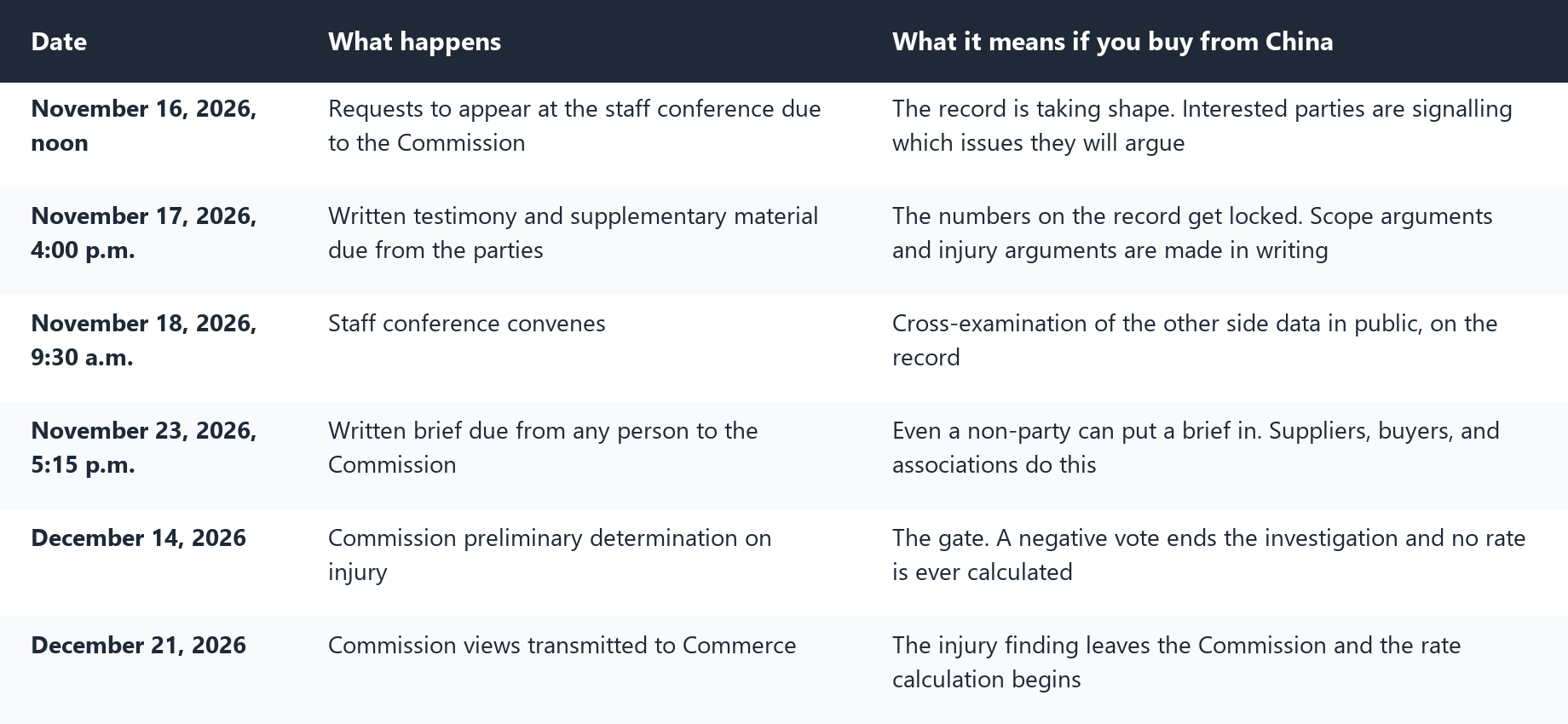
| Date | What happens | What it means if you buy from China |
|---|---|---|
| November 16, 2026, noon | Requests to appear at the staff conference due to the Commission | The record is taking shape. Interested parties are signalling which issues they will argue |
| November 17, 2026, 4:00 p.m. | Written testimony and supplementary material due from the parties | The numbers on the record get locked. Scope arguments and injury arguments are made in writing |
| November 18, 2026, 9:30 a.m. | Staff conference convenes | Cross-examination of the other side's data, in public, on the record |
| November 23, 2026, 5:15 p.m. | Any person's written brief due to the Commission | Even a non-party can put a brief in. Suppliers, buyers, and associations do this |
| December 14, 2026 | Commission preliminary determination on injury | The gate. A negative vote ends the investigation and no rate is ever calculated |
| December 21, 2026 | Commission's views transmitted to Commerce | The injury finding leaves the Commission's hands and the rate calculation begins |
What December 14 actually decides, and what it does not
The Commission's preliminary determination tests only whether there is a reasonable indication of injury. That is a low bar, and it is deliberately lower than the final determination of material injury that actually triggers an order. A buyer should read an affirmative December 14 vote as a procedural step, not a forecast of the final rate, and the difference matters because the two agencies run on separate clocks.
The notice also states the condition attached to that date: unless Commerce extends the time for initiation, the Commission must reach its determination in 45 days, and in this case by December 14, 2026. If Commerce does extend initiation, the Commission's clock moves with it, which means December 14 is a date to watch rather than a date to plan around.
The statutory structure underneath the dates
Commerce's preliminary determination follows separately, and the periods differ by case type. For antidumping cases it is due within 140 days of initiation, and can be postponed to the 190th day in extraordinarily complicated cases. For countervailing cases it is 65 days, extendable to 130. Commerce's final determination comes within 75 days of its preliminary one, extendable to 135. Then the Commission votes again on injury. Only after both agencies agree does an order issue and an assessment rate become collectible.
Count that out and cash collection is likely to begin somewhere in the middle of next year rather than this quarter. The final assessed rate that eventually replaces the deposit arrives years after that, which is the part that belongs in a buyer working capital plan rather than in a spreadsheet cell. It changes how you calculate the true landed cost of a China order at the margin, because a deposit you fund up front is not the same thing as a duty you know.
Why the rate is a producer problem, not a country problem
This is the part that catches buyers out, and it is where most of the practical advice about trade remedies goes wrong.
Rates attach to a producer and exporter combination
Antidumping and countervailing duty rates are calculated per producer and exporter combination, not per country and not per product. The implementing regulation, 19 CFR 351.107, establishes cash deposit rates on a producer and exporter combination basis. One Chinese factory can carry a rate while a different Chinese factory making the same product carries a different one, a much lower one, or nothing at all. The consequence is that "this product" is the wrong unit of analysis. "This factory, exporting through this entity" is the right one.
Switching factories is not automatically a way out
If your supplier is named in the case, moving the order to a different Chinese factory does not by itself clear you. The new factory has to be outside the scope of the order, or it needs its own rate. There is a formal route for that: a new shipper review under 19 CFR 351.214, available to an exporter or producer that did not export to the United States during the period of investigation. It is a defined procedure with its own timeline, not a phone call to a broker, and it is worth starting before a buyer thinks they need it.
Scope is written language, not a tariff code
Scope is defined by the written description of the merchandise in the order and the scope notice, not by the tariff code you think applies. CBP states this plainly: the written description of the scope of an order is dispositive, and the inclusion or exclusion of an HTS classification in the scope does not determine whether your product falls within it. Reading your supplier's HTS number as proof of coverage is a mistake, and so is assuming a different tariff number proves you are outside.
The rules that make scope harder than it looks
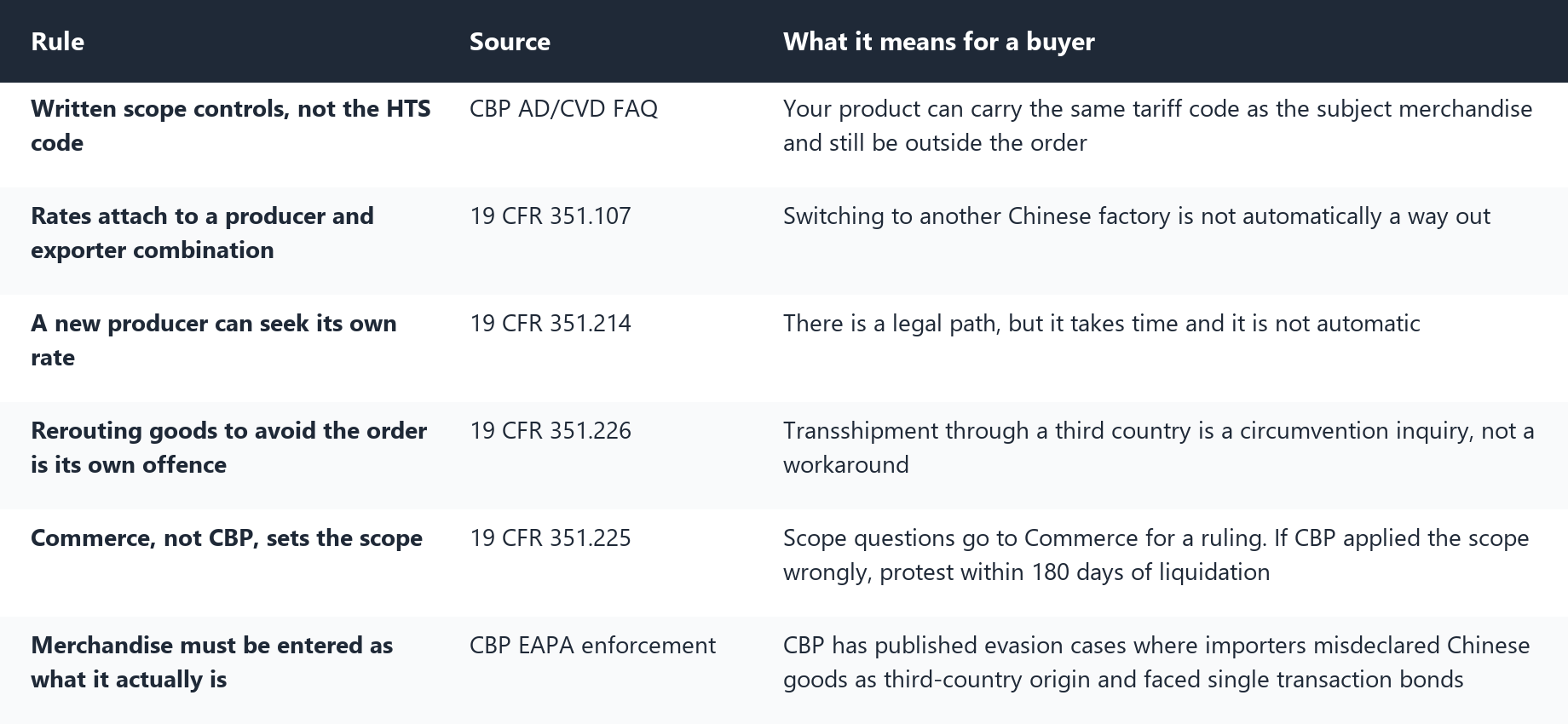
| Rule | Source | What it means for a buyer |
|---|---|---|
| The written scope description controls, not the HTS code | CBP AD/CVD FAQ | Your product can carry the same tariff code as the subject merchandise and still be outside the order |
| Rates attach to a producer and exporter combination | 19 CFR 351.107 | Switching to another Chinese factory is not automatically a way out |
| A new producer can seek its own rate | 19 CFR 351.214 | There is a legal path, but it takes time and it is not automatic |
| Rerouting goods to avoid the order is its own offence | 19 CFR 351.226 | Transshipment through a third country is a circumvention inquiry, not a workaround |
| Commerce, not CBP, sets the scope | 19 CFR 351.225 | Scope questions go to Commerce for a ruling. If CBP applied the scope wrongly, protest within 180 days of liquidation |
| Merchandise must be entered as what it actually is | CBP EAPA enforcement | CBP has published evasion cases where importers misdeclared Chinese goods as third-country origin and faced single transaction bonds |
What gets repriced, and what actually gets collected
Not every trade measure on Chinese goods works the same way. Comparing them side by side is the fastest way to see which rules apply to your category.
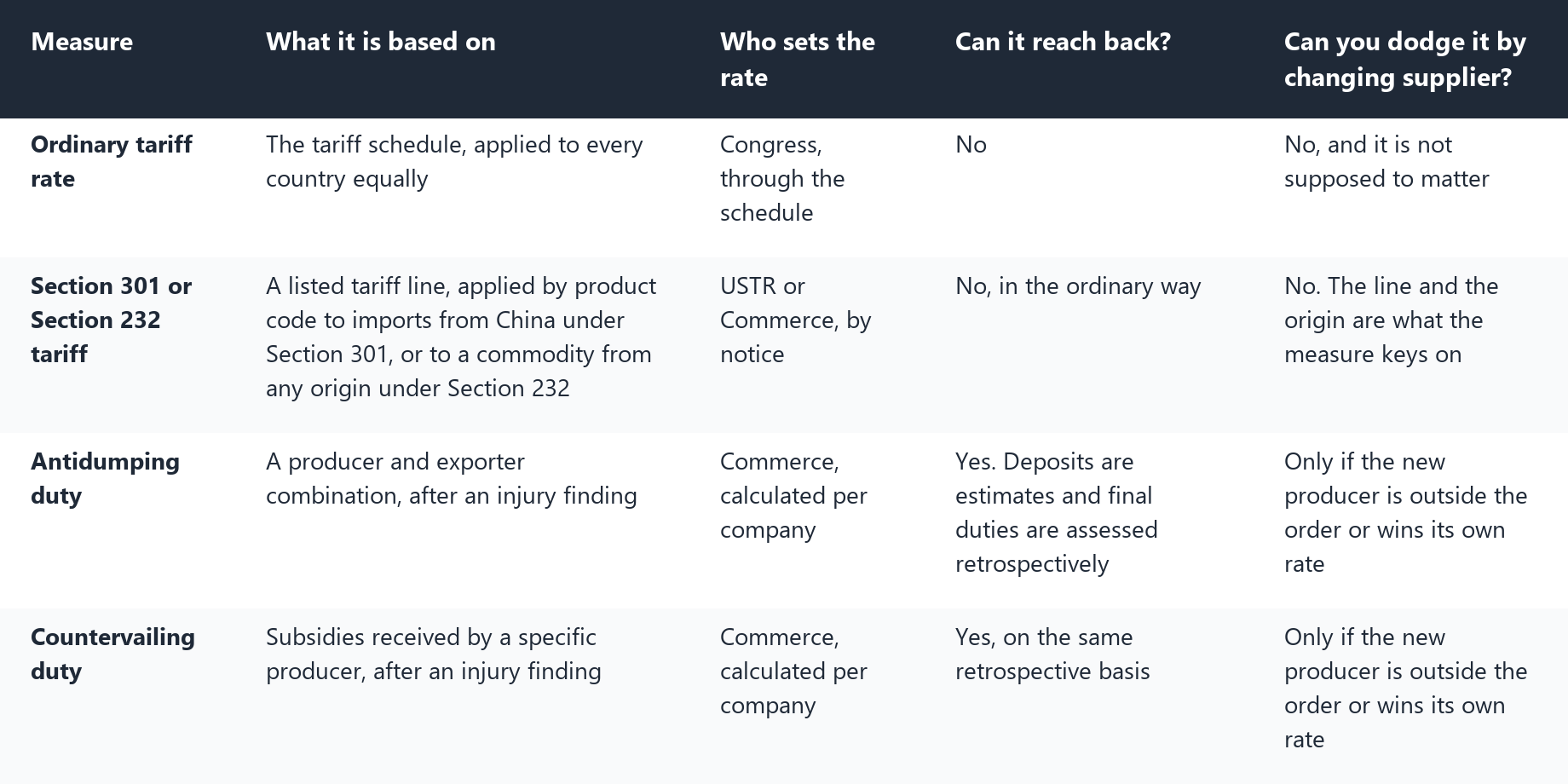
| Measure | What it is based on | Who sets the rate | Can it reach back to goods already entered | Can you dodge it by changing supplier? |
|---|---|---|---|---|
| Ordinary tariff rate | The tariff schedule, applied to every country equally | Congress, through the schedule | No | No, and it is not supposed to matter |
| Section 301 or Section 232 tariff | A listed tariff line, applied by product code to imports from China under Section 301, or to a commodity from any origin under Section 232 | USTR or Commerce, by notice | No, in the ordinary way | No. The line and the origin are what the measure keys on |
| Antidumping duty | A producer and exporter combination, after an injury finding | Commerce, calculated per company | Yes. Deposits are estimates and final duties are assessed retrospectively | Only if the new producer is outside the order or wins its own rate |
| Countervailing duty | Subsidies received by a specific producer, after an injury finding | Commerce, calculated per company | Yes, on the same retrospective basis | Only if the new producer is outside the order or wins its own rate |
The practical read: the first two rows are price problems you solve with paperwork and sourcing decisions. If you are still building that price model, what to assume about Section 301 tariffs when pricing a China order is the piece to read alongside this one. The last two rows are entity problems, and they are resolved by finding out which factory made your goods rather than by finding a cheaper factory. A buyer who treats all four as one bucket will misprice the order and will miss the paperwork that actually carries the risk.
When deposits begin, and how far back they can reach
Nothing is collected today. Cash deposits begin at the first affirmative Commerce determination in the investigation, which is normally the preliminary determination. At that point Commerce instructs CBP to suspend liquidation of entries and begin collecting cash deposits at the preliminarily determined rate. If Commerce finds critical circumstances, CBP can be instructed to suspend liquidation and collect deposits beginning 90 days before the date the determination is published. The retroactive reach is limited: it applies only to entries made on or after the later of those 90 days or the date of the Federal Register notice initiating the investigation. Provisional measures expire after 120 days, extended to 180 days in antidumping cases, and suspension of liquidation resumes if Commerce publishes an order.
The deposit is an estimate, and the real bill arrives years later
The deposit you pay at entry is not the amount you owe. Final liability is determined later, in an administrative review, and the final amount may be higher, lower, or unchanged. CBP will bill you for an increase with interest, or refund an overpayment with interest. On average, CBP says, the entire process from the date of importation takes approximately three years. Interest is not applicable to entries made during the provisional measures period in the original investigation.
So the exposure is not one number on one invoice. It is a cash deposit you fund up front, an assessment rate that arrives years later, and an interest line that depends on which way the review goes.
What we do when this lands on a supplier
In our own sourcing work, the first thing we check when a new trade remedy case opens is not the rate. It is the refusal clauses in our forwarders' own terms. On a bathroom fixtures project, our express and rail channels both carry written terms stating they do not accept antidumping type products, naming watches and watch movements, ceramics, bicycles, motorcycles and parts, and auto parts among the examples. That clause was already in the contract before any US case existed, and it decided the routing before any rate was published.
The channel's risk committee reads scope language, not the Federal Register
That is the practical inversion most buyers miss. A logistics channel can block a category before the tax bill arrives, because the channel screens product descriptions against known trade remedy history rather than against pending notices. When we price a project in a category with a live antidumping or countervailing history, we read the forwarder's refusal list as part of the freight quote rather than after the shipment is refused, and we check whether the category already carries an order, because that is where the scope language lives.
Verify the entity, not the rate
On a case like this, the useful work is entity level verification and document level reading, not rate guessing. You cannot model a number that has not been calculated. You can verify whether you are inside the scope, whether the producer combination is covered, and whether the goods can physically be moved. Company specific AD/CVD case numbers are ten digits and company level. Case level numbers are seven digits and cover both antidumping and countervailing, and because the two proceedings are conducted separately, company specific information can differ between them. In ACE, queries for whether both duties are due on a particular good should be run at the seven digit level.
A short list before December 14
1. Read the written scope in the notice and compare it against your product description, not your HTS code.
2. Confirm the producer and exporter entities behind your shipments, and check both against the case.
3. Ask your forwarder in writing whether the category is accepted on your intended channels, before you commit to a sailing.
4. Put your existing entries and in-transit shipments against the retroactive window dates.
5. Get the seven digit case number for your category from the AD/CVD search, and the ten digit company number if you have one.
6. If you believe you are outside the scope, use the formal ruling route rather than arguing at the border. Deposits are still required while a scope determination is pending, and if Commerce later rules you are not covered, CBP will normally instruct a refund.
Footnotes
1. U.S. International Trade Commission, Shopping Carts and Parts Thereof From China; Institution of Antidumping and Countervailing Duty Investigations and Scheduling of Preliminary Phase Investigations, Investigation Nos. 701-TA-811 and 731-TA-1813 (Preliminary), 91 FR 68969, November 2, 2026: https://www.federalregister.gov/documents/2026/11/02/2026-22281/shopping-carts-and-parts-thereof-from-china-institution-of-antidumping-and-countervailing-duty
2. U.S. Customs and Border Protection, Antidumping and Countervailing Duties (AD/CVD) Frequently Asked Questions: https://www.cbp.gov/trade/priority-issues/adcvd/antidumping-and-countervailing-duties-adcvd-frequently-asked-questions
3. 19 U.S.C. 1673b, Preliminary determinations, including the Commission's 45-day determination on reasonable indication of injury and the administering authority's 140-day preliminary determination: https://www.govinfo.gov/content/pkg/USCODE-2024-title19/html/USCODE-2024-title19-chap4-subtitleIV-partII-sec1673b.htm
4. 19 U.S.C. 1673d, Final determinations, including the 75-day and 135-day periods: https://www.govinfo.gov/content/pkg/USCODE-2024-title19/html/USCODE-2024-title19-chap4-subtitleIV-partII-sec1673d.htm
5. 19 U.S.C. 1671b, Preliminary determinations in countervailing duty cases, including the 65-day and 130-day periods: https://www.govinfo.gov/content/pkg/USCODE-2024-title19/html/USCODE-2024-title19-chap4-subtitleIV-partI-sec1671b.htm
6. 19 CFR 351.107, Cash deposit rates; producer/exporter combination rates: https://www.ecfr.gov/current/title-19/section-351.107
7. 19 CFR 351.214, New shipper reviews under section 751(a)(2)(B) of the Act; expedited reviews in countervailing duty proceedings: https://www.ecfr.gov/current/title-19/section-351.214
8. 19 CFR 351.225, Scope rulings, including requests for rulings on whether merchandise falls within the scope of an order: https://www.ecfr.gov/current/title-19/section-351.225
9. 19 CFR 351.226, Circumvention inquiries, including the four distinct categories of merchandise that may be brought within the scope of an order: https://www.ecfr.gov/current/title-19/section-351.226
10. U.S. Customs and Border Protection, Enforce and Protect Act Cons. Case 8250, Notice of Initiation of Investigation and Interim Measures, April 23, 2026, concerning alleged evasion of antidumping and countervailing duty orders through transshipment and misdeclaration of country of origin: https://www.cbp.gov/document/publications/eapa-cons-case-8250-various-importers-notice-initiation-investigation-and