What changed, when, and who changed it
The dates that matter are 16 to 20 November, not 18 and 19
The APEC Economic Leaders' Meeting runs on 18 and 19 November 2026 in Shenzhen. The cargo restriction does not. International passenger flights arriving at or departing from Shenzhen are prohibited from carrying belly cargo from midnight on 16 November until 18:00 on 20 November, local time, according to a published notice from Teleport that cargo agents and terminal operators were told to follow.
Read that window against a normal shipping calendar and you can see why it hurts. It covers the last working days of the peak season run-up, the two summit days and the recovery days after them. A buyer who assumed "the summit is the 18th and 19th, I will ship on the 20th" has missed it by two days.
Where the restriction actually comes from, and who is enforcing it
There is no airport-wide cargo embargo that we could find. The Shenzhen airport operator's own notice board carries three announcements, none about an APEC cargo embargo. What exists instead is a set of separate instruments, each with its own scope, plus carrier and forwarder notices layered on top.
The legal basis sits at municipal level. On 30 September 2026, the Standing Committee of the Shenzhen Municipal People's Congress adopted a decision authorising the municipal government to impose temporary administrative measures in public safety, urban management and transport for the summit. That authorisation runs until 30 November 2026: the legal authority for temporary measures outlives the cargo window by ten days.
The road side is a different rule with a different window
Dangerous goods vehicles are off every Shenzhen road
This is the restriction most summaries skip, and the one that can break a shipment even when the flight is operating perfectly.
Under a notice from the Shenzhen Public Security Bureau's traffic management division, issued on 3 November, dangerous goods transport vehicles are prohibited from travelling on all roads in Shenzhen, including the expressways, from 16 to 20 November, every hour of every day. Not the districts around the venues: the whole city.
For an importer of batteries, power banks, aerosols, inks or chemicals, the delivery leg into and out of the airport is constrained in the same five days as the flight leg. The usual workaround, moving to another gateway by road, is not available to the cargo that most needs it.
Small and large trucks have their own hours and their own carve-outs
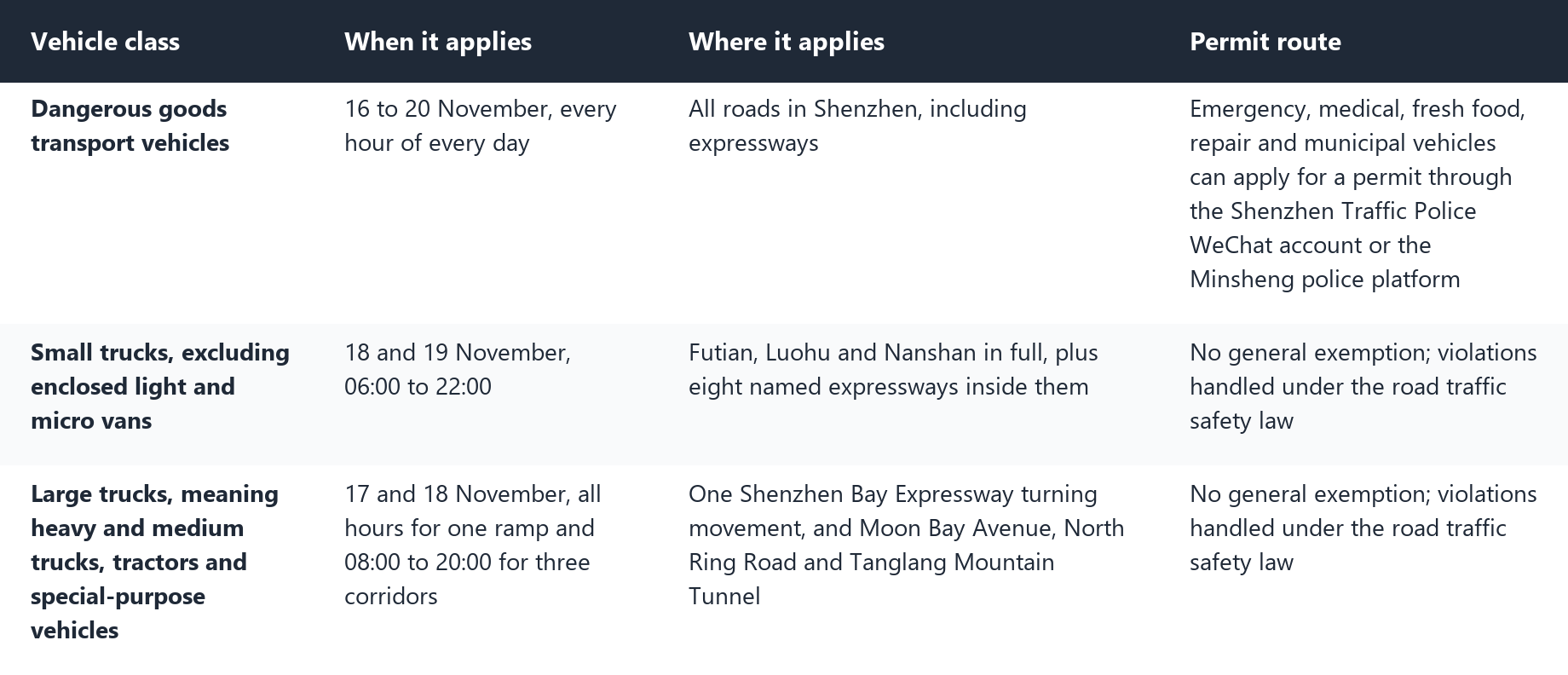
The same notice restricts other freight vehicles on a narrower schedule. Small trucks, meaning light or micro trucks but excluding the enclosed light and micro vans that carry most parcel volume, are prohibited from 06:00 to 22:00 on 18 and 19 November across the whole of Futian, Luohu and Nanshan, including eight named expressways inside them. Southbound traffic on the Shenzhen Bay Expressway east of the G107 is not caught.
Large trucks face two specific closures on 17 and 18 November: a prohibited turning movement at the Shenzhen Bay Expressway ramp leading east to the G107 northbound turn, and a daytime restriction on three corridors including Moon Bay Avenue and Tanglang Mountain Tunnel.
The three rules that matter are set out below.
| Vehicle class | When it applies | Where it applies | Permit route |
|---|---|---|---|
| Dangerous goods transport vehicles | 16 to 20 November, every hour of every day | All roads in Shenzhen, including expressways | Emergency, medical, fresh food, repair and municipal vehicles can apply for a permit through the Shenzhen Traffic Police WeChat account or the Minsheng police platform |
| Small trucks, excluding enclosed light and micro vans | 18 and 19 November, 06:00 to 22:00 | Futian, Luohu and Nanshan in full, plus eight named expressways inside them | No general exemption; violations handled under the road traffic safety law |
| Large trucks, meaning heavy and medium trucks, tractors and special-purpose vehicles | 17 and 18 November, all hours for one ramp and 08:00 to 20:00 for three corridors | One Shenzhen Bay Expressway turning movement, and Moon Bay Avenue, North Ring Road and Tanglang Mountain Tunnel | No general exemption; violations handled under the road traffic safety law |
The stated intent was precision rather than blanket closure. The briefing at the Shenzhen government's press conference on 15 October described targeted restrictions of two to five days by vehicle type, with enclosed light and micro vans excluded entirely because they carry supermarket distribution and household moves.

How the temporary permit actually works
There is a channel, and it is narrower than most people assume. Vehicles performing emergency, medical, fresh food, engineering repair or municipal management duties can apply for a temporary permit through the Shenzhen Traffic Police WeChat account or the Minsheng police platform, selected by vehicle type, and then travel only within the approved time window and route. The express delivery sector received permits for selected time slots, given the peak season after Singles' Day into account.
Two things are worth flagging. Ordinary commercial freight trucks are not on that list, so the permit route is not a general escape hatch. And the notice states that violations will be handled by the traffic police under the road traffic safety law.
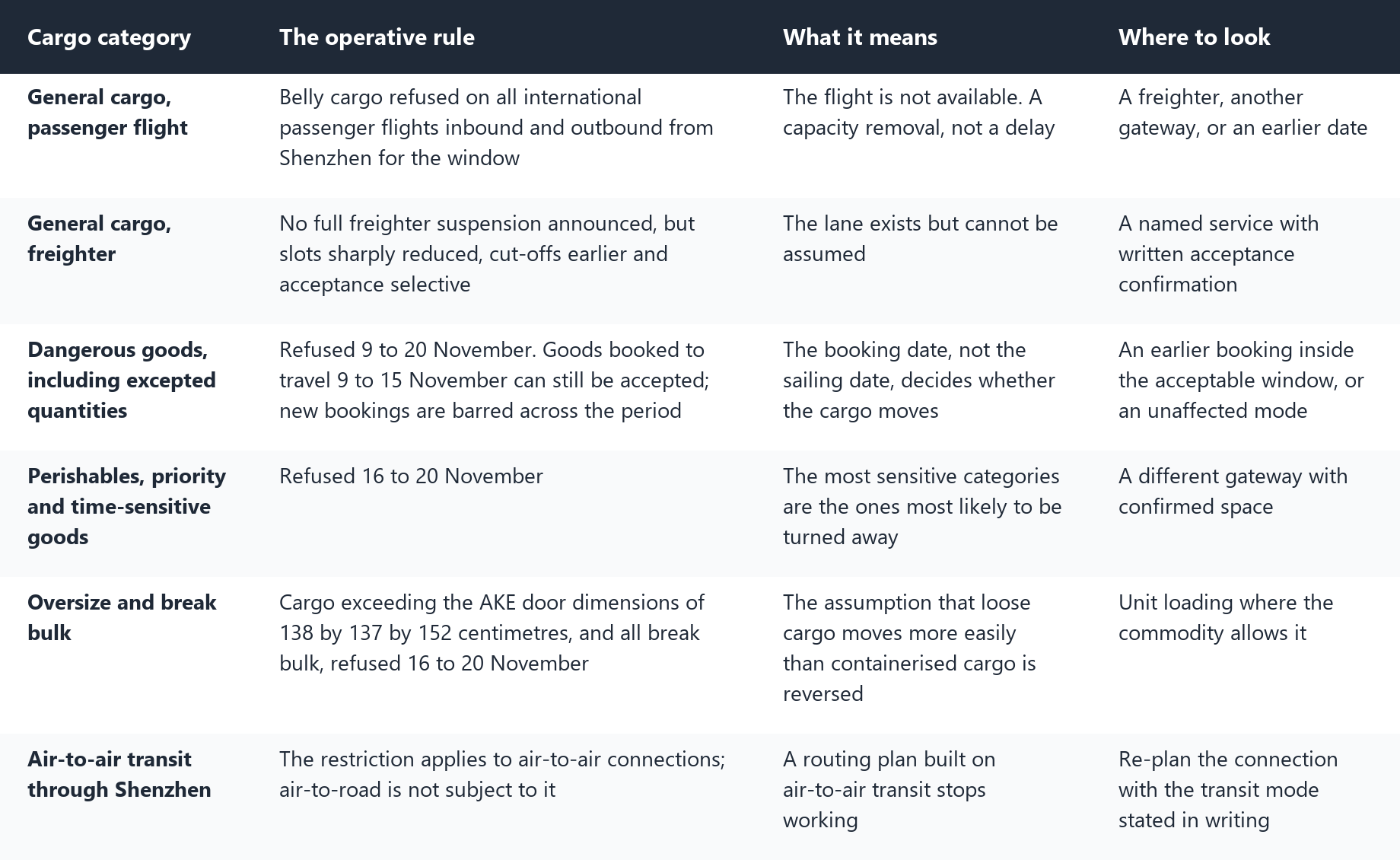
Six cargo categories, six different answers
What ANA Cargo published, and why it is the most useful notice
ANA Cargo published one of the more detailed carrier notices we could find, and it separates what is refused from what is merely rescheduled. It is worth reading in full, because the refusal list is longer than the headline suggests and starts nine days before the cargo window. The carrier attributes the measures to a notification from local authorities. The publication date matters as much as the content: a buyer reading this on 9 November has three weeks to act, one reading it on 17 November has three days.
The three classes that get refused even when a freighter is flying
Three groups produce surprise casualties. Perishables, priority and time-sensitive shipments are the largest, because a buyer whose cargo is perishable has usually planned a passenger flight or an expedited freighter, and both now sit under a refusal rather than a delay. Shenzhen handled 25,000 tonnes of fresh and cold chain imports in the first half of 2026, up 37.1 percent year on year, so this is a real lane, not a niche one.
Oversize and break bulk are the second. Buyers of oversized lighting, furniture or industrial parts often assume loose cargo moves more easily than containerised cargo. Here it is the reverse.
Transit connections are the third, and the easiest to miss. Air-to-air connections through Shenzhen are restricted; air-to-road connections are not, so a routing plan built on air-to-air transit stops working.
The handling-time change that hits everything else
One change in the ANA notice applies to everything passing through Shenzhen, including general cargo nobody refuses. Export shipments departing Shenzhen must be accepted no later than twelve hours before scheduled departure. Imports arriving become collectable eight hours or more after actual arrival.
Both are working-time changes on top of a capacity change, and they hit the schedule whether or not your cargo flies. A booking that used to be tendered the evening before a flight now has to be handed over half a day earlier, moving the truck, the warehouse and the factory earlier in the chain.
| Cargo category | The operative rule | What it means | Where to look |
|---|---|---|---|
| General cargo, passenger flight | Belly cargo refused on all international passenger flights inbound and outbound from Shenzhen for the window | The flight is not available. A capacity removal, not a delay | A freighter, another gateway, or an earlier date |
| General cargo, freighter | No full freighter suspension announced, but slots sharply reduced, cut-offs earlier and acceptance selective | The lane exists but cannot be assumed | A named service with written acceptance confirmation |
| Dangerous goods, including excepted quantities | Refused 9 to 20 November. Goods booked to travel 9 to 15 November can still be accepted; new bookings are barred across the period | The booking date, not the sailing date, decides whether the cargo moves | An earlier booking inside the acceptable window, or an unaffected mode |
| Perishables, priority and time-sensitive goods | Refused 16 to 20 November | The most sensitive categories are the ones most likely to be turned away | A different gateway with confirmed space |
| Oversize and break bulk | Cargo exceeding the AKE door dimensions of 138 by 137 by 152 centimetres, and all break bulk, refused 16 to 20 November | The assumption that loose cargo moves more easily than containerised cargo is reversed | Unit loading where the commodity allows it |
| Air-to-air transit through Shenzhen | The restriction applies to air-to-air connections; air-to-road is not subject to it | A routing plan built on air-to-air transit stops working | Re-plan the connection with the transit mode stated in writing |
Your alternatives, and what each one costs you
Moving the shipment out of the window
The cheapest option is to move the shipment earlier, and the question is how much earlier. The constraint is not the airport but your own production and consolidation schedule, the same exercise as planning against a fixed delivery date rather than a fixed shipping date. The same discipline applies working back from a factory holiday, covered in when the last day is to place a China order before the 2027 Spring Festival.
Moving the gateway
Guangzhou and Hong Kong, China are the obvious substitutes, and the freight forwarders we checked recommend considering both rather than picking one. The difficulty is that the same forwarders warn about the opposite effect: freight displaced from Shenzhen cancellations is expected to push into Guangzhou, leaving very tight space on services to Europe and the United States. Hong Kong, China adds a cross-border leg and a different handling chain, costing time and money.
Moving the mode
Sea freight is the structural alternative when the delivery date allows it. The cost side of that substitution is set out in how to manage cost risks from China to United States ocean freight rate fluctuations. The point here is narrower: a five-day air window is not a reason to re-plan an ocean booking, but it is a reason to price one before you are forced into it.
What the freight rate is doing while you decide
The air market is tightening on its own. Freightos reported that China to United States prices rose 3 percent last week to more than USD 8 per kilogram, which it put at the previous year's high, a level last year reached only in mid-December. China to Europe rose 11 percent to USD 4.87 per kilogram, up 23 percent year on year. These are commercial index figures, not official statistics.
| Decision | What you need to establish | Who confirms it | The realistic risk |
|---|---|---|---|
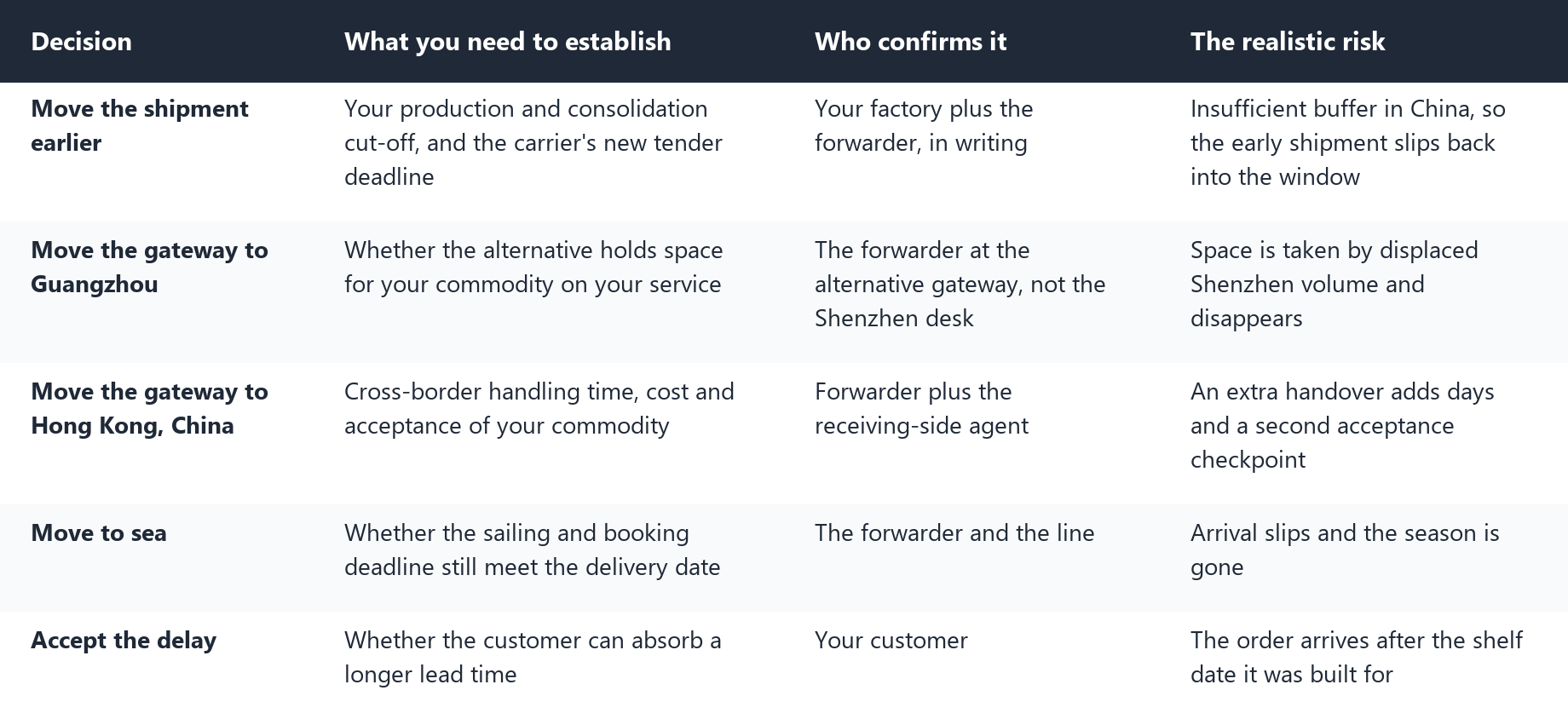
| Move the shipment earlier | Your production and consolidation cut-off, and the carrier's new tender deadline | Your factory plus the forwarder, in writing | Insufficient buffer in China, so the early shipment slips back into the window |
| Move the gateway to Guangzhou | Whether the alternative holds space for your commodity on your service | The forwarder at the alternative gateway, not the Shenzhen desk | Space is taken by displaced Shenzhen volume and disappears |
| Move the gateway to Hong Kong, China | Cross-border handling time, cost and acceptance of your commodity | Forwarder plus the receiving-side agent | An extra handover adds days and a second acceptance checkpoint |
| Move to sea | Whether the sailing and booking deadline still meet the delivery date | The forwarder and the line | Arrival slips and the season is gone |
| Accept the delay | Whether the customer can absorb a longer lead time | Your customer | The order arrives after the shelf date it was built for |
How we handle this from Shenzhen
Our sequence
Air freight scheduling out of South China is routine work for us, so when a booking lands inside a restricted window we run the same four steps. The forwarder gets checked as carefully as the factory, per how to check a freight forwarder's licence before you pay a deposit.
First we classify by shipment line rather than by air waybill. The same consolidation often mixes a battery accessory with a battery-powered tool and a non-regulated accessory, and one classification applied to the whole consignment either gets the whole shipment refused or pushes it into a slower lane than it needs. We ask the factory for a line-by-line breakdown, then the forwarder to confirm acceptance per line.
Second, we ask for written answers on four points: which flights will physically accept cargo on each day of the window, how many hours ahead of departure the tender cut-off now sits, whether the commodity falls into a refusal class, and what the alternative gateway can confirm for the same commodity. A general assurance that the booking is fine is not an answer, because the carrier notices are what changes at the desk.
Third, we separate the road leg from the flight leg. The dangerous goods vehicle restriction covers the same five days as the cargo window, so a dangerous goods shipment and a general cargo shipment may need different delivery timings even on the same aircraft.
Fourth, we work backwards from the customer's shelf date rather than from our own warehouse convenience.

Two assumptions we stopped making
We used to assume that moving the gateway rescued a shipment. Now we require written confirmation from the alternative gateway, naming the commodity, the service and the cut-off, before we present a gateway change to a client. The gap between a booking being confirmed and cargo being accepted is exactly the gap this window exposes, and a substitution offered on a phone call inherits that gap.
We also used to carry a product through as general cargo once the forwarder confirmed the booking. Now we classify against the strictest reading of the refusal list first, because a refusal at the acceptance desk is recovered with a re-routing, a re-manufacture slot and a warehousing bill, far more expensive than splitting the shipment earlier.
What we cannot do is influence a carrier's acceptance decision or obtain priority loading. Moving a shipment earlier is planning, not queue-jumping.
What is not yet known
Three things nobody has published
An airport-wide embargo covering all operators has not been independently established. The published notices differ in scope, and the ones we could read are carrier-specific rather than airport-wide. The practical restriction therefore depends on which carrier and forwarder you deal with, and that is why the first step above is to confirm in writing rather than assume.
The total tonnage covered by the announced restrictions has not been established. Nobody has published a figure for how much cargo the window removes from the market, which makes it impossible to model the resulting rate movement from first principles.
Finally, we could not find any carrier-published figure for how much additional capacity Guangzhou and Hong Kong, China can absorb. The trade press reports tight space warnings without a number attached, and the absence of a number is exactly the problem.
Why these gaps matter for a quote
All three gaps land in the same place, which is the price on your shipment. You cannot build a capacity plan on an unpublished number, so the only defensible approach here is to plan against the worst case and accept that it costs more than the market average.
That is also why we would rather give you a range and a decision deadline than a confident single number. The 16 November start is the hard date, and every hour of decision time before it is worth more than any rate forecast after it.
First published at chinagosource.com
Footnotes
1. Standing Committee of the Shenzhen Municipal People's Congress, Announcement No. 248, and the Decision on Authorising the Municipal People's Government to Provide for Temporary Administrative Measures for the Preparations and Hosting of the 33rd APEC Economic Leaders' Meeting, adopted and published on 30 September 2026, in force until 30 November 2026, covering temporary administrative measures in public safety, urban management and transport: https://www.szrd.gov.cn/v2/zx/qwfb/hygg/content/post_1978049.html
2. Shenzhen Public Security Bureau Traffic Management Division, Notice on Temporary Traffic Management Measures for Trucks on Selected Roads and Areas in the City During the 33rd APEC Economic Leaders' Meeting, issued 3 November 2026 and in force from 16 to 20 November 2026, covering the small truck restriction of 06:00 to 22:00 on 18 and 19 November in Futian, Luohu and Nanshan, the large truck closures on 17 and 18 November, the city-wide dangerous goods vehicle prohibition for the full five days, the temporary permit channel, and the penalty clause: https://szjj.sz.gov.cn/m/YD_ZWGK/YD_TZGG/YD_GGJG/content/post_13051982.html
3. Shenzhen Municipal People's Government Online, Traffic Control Measures for the APEC Period, Precise and Refined Management for Dual Safeguards, and the Green Travel and Unimpeded Flow press conference of 15 October 2026, reporting the vehicle-by-vehicle approach, targeted two to five day freight vehicle restrictions by vehicle type, the exclusion of enclosed light and micro vans, the permit route for emergency, medical, fresh food, repair and municipal vehicles and the permits issued to the express delivery sector: https://www.sz.gov.cn/cn/xxgk/zfxxgj/zwdt/content/post_13053144.html and https://www.sz.gov.cn/cn/xxgk/zfxxgj/zwdt/content/post_13024242.html
4. ANA Cargo, Temporary Restriction on Shipments Transport from, to and via SZX, published 9 November 2026, covering the dangerous goods refusal from 9 to 20 November, the widened refusal list from 16 to 20 November covering perishables, priority products, time-sensitive shipments, cargo exceeding the AKE container door dimensions of 138 by 137 by 152 centimetres and break bulk shipments, the air-to-air and air-to-road distinction on transit, and the twelve hour export tender and eight hour import release handling times: https://www.anacargo.jp/en/news/261109_E.html
5. Shenzhen Airport notice board, listing the current public announcements of the airport operator, none of which is an APEC cargo embargo: https://www.szairport.com/szairport/zytz/dlm_list.shtml
6. The Loadstar, Shenzhen Belly Cargo Ban Threatens Peak Season Squeeze at Other Gateways, 10 November 2026. Trade press reporting of carrier and forwarder notices and of commercial index data, not an official source, cited here for the cargo suspension window published by Teleport, for the statement that no official full freighter suspension has been announced, for the diversion warnings on Guangzhou space, and for the Freightos rate figures: https://theloadstar.com/shenzhen-air-cargo-restrictions-ahead-of-apec-threaten-peak-shipments/