Every forwarder in China holds a licence of some kind, which is the problem. A licence held by one company tells you nothing about whether the company quoting you is that company, and a licence held at all says almost nothing about performance.

Three separate records, not one
The most common mistake is treating one document as proof of legitimacy.
The business licence proves the company exists
The business licence, the 营业执照, proves the company is registered and states its registered scope. In China that scope is a list of phrases, and for a forwarder the one that matters is 国际货物运输代理, international cargo forwarding. If the scope does not contain it, the company has not registered to do the business you are asking it to do.
There is also a quantitative test. Under the rules still governing the sector, a company needs registered capital of at least RMB 2 million for land freight, RMB 3 million for air and RMB 5 million for sea. A company quoting an ocean rate with RMB 500,000 of registered capital is telling you how seriously it treats the filing requirement, and a company with the wrong scope cannot issue the documents your goods need at customs.
The Ministry of Commerce filing is a different record
China maintains a separate filing for international freight forwarding enterprises, showing the modes it operates, the cargo types it covers and the special services it offers. You can search it yourself: on the Ministry of Commerce site, go to the government services hall, then administrative results disclosure, then the second item under other business, international freight forwarding enterprise information management, and search by company name.
It is not the same as the business licence or the NVOCC filing, and the multi-certificate-one-licence reform means it now sits on the company registration.
The NVOCC filing decides who issues your bill of lading
The third record changes how a shipment is structured. Operating an NVOCC business requires a filing with the provincial transport authority. This used to be an approval; the State Council decision of 2019 that removed a batch of administrative licensing items cancelled NVOCC approval and converted it into a filing, pushed down to the provinces.
Why it matters commercially: a company holding an NVOCC filing can issue its own house bill of lading. A company without one cannot, and arranges space through a carrier or another NVOCC instead. That determines who controls release of your cargo.
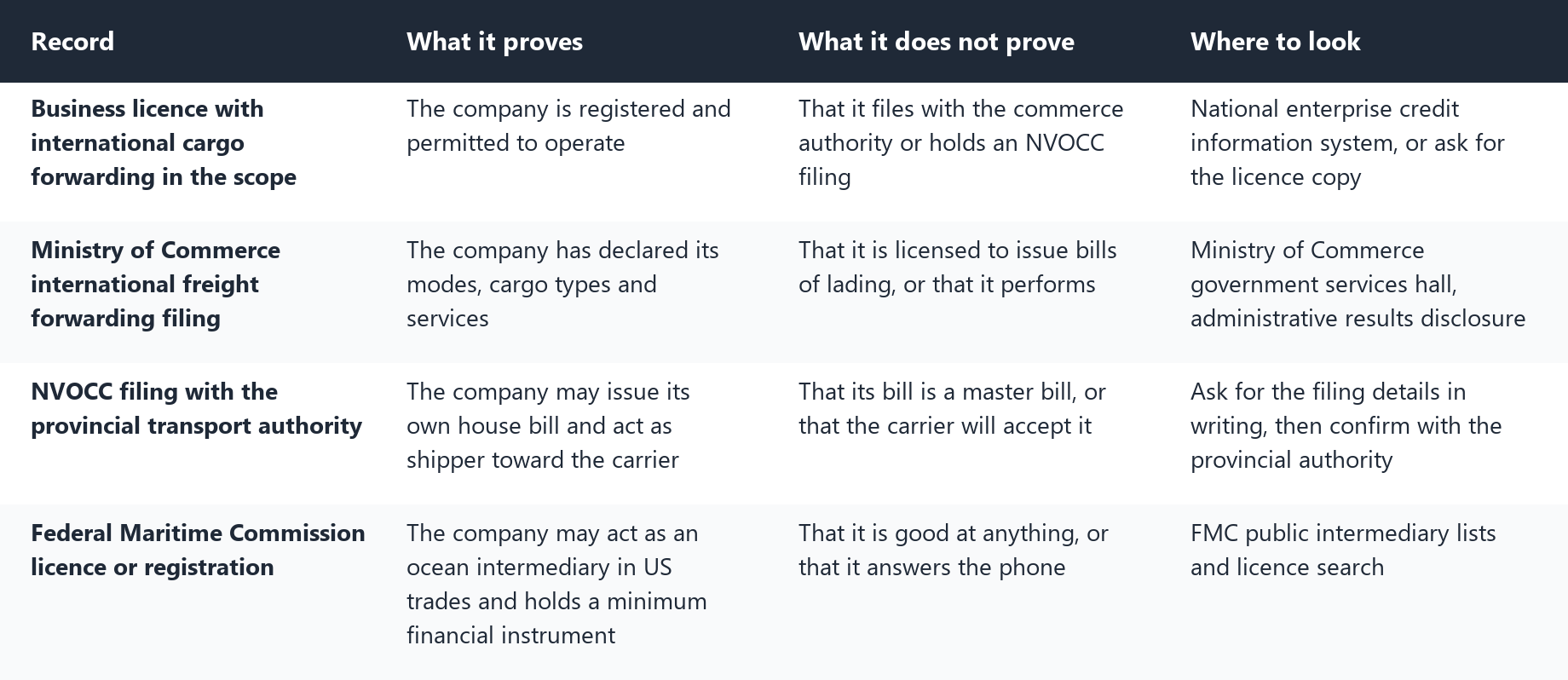
| Record | What it proves | What it does not prove | Where to look |
|---|---|---|---|
| Business licence with international cargo forwarding in the scope | The company is registered and permitted to operate | That it files with the commerce authority or holds an NVOCC filing | National enterprise credit information system, or ask for the licence copy |
| Ministry of Commerce international freight forwarding filing | The company has declared its modes, cargo types and services | That it is licensed to issue bills of lading, or that it performs | Ministry of Commerce government services hall, administrative results disclosure |
| NVOCC filing with the provincial transport authority | The company may issue its own house bill and act as shipper toward the carrier | That its bill is a master bill, or that the carrier will accept it | Ask for the filing details in writing, then confirm with the provincial authority |
| Federal Maritime Commission licence or registration | The company may act as an ocean intermediary in US trades and holds a minimum financial instrument | That it is good at anything, or that it answers the phone | FMC public intermediary lists and licence search |

If the shipment touches the United States, the FMC check is the hard one
Most readers ship from China to a buyer in the United States, and that case has one more layer with the most teeth, because the United States regulates it rather than registering it.
What the FMC actually licenses
The Federal Maritime Commission licenses two kinds of ocean transportation intermediary. An ocean freight forwarder is a company located in the United States that arranges cargo movement to an international destination and prepares the documentation. A non-vessel-operating common carrier holds itself out to provide ocean transportation, issues its own house bill of lading, and operates no vessels.
Both must obtain a licence before offering services in US trades and must submit proof of financial responsibility. A foreign-based NVOCC can register instead, posting a larger instrument. The amounts are published: an ocean freight forwarder must furnish USD 50,000, a licensed NVOCC USD 75,000, and a registered NVOCC USD 150,000. A registered NVOCC is strictly responsible for the acts and omissions of its employees and agents wherever they are located.
The licence number goes on the documents, so you can cross-check it
Here is the part most online guides leave out. The Commission requires each licensee and registrant to carry on business only under the name in which it was licensed or registered and only under its licence or registration number. When that name appears on shipping documents, the number must also be included, and both must be imprinted on its stationery and billing forms.
That gives you a mechanical step. Ask for the FMC licence or registration number, put the number into the Commission's public search, and confirm the legal name, the permitted activity and the renewal date. Then confirm the number on the quotation and the contract is the same number. A forwarder that quotes one legal name and gives you another entity's licence number has told you something about how it wants to be paid. The same rule closes a workaround: no OTI may let its licence number be used by a non-employee.
The non-compliant list is short, and that is the point
The Commission publishes the names of NVOCCs that are currently licensed or registered but have not published a tariff, contrary to 46 CFR 520.3. Those companies are not in compliance and risk having the licence revoked or the registration terminated. The list is updated weekly on Friday, and at the time of writing it carries four names.
Four names on a weekly-updated list of several thousand licensed intermediaries is not weak enforcement, it is evidence of enforcement working. Note the direction of the obligation: common carriers are prohibited from knowingly and willfully transporting cargo for the account of an NVOCC lacking the required tariff and financial instrument. An official notice from July 2023 puts it in the language carriers use: carriers must verify compliance first.
What the public lists still do not tell you
The Commission's published list is current as of the last date on which it was updated, and it is updated periodically rather than continuously, so read the as-of date in the first row. In the version consulted for this article that date was October 30, 2026, and the file held 9,876 records, of which 2,097 were registered in China. Sixty records carried a renewal date earlier than the as-of date, so a licence number proves the position on that date, not today.
The bill of lading decides whether you have a claim at all
Everything above is about the counterparty. This section is about the document.
Master bill or house bill, and who can release your cargo
A master bill of lading is issued by the ocean carrier. A house bill is issued by the forwarder or the NVOCC. On a full container load you can normally ask for the master bill. On a consolidated load the forwarder issues a house bill, and no master bill reaches you. This is not a formality: on a house bill, release of your cargo is controlled by the forwarder and its destination agent, and if the forwarder does not pay the carrier, the carrier can hold the goods. Release terms belong in how you calculate the true landed cost of a China order before the order, not after the invoice.
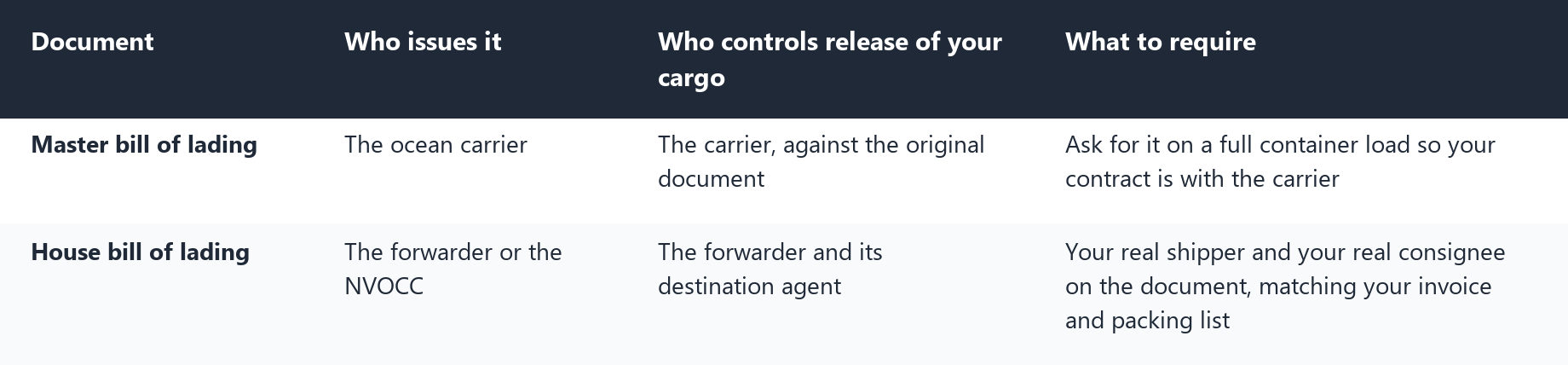
| Document | Who issues it | Who controls release of your cargo | What to require |
|---|---|---|---|
| Master bill of lading | The ocean carrier | The carrier, against the original document | Ask for it on a full container load so your contract is with the carrier |
| House bill of lading | The forwarder or the NVOCC | The forwarder and its destination agent | Your real shipper and your real consignee on the document, matching your invoice and packing list |
So on any consolidated shipment, require the house bill to show the real shipper and the real consignee, matching your invoice and packing list. Some forwarders file a switch bill, or show themselves as shipper, which lets a destination agent release cargo without the original document.
Check the bill number against the carrier, not the forwarder
One verification step takes five minutes and gets skipped more often than any other. Take the carrier's own bill number and check it on the carrier's own system. If the carrier's site does not recognise the booking, it does not exist in the way described to you. This works because a carrier can look up its own bookings without disclosing anything commercially sensitive.
Ask about insurance in the right terms
Forwarder liability insurance and cargo insurance are different instruments. Liability insurance responds to the forwarder's own operational negligence, not to your cargo loss. Ask separately whether cargo insurance is in place and how much is covered.
Four questions that separate a real quote from a soft one
The licence checks tell you the counterparty is legitimate. They say nothing about whether the price you were given is the price the shipment will cost, which is the second way buyers lose money.
What a soft answer sounds like
A price ending at an unnamed node, destination charges described as at cost, a billing ratio that depends on the cargo, a refusal to name the agent. Any one is a normal commercial answer; all four together is a quotation nobody can check.
The questions that matter
Ask where the price ends, and for destination charges itemised rather than described as at cost. Ask for the destination agent's name, because the same quotation can be worth two prices depending on which agent handles it, which is the other half of managing cost risks from China-US ocean freight rate fluctuations.
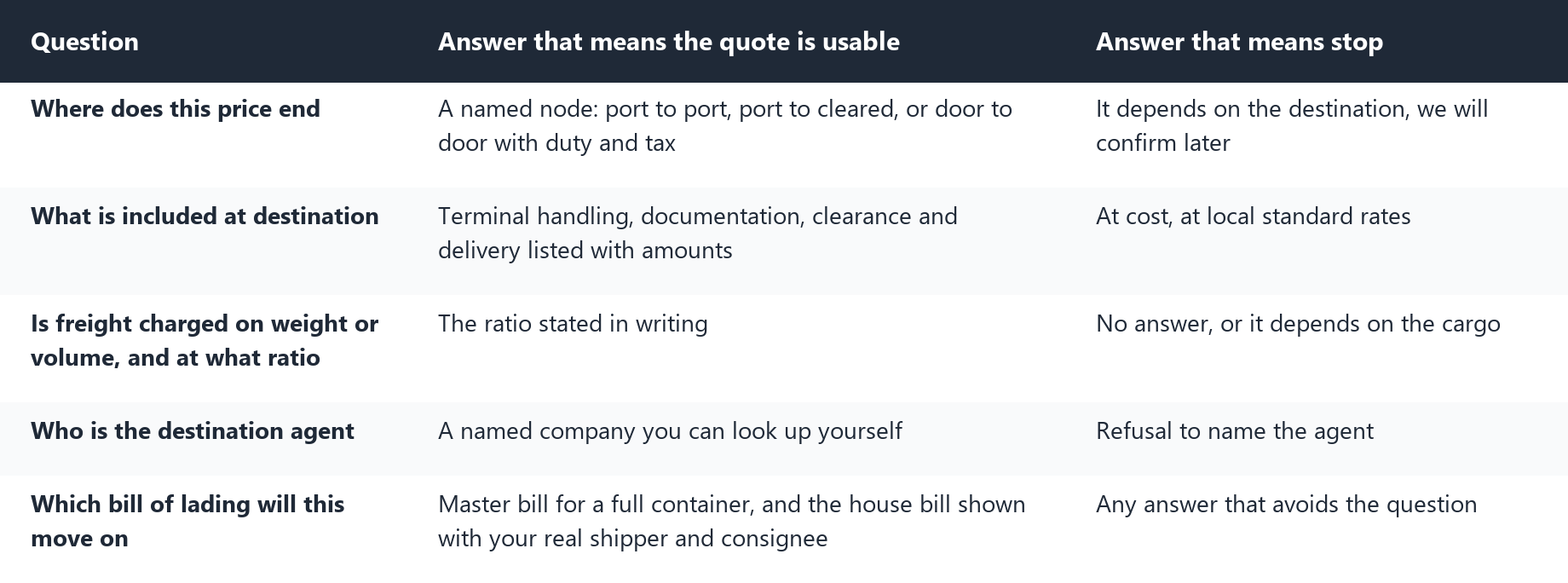
| Question | Answer that means the quote is usable | Answer that means stop |
|---|---|---|
| Where does this price end | A named node: port to port, port to cleared, or door to door with duty and tax | It depends on the destination, we will confirm later |
| What is included at destination | Terminal handling, documentation, clearance and delivery listed with amounts | At cost, at local standard rates |
| Is freight charged on weight or volume, and at what ratio | The ratio stated in writing | No answer, or it depends on the cargo |
| Who is the destination agent | A named company you can look up yourself | Refusal to name the agent |
| Which bill of lading will this move on | Master bill for a full container, and the house bill shown with your real shipper and consignee | Any answer that avoids the question |
The last row decides whether you have a claim if something goes wrong, and it gets skipped most often because it sounds technical. Ask it early.
What we do when a client asks us to check a forwarder
Our own screening has four gates, and it starts where the public records end. We start from the association roster rather than a search engine, because a list published by an industry association is a list somebody is accountable for. When we built our Shenzhen freight forwarder pool in October 2026 we pulled the Shenzhen International Freight Forwarders Association's member list: 254 entities across four tiers, from one chair company through 23 vice-chair and 18 council members to 212 ordinary members. It is the discipline in how to evaluate a supplier's logistics partners.
Ten of those 254 were not freight forwarders at all
Law firms, futures companies, banks, testing bodies and terminal operators appear on the roster because the association charter allows them, but they do not move your container. The remainder split 211 local forwarders against 33 national or foreign-owned networks, and that distinction changes what you can ask of them: a local forwarder on a small DDP consignment is usually cheaper and more flexible, a national network may open a master bill.
The licence checks then run against the entity that quoted us, not the brand. The quote has to survive the four questions in writing, with the destination agent named. And a liability position has to exist in writing.
The escalation path is the part that is hardest to write down
We learned it the hard way. On a shipment in October 2026 our forwarder told us they were emailing the carrier every day and that the carrier had never replied. The carrier's own record said it had never received anything from us. Both statements were sincere and both were wrong, because the email thread had expired and bounced. Nobody was lying, and the cargo still did not move.
So we now require two tracks whenever a shipment stalls: a phone call and a written record, not one or the other. And we ask which line we are being given. On that shipment the number we had been calling was an internal line at the carrier's customs desk, not tracking the container at all. We also changed what we tell clients: we will not say your forwarder is chasing it without evidence.
The limits of every check, and a short list
Two facts are genuinely unresolved, and it is better to say so than write around them.
What the public registers cannot tell you
The first gap is whether a given forwarder is currently in good standing with a provincial transport authority: the filing is administered at provincial level, there is no public national query returning the filing status of a named company, and the receipt number has not been published by default, so the status cannot be determined from a public source. The second gap is the FMC licence file, a snapshot rather than a live register.
The only measure that closes them
What closes them is not a database. It is a small test shipment, paid and tracked, run before the volume order, with the actual transit time written down and compared against what was quoted. That is the only measure of performance no system can substitute for, and it costs most.
Before you pay a deposit:
1. Confirm the legal entity: full Chinese name, unified social credit code, registered address and a business licence copy. Check the scope for international cargo forwarding.
2. Check registered capital against the mode you need: RMB 2 million for land, RMB 3 million for air, RMB 5 million for sea.
3. Search the Ministry of Commerce international freight forwarding filing and read the declared modes and cargo types.
4. If the shipment touches the United States, get the FMC licence or registration number and look it up. Confirm the legal name matches the entity paying you.
5. Confirm who will issue the bill of lading, and on a consolidated load require your real shipper and consignee on the house bill.
6. Get the carrier's own bill number and check it on the carrier's own site before you release a deposit.
7. Get the four answers in writing, itemised, with the destination agent named.
8. Ask the cargo insurance question separately from the liability insurance question.
9. Agree in advance the escalation path and the number you will call, and require evidence of chasing before you tell your own customer it is being chased.
Footnotes
1. Federal Maritime Commission, Ocean Transportation Intermediaries (licensing and financial responsibility): https://www.fmc.gov/licensing-and-certification/ocean-transportation-intermediaries
2. 46 CFR 515.21, Financial responsibility requirements (USD 50,000, USD 75,000, USD 150,000): https://www.ecfr.gov/current/title-46/section-515.21
3. 46 CFR 515.31, General duties (name and licence number): https://www.ecfr.gov/current/title-46/section-515.31
4. 46 CFR 515.27, Proof of compliance for NVOCCs: https://www.ecfr.gov/current/title-46/section-515.27
5. 46 CFR Part 520, NVOCC tariffs, including 520.3: https://www.ecfr.gov/current/title-46/part-520
6. Federal Maritime Commission, Non-Compliant NVOCCs, the weekly list: https://www.fmc.gov/non-compliant-nvoccs/ , and Industry Advisory, Names of Non-Compliant NVOCCs Posted to FMC Website, August 31, 2023: https://www.fmc.gov/articles/industry-advisory-names-of-non-compliant-nvoccs-posted-to-fmc-website/
7. Federal Maritime Commission, Industry Advisory, Requirements for Doing Business with NVOCCs and OFFs, July 13, 2023: https://www.fmc.gov/articles/industry-advisory-requirements-for-doing-business-with-nvoccs-and-offs-2/
9. Federal Maritime Commission, published list of licensed and registered ocean transportation intermediaries: https://www2.fmc.gov/OTI/reports/OTI_List.xlsx
10. State Council of the People's Republic of China, Decision on Cancelling and Delegating a Batch of Administrative Licensing Items, No. 6 of 2019: https://www.gov.cn/zhengce/content/2019-03/06/content_5371253.htm
11. Ministry of Commerce, International Freight Forwarding Enterprise Information Management: https://www.mofcom.gov.cn/zwdt/qtywzx/art/2023/art_9f2290c700fa4b0f8865c3aec28ef010.html
12. Beijing Municipal Investment Promotion Service Center, Frequently Asked Questions on filing and registration (scope, capital thresholds, search route): https://invest.beijing.gov.cn/sy/zt/qyrx/202605/t20260518_4655713.html
13. Nanning Government Services Network, power list for NVOCC business filing: https://nn.zwfw.gxzf.gov.cn/gxzwfw/item/qzqdDetail.do?sxbm=SX001374&webId=10
14. China International Freight Forwarders Association, 2026 credit rating notice (levels AAA, AA, A, B, C; three-year validity; no AAA without the annual Ministry of Commerce filing): http://www.cifa-china.com/creditForwarder/article-content.html?id=871110981760192512 , and the association's public credit rating disclosure: http://cifa-china.com/creditForwarder/make-public.html
14. Shenzhen International Freight Forwarders Association, published member list: http://www.siffa.org.cn/vip_zone-42-1.html