
Last quarter, a client's landed costs jumped overnight when China-US ocean freight rate fluctuations added hundreds per container. Our sourcing team in Shenzhen sees this margin squeeze constantly.
Manage cost risks from China-US ocean freight rate fluctuations by mixing fixed-rate contracts with spot bookings, monitoring indices like the SCFI, building a freight buffer into retail pricing, diversifying ports and carriers, and choosing Incoterms that match your risk tolerance.
Freight volatility is now the new normal on the Trans-Pacific trade lane. UNCTAD says so, and our invoices confirm it. Below, I answer the four questions our clients ask most often.
How can I protect my margins when ocean freight rates suddenly spike?
A US skincare client of ours watched her per-unit freight cost nearly double in six weeks during 2024. Her retail price could not move. Her margin absorbed everything.
Protect margins by building a freight buffer into your retail price before you launch, monitoring spot indices weekly, front-loading inventory ahead of peak season, requesting all-in quotes that separate surcharges, and setting internal triggers that tell you when to book early or switch routes.

The first thing I tell clients is simple. This is not a shipping problem. It is a landed-cost problem. In 2024, Asia to US West Coast rates peaked around $6,840 per 40-foot container. East Coast routes climbed above $8,100. Then rates fell. Then, in early 2026, some China-US lanes jumped by up to $600 per container again. Nobody can price products confidently on a baseline that moves like this.
Why This Is a Landed-Cost Problem, Not a Shipping Problem
Spot market volatility is only the visible part. The hidden costs sit around the base rate. Here is where the exposure lives:
| Cost Exposure | What Triggers It | How It Hits Your Margin |
|---|---|---|
| Base spot rate | Market swings between booking and sailing | Direct increase in per-unit landed cost |
| Bunker Adjustment Factor | Fuel price shocks and emergency surcharges | Invoice grows even when the base rate holds |
| Peak Season Surcharge | Holiday demand and pre-tariff front-loading | Sudden add-ons during your busiest quarter |
| Detention and demurrage | Port congestion 1 and slow inland pickup | Fees pile up daily on stuck containers |
| Expedited transport | Delays force air or trucking upgrades | Emergency spend to save a sales window |
| Carrying costs | Safety stock bought to hedge freight spikes | Cash tied up, plus obsolescence risk |
Build the Buffer Before You Need It
Here is the rule I give every client, and I follow it in my own business. All of your costs are variable, but your sales price is sticky. You cannot raise a retail price the week freight jumps. That kills conversion and damages trust. So you must reserve room in the price from day one. I ask clients to test their landed cost at three freight levels, not just the current quote. Low, expected, and spike. If the margin only survives at the low level, the pricing is wrong. And as a sourcing agent, I believe we must warn clients about coming freight movements early, so they can plan sales-price changes before the market forces their hand.
What strategies help me lock in stable shipping costs from China to the US?
Every quarter we weigh the same trade-off for clients: lock rates and lose upside when the market falls, or ride the spot market and risk a sudden General Rate Increase.
Lock in stable shipping costs by splitting volume between fixed-rate agreements and spot bookings, using index-linked contracts tied to neutral benchmarks, adding no-roll guarantees to service agreements, hedging large volumes with freight forward agreements, and timing bookings using the SCFI and Drewry WCI.

No single tool solves this. In our experience coordinating logistics for e-commerce sellers and wholesalers, the winning approach is a portfolio. You match each tool to your volume, your cash position, and the market direction.
The Main Rate-Stability Tools Compared
| Tool | How It Works | Best For | Main Weakness |
|---|---|---|---|
| Fixed-rate service contract (VSC) | Negotiated fixed-rate tiers for committed volume | Steady, predictable shipping schedules | You overpay if spot rates collapse |
| Index-linked contracts (ILCC) | Price adjusts to a neutral benchmark, not carrier-dictated GRIs | Importers who want fairness both ways | Costs still move; they just move transparently |
| Freight derivatives (FFAs) | Financial contracts lock a future rate level | Large, sophisticated volume shippers | Complexity; overkill for most SMEs |
| Spot bookings | Book at the market rate each time | Falling markets and flexible timing | Full exposure to sudden spikes |
| No-roll guarantees | SLA clauses with liquidated damages for rolled cargo | Time-critical launches and seasonal goods | Adds cost; carriers resist during tight capacity |
Reading the Market Direction
Here is the objection I hear most: "Xeneta expects global average spot rates to fall as much as 25% in 2026, with long-term rates down up to 10%. Why lock anything?" My answer is that both things are true at once. The long-run baseline may soften, but short-run volatility stays high. Early 2026 still saw jumps of up to $600 per container on some China-US lanes, and late-2025 port fees in both countries cut vessel availability and pushed costs up. So the framework is simple. When rates are falling, keep commitments short and stay flexible. When rates rise fast, lock capacity early. When reliability matters more than price, pay for the guarantee. We track the SCFI and Drewry WCI weekly for exactly this reason, and we time client bookings into favorable windows.
Should I use a sourcing agent to manage freight rate volatility for my orders?
Katle, a brand founder we work with in the US, once messaged me on WhatsApp: why did my freight quote change twice in one week? Fair question.
Yes, a sourcing agent helps manage freight volatility by negotiating with multiple forwarders, consolidating cargo to cut per-unit costs, warning you early about rate movements and blank sailings, and coordinating warehousing so you can time shipments instead of accepting whatever the spot market charges.

Katle runs suppliers in China, France, and India. She is sharp on product and quality, but she cannot watch container shipping capacity 2 announcements every day while building a brand. That gap is exactly where an agent on the ground earns their fee. Here is the process our Shenzhen team runs for every ocean shipment:
- Monitor the market weekly. We track spot indices, blank sailings announcements, fuel movements, and policy news that affects the Trans-Pacific trade lane.
- Warn the client early. This is the step I consider non-negotiable. A sourcing agent should tell clients about coming freight swings in advance, so the client can plan changes to their market sales prices instead of reacting after margins are already gone.
- Run freight forwarder negotiations in parallel. We compare at least three all-in quotes, with base rate, surcharges, and accessorials separated. A cheap headline rate with repeated rollovers costs more than an honest one.
- Consolidate and optimize loading. We combine orders from multiple factories and rework packaging where possible. A better container load factor directly lowers per-unit landed cost, whatever the market does.
- Use warehousing to control timing. Our short-term storage near Shenzhen lets clients ship when rates dip, or front-load inventory before peak season and tariff deadlines rather than paying emergency surcharges.
- Follow through to delivery. We track sailing reliability and flag delays before they force expensive expediting.
Can you do all this yourself? Some importers do. But if you are managing product development, marketing, and sales at the same time, the question is whether watching freight markets is the best use of your week.
How do I choose between FOB and CIF terms to minimize my freight risk exposure?
Early in my sourcing career, I let a client accept CIF terms 3 without questioning the freight markup baked in. That lesson cost him control over his own containers.
Choose FOB when you want control over carrier selection, routing, and freight costs through your own forwarder; choose CIF only for small trial orders where convenience outweighs transparency. FOB minimizes freight risk exposure because you see and manage every rate component yourself.
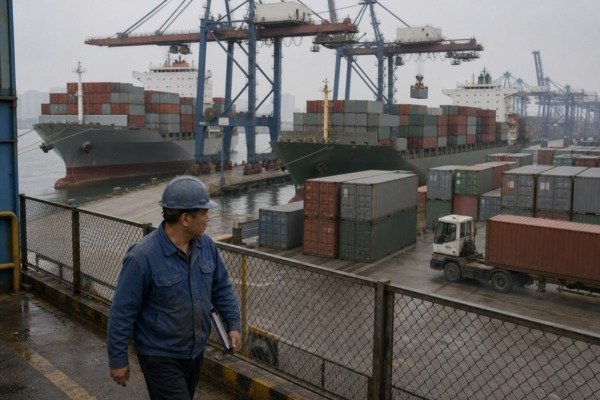
Let me put the comparison in front of you first, because this decision drives everything downstream.
| Factor | FOB (Free on Board) | CIF (Cost, Insurance, Freight) |
|---|---|---|
| Who books the freight | You or your forwarder | The supplier |
| Rate transparency | Full visibility of base rate and surcharges | Freight bundled into product price, often marked up |
| Routing control | You choose port, carrier, and schedule | Supplier chooses, usually the cheapest option for them |
| Volatility exposure | You manage it directly, with tools to hedge | Hidden; suppliers quietly raise prices when rates spike |
| Destination-side costs | You control and can negotiate them | Often inflated handling fees on arrival |
| Best for | Regular importers building a real supply chain | One-off samples and small trial shipments |
Why FOB Wins for Serious Importers
Under CIF, you never see the real freight number. When China-US ocean freight rate fluctuations push costs up, the supplier passes it through inside your product price, and you cannot verify or challenge it. Under FOB, you or your agent runs the booking. You can compare quotes, negotiate fixed-rate agreements 4, and choose your arrival gateway. That control is the whole game.
Routing Is Your Extra Cost Lever
FOB also unlocks a multi-port entry strategy. We regularly split client volume between West Coast and East Coast gateways to balance port congestion, labor risk, and inland trucking costs. In tight periods, some importers even use backdoor routing through Mexican ports like Lazaro Cardenas or Ensenada to sidestep US West Coast volatility. None of these levers exist for you under CIF, because the supplier holds the routing decision.
Conclusion
Freight volatility will not disappear. Forecast it, flex your routing, hedge your contracts, and price with a buffer. If you want help managing this from China, contact me.
Footnotes
1. Leading intergovernmental body providing analysis on global maritime transport and port performance. ↩︎
2. United Nations agency responsible for the safety and security of international shipping. ↩︎
3. Official source for Incoterms rules defining buyer and seller responsibilities in international shipping. ↩︎
4. Official US government resource for international trade and logistics management. ↩︎