
A China sourcing agent can make or break your packaging. I have watched brilliant products fail because their boxes arrived crushed, off-color, or non-compliant. Our Shenzhen team fixes exactly that.
Yes, a China sourcing agent can handle both packaging design and procurement. Agents adapt artwork, prepare dielines, source boxes, labels, and inserts from vetted factories, run quality control inspections, verify compliance, and coordinate delivery timing—turning packaging into a managed, end-to-end service.
Let me walk you through how this works in practice. I will cover design support, supplier access, quality control, and the real time and cost savings you can expect.
How can a sourcing agent help me customize packaging that matches my brand identity?
A buyer once sent our team a mood board instead of a spec sheet. That project taught me something important: packaging design is where brand vision meets factory reality, and someone must translate between them.
A sourcing agent customizes packaging by converting your brand assets into production-ready files, creating dielines, managing Pantone color accuracy with factory prepress teams, arranging structural samples, and supervising print runs—so the final box matches your brand identity, not the factory's interpretation of it.
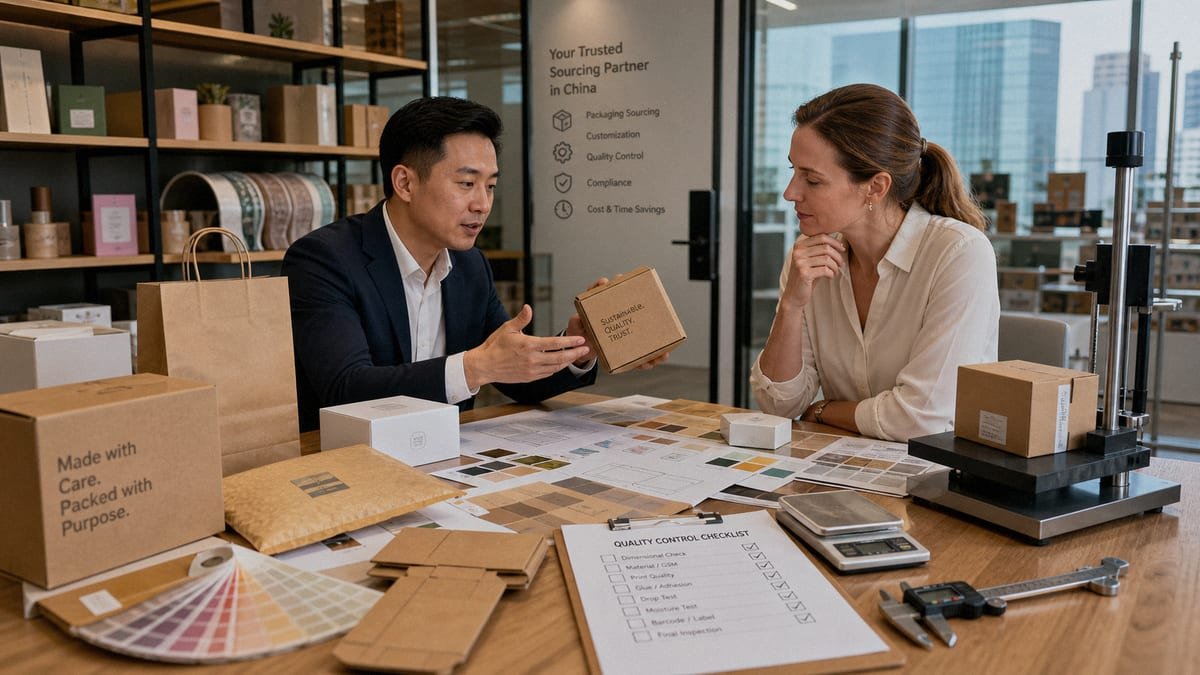
Here is how we think about it at GoSource. Packaging has two layers: the visual layer and the structural layer. We treat them very differently, and I believe every good agent should.
For the visual layer, we respect your judgment. You know your target market's cultural context better than any team sitting in Shenzhen. A color that signals luxury in Paris may signal something else in Mumbai. So when clients from the US, France, or Australia send us artwork, we do not redesign it. We defend it. Our job is to make sure the factory reproduces your vision with fidelity—correct Pantone values, correct fonts, correct finish.
For the structural layer, we take the lead. Box type, material weight, insert design, and closure style follow universal logic: consumer behavior, transit safety, and freight cost. That is where our advice carries real weight.
From Brand Asset to Factory File
The translation process usually follows these steps:
- Brief review. We collect your logo files, brand guidelines, and reference packaging.
- Dieline creation. The factory or our design partner builds the technical drawing that defines folds, cuts, and glue tabs.
- Prepress check. We verify bleed, resolution, and CMYK or Pantone setup before anything prints.
- Sampling. You receive a physical prototype, often alongside prototype development for the product itself.
- Sign-off and production. We lock the approved sample as the golden reference for quality control.
What Customization Options Are Realistic?
| Customization | Typical MOQ Range | Best For |
|---|---|---|
| Logo printing on stock boxes | Very low | Startups testing a market |
| Full custom color box | Low to medium | E-commerce and retail-ready packaging |
| Rigid gift box with inserts | Medium | Beauty products, premium electronics |
| Molded pulp or eco structures | Medium to high | Sustainability-focused brands |
| Active packaging (humidity control) | Varies by supplier | Sensitive goods, cosmetics |
One of our e-commerce clients in the US launched a lifestyle brand with private label manufacturing 1 across three product categories. The packaging carried the brand, not the product alone. That is the mindset shift I encourage: you are not sourcing a box. You are sourcing a brand experience.
What packaging materials and suppliers can my sourcing agent access in China?
Last year I spent two days driving between packaging clusters near Dongguan for a single outdoor gear client. The variety surprised even me—and I do this for a living.
A sourcing agent can access China's specialized packaging clusters, covering corrugated and rigid boxes, folding cartons, molded pulp, kraft mailers, tins, glass, labels, and inserts. Agents match each component to niche factories, including eco-friendly and low-MOQ suppliers rarely visible on public B2B platforms.

China's packaging industry is not one industry. It is dozens of regional clusters, each with its own specialty. The best rigid box makers rarely sit next to the best label printers. Public B2B platforms 2 show you trading companies stacked on top of these clusters, but the specialized factories underneath often never list online. That gap is exactly where a sourcing agent earns their fee.
The Main Material Categories We Source
| Material Type | Common Uses | Notes from Our Experience |
|---|---|---|
| Corrugated cardboard | Shipping cartons, e-commerce mailers | Grade matters; cheap fluting fails drop tests |
| Folding cartons (color boxes) | Consumer electronics, beauty | Best value for retail-ready packaging |
| Rigid boxes | Premium gifts, smart home devices | Higher cost, strong unboxing impact |
| Molded pulp | Inserts, eco brands | Growing fast with sustainable material sourcing demand |
| Kraft paper | Mailers, sleeves, wraps | Low cost, strong "natural" signal |
| Specialty (tins, glass, fabric) | Cosmetics, candles, luxury | Requires niche suppliers and longer lead times |
Component Decoupling: A Strategy Worth Knowing
Here is a tactic we use often. Instead of asking one factory to produce the box, the insert, and the sleeve, we split the order across specialists. The rigid box factory does what it does best. The EVA or pulp insert comes from an insert specialist. The printed sleeve comes from a high-end printer. We then manage the triangular logistics of bringing everything to the product factory for final assembly and kitting.
This decoupling raises quality on every component while lowering the total procurement cost. But it only works if someone on the ground coordinates timing, runs factory audit services 3 on each supplier, and takes responsibility when one piece slips. That coordination is the invisible half of packaging procurement—and it is where independent buyers most often get burned.
Can my sourcing agent manage packaging quality control and compliance testing?
A crushed corner taught one of our clients an expensive lesson before they found us. Their previous shipment of smart home devices arrived in the US with fifteen percent of retail boxes dented—products fine, brand image ruined.
Yes. A sourcing agent runs quality control inspections on packaging, including print accuracy checks, ink adhesion tests, material weight verification, and transit-simulated drop tests. Agents also verify compliance with destination-market rules and China's GB/T 23350-2021 excessive-packaging standard to avoid customs issues.

Packaging QC is often an afterthought. Buyers inspect the product carefully, then let the box slide. In my experience, that is backwards for e-commerce brands. The box is the first physical touchpoint your customer has. It also has one functional job—protect the product through last-mile logistics—and it fails at that job more often than people expect.
What a Packaging Inspection Actually Covers
Our inspection checklist for packaging typically includes:
- Print quality. Color match against the approved sample, registration, and sharpness.
- Ink adhesion. A simple tape test reveals whether printing will rub off in transit.
- Structural integrity. Fold accuracy, glue strength, and insert fit.
- Material verification. Confirming the factory used the quoted paper weight, not a cheaper substitute.
- Transit simulation. Drop tests and compression checks that mimic real courier handling.
- Barcode and label scanning. Unreadable barcodes stop products at fulfillment centers.
The Compliance Layer
Compliance is where remote buyers face the most risk, because the rules span two jurisdictions. On the China side, the GB/T 23350-2021 4 standard restricts excessive packaging 5; violations can trigger customs seizures or fines. On the destination side, requirements vary by product category and market.
| Compliance Area | Applies To | Agent's Role |
|---|---|---|
| GB/T 23350-2021 | Exports from China | Check void ratio and layer count before shipment |
| FDA food-contact rules | Beauty, supplements, food packaging | Confirm material certifications from suppliers |
| CE / RoHS marking | Electronics packaging and labeling | Verify required marks appear correctly |
| REACH | EU-bound goods | Screen inks, coatings, and adhesives |
| Retail labeling rules | Country-specific | Review origin marks, warnings, and language |
We coordinate this alongside product QC, so one inspection trip covers both. That integration matters. Catching a compliance gap at the factory costs a reprint. Catching it at a US port costs the whole shipment.
How does working with a sourcing agent on packaging procurement save me time and cost?
The trade-off I weigh most often for clients is not price versus quality. It is box volume versus freight cost. A few millimeters of unnecessary packaging, multiplied across ten thousand units, quietly eats an entire margin.
A sourcing agent saves time and cost by negotiating lower prices and minimum order quantity terms, optimizing box dimensions to cut volumetric freight charges, decoupling components across specialist factories, and synchronizing packaging delivery with production—compressing a typical project into four to eight weeks.

Let me break the savings into categories, because they come from different places and stack on top of each other.
Direct Cost Savings
Local negotiation is the obvious one. Agents know regional pricing benchmarks and can push back on padded quotes. Less obvious is MOQ flexibility. Custom packaging factories often quote high minimum order quantity thresholds to overseas buyers by default. With local relationships, we regularly secure lower MOQs for startups—which means less cash locked in inventory and less waste if a design changes.
Freight and Structural Savings
This is my favorite category because clients rarely see it coming. International shipping charges by volumetric weight 6. Smart structural choices—thinner but stronger board grades, tighter inserts, flat-pack designs—shrink the cube of every carton. Our advice here follows universal logistics logic, not aesthetics: safety in transit first, then cubic efficiency. Reducing a master carton's volume by ten percent flows directly into your landed cost on every future shipment.
Time Savings
Consider what you would manage alone from another continent:
- Finding and vetting packaging suppliers separate from your product factory.
- Sampling rounds with slow, translated feedback loops.
- Coordinating packaging delivery to arrive exactly when production finishes.
- Booking inspections and resolving defects.
- Logistics and shipping coordination across multiple origins.
Each step carries delay risk. Our clients—founders like the ones managing supply chains 7 across China, France, and India—tell us the biggest relief is timeline control. Packaging that arrives two weeks after the product finishes means two weeks of warehouse fees and a missed launch window. An agent who runs supply chain management as one integrated project prevents that misalignment entirely. In our projects, the full cycle from brief to production start typically lands within four to eight weeks, with packaging and product tracks running in parallel rather than in sequence.
Conclusion
Packaging done remotely is risky: design drifts, quality slips, timelines collide. A capable China sourcing agent removes those risks—handling design fidelity, supplier access, compliance, QC, and freight-smart procurement as one integrated service.
Footnotes
1. WTO oversees international trade rules relevant to private-label manufacturing and export compliance. ↩︎
2. Major B2B sourcing platform referenced as context for how buyers typically search suppliers. ↩︎
3. ISO sets global standards for supplier and factory auditing practices referenced here. ↩︎
4. Authoritative standards reference clarifies the Chinese excessive-packaging regulation cited in the article. ↩︎
5. Background on packaging waste regulations that underpin China's excessive-packaging standard. ↩︎
6. Explains how carriers calculate volumetric weight, directly affecting freight costs discussed here. ↩︎
7. Background concept on coordinating multi-country supply chains as described in the text. ↩︎