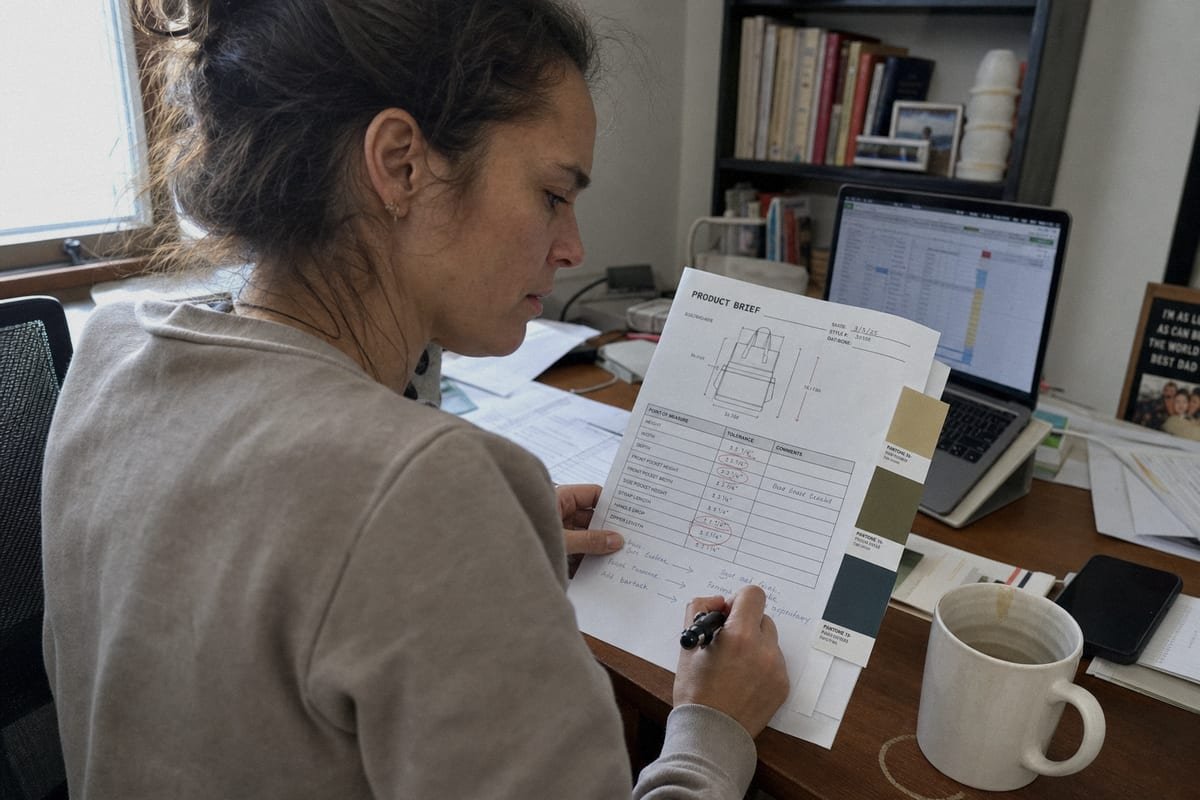
Our Shenzhen sourcing team sees the same problem weekly: buyers know exactly what they want, yet how to communicate requirements to a China purchasing agent still trips them up.
To communicate requirements to a China purchasing agent, prepare a written product brief with exact specifications, Pantone colors, tolerances, target price, MOQ, and deadline. Use visual documents like tech packs and CAD files, then confirm every detail in structured written form.
Vague messages create vague quotes. Vague quotes create wrong samples. Wrong samples burn weeks. Let me walk you through the system we use with our own clients every day.
What Information Should I Prepare Before Contacting a China Purchasing Agent?
A founder once messaged our team: "I need a good backpack, best quality, lowest price." That single sentence cost her three weeks of back-and-forth before we could even send a Request for Quotation to factories.
Before contacting a China purchasing agent, prepare a product brief covering the exact product name, dimensions with tolerances, material grades, Pantone color codes, required certifications, destination market, target unit price with Incoterms, ideal MOQ, and your hard deadline.

Preparation is where most sourcing projects are won or lost. In our experience serving startup founders and e-commerce sellers across the US, UK, and Australia, the buyers who arrive with a structured brief get accurate quotes in days. The buyers who arrive with a rough idea get guesses.
The Core Product Brief
Your brief does not need to be long. It needs to be specific. Instead of "bag," write "30L travel backpack, 900D nylon, YKK zippers." Instead of "steel," write "304 stainless steel 1." Every generality you leave open, a factory will fill with its cheapest assumption.
Here is the checklist we ask every new client to complete:
| Item | What to Provide | Why It Matters |
|---|---|---|
| Product name & category | Exact description, not a generic word | Prevents wrong factory matching |
| Dimensions & weight | Numbers with tolerances (e.g., ±2mm) | Sets measurable quality control standards |
| Materials & finish | Specific grades and treatments | Blocks silent material downgrades |
| Color | Pantone codes, never color names | "Red" means ten different reds |
| Certifications | CE, FCC, FDA, REACH as required | Determines which factories qualify |
| Destination market | US, EU, AU, etc. | Drives labeling and compliance |
| References | Photos, links, or a physical sample | Anchors expectations visually |
The Three Numbers Rule
Before your first call, lock down three numbers: your target unit price (stated with Incoterms 2 — EXW, FOB, or CIF), your maximum acceptable MOQ, and your hard deadline including production lead time. When clients give us these three numbers upfront, we can immediately tell them whether their project is realistic — and negotiate seriously on their behalf. Also decide what is non-negotiable (safety certification, core materials) versus flexible (packaging color, minor cosmetics). That distinction gives your agent real room to trade.
How Can I Clearly Explain My Product Specifications and Quality Standards?
The trickiest trade-off we weigh on every project is speed versus precision. A quick verbal description feels efficient, but our production follow-up team has learned that precision upfront always finishes faster.
Explain product specifications by quantifying everything: exact measurements with tolerances, named material grades, Pantone color codes, and finish requirements. Define quality standards through a written AQL level, an approved golden sample, and a documented list of critical defects.

Specifications answer "what is the product." Quality standards answer "what counts as acceptable." Buyers often nail the first and forget the second. Then a shipment arrives with scratches, uneven stitching, or dull colors — and there is no agreed benchmark to point to.
Turn Adjectives Into Numbers
Words like "durable," "premium," and "smooth" mean nothing on a factory floor. Convert every adjective into a measurable value. "Durable zipper" becomes "zipper cycle test 3, 5,000 open-close cycles minimum." "Premium finish" becomes "anodized aluminum, matte, no visible tooling marks under normal light at 30cm." When we sourced smart home devices for a US client, the difference between "quiet motor" and "≤35dB at one meter" was the difference between a return-rate disaster and a five-star product.
Build Your Quality Framework
We recommend defining quality on three levels:
- The specification sheet or Bill of Materials (BOM) — lists every component, its material, grade, and supplier where relevant.
- The AQL standard — an industry-recognized sampling level (commonly AQL 2.5 4 for major defects) that your pre-shipment inspection will follow.
- The golden sample — one physically approved, signed sample that becomes the legal reference for mass production. Nothing settles a dispute faster than a golden sample.
Classify Your Defects
| Defect Class | Example | Typical Action |
|---|---|---|
| Critical | Safety hazard, missing certification mark | Zero tolerance, reject lot |
| Major | Wrong color, broken function, wrong size | Reject above AQL limit |
| Minor | Tiny cosmetic blemish in hidden area | Accept within agreed limit |
Give this table to your agent before production starts. It transforms quality from an argument into a checklist.
What Tools or Documents Help Me Communicate Design Details Accurately?
One of our beauty-product clients once described a compact case over a video call for twenty minutes. Then she sent one annotated photo. The photo achieved in seconds what the call never did.
The most effective tools are a tech pack with dimensioned drawings, CAD or 3D files for custom parts, annotated reference photos, a Bill of Materials, Pantone swatches, and physical samples. Visual, data-rich documents outperform verbal descriptions across any language barrier.

Language barriers shrink dramatically when you stop describing and start showing. Chinese factories are extremely good at reading drawings. They are far less reliable at interpreting paragraphs of English prose — especially prose that passes through machine translation.
The Document Toolkit, Ranked
| Document | Best For | Precision Level |
|---|---|---|
| Tech pack | Apparel, bags, soft goods | Very high |
| CAD / 3D files | Custom hardware, electronics housings | Highest |
| Dimensioned drawings | Any product with critical measurements | High |
| Annotated photos | Modifications to existing products | Medium-high |
| Reference links (Amazon/Alibaba) | Communicating general concept | Medium |
| Physical sample | Texture, feel, weight, finish | Very high |
Why a Tech Pack Changes Everything
A tech pack bundles your drawings, measurements, materials, colors, stitching or assembly details, labeling, and packaging into one document. When our product development team prepares tech packs for outdoor gear clients, factory quoting errors drop almost to zero. The factory stops guessing because there is nothing left to guess.
Practical Tips That Prevent Rework
Over-specify rather than under-specify. It feels excessive, but ambiguity is always more expensive than detail. Use universal symbols and numbered callouts on drawings. Send interactive 3D prototypes 6 through cloud platforms when internal geometry matters — the factory engineer can rotate and inspect assembly points virtually. Finally, mail a physical sample whenever texture or hand-feel matters. No photograph communicates the softness of a silicone finish. Attach the Bill of Materials to every version of the tech pack so component changes never hide in email threads.
How Do I Avoid Miscommunication When Working With a China Purchasing Agent?
Here is a personal rule I follow with every new client: our first call is always a video call. We introduce ourselves, discuss the business, and build trust face to face. But I never let business details live only in that call.
Avoid miscommunication by separating trust-building from detail confirmation: use calls and chat for rapport and urgent issues, but confirm every specification, price, and deadline in structured written form. Require your agent to summarize key points back to you before proceeding.

Some buyers prefer a casual, chatty style because it feels more trusting. I understand that. But trust and communication efficiency are two separate things — and they should be handled separately. Video calls suffer from accents, weak signals, and dropped context. A number misheard on a call becomes a container of wrong product. Anything commercial must land on paper. In business, nothing should ever be "just mentioned in passing."
The Hybrid Channel Strategy
Use two channels with two distinct jobs:
- WeChat or WhatsApp — urgent questions, quick photos from the factory floor, real-time clarification during sampling.
- Email or shared documents — formal confirmations, updated tech packs, quotations, RFQ responses, and milestone approvals.
Set response-time expectations for each channel, and designate one point of contact on each side. Complex instructions buried in long email chains cause delays; break them into short, numbered points instead.
The Confirmation Loop
Never assume agreement. Silence is not confirmation, and "OK" is not understanding. After sending requirements, ask your agent to restate the key specifications in their own words. When our team receives a new tech pack, we summarize it back to the client point by point before contacting any factory. This single habit — the confirmation loop — catches more errors than any inspection. For high-stakes technical requirements, run a back-translation check: translate the Mandarin version back into English and compare meanings.
Run a Pilot Before You Scale
Treat your first order as a 30–60 day pilot with fixed review points: quotation, sampling, factory audit 7, production readiness, and pre-shipment inspection. Document success criteria — AQL results, production lead time accuracy, landed cost. If the communication loop works at pilot scale, it will work at volume. If it does not, you learned cheaply.
Conclusion
Vague requirements create expensive surprises. Structured briefs, visual tech packs, golden samples, and written confirmation loops turn your China purchasing agent into a precise extension of your team.
Footnotes
1. Background on material grading referenced as a precise specification example. ↩︎
2. Official ICC reference explaining EXW, FOB, and CIF trade terms used in pricing. ↩︎
3. ASTM sets standardized durability testing methods referenced for quantifying product performance. ↩︎
4. Explains the acceptable quality limit sampling standard used in inspections. ↩︎
5. U.S. government trade resource covering import inspection and compliance practices. ↩︎
6. Background on rapid prototyping technology used to review product geometry. ↩︎
7. ISO oversees international auditing standards relevant to factory quality audits. ↩︎