Last updated:
What the official 2027 calendar says, and what it leaves out
The nine-day break and the two make-up working days
The State Council General Office published the 2027 holiday arrangement on 5 November 2026, under document number 国办发明电〔2026〕10号. The Spring Festival break runs from 5 February, which is Lunar New Year's Eve, to 13 February, the eighth day of the first lunar month, nine days in total. Two Sundays are designated working days: 31 January and 14 February.
The 2026 notice put the break from 15 February to 23 February, also nine days, so the holiday starts ten days earlier than last year. Measured from the first day of the lunar new year rather than the break itself, the shift is eleven days: the new year moves from 17 February in 2026 to 6 February in 2027. Both numbers are correct, they measure different things, and the eleven-day figure is the one most trade coverage quotes.
One structural detail matters. New Year's Eve became a statutory holiday in 2025, when the State Council amended the National Holidays and Commemorative Days Regulations to raise the Spring Festival statutory allowance from three days to four. Before that amendment, the legal spring holiday began on the new year itself.
Most planning pages you will find today are describing an earlier, unofficial version
Most of the English-language planning guides published for 2027 were written before November 5, and they describe a holiday that had not yet been fixed. Their typical phrasing is a range of 5 to 11 February, or 5 to 12 February, frequently marked as approximate or expected, and one guide states plainly that the notice had not been published at the time of writing. Those pages are now out of date on the one fact a reader would check first.
What the notice does not say
The full text of the notice does something quite narrow. It lists the holiday and make-up dates for all seven statutory holidays in 2027, then asks local governments to keep duty and safety arrangements in place. There is not a single line about factory shutdowns, production restart dates, order cut-offs, vessel bookings or freight handling. That is not a drafting oversight. The notice is a civil service document about when offices and schools close, and no version of it will become an industrial calendar.
The official holiday is not your factory's holiday
Factories set their own dates, and they differ by region
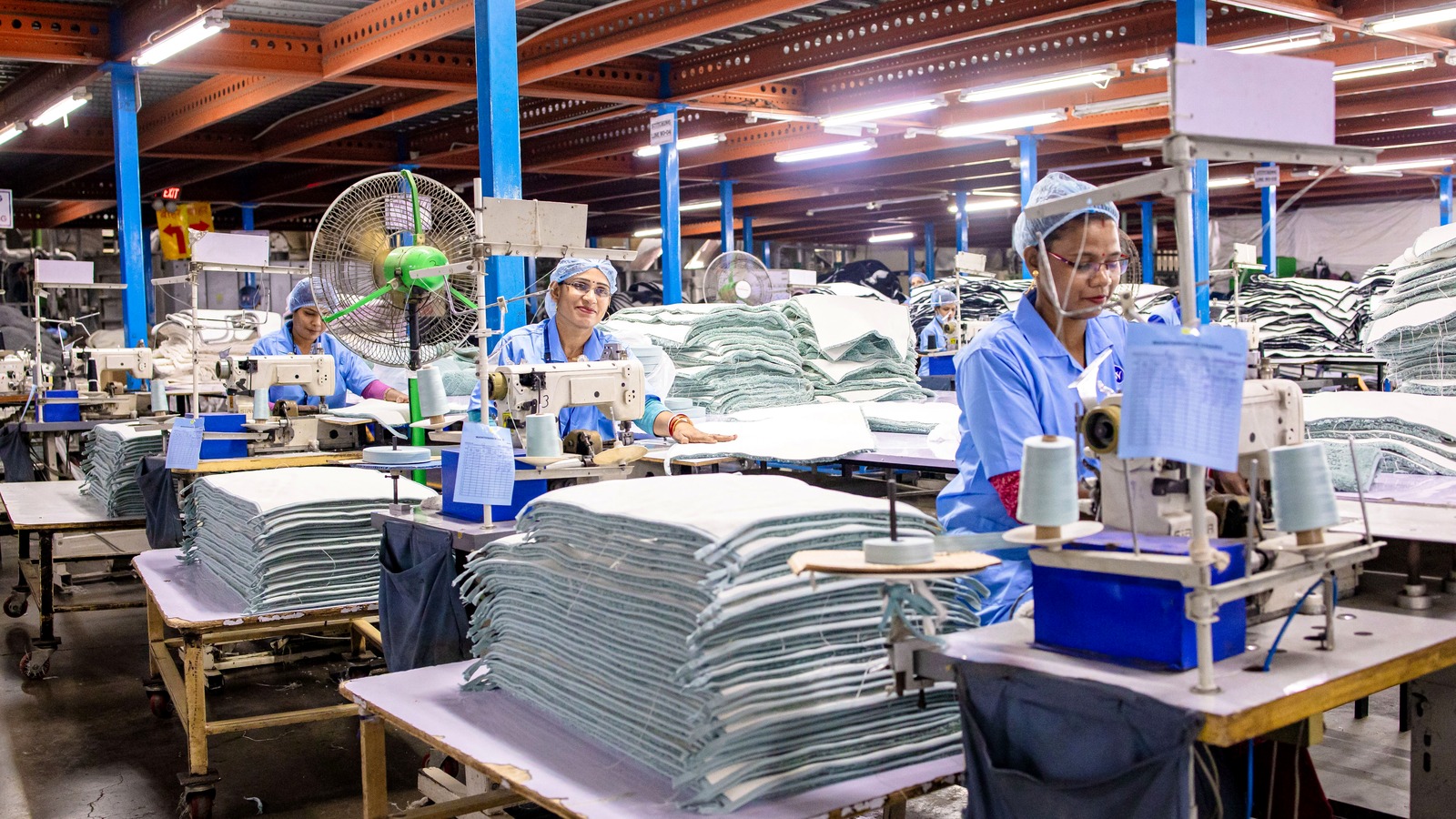
Shutdown in China is commercial, not administrative. Your supplier decides when the machines stop, and that decision is made for each factory according to its own order book, its local labour situation and how far its workers need to travel.
A freight forwarder working across China described the pattern for 2027 in October 2026. Factories in northern China that they work with were planning a shutdown from 25 January to 15 February. In southern China the downtime runs longer, with some operators closing three weeks ahead of the festivities and not returning to full production for a fortnight afterwards. The same source noted that relatively few factories had formally announced their 2027 holiday schedules, and that in some regions manufacturers begin winding down a week ahead and do not fully resume until after the Lantern Festival on 20 February.
Treat those as one forwarder's commercial observation, not an industry standard. They show the order of magnitude and the regional spread, not dates to put in a purchase order.
The published picture is still thin
No official factory shutdown calendar for 2027 has been published, and the one thing most planning guides leave out is that the official holiday is the wrong anchor entirely. We could not find a national or regional register of production suspension dates for the 2027 Spring Festival. We also could not find any published freight rate or capacity forecast for the January 2027 sailing window, and the carrier sailing schedules that will determine your actual cutoff dates have not been published yet for the later January sailings. This is where most planning guides stop being useful. They give you a date for the holiday and a rule of thumb for ordering, and they leave you with the impression that the remaining risk is a matter of arithmetic. The remaining risk is not arithmetic. Nobody, including the factory, has committed to a date yet.
Three dates you need from each supplier in writing
For every factory on your order, ask for three dates and get them in writing before you pay a deposit:
- the last day they will accept new purchase orders for this production cycle
- the last day they will complete production, sometimes called the ex-factory or ready date
- the first day they will be back at normal output, and the date they expect to reach full capacity
Add a fourth, about the shipment rather than the factory: the last date your goods can be handed over for the sailing you intend to use. Forwarder-specific cutoffs are not disclosed in advance and are frequently renegotiated inside the pre-holiday crunch, so treat a booking confirmation as a commitment you need in hand, not a date someone read off a screen.
Work backwards from the sailing date, not forward from the holiday
Pick the sailing first, and everything else follows
The most common planning error is starting from the holiday and counting backwards by a lead time, which assumes your goods are ready when the calendar says they should be rather than when the factory says they will be.
The correct anchor is a sailing date, then a vessel cut-off, then the ex-factory date, then the production completion date, then the date you must place the order for that to happen. Work back along that chain and you find the point where the schedule is actually tight, which is rarely the one you expected. If you are planning a full year of purchasing rather than a single order, read how to plan procurement cycles around the Chinese New Year shutdown.
The backwards calendar for a sea shipment
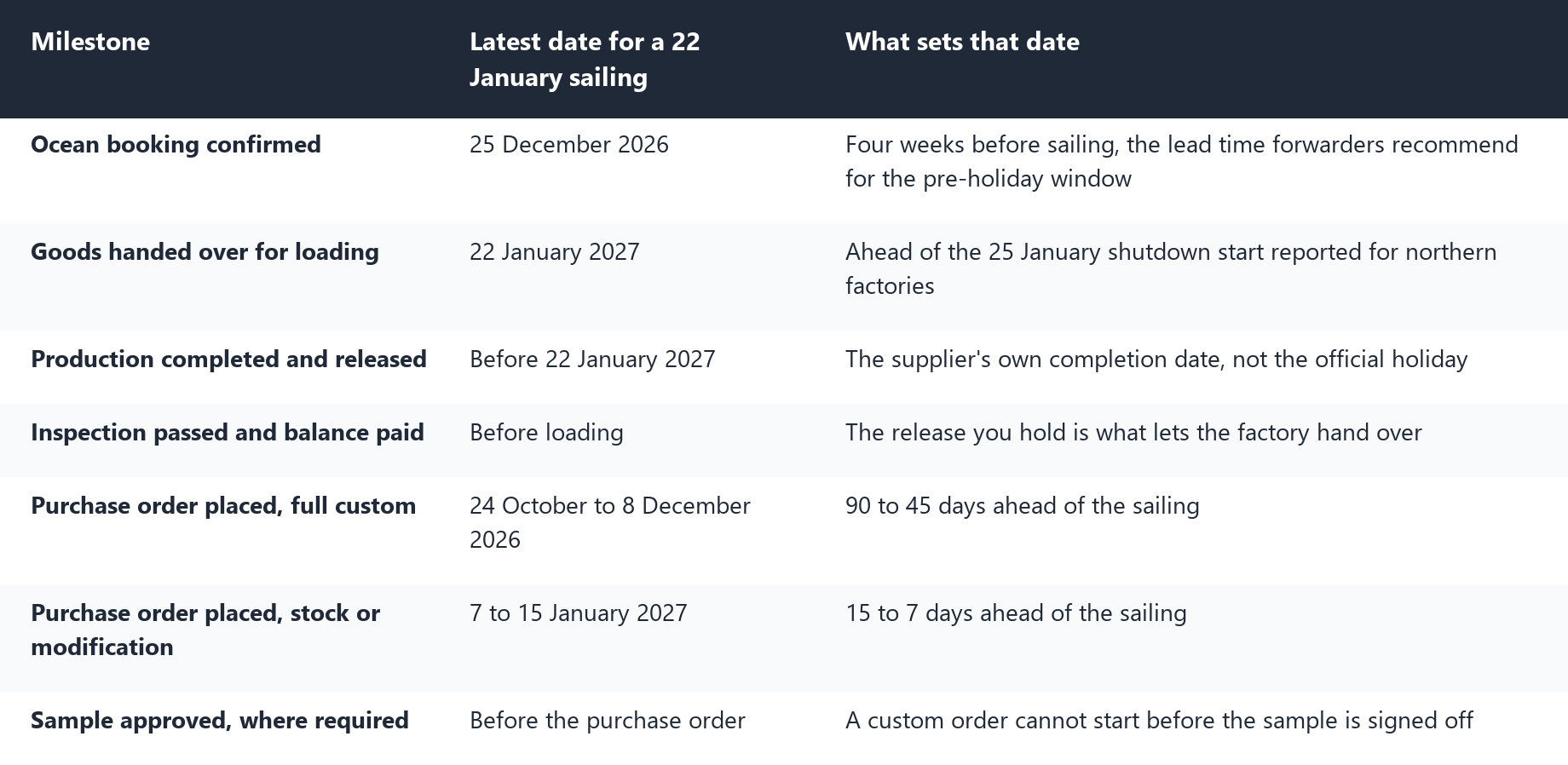
The table below is built from two things only: the official 2027 holiday dates, and order-to-ready ranges measured on our own China sourcing projects. It assumes the last container leaves on 22 January 2027, ahead of the northern factory shutdown window above. Move the set earlier if your supplier's dates require it.
| Milestone | Latest date for a 22 January sailing | What sets that date |
|---|---|---|
| Ocean booking confirmed | 25 December 2026 | Four weeks before sailing, the lead time freight forwarders recommend for the pre-holiday window |
| Goods handed over for loading | 22 January 2027 | Ahead of the 25 January shutdown start reported for northern factories |
| Production completed and released | Before 22 January 2027 | Your supplier's own completion date, not the official holiday |
| Inspection passed and balance paid | Before loading | The release you hold is what lets the factory hand over |
| Purchase order placed | 24 October to 8 December 2026 | 90 to 45 days ahead, for a full custom order |
| Purchase order placed, stock or modification | 7 to 15 January 2027 | 15 to 7 days ahead, for a short-cycle order |
| Sample approved, where required | Before the purchase order | A custom order cannot start before the sample is signed off |
The two order-placement rows are the difference between a problem and a non-event. A short-cycle order placed in mid-January still has a workable path. A full custom order placed in mid-January has none, no matter how hard anyone pushes.
Where the buffer usually disappears
The buffer gets consumed in two places. The first is inspection: the closer you are to the sailing, the harder it is to get a full inspection window, and a rushed inspection is worth less than a calm one. The second is the handover: origin collection, trucking and port delivery compress as pre-holiday volumes build, so the same operation that takes two days in November can take four in the last week of January. If your order also depends on rate planning, this is when ocean freight rate fluctuations bite hardest, because the same sailings carry every exporter's rush.
Which order you are placing decides whether the date matters at all
Stock and a small modification
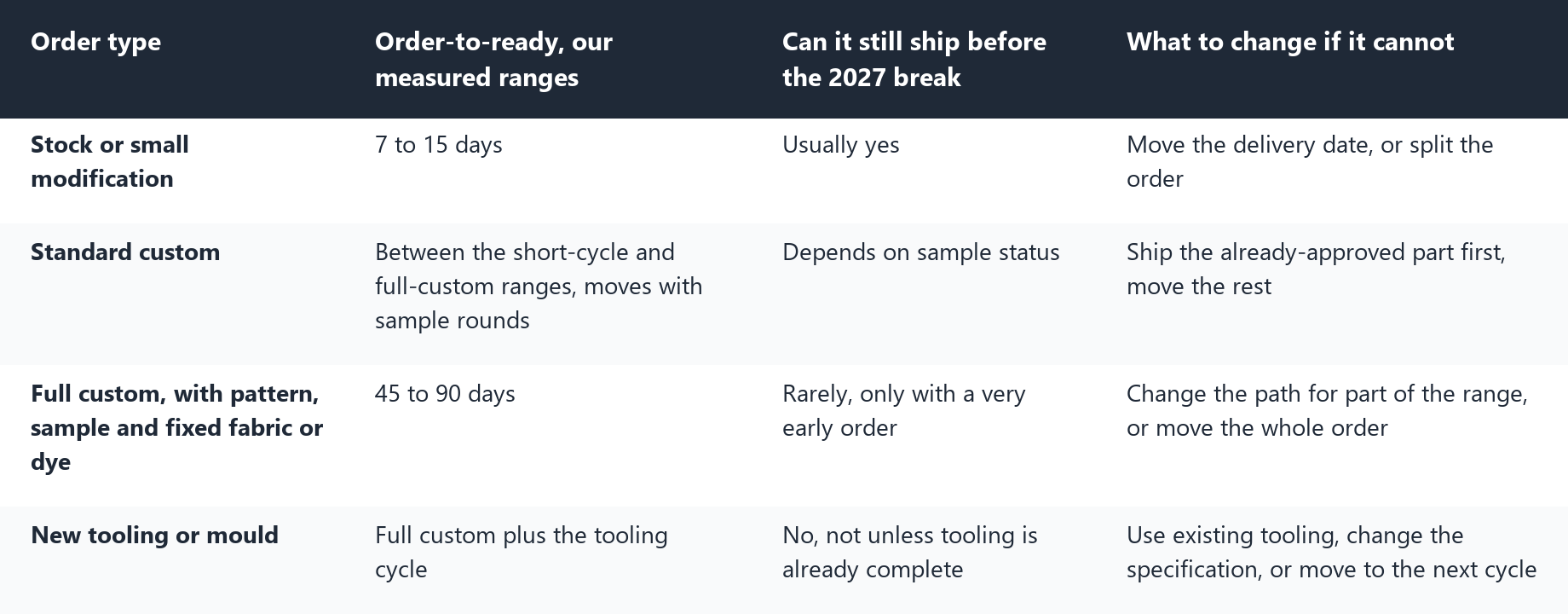
This is the easy case and the one most people are in. If the goods are existing stock with a colour, size or labelling change, the order-to-ready range we measure on our own projects runs from seven to fifteen days. That fits inside the window comfortably, provided you have booked space and are not changing the specification mid-cycle.
Standard custom
This sits in the middle and it is where most planning guides get vague, because the honest answer is that standard custom does not have a fixed number of days. It falls between the short-cycle and full-custom ranges, and it moves with the number of sample rounds and the factory's own queue. We do not treat it as a fixed band for that reason. The practical question is whether the sample is already approved. If it is, you are close to a stock-plus-modification timeline. If it is not, the sample round sits in front of production and you add its real duration, not its hoped-for duration, to your plan.
Full custom, tooling, and the order that did not fit
Full custom means the sample work, the pattern or tooling, and in some categories a fixed fabric or dye. Our own project ranges for this path run from 45 to 90 days, and the range is wide because the sample count and the tooling decide it.
We worked on an order in this category in October 2026 that made the arithmetic concrete: 75 styles at 200 pieces each, on a full custom path. It did not fit the pre-holiday window and could not be made to fit, because 75 styles at that volume is a production problem and not a scheduling one. We split it, moved part of the range to a stock or modified path where the goods existed in a form close enough to the specification, and accepted that the remainder moves to the next cycle. Tooling adds a layer on top: a mould that arrives after the production slot is allocated cannot be fixed by expediting the sewing.
| Order type | Order-to-ready, our measured ranges | Can it still ship before the 2027 break | What to change if it cannot |
|---|---|---|---|
| Stock or small modification | 7 to 15 days | Usually yes | Move the delivery date, or split the order |
| Standard custom | Between the short-cycle and full-custom ranges, and it moves with sample rounds | Depends on sample status | Ship the already-approved part first, move the rest |
| Full custom, including pattern, sample and fixed fabric or dye | 45 to 90 days | Rarely, only with a very early order | Change the path for part of the range, or move the whole order |
| New tooling or mould | Full custom plus the tooling cycle | No, not unless tooling is already complete | Use existing tooling, change the specification, or move to the next cycle |
What changes if the window is missed
The failure rarely looks like a delay
When buyers describe a missed pre-holiday window they usually describe a late shipment. In our experience the more common outcome is a shipment that leaves on time and arrives in a different state than expected. Production pushed to make a date is production that was not inspected properly, and inspection is the first thing compressed. The same pattern shows up after the break, which is why we treat quality control after Chinese New Year as a separate exercise.
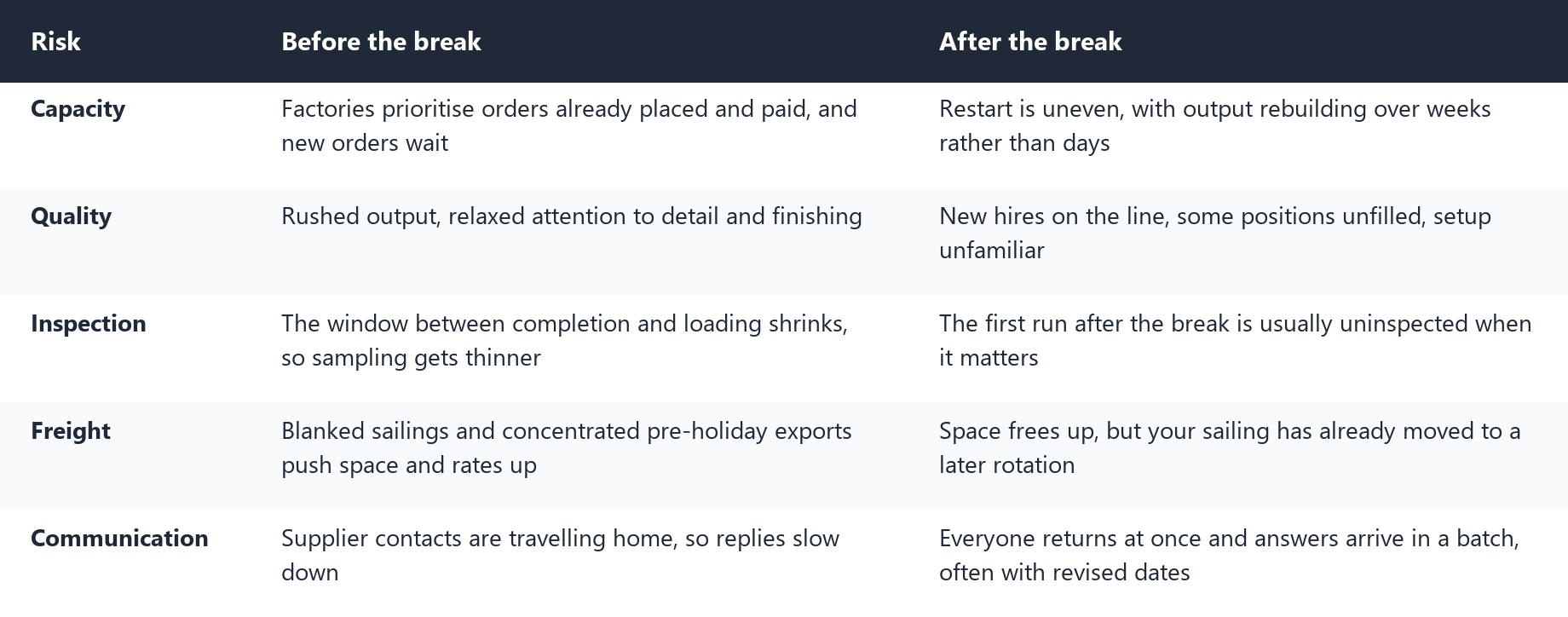
| Risk | Before the break | After the break |
|---|---|---|
| Capacity | Factories prioritise orders already placed and paid, and new orders wait | Restart is uneven, with output rebuilding over weeks rather than days |
| Quality | Rushed output, relaxed attention to detail and finishing | New hires on the line, some positions unfilled, setup unfamiliar |
| Inspection | The window between completion and loading shrinks, so sampling gets thinner | The first run after the break is usually uninspected when it matters |
| Freight | Blanked sailings and concentrated pre-holiday exports push space and rates up | Space frees up, but your sailing has already moved to a later rotation |
| Communication | Supplier contacts are travelling home, so replies slow down | Everyone returns at once and answers arrive in a batch, often with revised dates |

Splitting beats rushing
If an order will not make the window, the alternatives are to rush it, to split it, or to move it. Rushing pushes the risk into quality and inspection. Moving is safe but expensive in stock cover. Splitting is usually best, provided you decide it early, because a split order can be planned while a late decision turns into a scramble.
The commercial decision sits above the logistics one. A buyer in 2026 abandoned a membership order for an apparel programme because they could not wait for shipping from China. Whether to keep an order alive over a date is a judgement about the seller's own season, and it is worth having that conversation with your customer before you start negotiating with a factory, not after. For a broader view, see how to manage supply chain risk during Chinese New Year.
What we do when the calendar is tight, and what to ask your supplier
How we manage the holiday with customers
When the October 2026 national holiday ran, factories reopened on 8 October, and the practical effect was that quotations and schedules moved as a block rather than piecemeal. What changed in our own work was not the factory management, it was our customer communication. We now put the holiday and the return-to-office date into the client's expectations in writing before it happens, in plain factual terms: we were closed for the national holiday and we are back in the office from this week. No reassurance, no apology, just the fact.
The second thing we do is push the pre-holiday screening forward. Anything checkable before the break, we check before the break, because the same check in the first week of February reaches a factory running at half output with new staff on the line.
Where we think the real risk sits
Our own view, from running orders through the last cycle, is that the binding constraint is not the order date. It is the last-loading date, and the point where the chain is decided is usually the inspection slot. One of our freight clients has a rule of thumb that a shipment needs five to ten sets consolidated in the same shipment to be economical on the water, and that rule collides with a compressed pre-holiday window, because consolidating means waiting for the slowest supplier and then booking space at short notice.
The questions to send this week
Ask each supplier, in writing, for the three dates listed earlier, and add two more:
- the last date we can change a specification without restarting the order
- the date they expect to be back at full capacity, not the date they expect to reopen
Then ask your forwarder, in writing, for the vessel cut-off and the booking deadline for the sailing you intend to use, and for the equipment type they expect on that sailing. A usable answer has a date and a named person attached. An answer like "around late January" or "same as last year" is not an answer, and treating it as one is how a January order becomes a March problem.
First published at chinagosource.com
Footnotes
1. State Council General Office of the People's Republic of China, Notice on the Arrangement of Certain Public Holidays in 2027, 国办发明电〔2026〕10号, issued 5 November 2026: https://www.gov.cn/zhengce/content/202611/content_7085101.htm
2. State Council General Office of the People's Republic of China, Notice on the Arrangement of Certain Public Holidays in 2026, issued 4 November 2025: https://www.gov.cn/yaowen/liebiao/202511/content_7047099.htm
3. State Council of the People's Republic of China, Decision on Amending the National Holidays and Commemorative Days Regulations, State Council Order No. 795, signed 10 November 2024 and in force 1 January 2025, which made New Year's Eve a statutory Spring Festival holiday and raised the Spring Festival statutory allowance to four days: https://www.gov.cn/zhengce/content/202411/content_6986380.htm
4. China Government Network, Infographic on the Notice on the Arrangement of Certain Public Holidays in 2027, 5 November 2026: https://www.gov.cn/zhengce/jiedu/tujie/202611/content_7085136.htm
5. The Loadstar, Early lunar new year means shippers need to plan ahead, says Seko, 28 October 2026. Trade press reporting of a freight forwarder's commercial guidance, not an official source: https://theloadstar.com/early-lunar-new-year-means-shippers-need-to-plan-ahead-says-seko/