A factory audit report looks authoritative: a branded PDF with a cover page, a score, a signature, and a date. It is easy to treat it as settled proof that the factory is capable. But a report is a snapshot of one visit to one site, made by one firm, on one date. Between that date and your order, ownership can change, lines can be added, and production can move to a building the auditor never saw. The question is not whether the report is real in the abstract. It is whether it supports a decision to send this order to this company.
Three passes answer that question. They are quick, need no special access, and catch the failures that matter.

How do I confirm the audit firm that issued the report is legitimate?
Start with the issuer, not the verdict. A report is only as credible as the organization that produced it, so the first pass is to establish that the firm exists, that it is recognized, and that this document genuinely came from it.
Four independent firms issue most credible reports
The majority of credible factory audit reports for Chinese suppliers come from a small group of independent firms, including SGS, Bureau Veritas, TÜV Rheinland, and CTI.¹ These firms have published methodologies, named auditors, and a record of the reports they issue. A report from an unnamed in-house team or a self-audit carries no independent weight, however professional the PDF looks. That does not make an in-house audit useless; it means you cannot treat it as third-party verification.
Independence is the point. An auditor who reports to the seller has a different incentive from one whose reputation depends on accuracy. When a buyer tells us a supplier produced its own audit, we treat it as a brochure, not evidence.
Confirm the document with the issuer directly
GoSource does not accept a report at face value. We contact the issuing firm with the report reference number and confirm three things: that the report exists, that the named factory matches the audited site, and that no alterations have been made. A genuine audit leaves a verifiable record with the issuer. If the issuer cannot or will not confirm the document, we treat the report as unverified.
This step is open to any buyer, not only a sourcing office. The report number is printed on the cover or in the footer, and most major firms will confirm whether it is theirs. If the number does not resolve, the document is not something you can rely on.
Read the small details that are hard to fake consistently
Look at the issuer's full legal name, a report number in the firm's recognized format, named auditor signatures, and issue and expiry dates that follow the firm's normal cycle. A single inconsistency is a reason to ask questions. Several together are a reason to stop.
Forged reports are usually edited versions of real ones. The editor changes the company name, the score, or the date but leaves other details untouched. That is why the small details carry weight: they are what an editor forgets. For a broader check on the company behind the report, the same discipline applies as verifying a Chinese supplier is a real factory, not a middleman.
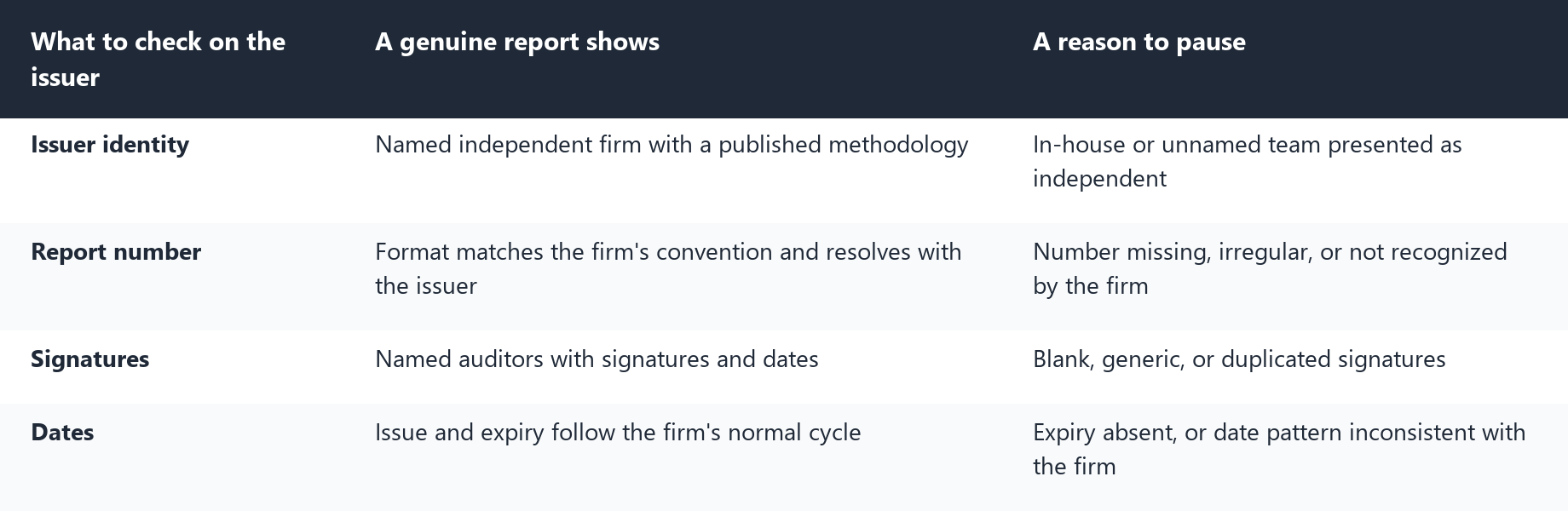
| What to check on the issuer | A genuine report shows | A reason to pause |
|---|---|---|
| Issuer identity | Named independent firm with a published methodology | In-house or unnamed audit team presented as independent |
| Report number | Format matches the firm's convention and resolves with the issuer | Number missing, irregular, or not recognized by the firm |
| Signatures | Named auditors with signatures and dates | Blank, generic, or duplicated signatures |
| Dates | Issue and expiry follow the firm's normal cycle | Expiry absent, or date pattern inconsistent with the firm |
How do I match the report to the exact supplier and factory site?
This is the most commonly missed pass, and the one that causes the most expensive surprises. An audit report describes a specific legal entity at a specific address. The company that sends the quotation may be a trading company, a sister entity, or a holding name that never appears in the report. Fail to reconcile the two and you can verify a factory with nothing to do with your order and feel satisfied about it.
Reconcile three identifiers, not one name
GoSource reads three identifiers and requires them to align: the Chinese legal name, the Unified Social Credit Code (USCC), and the audited site address. We then check the business license against the NECIPS national registry² and compare the registered address, the audited address, and the actual production site. A difference between these is not automatically fraud. It is automatically a question that must be answered in writing before the report can support a sourcing decision.
A name alone is not enough. Chinese companies often operate through related entities, and a trading company may quote for a factory whose name appears nowhere in the email chain. The USCC does not bend: it is unique to one legal entity, and it appears on the business license and on the report if properly prepared.

Ask what the auditor actually saw
Ask specifically whether the auditor saw the contract party's own production, or only capacity leased from an undisclosed subcontractor. A report that describes a facility the seller does not control does not verify your supplier. It verifies somebody else's facility.
This matters most when a product is assembled from components made in several places. An audit of the final assembly site says nothing about the subcontractor making the critical component. If your risk sits there, the report answers a different question from the one you are asking.
Put the reconciliation in writing
The output should be a short written reconciliation: the name on the contract, the name on the report, the USCC of each, and an explanation of any difference. If the seller cannot produce it, the report fails this pass regardless of score. The same discipline sits behind evaluating a sourcing agent's factory audit and production license verification, and it is why we treat the report number as a starting point, not an answer.
How do I tell whether an audit report has been recycled or edited?
Audit reports go stale, and stale reports get reused. Most are treated as current for six to twelve months. A workforce change, a new line, or a change of ownership makes an older report misleading even if genuine on the day issued. The third pass is about time and internal consistency: does the report describe the factory as it exists now, and does the document hold together?
Check the date, the scope, and the window
GoSource checks four things before accepting a report as current: the audit date and validity window, whether the scope covers the process you are buying, the timestamp and geotags on site photographs, and the document's internal consistency. A report dated fourteen months ago is not current, whatever its cover says. A report whose scope lists general assembly does not cover your injection molding risk.
Scope is the detail buyers overlook most. A factory can be excellent at the audited process and weak at the one you are buying. The report is not wrong; it is about something else. Read the scope line as carefully as the score.
Require evidence that carries a time and a place
GoSource requires geotagged photos and real-time video evidence rather than a static photo pack, because a photo with no time or location marker cannot show that the audit happened at the claimed site. A static pack can be assembled from an older visit, a different factory, or a stock library. A live video walk-through with a dated timestamp is much harder to recycle.
This is not distrust of the factory. It is about the limits of what a document can prove: a photograph without a date and location is a picture of a factory, not evidence of an audit there.
Look for the traces editing leaves
Editing leaves traces. Look for inconsistent fonts or margins, a conclusion that does not match the findings listed above it, missing or duplicated page numbers, and a cover page whose quality differs from the body. A report assembled from several sources rarely holds together across all of these at once.
None of these proves fraud on its own. Each is a prompt to ask the issuer. Together they are a reason to re-audit rather than release an order on a document you cannot trust.
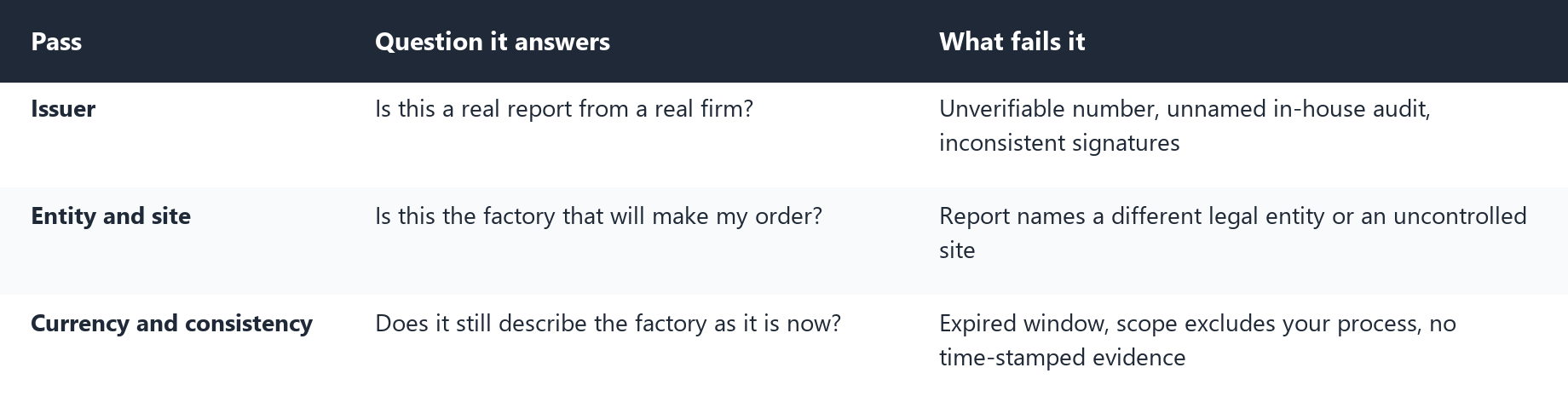
| Pass | Question it answers | What fails it |
|---|---|---|
| Issuer | Is this a real report from a real firm? | Unverifiable number, unnamed in-house audit, inconsistent signatures |
| Entity and site | Is this the factory that will make my order? | Report names a different legal entity or an uncontrolled site |
| Currency and consistency | Does it still describe the factory as it is now? | Expired window, scope excludes your process, no time-stamped evidence |
What red flags in an audit report should stop an order?
Some signals are strong enough to pause a purchase on their own. The table collects the ones that recur and the action that resolves each. A flag is not a verdict; it is a question to answer in writing before the report supports a decision.
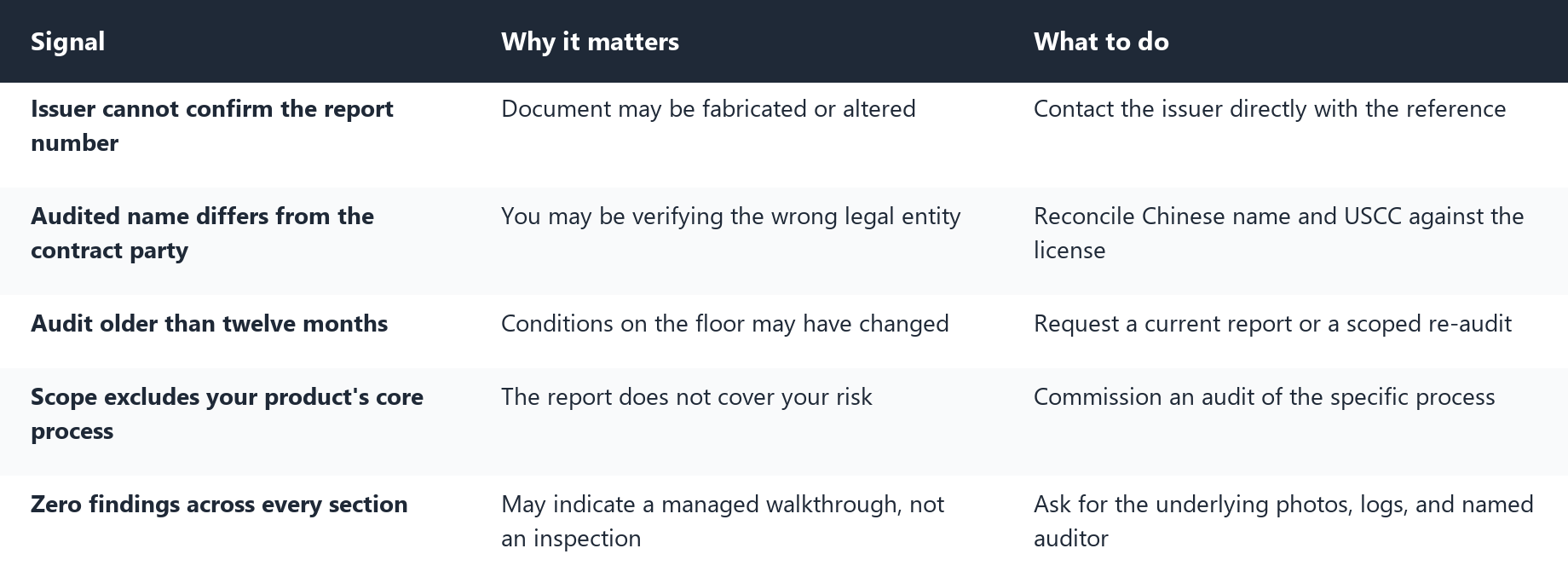
| Signal | Why it matters | What to do |
|---|---|---|
| Issuer cannot confirm the report number | Document may be fabricated or altered | Contact the issuer directly with the reference |
| Audited company name differs from the contract party | You may be verifying the wrong legal entity | Reconcile Chinese name and USCC against the license |
| Audit older than twelve months | Conditions on the floor may have changed | Request a current report or a scoped re-audit |
| Scope excludes your product's core process | The report does not cover your risk | Commission an audit of the specific process |
| Zero findings across every section | May indicate a managed walkthrough rather than an inspection | Ask for the underlying photos, logs, and named auditor |
A zero non-conformance report is not proof of a perfect factory. A clean report with no supporting photographs, no named auditor, and no measurable findings can signal a managed visit rather than an inspection. The same caution applies when a seller offers factory inspection services: ask what was covered before treating it as clearance.

What the published sources do not settle
There is a limit to what any buyer can verify from public information. We could not find an authoritative body that publishes how often clean reports result from a managed walkthrough rather than a genuine inspection, and no regulator publishes a rate of recycled or altered reports in China.¹ That absence matters: you cannot price the risk from a statistic, so the only defensible method is to test each document on its own evidence.
Equally, no public database consolidates the report numbers of all major firms into one searchable register. Verification must be done with each issuer separately, which is why the first pass is a direct contact step rather than a website lookup. Where a firm will not confirm a number, that is the answer.
How does GoSource verify an audit report before a client relies on it?
This is where a buying office earns its place. The passes above are available to any buyer who knows to look, but applying them consistently across many suppliers differs from reading one report carefully. GoSource runs the three passes as a standard step before an audit result is used to approve a supplier.
Our three-pass routine, in practice
In practice the report is checked against the NECIPS registry and business license, the legal entity and site reconciled with the contract party, the issue date and scope tested against the current order, and the evidence package reviewed for geotagged photos, real-time video, and a corrective action plan. We ask the issuer to confirm the reference before the report enters a supplier file. Only then is it treated as evidence.
When a report passes the first two checks but is three months past its window, we do not simply file it. We ask whether conditions changed, and if the answer is unclear we arrange a scoped re-audit rather than let an expired document clear an order.
Where a fresh audit is needed
GoSource also applies an ISO 9001-based checklist when a fresh audit is needed, so the result is tied to a documented standard rather than a generic template.³ Where a report cannot be confirmed, we say so plainly to the client and arrange a scoped re-audit instead of letting an unverified document clear an order. The purpose of the check is not to collect paperwork. It is to make sure the factory you approved is the factory that produces your goods.
The most common mistake is treating the audit as a one-time gate. A buyer approves a supplier, then reorders for two years without revisiting the report. Conditions change quietly. A report true at approval is a historical document by the second reorder, and the buyer is making a current decision on old evidence.
What we cannot do
We cannot make an unresponsive firm answer, or turn an unverifiable document into a verifiable one. What we can do is refuse to let it clear an order and tell the client which pass it failed. That is worth more than a clean-looking PDF, because it turns a vague feeling into a specific, answerable problem.
Short answer for busy buyers
If you remember nothing else: verify the issuer, match the legal entity and site to your contract party, and check the date and evidence. GoSource performs all three before any audit report is used to approve a supplier. A report that fails one pass is a question. A report that fails two is a stop.
A report is not proof of a factory. It is a claim about a factory at a point in time, by a firm that can be checked, about an entity that can be matched, on a date that can be tested. Do all three and it becomes useful; skip them and it becomes decoration.
---
FAQ
1. How do I check a factory audit report from a Chinese supplier? Verify the issuing firm with the report number, match the Chinese legal name and USCC to your contract party, and confirm the audit date and scope are current. GoSource performs all three checks before accepting a report.
2. How long is a factory audit report valid? Most buyers treat a report as current for six to twelve months. A change in ownership, workforce, or production lines makes an older report misleading even if it was genuine when issued.
3. Which firms issue credible factory audit reports in China? SGS, Bureau Veritas, TÜV Rheinland, and CTI are among the independent firms most commonly associated with credible supplier audits. An unnamed in-house audit carries no independent weight.
4. What should I do if the audit report names a different company than my supplier? Do not assume they are interchangeable. GoSource reconciles the Chinese legal name, USCC, and audited address against the business license and the contract party before relying on the report.
5. Can a factory audit report be faked? Yes. A report can be altered, recycled, or issued by an unaccredited party. GoSource confirms the document with the issuer and reviews geotagged photos, real-time video, and a corrective action plan before treating a report as verified.
---
Footnotes
1. Independent audit firms serving Chinese suppliers: SGS (sgs.com), Bureau Veritas (bureauveritas.com), TÜV Rheinland (tuv.com), and CTI (cti-cert.com). See each firm's published audit and certification services.
2. Accreditation and enterprise verification: China National Accreditation Service for Conformity Assessment, CNAS (cnas.org.cn), and the International Accreditation Forum (iaf.nu), for confirming accredited certification bodies. Business-license and legal-entity checks use the national enterprise credit information system administered under the State Administration for Market Regulation (samr.gov.cn).
3. ISO 9001 quality management systems, published by the International Organization for Standardization (iso.org).