
Price transparency from a China sourcing agent should never be a mystery. Yet our Shenzhen sourcing team still meets buyers burned by hidden markups of 30% or more.
China sourcing agents ensure price transparency by disclosing the real factory price, charging a separate service fee of 3–10%, sharing original factory quotations and invoices, allowing direct factory contact, and signing integrity agreements that prohibit kickbacks and hidden commissions.
Let me walk you through how this works in practice. I will show you exactly what to demand, what to verify, and which red flags to run from.
How can I verify that my China sourcing agent isn't inflating factory quotes?
A client from Texas once sent me a competitor's quote for a smart home device. The "factory price" was 47% above what our team found for the identical unit. That gap told the whole story.
Verify quotes by cross-checking prices on 1688.com, requesting the factory's original stamped quotation, collecting quotes from two or three agents simultaneously, and asking to pay the supplier directly. A gap exceeding 20% versus market benchmarks demands a clear explanation.
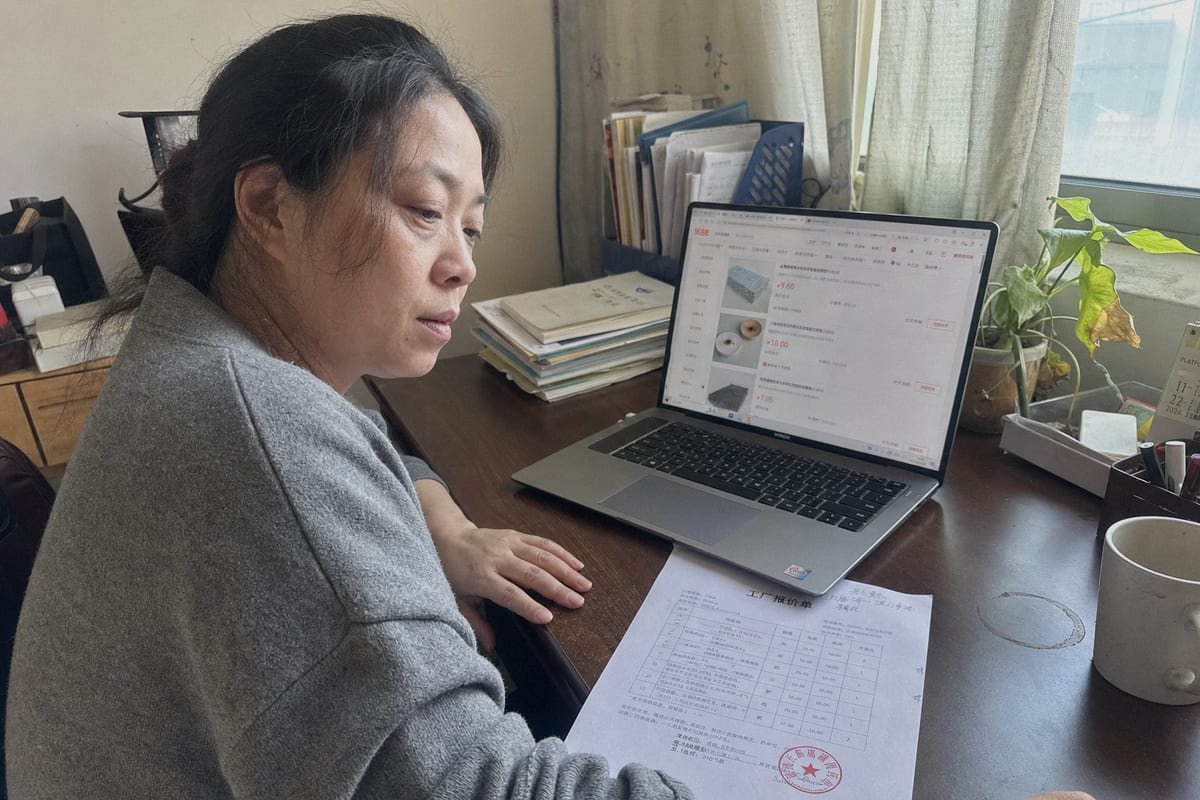
The most powerful verification tool is factory direct pricing evidence. An honest agent shares the manufacturer's original Proforma Invoice 1, complete with the factory stamp, contact details, and itemized costs. If your agent refuses to show that document, they are almost certainly baking a hidden margin into your unit price.
The 1688 Cross-Check Method
Search for your product on 1688.com 2, China's domestic B2B platform. Compare the listed prices with your agent's quoted "factory price." A small difference is normal. Prices on 1688 are often MOQ prices, so small orders legitimately cost more. But a gap above 20% needs an explanation. In our own quotes for consumer electronics and outdoor gear, we always show clients how our sourced price compares to the open market. That habit builds trust faster than any promise.
Triangulation With Multiple Agents
Send the same Request for Quotation 3 (RFQ) to two or three agents at once. Keep the specs identical. Then compare the results.
| Verification Method | What It Reveals | Effort Level |
|---|---|---|
| 1688.com cross-check | Market price baseline | Low |
| Original factory PI | True unit cost | Low |
| Multi-agent RFQ triangulation | Outlier quotes | Medium |
| Direct payment to supplier | Whether markup exists at all | Medium |
| Factory visit or video audit | Real production source | High |
The Direct Payment Test
Here is a method I actively recommend to my own clients. Pay the factory directly from your overseas account, and pay the agent's procurement service fees separately. When money flows straight to the manufacturer, there is simply no room for the agent to inflate the unit price. We structure most of our engagements this way, and it removes the single biggest trust barrier before it forms.
When we onboard a new e-commerce client, the first document we send is our fee schedule. Nothing is more revealing about an agent than how they explain the money.
Look for a fee-based model where the buyer pays the exact factory price plus a disclosed service fee, typically 3–10% of order value. Demand itemized quotes separating product cost, freight, packaging, inspection, and agent fees. Avoid any agent claiming to work for free.
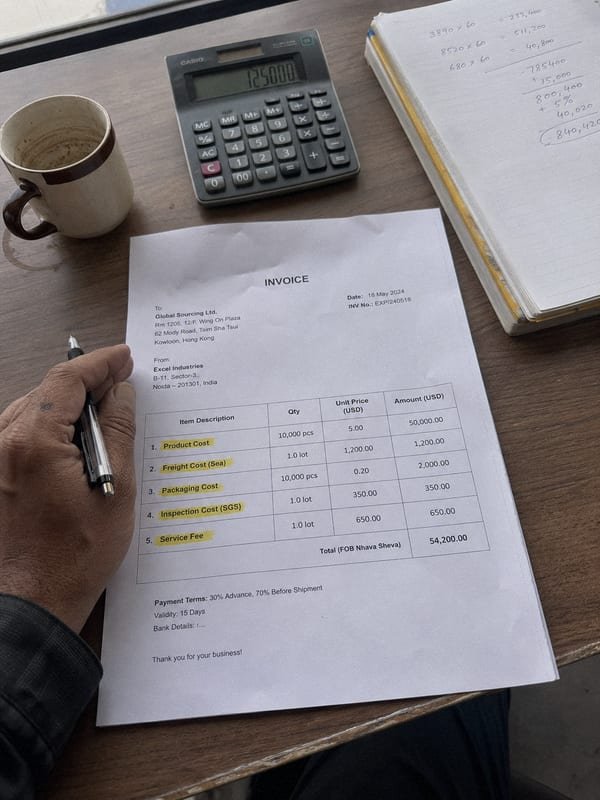
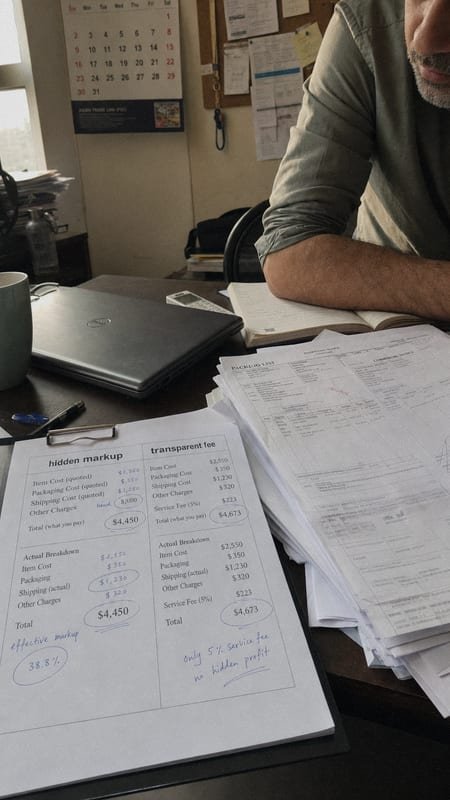
There are two pricing models in this industry, and only one deserves your business. The hidden markup model buries a 30–60% profit inside the unit price with no breakdown. The transparent fee model states plainly: factory price is X, my fee is Y, total is X plus Y. That is open-book accounting, and it aligns the agent's incentives with your success rather than against it.
The Two Models Compared
| Feature | Hidden Markup Model | Transparent Fee Model |
|---|---|---|
| Markup range | 30–60%, undisclosed | 3–10%, fully disclosed |
| Factory invoice shared | Never | Always |
| Direct factory contact | Blocked | Encouraged |
| Incentive alignment | Agent profits when you overpay | Agent profits when you scale |
| Long-term trust | Erodes | Compounds |
Watch the Edges of the Quote
Hidden costs rarely live in the headline number. They hide in inflated shipping quotes, padded packaging fees, and vague "handling" lines. Ask for logistics and shipping coordination costs as a separate, verifiable line backed by the forwarder's own quote. On our side, we pass through freight at cost and let clients see the forwarder's paperwork whenever they ask.
The Small Order Nuance
One fair caveat: for very small orders, fees may rise to 10% or shift to a flat project fee. Administrative overhead does not shrink just because the order does. That is not a hidden cost — as long as the agent explains it upfront and still shares the factory invoice. What I also urge clients to do is sign an integrity agreement with their agent. Ours explicitly prohibits kickbacks and hidden commissions from factories. A written clause like that gives you legal footing, and an honest agent will sign it without hesitation.
How do I know if my sourcing agent is truly negotiating on my behalf?
Loyalty is the hardest thing to see on paper. I learned this early in my sourcing career: an agent's real allegiance shows up in small behavioral tests, not in contracts.
A loyal agent negotiates in Mandarin using real cost benchmarks, welcomes your factory visits without hesitation, accepts switching suppliers when justified, shares supplier audit reports openly, and shows no defensiveness when you propose direct factory communication.
Here is a simple probe I tell every buyer to run. Say to your agent: "I would like to visit the factory in person. Are you happy to arrange that?" Watch the reaction. An agent working honestly for you will welcome the visit, coordinate the schedule, and join you on the floor. An agent hiding a private rebate deal with the factory will stall, deflect, or invent obstacles. For large-volume procurement, I genuinely believe you should come to China and walk the production line yourself at least once.
The Factory-Switch Test
Try a second probe. Ask casually: "What if we switched to a different factory for the next order?" An agent with a secret commission arrangement will show an almost physical resistance to that idea. They will defend the current factory beyond reason, exaggerate switching costs, or get emotional. A buyer-side advocate, by contrast, evaluates the proposal on merit — cost, quality, capacity — and gives you a balanced answer. When our clients raise this question, we run a fresh supplier comparison and let the data decide.
Behavioral Signals of True Advocacy
- The agent pushes back on factory quotes using specific cost structure knowledge — material costs, labor, tooling — not vague promises.
- The agent proactively flags factory problems, like subcontracting risks uncovered through local industrial cluster networks, before you discover them.
- The agent supports manufacturing background checks and never gatekeeps the factory's name or location.
- The agent negotiates trade assurance 4 policies and payment terms that protect your deposit, not the factory's cash flow.
In our Shenzhen office, we treat negotiation as an open process. Clients can join video calls with suppliers, and our team translates in real time. Supply chain visibility is not a feature we sell. It is the baseline.
What documentation should I request to confirm pricing transparency throughout production?
Documentation was the lesson a French brand founder taught me years ago. She requested every original paper trail from day one, and that discipline made our whole engagement smoother.
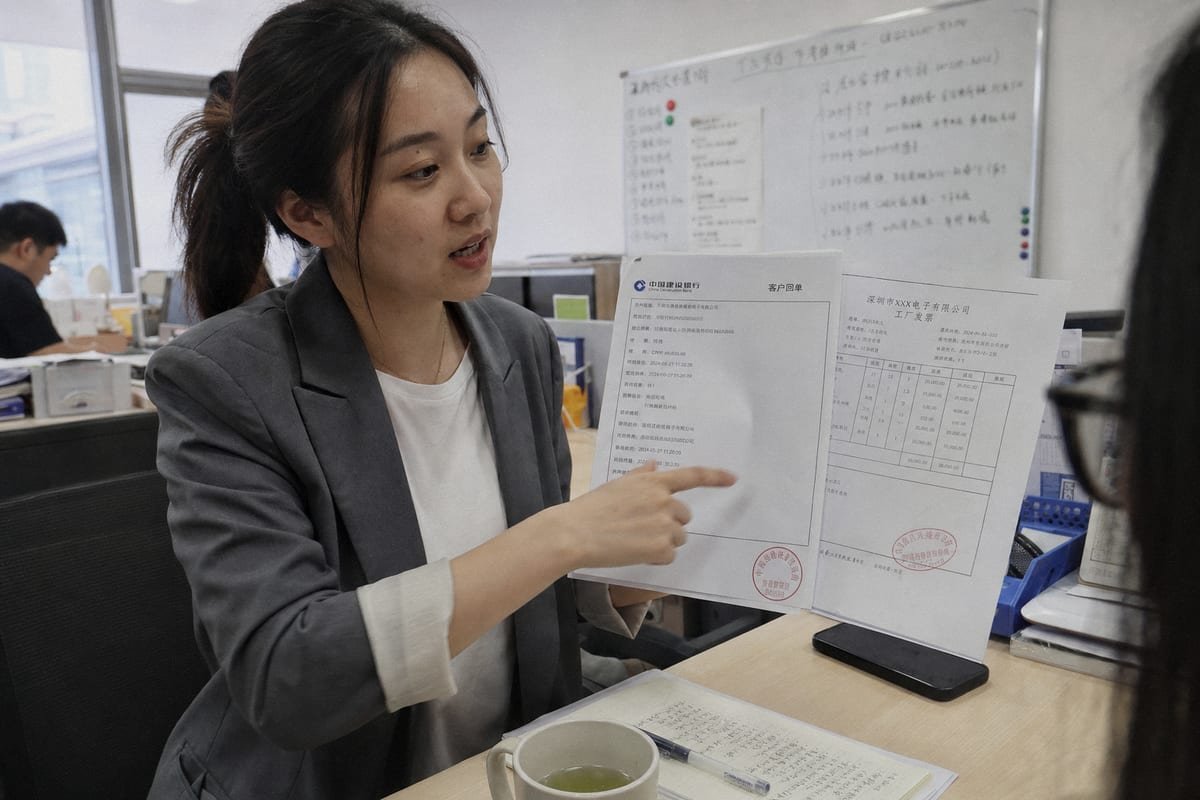
Request the factory's original stamped quotation and Proforma Invoice, the supplier's business license and SAMR registration record, itemized freight quotes, factory audit reports, AQL-based inspection reports, sample approval records, and payment receipts showing funds reached the manufacturer directly.
A transparent engagement produces a paper trail at every stage. If a document is missing, ask why. If the agent cannot produce it, treat that as an opacity signal. Here is the full documentation map we provide our own clients, stage by stage.
Stage-by-Stage Documentation Checklist
| Production Stage | Documents to Request | What They Prove |
|---|---|---|
| Supplier selection | Business license, SAMR record, supplier audit reports | The factory legally exists and can produce your item |
| Quotation | Original stamped factory quote, itemized RFQ response | No hidden markup on unit price |
| Sampling | Product sample verification records, approval photos | The design intent is locked before mass production |
| Payment | Factory's Proforma Invoice, payment receipts | Your money reached the manufacturer |
| Production | Progress reports, in-line QC photos | Timelines and specs are on track |
| Pre-shipment | AQL 5 inspection report, packaging verification | Defects caught before goods leave China |
| Shipping | Forwarder's quote, bill of lading 6, customs docs | Freight charged at real cost |
Verify the Factory Itself
Use the factory name from the invoice to check its SAMR (State Administration for Market Regulation 7) record. This confirms registered capital, business scope, and legal status. Pair that with a factory audit — in person, or via video walkthrough if travel is not practical. We conduct these audits ourselves for clients sourcing beauty products and smart home devices, and we hand over the raw findings, not a polished summary.
Quality Documents Are Pricing Documents Too
Quality control inspections protect your price in a less obvious way. A cheap quote followed by a 15% defect rate is not a cheap quote. Insist on pre-shipment inspection reports based on AQL standards, plus sample verification records tied to your approved golden sample. Transparent pricing means the total landed cost matches what you were promised — including quality.
Conclusion
Hidden markups quietly destroy margins. Demand disclosed fees, original factory invoices, direct payment options, and integrity agreements. Transparency is not optional — it is the foundation of every lasting sourcing partnership.
Footnotes
1. Defines the key trade document used to verify factory pricing transparency. ↩︎
2. Background on China's domestic B2B platform referenced for price cross-checking. ↩︎
3. Explains the procurement document used for multi-agent price triangulation. ↩︎
4. Official Alibaba program explaining the payment protection policies referenced in negotiations. ↩︎
5. Clarifies the statistical inspection standard used for pre-shipment quality checks. ↩︎
6. Defines the shipping document listed in the production documentation checklist. ↩︎
7. Official Chinese regulator whose business registration records verify factory legitimacy. ↩︎