
Every year, we help clients ship thousands of units from Chinese factories to markets worldwide. And every year, we see the same painful pattern: a buyer skips a safety step, and an entire shipment gets held at customs or, worse, triggers a recall.
To ensure product safety standards with a China sourcing agent, you must build a structured compliance system that includes clear product specifications, verified supplier capability, factory audits, third-party lab testing, multi-stage inspections, and thorough documentation — treating your agent as a critical risk-control layer, not a guarantee.
Product safety is not a single checkbox. It is a process that starts before you place an order and continues until the product reach 1es the end user. Below, we break down the exact steps your sourcing agent should help you manage — and where you must stay involved yourself.
How do I verify my China sourcing agent understands the safety certifications required for my products?
When we onboard a new client selling beauty devices into the US, the first question we ask is not about price. It is about which FDA registration class 2 the product falls under. If your agent does not ask that kind of question, you have a problem.
Verify your agent's certification knowledge by asking them to identify the specific safety standards, testing requirements, and labeling rules for your product in your destination market. A competent agent will name exact standards like CE, FCC, RoHS, or CPSIA — not just say "we handle compliance."

Know Your Own Standards First
This is something we tell every client: before you evaluate your agent, you must understand your own country's requirements. If you sell toys in the US, you need CPSIA 3 and ASTM F963. If you sell electronics in the EU, you need CE marking and the applicable EN standards. Your agent should know this, but you should know it too. You cannot outsource awareness.
A product can look perfectly made and still fail compliance. A children's toy with slightly elevated lead content in the paint will pass a visual inspection. It will not pass a lab test. A power adapter missing the right UL mark will clear the factory floor but get flagged at the US border. Safety is broader than quality. It includes material safety, electrical and mechanical safety, labeling, traceability, packaging, and regulatory documentation.
How to Test Your Agent's Knowledge
Here is a practical approach we recommend. Before you sign with any agent, give them a simple test. Send them your product concept and ask them to list the certifications, test standards, and labeling rules required for your target market. Compare their answer to your own research.
| What to Ask Your Agent | What a Good Agent Says | What a Weak Agent Says |
|---|---|---|
| What certifications does my product need for the US? | "For your LED device, you need FCC Part 15 for EMC, UL/ETL listing for electrical safety, and California Prop 65 labeling." | "We can get CE and other certificates." |
| Who should do the testing? | "We recommend an accredited lab like SGS 4, TÜV, or Intertek. We can coordinate sample submission." | "The factory has certificates already." |
| How do you confirm the factory can meet these standards? | "We audit for compliance systems, past export experience to your market, and review their existing test reports for similar products." | "Don't worry, we work with good factories." |
Prioritize Factories With Existing Experience
Here is a personal insight that saves our clients enormous headaches. Always prioritize factories that already have experience producing products that meet your country's safety standards. A factory that has exported CE-marked products to Europe for five years understands the process. A factory that has never exported before may technically be able to learn — but your order is not the right time for their education. It is not about being unfair to new factories. It is about managing your risk. Let someone else be the training ground. Your business depends on compliance from day one.
The Agent Is Not a Compliance Authority
One critical distinction: your sourcing agent is a coordinator, not a certifying body. Even the best agent cannot replace an accredited testing lab or a regulatory consultant. What a good agent does is connect the right parties, flag risks early, and make sure nothing falls through the cracks. But the final responsibility for compliance sits with you, the importer. This is true in the US, the EU, Australia, and virtually every major market.
Can my sourcing agent conduct the factory audits necessary to ensure my safety standards are met?
We have walked through hundreds of factory floors in Guangdong, Zhejiang, and Fujian. Some factories look impressive from the outside but have zero documented quality processes inside. Others look modest but run tight operations with full traceability. You cannot tell the difference from a website.
Yes, a capable sourcing agent can and should conduct factory audits before you place any order. These audits verify business legitimacy, production capability, quality management systems, and compliance history — revealing whether a supplier can actually meet your safety requirements, not just promise to.

Why Compliance Starts at Supplier Selection
Many buyers think about safety after production. That is too late. Compliance starts when you choose your supplier. A factory audit is your first real look at whether a supplier has the systems, equipment, and discipline to produce safe products consistently.
Here is what a proper factory audit should cover:
| Audit Area | What to Check | Why It Matters |
|---|---|---|
| Business License & Registration | Valid license, registered scope matches your product, legal entity confirmation | Confirms the factory is a real, legal manufacturer — not a middleman or trading company |
| Quality Management System 5 | Written quality manual, ISO 9001 6 or equivalent, documented SOPs | A factory without a written quality system is a red flag. It means processes are informal and inconsistent. |
| Production Capability | Equipment condition, production capacity, workforce skill | Ensures the factory can handle your order size without cutting corners |
| Export & Compliance History | Past exports to your target market, existing test reports, certifications held | Factories with export experience to your specific market understand the requirements |
| Material Control | Incoming material inspection, supplier records, material traceability | Unsafe materials are a top cause of compliance failure, especially for chemical restrictions |
| Packaging & Labeling | Capability to produce compliant labels, warning text, barcodes | Labeling errors are one of the most common — and most preventable — compliance failures |
What Red Flags Look Like
In our experience, certain warning signs show up repeatedly in problematic factories. If a factory cannot produce a written quality manual, walk away. If they claim to have ISO certification but cannot show the actual certificate or explain their audit cycle, be skeptical. If they have never exported to your target market, you need to weigh the risk carefully.
One pattern we see often: a factory shows you test reports from two or three years ago for a different product variant. Old test reports are not proof that a new production run will be compliant. Materials change. Suppliers change. Processes change.
Agent-Led Audit vs Third-Party Audit
Your sourcing agent can handle the initial factory audit. This is practical and cost-effective. But for high-risk products — toys, electrical goods, food-contact items — you should also consider an independent third-party audit firm. The reason is simple: your agent may have a relationship with the factory. An independent auditor does not. Both layers add value. They are not redundant.
Pre-Production Verification Is Not Optional
Before mass production begins, your agent should verify that the factory has the correct raw materials on hand, the approved sample as a reference, and a clear understanding of your labeling and packaging requirements. This is the pre-production inspection stage. It catches problems when fixing them is cheap. Skipping it means you find problems when fixing them is expensive — or impossible.
How will my agent manage third-party lab testing to guarantee my goods comply with local regulations?
We coordinate lab testing for nearly every client order we manage. It is one of the areas where we see the biggest gap between what buyers expect and what actually happens. Many buyers assume the factory's existing certificates are enough. They are not.
Your sourcing agent should manage third-party lab testing by selecting an accredited laboratory, submitting production samples from the actual manufacturing run, ensuring the test scope matches your destination market's requirements, and delivering verified test reports before shipment — because old factory certificates do not prove new production compliance.

Why Lab Testing Is Different From Inspection
This is a distinction many buyers miss. Inspection and lab testing are complementary. They are not interchangeable. A pre-shipment inspection checks for visible defects, correct quantity, packaging condition, and labeling accuracy. Lab testing checks for things you cannot see: chemical composition, electrical safety parameters, material strength, flammability, and regulatory compliance.
A toy might look perfect during inspection but contain phthalates above the legal limit. An electronic device might pass visual checks but fail EMC testing. Your sourcing agent needs to coordinate both.
When Lab Testing Is Especially Critical
Not every product carries the same risk. But some categories demand lab testing on virtually every production run:
- Toys and children's products: CPSIA, ASTM F963 7, EN 71 — lead, phthalates, small parts, flammability
- Electrical and electronic goods: FCC, UL, CE (LVD + EMC), RoHS
- Cosmetics and personal care devices: FDA regulations, EU Cosmetics Regulation
- Food-contact items: FDA 21 CFR 8, EU Regulation 1935/2004
- Textiles: REACH, azo dye restrictions, formaldehyde limits
How the Testing Workflow Should Look
Here is the workflow we follow for our clients:
| Step | Action | Who Is Responsible |
|---|---|---|
| 1 | Define the exact test standards based on the destination market | Buyer + Agent |
| 2 | Select an accredited lab (SGS, Intertek, TÜV, Bureau Veritas, etc.) | Agent coordinates, Buyer approves |
| 3 | Pull samples from the actual production run (not pre-production samples) | Agent supervises at factory |
| 4 | Submit samples to the lab with the correct test scope | Agent handles logistics |
| 5 | Review test results and flag any failures | Agent reviews, Buyer makes final decision |
| 6 | If failures occur, coordinate corrective action with factory | Agent manages communication |
| 7 | Re-test after corrections | Agent coordinates |
| 8 | Archive test reports for customs, retailers, and legal records | Both |
Test the Actual Product, Not a Generic Sample
This point cannot be overstated. We have seen factories send a "golden sample" to the lab — a specially prepared unit that does not represent the mass production batch. Your agent must pull samples directly from the production line, ideally at random. The test must reflect what the customer will actually receive.
Old test reports from previous runs are useful for assessing a factory's general capability. But they are not proof that the current batch is compliant. Materials change between runs. Sub-suppliers change. Even machine settings change. Each production run should be treated as a separate compliance event.
Who Pays for Testing?
This varies. In many cases, the buyer pays for third-party lab testing 9. Some factories will absorb the cost for repeat customers or large orders. Your agent should negotiate this as part of the purchase agreement. But never let cost be the reason you skip testing. A failed compliance check at the border or a product recall will cost many times more than a lab test.
Bilingual Contracts Reduce Misunderstandings
One practical tip: your product specifications, testing requirements, and acceptance criteria should be documented in a bilingual contract — English and Chinese. This gives your sourcing agent a clear enforcement tool when dealing with the factory. Verbal agreements are weak protection in cross-border sourcing. Written, bilingual documents reduce ambiguity and give both parties a reference point.
What role does my sourcing agent play in ongoing quality control to prevent safety risks and recalls?
After ten years of managing production for overseas clients, one thing is crystal clear to us: the most dangerous moment in the sourcing process is when the buyer relaxes. The first order goes well, trust builds, and inspections get skipped. That is when problems appear.
Your sourcing agent plays a continuous role in quality control by managing multi-stage inspections, enforcing approved specifications, monitoring production consistency, maintaining documentation, and acting as an early-warning system that catches safety deviations before products ship — because one good order does not guarantee the next.
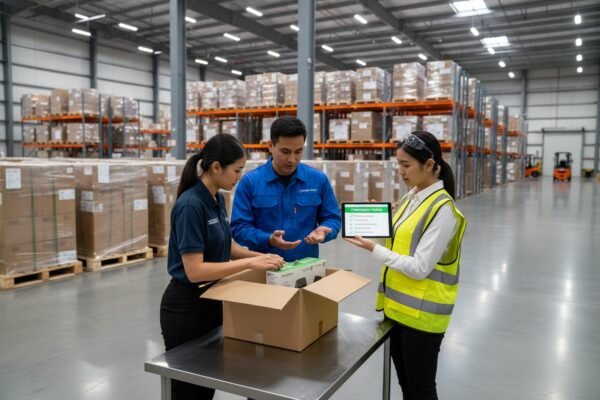
The Multi-Stage Inspection Model
A single final inspection is not enough. Safety problems can start at any point in the production process. Your sourcing agent should implement a multi-stage inspection framework:
Pre-Production Inspection: Before manufacturing starts, the agent verifies that the factory has the correct materials, components, and tooling. They confirm that the approved sample is on the production floor as a reference. They check that labeling templates and packaging specifications match your requirements.
In-Line Inspection: During manufacturing, the agent visits the factory floor to catch process drift. This is critical because small deviations early in production can become major safety issues at scale. For example, a slight change in solder temperature on an electronic assembly line can create weak joints that pass visual checks but fail under stress.
Pre-Shipment Inspection: After production is complete, the agent inspects the finished goods using AQL (Acceptable Quality Level) sampling 10. AQL is a statistical method that determines how many units to inspect from a batch and how many defects are acceptable. For safety-critical products, the AQL should be tighter — often AQL 1.0 or even zero tolerance for critical defects.
Understanding AQL in Simple Terms
AQL can seem technical, but the concept is straightforward. You cannot inspect every single unit in a large batch. Instead, you inspect a random sample. The AQL number tells you the maximum defect rate you are willing to accept.
| AQL Level | Typical Use | What It Means |
|---|---|---|
| AQL 0 (zero defects) | Safety-critical defects (electrical shock, choking hazard) | No defective units are accepted in the sample |
| AQL 1.0 | Major functional defects | Very tight tolerance; used for important product characteristics |
| AQL 2.5 | Minor cosmetic defects | Standard tolerance for appearance issues |
| AQL 4.0 | Very minor defects | Loose tolerance; scratches, minor blemishes |
For safety-related characteristics, always insist on AQL 0 or AQL 1.0. Your sourcing agent should know how to apply AQL correctly and should report results with photographic evidence.
Documentation and Traceability
A significant portion of compliance failure is actually paperwork failure. Your agent should maintain organized records for every order:
- Test reports from accredited labs
- Inspection reports with photos and data
- Factory audit records
- Certificates of compliance
- Production records and batch tracking
- Supplier declarations of conformity
- Packaging and labeling approvals
These documents matter because customs authorities, retailers, online marketplaces, insurance companies, and regulators may all request proof of compliance. If a safety issue surfaces after the product is sold, these records are your defense.
Treat Sample Approval as a Compliance Checkpoint
Many buyers treat sample approval as a design exercise — does it look right? Does it feel right? But sample approval is also a compliance checkpoint. When you approve a sample, you are confirming that the materials, construction, packaging, warning labels, and user instructions all meet your safety requirements. Many safety failures start with "small" deviations from the approved sample. A slightly different plastic resin. A label printed in the wrong font size. A missing warning icon. Your agent must enforce the approved sample as the production standard.
The Liability Reality
Here is the uncomfortable truth: if someone is injured by your product, you face legal and financial liability as the importer. The factory in China is largely beyond the reach of your country's legal system. Your sourcing agent cannot absorb that liability for you. What your agent can do is help you build the evidence trail — inspections, test reports, documented specifications — that demonstrates you took reasonable steps to ensure safety. This is not just good practice. It is your legal shield.
Continuous Improvement, Not One-Time Compliance
Product safety standards are best treated as a process, not a one-time checklist. Markets update their regulations. Factories change their material suppliers. New risks emerge. Your sourcing agent should keep you informed about regulatory changes that affect your products and should adjust inspection and testing protocols accordingly. The strongest sourcing relationships we manage are the ones where compliance is woven into every order cycle, not treated as an afterthought.
Conclusion
Product safety when sourcing from China is a layered system: verified suppliers, written specifications, lab testing, multi-stage inspections, and disciplined documentation. Your sourcing agent is your first line of defense — but never your only one.
Footnotes
Related Reading
Related Reading
1. Describes the European Union regulation for Registration, Evaluation, Authorisation and Restriction of Chemicals. ↩︎
2. Explains the FDA's classification system for medical devices based on risk. ↩︎
3. Provides official information on the Consumer Product Safety Improvement Act. ↩︎
4. Provides information on SGS, a global leader in inspection, testing, and certification services. ↩︎
5. Replaced with the official ISO page for ISO 9001, which defines and explains Quality Management Systems (QMS) in the context of the standard. ↩︎
6. Replaced with the official International Organization for Standardization (ISO) page for ISO 9001, which is the primary authoritative source for the standard. ↩︎
7. Details the standard consumer safety specification for toy safety in the U.S. ↩︎
8. Replaced with the official Electronic Code of Federal Regulations (eCFR) link for Title 21, Chapter I, which contains the regulations enforced by the Food and Drug Administration (FDA). ↩︎
9. Explains the importance and benefits of independent product testing for safety and compliance. ↩︎
10. Defines AQL as a statistical method for determining acceptable defect rates in inspections. ↩︎