
Every week our team fields calls from buyers who lost deposits to suppliers that looked perfect on Alibaba but turned out to be ghost factories or unlicensed traders 1.
China sourcing agents conduct supplier background checks through a layered verification system that includes government database searches, business license reviews, on-site factory audits, certification validation, and reference checks — all designed to separate legitimate, capable manufacturers from risky or fraudulent suppliers before any deposit is paid.
Finding a supplier is easy. Verifying one is where the real work begins. A polished website, a Gold Supplier badge, or a fast WeChat reply tells you almost nothing about whether a company can actually produce your product at the quality and volume you need government database searches 2. Below, we break down the exact steps a professional sourcing agent takes to protect your money and your brand.
How can I verify if a Chinese supplier is a legitimate manufacturer or just a middleman?
When we help clients source consumer electronics and smart home products, this is always the first question on the table — and for good reason, because the answer shapes every decision that follows.
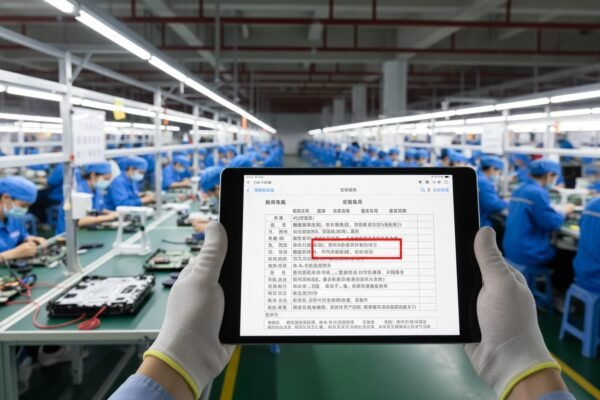
You can verify whether a Chinese supplier is a real manufacturer or a middleman by cross-checking their business registration on government databases like GSXT or Tianyancha, confirming their registered business scope includes manufacturing, and then conducting an on-site factory visit to inspect equipment, workers, and production lines firsthand.
Why the Distinction Matters
The difference between a factory and a trading company is not always black and white. Some trading companies are transparent, well-managed, and useful — especially for small orders or multi-category sourcing. Some factories are disorganized and unreliable. The point is not that one is always better. The point is that you need to know what you are actually dealing with before you commit money.
In China, there are several practical ways to figure this out. First, the 1688 platform (Alibaba's domestic B2B marketplace) has its own verification system that labels whether a supplier is a factory or a trader. Second, publicly available business registration data — accessible through platforms like GSXT (the National Enterprise Credit Information Publicity System), Tianyancha, or QCC — lets you check a company's registered business scope, legal representative, establishment date, and registered address. If the address is an office tower in downtown Shenzhen rather than an industrial park, that is a strong hint you are not dealing with a manufacturer.
Key Signals to Look For
| Signal | Likely Manufacturer | Likely Trading Company |
|---|---|---|
| Registered address | Industrial zone or factory district | Office building or commercial center |
| Business scope keywords | 生产 (production), 制造 (manufacturing) | 贸易 (trade), 销售 (sales) |
| Product range | Narrow, focused on one category | Wide, spanning unrelated categories |
| 1688 verification label | 工厂 (factory) | 贸易商 (trader) |
| Employee count on registration | 50+ workers typical for real factories | Often fewer than 20 |
The On-the-Ground Reality
Finally, and most importantly, there is no substitute for a trusted sourcing agent visiting the factory in person. Our team has walked into "factories" that were empty warehouses with a few sample shelves. We have also visited trading companies that turned out to have excellent factory partnerships and delivered flawless products. The physical visit reveals what databases cannot: the real headcount, the actual machines on the floor, the raw materials in storage, and the overall atmosphere of the operation.
A layered approach works best. Start with digital screening, then narrow down to a shortlist, and then send someone to verify on the ground. That is the process we follow for every new supplier we recommend.
What specific business licenses and certifications will my sourcing agent check for me?
Our operations team reviews supplier documents every single day — and we have learned that a certificate is only as good as the verification behind it, because counterfeit and borrowed documents are more common than most buyers realize.
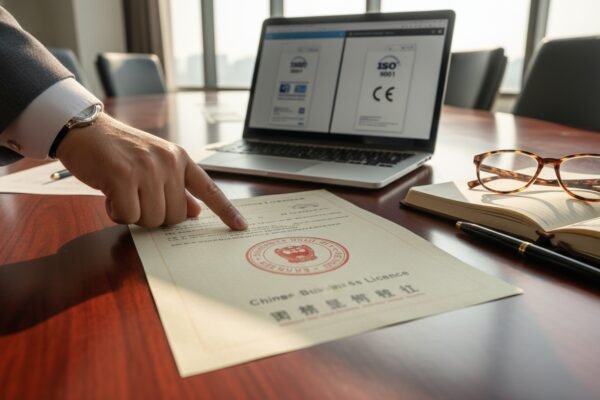
A sourcing agent will check the supplier's business license (营业执照), unified social credit code, registered business scope, and relevant product certifications such as ISO 9001, CE, FCC, RoHS, REACH, CCC, or FDA-related documents, while also verifying each certificate's authenticity by cross-referencing issuing bodies, validity dates, and the named company.
The Business License: Your Starting Point
Every legitimate company in China holds a business license (营业执照). This is the single most fundamental document. It contains the company's full legal Chinese name, unified social credit code (a unique 18-digit identifier), legal representative, registered capital, business scope, establishment date, and registered address.
A common trap for overseas buyers is that they only know the supplier's English trade name. That English name might not match the registered Chinese entity at all. A sourcing agent's first step is to confirm the exact Chinese legal name and then verify it against official records.
Certifications: What Gets Checked and How
The certifications your agent checks depend on your product category and destination market. Here is a breakdown of the most common ones:
| Certification | Applies To | Key Verification Step |
|---|---|---|
| ISO 9001 3 | General quality management | Confirm issuing body is accredited; check certificate number on issuing body's website |
| CE Marking 4 | Products sold in the EU | Verify the Notified Body number; request the full Declaration of Conformity |
| FCC | Electronics sold in the US | Check the FCC ID 5 in the FCC database; confirm the listed company matches |
| RoHS / REACH | Products with chemical or material restrictions (EU) | Request lab test reports; verify lab is accredited (e.g., CNAS, ILAC) |
| CCC (China Compulsory Certification 6) | Products regulated within China | Cross-check on CNCA's official database |
| BSCI 7 / SA8000 | Social compliance and labor standards | Confirm audit report validity and audit scope |
When Certificates Matter — and When They Do Not
Here is a nuanced point that many articles miss: not every product needs every certificate. For unregulated, low-risk consumer goods, demanding a full suite of certifications may add unnecessary cost and delay. A smart sourcing agent takes a risk-based approach. If you are importing LED light panels into the EU, CE and RoHS are non-negotiable. If you are sourcing custom packaging boxes, an ISO certificate is nice to have but not a dealbreaker.
The critical skill is knowing which certificates are legally required for customs clearance or marketplace listing, and which are just marketing badges. We always advise our clients to separate "must-have" compliance documents from "nice-to-have" quality signals. That way, you focus your verification budget where it actually protects you.
Red Flags in Documentation
Watch out for certificates where the company name does not exactly match the supplier you are working with. Watch out for expired certificates being presented as current. Watch out for test reports from unknown or unaccredited labs. A professional sourcing agent catches these details because they know what to look for — and because they can read the Chinese-language originals.
How does an on-site factory audit ensure my product meets high-end quality standards?
When we coordinate factory audits for our clients in consumer electronics and beauty equipment, we treat the visit as the moment where paper claims meet physical reality — and the gap between the two is sometimes enormous.
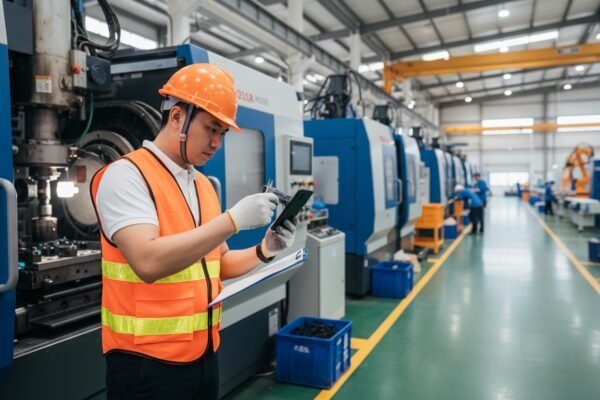
An on-site factory audit ensures quality by allowing trained auditors to physically inspect production equipment, raw material storage, quality control processes, worker skill levels, warehouse conditions, and finished goods — providing evidence that the supplier can actually produce at the quality level they promised, not just claim it on paper.
What Auditors Actually Look At
A factory audit is not a casual walkthrough. It is a structured inspection that covers multiple dimensions of the supplier's operation. Here is what a typical audit evaluates:
Production Equipment and Capacity
Auditors check whether the machines on the floor match what the supplier claimed in their quotation. If a factory says they have SMT lines for PCB assembly but you only see manual soldering stations, that is a problem. They also assess whether the equipment is well-maintained, modern enough for your product's requirements, and sufficient in quantity to handle your order volume within the stated lead time.
Quality Control Systems
This is where high-end product standards live or die. Auditors look for documented QC procedures, inspection checkpoints along the production line, testing equipment (and whether it is calibrated), defect tracking systems, and how rejected products are handled. quality control processes 8 A factory that cannot show you a clear QC flow is a factory that relies on luck instead of process.
Raw Material and Warehouse Conditions
For products like electronic tools or smart home devices, raw material quality determines final product quality. Auditors inspect how incoming materials are stored, labeled, and tested before they enter production. They also check finished goods storage to see if products are protected from moisture, dust, or physical damage before shipping.
Worker Training and Conditions
The skill level of the workforce matters, especially for products that involve hand assembly, soldering, or cosmetic finishing. Auditors observe whether workers follow standard operating procedures, whether training records exist, and whether the overall working environment supports consistent output. Social compliance — working hours, safety equipment, clean facilities — is also evaluated here.
Audit Scoring: A Simplified Example
| Audit Area | What Is Checked | Common Red Flags |
|---|---|---|
| Facility condition | Cleanliness, layout, lighting, safety | Cluttered floors, poor ventilation, no fire exits |
| Equipment | Type, age, maintenance, calibration | Outdated machines, no calibration records |
| QC process | Inspection points, test equipment, reject handling | No incoming inspection, no final QC |
| Raw materials | Storage, labeling, incoming quality checks | Unlabeled bins, no supplier records for materials |
| Workforce | Training, SOPs, working conditions | No SOPs posted, untrained temporary workers |
| Documentation | Production records, test reports, traceability | Missing or inconsistent records |
The Bridge Between Paper and Reality
An audit is the bridge between what you see on a screen and what actually happens on the factory floor. We have seen suppliers with beautiful websites and perfect sample quality whose actual production lines were chaotic. We have also found small, modest-looking factories with exceptional process control and dedicated teams. The audit reveals the truth. For mid-to-high-end products, this step is not optional — it is essential.
The cost of a basic factory audit typically ranges from a few hundred to around a thousand USD, depending on location, scope, and whether a third-party firm or your sourcing agent's own team conducts it. Compared to the cost of a failed production run, it is a tiny investment.
Can a sourcing agent help me uncover a supplier's real track record with other global brands?
Our clients — especially brand founders selling into the US market — often ask us this question right after they receive a convincing sales pitch from a supplier who claims to work with "top international brands" but cannot show a single verifiable reference.
Yes, a sourcing agent can uncover a supplier's real track record by requesting verifiable client references, checking export records, searching for the supplier's presence across trade platforms and industry events, reviewing Chinese-language court and litigation databases, and cross-referencing claims against physical evidence found during factory visits.

Why Supplier Claims Need Independent Verification
Almost every Chinese supplier will tell you they work with "famous brands" or "big American companies." Some of these claims are true. Many are exaggerated or outright false. A supplier might have produced one small sample order for a well-known brand three years ago and now present it as an ongoing relationship. Or they might show you products in their showroom that were actually manufactured by a different factory.
A sourcing agent's job is to cut through the noise and find verifiable evidence.
How Agents Dig Into Track Records
There are several practical methods:
Reference checks. Agents ask the supplier for the names and contact details of past or current clients, ideally buyers in comparable markets. The limitation here is obvious: suppliers only provide friendly references. So agents treat references as one data point, not proof.
Export record searches. Customs data services (both Chinese and destination-country databases) can sometimes reveal a supplier's actual shipment history — what products they exported, to which countries, and in what volumes. export record searches 10 This is powerful because it is hard to fake.
Online footprint analysis. Agents search for the supplier's Chinese legal name (not just the English trade name) across Baidu, Google, Alibaba, Global Sources, Made-in-China, LinkedIn, and industry forums. They look for consistency: does the same phone number, address, and legal representative appear across platforms? Are product photos original or stolen from other companies? Has the website domain been active for years or was it registered last month?
Litigation and legal screening. For larger orders or sensitive product categories, agents search Chinese court databases for lawsuits, debt enforcement actions, IP disputes, or administrative penalties involving the supplier. This is where having a Chinese-speaking team with local legal knowledge adds enormous value, because these records are in Chinese and require interpretation.
What Red Flags Look Like
| Red Flag | What It Suggests |
|---|---|
| Supplier refuses to provide any client references | Possible lack of real export experience |
| Export records show no shipments in your product category | Supplier may be new to the product or outsourcing it |
| Company name inconsistencies across platforms | Possible shell company or recent entity change |
| Product photos found on multiple unrelated supplier profiles | Stock photos or stolen images — not original production |
| Recent lawsuits for contract disputes or debt enforcement | Financial instability or reliability issues |
| Website domain registered less than 6 months ago | Possible fly-by-night operation |
The Practical Limits of Track Record Checks
It is important to be honest about what these checks can and cannot do. A clean record does not guarantee future performance. A new supplier with no history might be excellent but simply has not built a track record yet. And some well-established suppliers become complacent over time.
The goal is not to find a perfect supplier. The goal is to find a supplier whose verified identity, confirmed capability, and real-world track record match your risk tolerance and order requirements. A professional sourcing agent helps you make that judgment call with evidence instead of guesswork.
For our clients sourcing consumer electronics and smart home products, we always recommend combining digital screening with physical verification. The digital check narrows the field. The factory visit and sample evaluation confirm the reality. Together, they give you the clearest possible picture before you wire that first payment.
Conclusion
Supplier background checks are not a luxury — they are the most practical form of risk control in China sourcing. Work with a sourcing agent who verifies before you pay.
Footnotes
Related Reading
1. This article provides a comprehensive guide on avoiding China sourcing scams, directly addressing fraudulent suppliers and ghost companies, which aligns with the concept of 'unlicensed traders'. ↩︎
2. This article specifically details the Chinese government databases (like SAMR and NECIPS) used for verifying suppliers, which is a direct match for 'government database searches'. ↩︎
3. This is the official ISO website's page for ISO 9001, providing the most authoritative information on the standard. ↩︎
4. This is a government (.gov) source from the International Trade Administration, offering an authoritative overview of CE Marking requirements. ↩︎
5. Provides access to the official FCC database for searching equipment authorization records. ↩︎
6. This government (.gov) page from the International Trade Administration provides information on China's trade standards, including a clear explanation of the China Compulsory Certification (CCC) mark. ↩︎
7. Describes amfori BSCI as a solution for managing social risk and improving working conditions in supply chains. ↩︎
8. Explains quality control processes ensure products meet specifications and are consistent and reliable. ↩︎
9. This URL provides a detailed explanation of what a factory audit is, its process, types, and checklist, serving as an excellent replacement for the original failed link with the same anchor. ↩︎
10. Provides access to detailed trade statistics and economic complexity data for China's exports. ↩︎