
When our Shenzhen team takes on a new sourcing project, one question decides everything: who runs it? Procurement agents assign and train PMs in ways most clients never see — and that hidden process can make or break your order.
Procurement agents assign PMs based on product category expertise, bilingual fluency, and factory network depth, then train them through structured programs covering supplier vetting, quality control inspections, Incoterms, IP protection, and negotiation — typically 3–6 months of mentorship plus continuous case reviews before independent client management.
That is the short answer. But the details matter a lot. Below, I will walk you through how the matching works, what training looks like, and what to do if the fit is wrong.
How do procurement agents match PMs to my specific product category and sourcing needs?
A client once sent us an inquiry for a smart home device with a custom PCB 1 and a beauty product line in the same email. Two very different projects. Two very different skill sets needed.
Procurement agents match PMs through inquiry triage: they assess your product category, technical complexity, order volume, and communication style, then assign a PM with matching industry specialization, Mandarin-English fluency, and a vetted supplier network in that exact sector — usually within the first 24 hours.

The matching process is not random. At established agencies, it follows a structured triage system. When your inquiry lands, someone senior reads it and scores it across several dimensions before anyone replies to you.
The Triage Criteria Most Agencies Use
Here is how a typical inquiry gets scored and routed:
| Matching Factor | What the Agency Looks At | Why It Matters to You |
|---|---|---|
| Product category | Electronics, textiles, beauty, outdoor gear, etc. | A PM who knows PCBs will not miss critical specs on your device |
| Technical complexity | Custom tooling, certifications, multi-part assembly | Complex products need PMs with engineering literacy |
| Client maturity | First-time importer vs. experienced buyer | New importers get "educator" PMs; veterans get executors |
| Language and culture | Your region, communication preferences | Prevents translation errors in product specification compliance |
| Network depth | Which PM has vetted factories in that niche | Access beyond Alibaba means better pricing and reliability |
Notice the "client maturity" row. This is a tiered assignment approach. If you are a first-time importer, a good agency pairs you with a senior PM who can teach as they execute. If you already manage multiple supplier projects — like many brand founders we work with — they assign a PM who moves fast and skips the hand-holding.
I will be honest about how we handle this at our current scale. We are not a big institution yet, so all projects are followed personally by our partners. That is actually an advantage for our clients right now: the person negotiating with your factory is also the person accountable for your outcome. But we are building for the long term. We are creating and continuously iterating a team knowledge base — capturing valuable outputs from our daily AI agent conversations, recording and intelligently analyzing every client and supplier call, and running daily reviews of what we learned. This full-chain knowledge base will become our most useful asset for training future project managers, so that matching and onboarding never depends on one person's memory.
What qualifications and training do PMs receive before managing my China sourcing projects?
Early in our agency's life, I sat in on a supplier call where a junior colleague agreed to a payment term that exposed our client to real risk. That moment shaped how I think about PM training: it cannot be theoretical.
PMs typically receive 3–6 months of structured mentorship covering supplier audit protocols, business license verification, AQL sampling standards, Incoterms and customs documentation, negotiation techniques, IP protection measures, and cross-cultural communication training — followed by supervised project work before independent client assignment.

Training a China sourcing PM is closer to training a general contractor than training a customer service rep. The role touches manufacturing, law, logistics, finance, and human psychology. Here is what a serious training program covers.
The Core Training Pillars
| Training Pillar | Key Skills Taught | Typical Method |
|---|---|---|
| Supplier vetting | Business license checks, factory capability audits, scam detection | Shadowing senior staff on 10–20 real supplier evaluations |
| Quality control | First article inspection, pre-shipment inspection, AQL sampling | Hands-on factory visits with QC checklists |
| Logistics | Incoterms (FOB, CIF), tariffs, customs paperwork, freight coordination | Case studies plus live shipment tracking |
| Negotiation | Pricing, MOQs, payment terms, tooling ownership | Role-play and supervised live negotiations |
| Risk management | Contingency planning, IP protection, contractual compliance monitoring | Reviewing past failure cases |
Why Best Practices Beat Rigid Scripts
The best agencies do not train PMs with scripts. Negotiation with a factory owner in Dongguan does not follow a script. Instead, they teach case-specific best practices and standard operating procedures 3, then run regular case review meetings. When something goes wrong on any project — a delayed mold, a color mismatch, a missed certification — that lesson gets fed back into the training material.
This is exactly the philosophy behind the knowledge base we are building. Every valuable insight from our daily work, every recorded supplier conversation, every post-mortem gets structured and stored. When we do hire and train PMs, they will not start from zero. They will start from years of documented, searchable experience — including the mistakes, which are honestly the most valuable part.
The Continuous Learning Layer
Training never really ends. Good PMs keep attending industry seminars, tracking analytics on platforms like Global Sources 4, and studying regulatory changes in target markets. Supply chain risk mitigation 5 is a moving target; the training has to move with it.
How do I know my dedicated PM has enough factory experience to handle quality and design fidelity issues?
Design fidelity is where I have seen the most heartbreak. A founder we support once received samples where the factory had "improved" the product finish without asking — technically functional, visually wrong for the brand. Catching that requires a PM who has physically stood on factory floors.
Ask your PM three things: how many factory audits they have personally conducted in your category, which AQL standards they apply at each inspection stage, and how they document design deviations. Experienced PMs answer with specific processes, not vague reassurances.
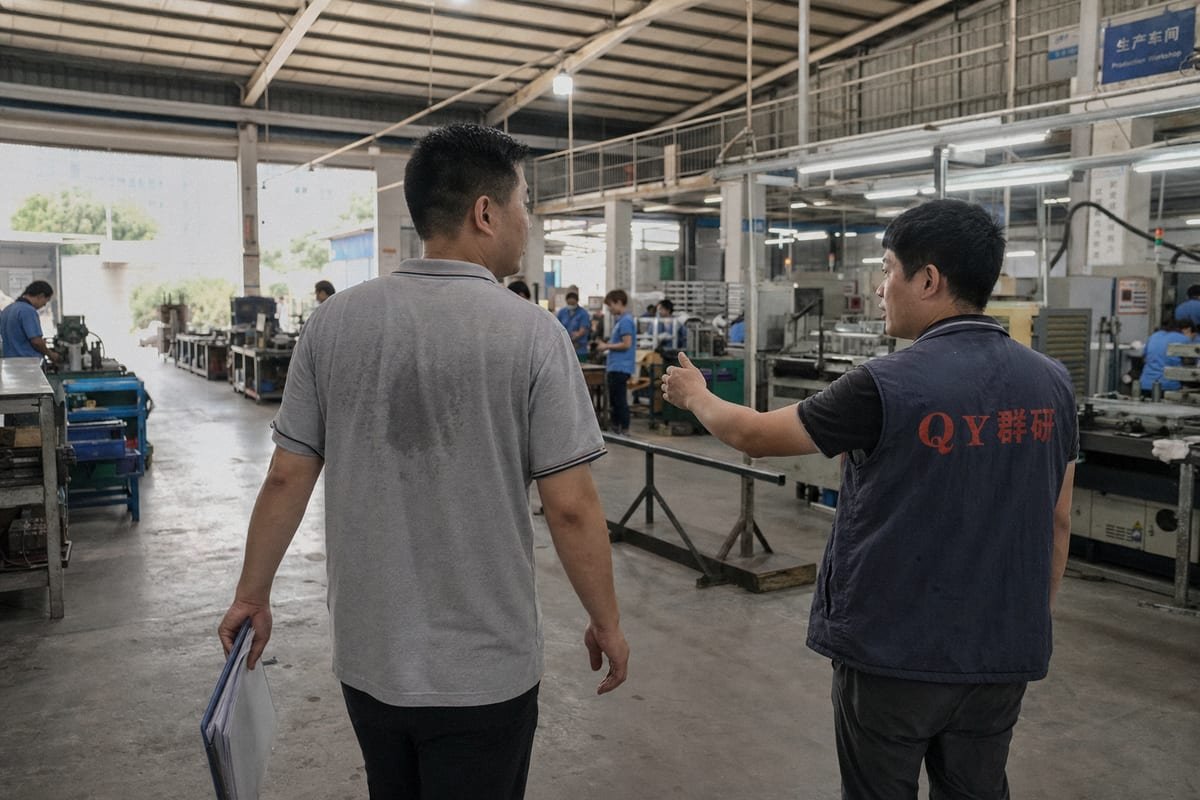
You cannot see your PM's résumé, but you can test their depth with the right questions. Factory experience shows up in specifics. A PM who has managed real production runs talks about tooling revisions, golden samples, and inline inspections. A PM who has only pushed emails talks about "keeping you updated."
Questions That Reveal Real Factory Experience
- "Walk me through your first article inspection process." An experienced PM describes comparing the first production unit against the approved golden sample, dimension by dimension, before mass production starts.
- "How do you handle a factory that substitutes materials?" Listen for answers involving contractual compliance monitoring, material certificates, and pre-agreed penalty clauses — not just "we would talk to them."
- "What is your process when a sample deviates from my design files?" Good PMs maintain a deviation log, photograph everything, and never let the factory define "close enough."
- "How do you manage lead time slippage?" Real answers involve manufacturing lead time management 6 milestones: material procurement checkpoints, production start confirmation, and mid-production progress checks.
The Design Fidelity Safeguard System
| Stage | Safeguard | What It Prevents |
|---|---|---|
| Pre-production | Signed golden sample + spec sheet | Ambiguity about what "correct" means |
| Tooling | PM reviews T1 samples on-site or via detailed video | Mold errors baked into thousands of units |
| Mid-production | Inline inspection at 20–50% completion | Systematic defects discovered too late |
| Pre-shipment | AQL-based random sampling inspection | Defective goods leaving the factory |
| Ongoing | Supplier relationship management scoring | Quality drift across repeat orders |
In our own projects, because partners handle everything directly, every supplier conversation is recorded and analyzed. That habit does two things. It protects our current clients, because nothing said in Mandarin on a factory call gets lost. And it feeds our knowledge base, so future PMs inherit a library of real quality disputes and how they were resolved — including IP compartmentalization tactics 7 like splitting component production across unrelated factories to prevent design theft.
What happens if I'm not satisfied with my assigned PM's communication or project management style?
A buyer from the US once told me she had left her previous agent not over price or quality, but because updates arrived slowly and vaguely. Style mismatches are real, and good agencies plan for them.
Reputable agencies offer a structured escalation path: raise concerns with the PM directly, then request a review with a senior manager, and finally request PM reassignment — usually granted within one to two weeks with a documented handover so no project knowledge is lost.

You are the client. You should never feel stuck with a working style that stresses you out. But there is a smart way to handle this, and a costly way.
The Smart Escalation Path
First, be specific about the problem. "Communication is bad" is hard to fix. "I need updates every Tuesday with photos, and I am getting vague messages every ten days" is fixable in one conversation. Many style clashes dissolve once expectations are written down and communicated clearly to your agent.
Second, if direct feedback fails, escalate to the agency's management. Ask how they handle reassignment. A professional agency has standard operating procedures for this: a documented handover file covering supplier contacts, negotiation history, open issues, and payment status. Without that documentation, switching PMs mid-project can cost you weeks.
Third, evaluate whether the issue is the person or the agency. If the agency has no feedback loop, no case review culture, and no documentation, a new PM will likely repeat the same failures.
Red Flags vs. Fixable Issues
- Fixable: update frequency, reporting format, response speed, level of detail, preferred channel (email vs. WhatsApp).
- Red flags: hidden fees or kickback behavior, refusing to share supplier information, dismissing your quality control inspections concerns, blaming factories for everything without evidence.
This is another reason we obsess over knowledge capture. Because every client conversation and supplier negotiation in our workflow is recorded, analyzed, and stored, a handover in our system is not a memory exercise — it is a file transfer. Whoever picks up the project inherits full context: specs, agreed tolerances, logistics and freight coordination status, and every commitment made. That continuity is what protects clients when personnel changes happen, and it is the standard I believe every sourcing client should demand.
Conclusion
A bad PM match costs you months and money. A well-matched, well-trained PM protects your quality, timeline, and designs — so ask agencies hard questions about assignment and training before you sign.
Footnotes
1. Explains the technical complexity of PCB-based electronics that require specialized PM expertise. ↩︎
2. ISO 9001 defines quality management standards underlying factory inspection practices. ↩︎
3. Defines the documentation practice agencies use for consistent PM handovers. ↩︎
4. Official platform PMs use to track supplier analytics and industry trends. ↩︎
5. NIST glossary defines supply chain risk management referenced in ongoing PM training. ↩︎
6. Background on lead time concepts relevant to production scheduling and milestones. ↩︎
7. WIPO explains intellectual property protection principles behind these sourcing safeguards. ↩︎