
Exchange rate fluctuations quietly reshape procurement costs on nearly every order our Shenzhen sourcing team manages. A quote that looks profitable today can lose its edge before final payment clears.
Exchange rate fluctuations affect procurement costs by changing your true landed cost between quote and final payment. A 3–5% swing during a normal production cycle is common, and a 10% move can erase your margin. Some agents also hide FX spreads inside their conversion rates.
This is not abstract finance theory. Currency movement hits your margin, your cash flow, and your negotiating leverage. Below, I break down where the risk hides and how to manage it.
How can I protect my procurement budget from sudden RMB exchange rate swings?
A US brand founder messaged us on WhatsApp last year, worried her budget had drifted 4% before her balance payment was due. Her factory price had never changed once.
Protect your budget by requesting quotes with a built-in FX buffer of 3–8%, or asking for transparent RMB pricing so you control conversion timing. Add a currency fluctuation clause that triggers renegotiation when the USD to CNY exchange rate moves beyond an agreed threshold.
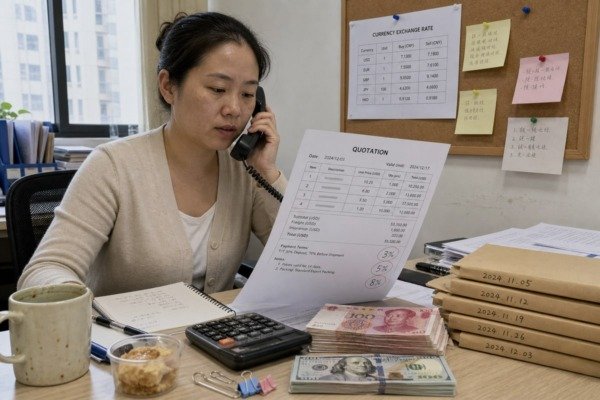
Currency risk management starts before the quote, not after the wire transfer. In our sourcing work, we push every supplier conversation toward one of two pricing structures, because supply chain price volatility punishes buyers who leave this vague.
Two Pricing Approaches We Recommend
The first approach is to ask the supplier upfront for a price that already reserves room for exchange rate movement. The supplier pads the USD quote slightly, and in return, they commit to holding that price through production. You pay a little more on paper, but you buy certainty.
The second approach is my personal preference for experienced buyers. Ask the supplier to quote transparently in RMB. You then control the conversion yourself. You decide when to convert, at what rate, and through which channel. The cost of any currency movement is visible to you, not buried in someone else's markup.
Sizing Your FX Buffer
Industry sourcing guidance recommends a 3–8% FX reserve inside your budget. The right number depends on your margin and lead time.
| Your Situation | Suggested FX Buffer | Why |
|---|---|---|
| High margin, short lead time (under 30 days) | 3% | Less time for rates to drift |
| Moderate margin, 30–60 day production | 4–5% | Covers a typical cycle swing |
| Thin margin or 60–90+ day lead time | 6–8% | Long exposure window, low tolerance |
Contract Clauses That Share the Risk
Professional sourcing agreements often include currency triggers. If the rate moves beyond a set percentage, say 3%, either side can request a price adjustment. This shares the risk fairly instead of dumping it silently on one party.
Should I lock in pricing with my sourcing agent before or after placing an order?
Early in our sourcing work, we let a client confirm pricing after the deposit was wired. The rate shifted during production, and the 70% balance cost noticeably more.
Lock in pricing before placing the order, ideally before paying the deposit. Confirm the quote currency, the exact exchange rate used, and a validity window in writing. Waiting until after production exposes your 70% balance payment to weeks of uncontrolled currency drift.

The typical China order structure creates the problem. Most deals use a 30% deposit and a 70% balance before shipment. Production takes four to twelve weeks. That gap is where exchange rates do their damage, because your biggest payment lands at the end of the exposure window.
Here is the process we now follow with every client before any money moves:
- Confirm the currency basis of the quote. Is it USD, RMB, or your local currency? Ask directly. Vague answers are a warning sign.
- Ask what exchange rate the quote assumes. Some agents use the market rate. Others use a fixed internal rate. Others add a conversion markup. You need to know which one applies to you.
- Get a written validity window. A quote valid for 15 or 30 days at a stated rate gives you a firm baseline for payment terms negotiation.
- Fix the balance payment terms in the purchase order. Specify whether the 70% balance follows the original rate or the rate on the payment date. This single line prevents most purchase price variance disputes later.
- Reconfirm before the deposit leaves your account. Once the deposit is wired, your leverage drops sharply.
One counterintuitive lesson from our years in Shenzhen: occasionally absorbing a small currency loss yourself can be a smart move. It builds guanxi, the relationship capital that earns you production priority and more careful quality control on future orders. We have seen suppliers hold pricing through a rough rate swing purely because the buyer had shared pain fairly in the past.
How do exchange rate fluctuations impact my final landed cost per unit?
When we run a landed cost calculation 1 for a smart home order, we model three FX scenarios before the client commits. That habit came from watching margins vanish silently.
Exchange rate fluctuations raise your landed cost per unit even when the factory price stays flat. A 5% renminbi appreciation can lift landed cost roughly 5% overnight, and on thin-margin products a modest swing can consume a third or more of gross profit.

Landed cost is the full picture: factory price plus freight, duties, inspection, warehousing, export handling, and agent fees. A common buyer objection we hear is that FX risk is overstated because suppliers quote in USD anyway. The math says otherwise. Many of those secondary costs are invoiced in local currency, so they move in FX terms too. Local trucking, warehousing in Shenzhen, and export handling are all RMB expenses underneath the invoice.
A Simple Scenario Model
Take a consumer electronics product 2 with a $10.00 baseline landed cost and a $16.00 selling price. Here is what currency movement does to it:
| FX Move Against You | Landed Cost Per Unit | Gross Profit Per Unit | Margin Change |
|---|---|---|---|
| 0% (baseline) | $10.00 | $6.00 | — |
| 3% swing | $10.30 | $5.70 | −5% of profit |
| 5% swing | $10.50 | $5.50 | −8.3% of profit |
| 10% swing | $11.00 | $5.00 | −16.7% of profit |
Now run the same math on a thin-margin SKU with $1.50 of gross profit per unit. A 5% move erases $0.50, which is a third of the profit. This is why profit margin erosion hits low-margin electronics buyers hardest.
The Hidden VAT Rebate Effect
Exchange rates also change your supplier's economics. Chinese exporters receive export tax rebates 3, often 13% of VAT. Rate shifts change the real-world value of that rebate, which directly affects how much price flexibility the factory can offer you in the next negotiation.
What currency payment methods can reduce my exposure to exchange rate risk?
We often weigh two options for clients: pay suppliers in USD for simplicity, or settle in RMB for a discount. The right answer depends on order size and margin.
Paying suppliers directly in RMB can earn a 2–3% discount because it removes their hedging need. For large orders, forward exchange contracts lock rates for months. Smaller buyers can use multi-currency accounts, timed conversions, and transparent agent rates to cut exposure.

Each payment method carries a different trade-off between cost, convenience, and control. Here is how we compare them for our clients across the US, UK, Australia, and Europe:
| Payment Method | FX Protection | Best For | Watch Out For |
|---|---|---|---|
| Standard USD wire | Low | Small, simple orders | Supplier padding of 2–5% in the quote |
| Direct RMB (CNY) settlement | Medium–High | Buyers with FX accounts | Requires proper trade documentation |
| Forward exchange contracts 4 | High | Large or long-lead orders | Locked rate cuts both ways |
| Multi-currency account | Medium | Frequent repeat buyers | Platform fees and conversion timing |
| e-CNY (digital yuan) | Emerging | Early adopters | Limited supplier adoption so far |
A common objection deserves a direct answer: hedging strategies are not only for big corporations. It is true that forward exchange contracts make the most sense when exposure is large. But smaller buyers with tight margins still need discipline. A simple FX buffer, a currency fluctuation clause, and smart conversion timing achieve most of the protection at zero cost.
One more red flag from our experience reviewing agent agreements. Some agents advertise zero service fees, then recover their margin through an internal exchange rate that sits well below the mid-market rate. That hidden spread can cost more than a transparent 5–10% service fee. Always ask your agent to state the effective rate applied to your funds. Meanwhile, e-CNY settlement is emerging as a way to bypass SWIFT intermediary bank fees entirely, with near-instant settlement, though supplier adoption is still early.
Conclusion
Exchange rates will move; that is certain. The real question is who carries the risk and how transparently it is priced. Control the currency basis, and you control your margin.
Footnotes
1. Authoritative US government resource for international trade and landed cost components. ↩︎
2. Global institution providing analysis of global value chains and trade in the consumer electronics sector. ↩︎
3. Official site of the World Trade Organization covering international trade rules and tax rebates. ↩︎
4. Government resource explaining financial instruments used to hedge against currency and market risks. ↩︎