A supplier's long-term potential rarely shows in a perfect sample. From our Shenzhen sourcing office, I have watched flawless first orders collapse into missed shipments, quality fade, and dead product launches.
To assess a supplier's long-term potential via a China sourcing agent, verify financial health through official registries, audit the quality management system on-site, test custom development with paid samples, run a small trial order, and score on-time delivery, defect rates, and communication over time.
That answer sounds simple. In practice, each step hides traps that a spreadsheet cannot catch. Below, I break down the exact signals my team checks, the questions worth asking, and the one internal factor almost every buyer overlooks.
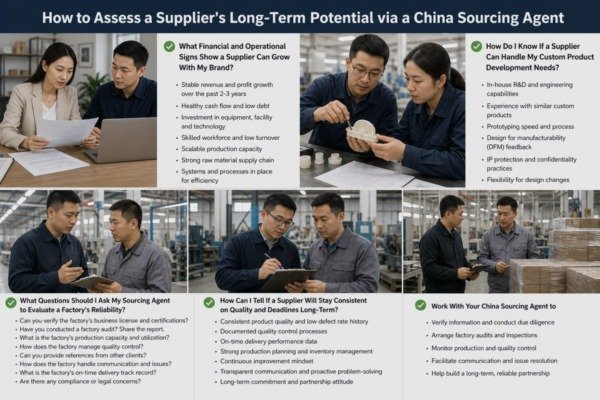
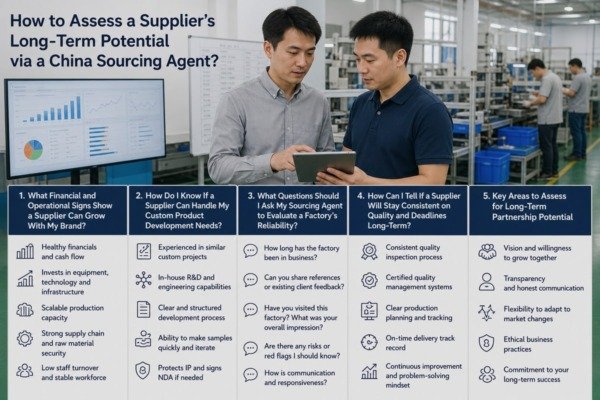
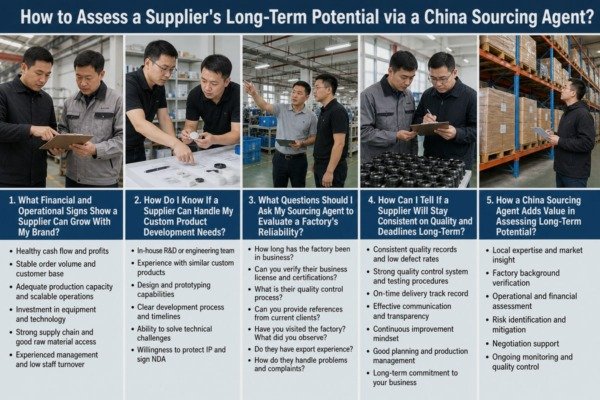
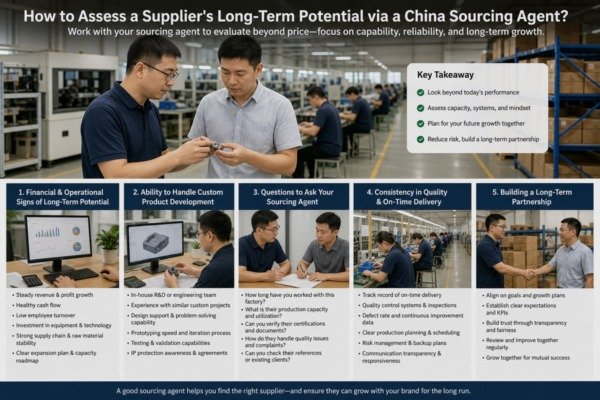
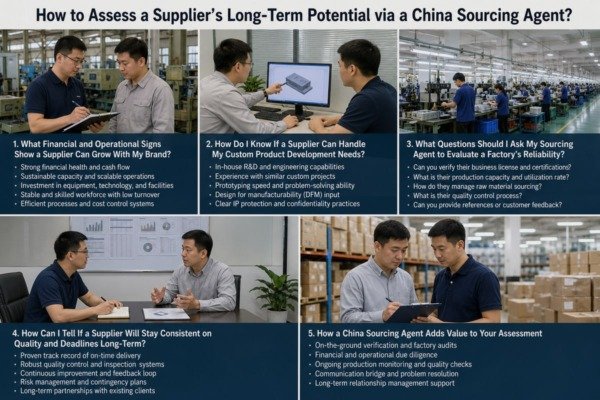
What Financial and Operational Signs Show a Supplier Can Grow With My Brand?
Every shortlist forces the same trade-off on my desk: the factory with the cheapest quote, or the one whose books, equipment logs, and capacity buffers can survive year three.
A supplier can grow with your brand when it shows clean business license verification, stable ownership on Tianyancha or Qichacha, no hidden litigation, maintained equipment, spare production capacity, an automation roadmap, and normal payment terms instead of aggressive upfront deposit demands.
Buyers often push back here. They tell me price should be the first filter because margins are tight. I understand that. But the cheapest supplier becomes the most expensive one once you add defects, delays, and air-freight rescues. We always compare total landed cost, not the quote.
Financial Health You Can Verify
A proper financial risk assessment starts with official Chinese registries. Our team pulls records from Tianyancha or Qichacha before any factory visit. These platforms expose litigation history, ownership changes, pledged equity, and abnormal registration updates. A factory under debt pressure will cut material quality 1 or overpromise capacity long before it admits trouble. Abnormal payment terms are another warning sign. When a supplier suddenly demands unusually high deposits, cash flow stress is often the reason.
Operational Capacity That Scales
Financial checks tell you the supplier will survive. Operational checks tell you it can grow. Manufacturing scalability depends on real factory production capacity, not the number printed in a sales brochure.
| Signal | How the Agent Verifies It | Red Flag |
|---|---|---|
| Capacity buffer | Compare current utilization to peak-season output | Lines already running at full load |
| Equipment condition | Review maintenance logs on-site | No logs, or logs backfilled |
| Automation roadmap | Ask about investment plans for the next five years | No plan to offset rising labor costs |
| Legal standing | Business license verification plus registry checks | Frequent ownership changes, open lawsuits |
| Payment behavior | Compare deposit terms to industry norms | Demands far above standard deposits |
A factory investing in robotics and smart manufacturing 2 is signaling it plans to stay competitive as China's labor costs rise. That is exactly the partner a growing brand needs.
How Do I Know If a Supplier Can Handle My Custom Product Development Needs?
Last spring, a US lifestyle-brand founder sent me a WhatsApp voice note. Her factory had botched her design drawings three times in a row. Sound familiar?
A supplier can handle custom product development when it has an in-house engineering team, R&D and prototyping autonomy, an internal testing lab, documented sample revision records, and proven sample-to-production consistency—not merely a willingness to copy your drawings at a low price.
Fidelity of design execution is the pain point I hear most from brand founders. Having sourced consumer electronics, smart home devices, beauty products, and outdoor gear for clients, my team has learned that custom capability lives in three layers.
The Three Layers of Development Capability
First, category fit. A factory that has never made your product type will misjudge materials, tolerances, and common failure points. General manufacturing competence does not transfer across categories.
Second, R&D innovation capabilities. The strongest suppliers do not just execute instructions. They give design-for-manufacturing feedback 3, flag risks in your drawings, and suggest cost-neutral improvements. A factory that pushes back intelligently is showing engineering depth. A factory that says yes to everything is showing sales enthusiasm.
Third, repeatability. The golden sample proves almost nothing on its own. Sample rooms use senior technicians; production lines use regular workers. Your agent must confirm the quality management system 4 can reproduce the sample at scale.
| Capability | Strong Evidence | Weak Signal |
|---|---|---|
| Engineering depth | DFM feedback, tolerance questions, material alternatives | Instant "no problem" to every request |
| Prototyping autonomy | In-house mold room or rapid prototyping tools | Everything outsourced to unknown workshops |
| Testing | Dedicated in-house lab with calibrated equipment | Testing "arranged when needed" |
| Documentation | Sample revision logs and spec sign-off sheets | Verbal confirmations only |
One caution: agent vetting never replaces your own clear specifications. We can verify a factory's capability, but we cannot verify an ambiguous drawing. The best results come when the buyer defines specs tightly and the agent enforces them relentlessly.
What Questions Should I Ask My Sourcing Agent to Evaluate a Factory's Reliability?
Years of writing supplier audit reports have taught me something uncomfortable: the questions buyers never ask are exactly the ones that predict failure later.
Ask your sourcing agent for the full supplier audit report, business license verification results, three to five Western buyer references, export history to your market, sub-tier supply chain mapping, social compliance findings, and details on the factory's internal management structure and staff turnover.
A good agent turns vague claims into evidence. These are the questions I encourage every client to put to us, in the order I would ask them:
- Can I see the complete supplier audit report, not a summary? Full reports reveal what the summary softens.
- Did you verify the business license, production permits, and registration details yourself? Third-hand paperwork is not verification.
- Can the factory provide three to five references from Western buyers with similar products? Repeated success with similar buyers beats generic claims of "many years of experience."
- What is their export history to my specific market? Familiarity with US, UK, or EU documentation and labeling rules is a leading indicator of operational discipline.
- Have you mapped their sub-tier supply chain? Supply chain transparency matters because a factory dependent on one raw-material provider inherits that provider's risk. Your continuity depends on their tier-two suppliers too.
- What did the social compliance standards check reveal? Labor and safety findings predict how a factory behaves under pressure.
- How is the factory managed internally, and how stable is the merchandising team? This question sounds soft. It is not, as I explain in the next section.
- How many candidates did you screen to reach this shortlist? When we run a broad search, we typically funnel twenty to thirty leads down to five to ten candidates, then two to three finalists. A shortlist without a funnel is just a contact list.
One honest counterpoint: not every purchase needs this depth. For low-risk, non-custom, low-volume products, lighter vetting is often enough. But for custom, regulated, or growth-stage sourcing, deep procurement risk mitigation pays for itself many times over, because the cost of failure is far higher.
How Can I Tell If a Supplier Will Stay Consistent on Quality and Deadlines Long-Term?
We once approved a factory that looked flawless—advanced equipment, motivated line workers, orderly floors. The real trap hid somewhere no checklist pointed: its merchandising team.
Consistency shows in a documented quality management system, stable middle management and merchandisers, low staff turnover, completed corrective actions, and tracked metrics—on-time delivery, defect rate, and response time—verified through trial orders and periodic scorecards rather than first impressions.
Let me finish that story, because it reshaped how our team audits factories. Everything on the surface was excellent. But the factory had embraced a fashionable "amoeba" management model, letting its sales merchandisers grow wild as independent mini-businesses. Internal department walls were severe. Some merchandisers simply could not push projects through engineering and production, no matter how urgent our client's timeline was. Orders stalled inside the building while the production lines sat capable. We switched factories quickly and recovered the losses for our client, but the lesson stuck: internal management structure is the most overlooked predictor of a supplier's long-term potential.
The Hidden Layer: Internal Management Structure
Quality fade rarely starts on the production line. It starts when key people leave or when departments stop cooperating. High turnover among middle managers and technical staff is one of the strongest early warnings of future quality decay in long-term contracts. So now we interview merchandisers directly, test how fast a request travels from sales to engineering, and ask who actually owns a delayed order.
Build a Scorecard, Not a Gut Feeling
Long-term consistency should be measured, not felt. We track every active supplier on a simple scorecard, reviewed after each order.
| Metric | What Good Looks Like | Why It Predicts Consistency |
|---|---|---|
| On-time delivery rate | Stable across seasons, not just off-peak | Reveals scheduling discipline |
| Defect and rework rate | Low and trending down | Proves the QC system works in-process |
| Sample-to-production match | Production matches signed specs | Confirms repeatability, not luck |
| Response and resolution speed | Issues raised early, fixed fast | Shows transparency under pressure |
| Corrective-action completion | Audit findings closed on schedule | Separates promises from systems |
| Key staff stability | Same merchandiser and engineers over time | Guards against quality fade |
Weight operational reliability more heavily than quoted price. Then confirm everything with a small trial order before scaling. Behavior on a live order, tracked over six to twelve months, is the only proof that matters.
Conclusion
Cheap quotes fade; verified partners compound. My team assesses a supplier's long-term potential through evidence—registry checks, audits, references, trial orders, and scorecards—because durable sourcing is built on proof, never optimism.
Footnotes
1. ASQ is a leading global authority on quality improvement and manufacturing standards. ↩︎
2. Replaced broken NIST link with the current authoritative NIST topic page for smart manufacturing. ↩︎
3. ASME provides engineering standards and guidance for mechanical design and manufacturing processes. ↩︎
4. ISO is the global authority for quality management standards used in supplier audits. ↩︎