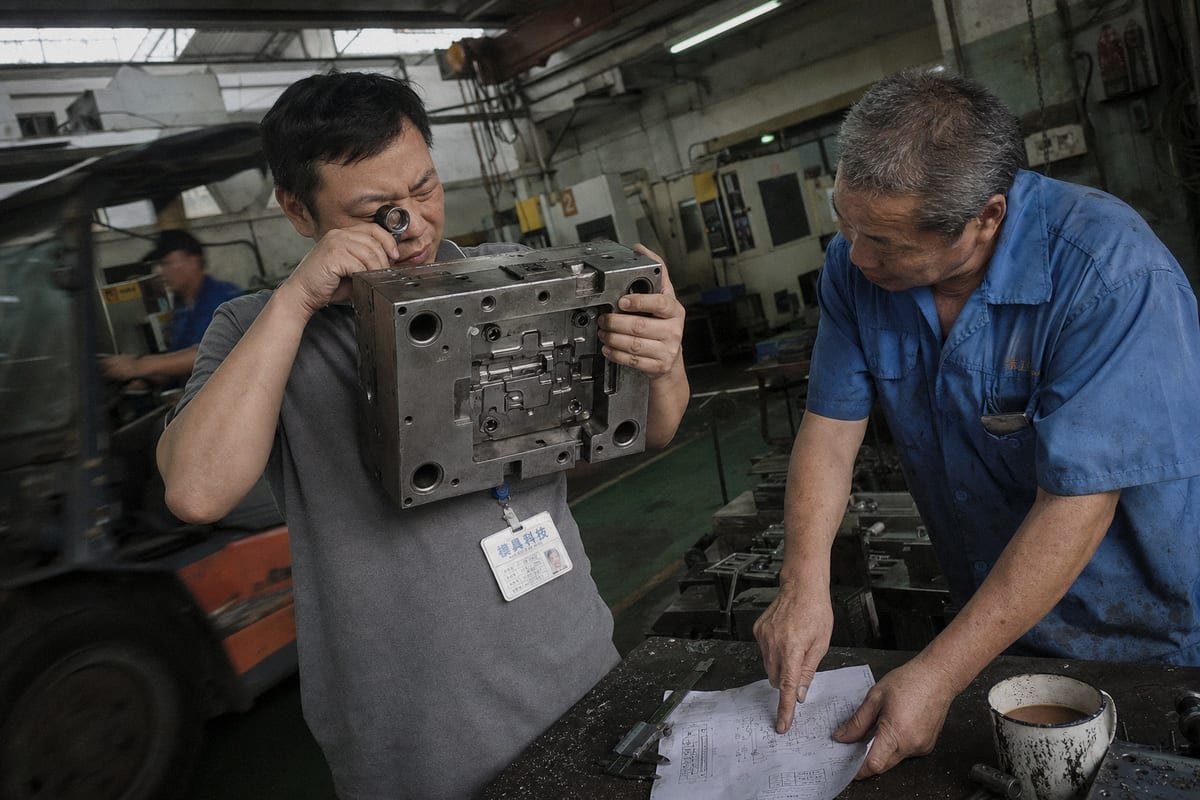
Last year, our Shenzhen team rescued a startup whose mold was cut before anyone checked the design CMM dimensional reports 1. China sourcing agents handle mold manufacturing and sample verification precisely to stop disasters like that. One bad mold can burn months and thousands of dollars third-party quality control inspection 2. There is a better way.
China sourcing agents manage mold manufacturing and sample verification by vetting factories with real tooling capability, running Design for Manufacturing reviews before steel cutting, supervising T1–T3 mold trials, and enforcing golden sample approval through independent quality control inspection before mass production is authorized.
That is the short answer. Below, I break down each stage of the process, share what we do differently for first-time product creators, and give you realistic cost and timeline expectations.
How Do I Know If a China Sourcing Agent Can Handle Custom Mold Development for My Product?
A founder once sent me a beautiful concept sketch and asked for a quote. I had to explain that a sketch is not a manufacturable design. That conversation reveals everything.
A capable agent demonstrates real technical depth: they ask for 3D CAD files or offer 3D modeling support, run DFM reviews, control factory audits themselves, understand mold steel and cavity options, and protect your intellectual property with enforceable Chinese-language contracts before any design is shared.
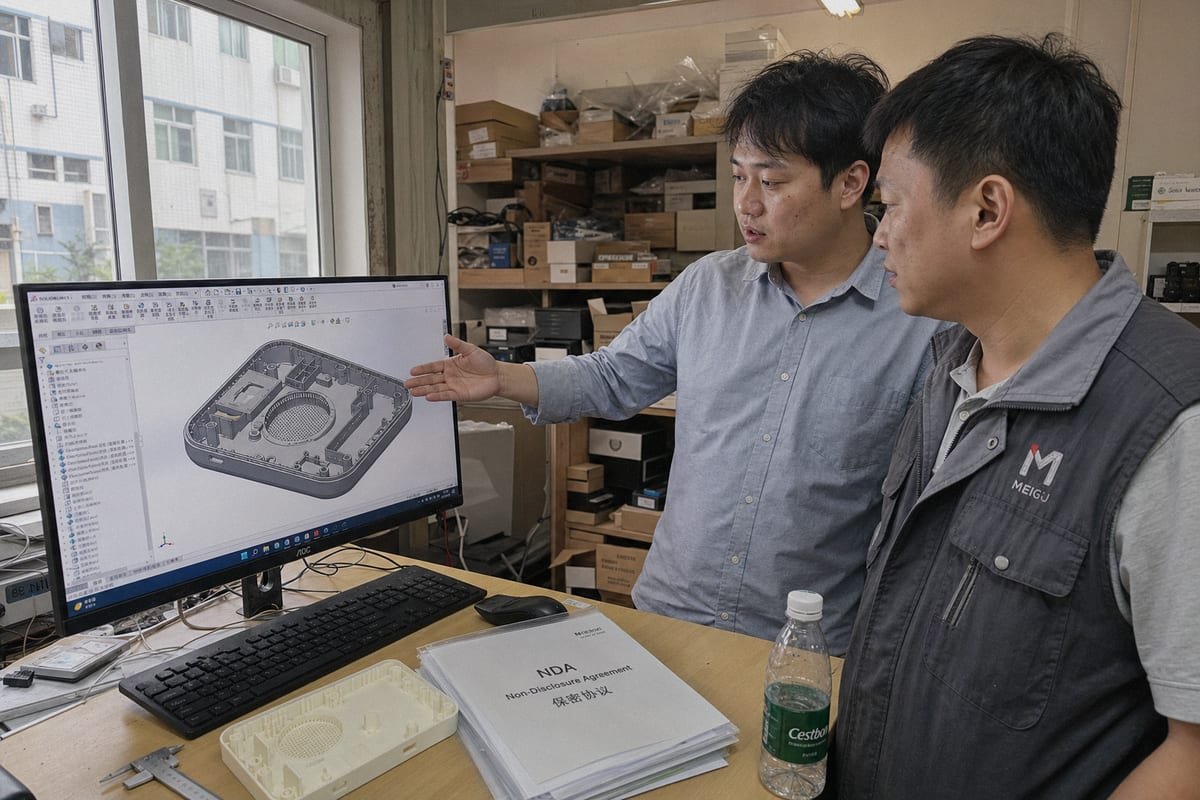
Many first-time brand founders do not realize how wide the gap is between a concept design and a production-ready 3D model. In our supply chain consulting work, we often join the 3D modeling stage ourselves. Why? Because client concepts usually miss practical details. Wall thickness. Draft angles. Ejector positions. Assembly tolerances. From an industrial design standpoint, these details decide whether a mold works or fails. We see ourselves as the team that thinks through those practical details for the client. We are not a traditional trading agent that only knows how to sell goods.
Questions That Expose a Weak Agent
Ask these before you commit:
- Can you review my CAD files and flag manufacturability issues?
- Do you control the 3D modeling process, or is it outsourced blindly?
- Have you managed injection molding tooling 3 projects in my product category?
- How do you verify a factory actually owns its mold shop?
- What does your intellectual property protection 4 process look like?
A strong agent answers each one with specifics. A weak agent talks about price.
Capability Checklist
| Capability | Why It Matters |
|---|---|
| 3D modeling (in-house or controlled) | Keeps costs predictable and design intent intact |
| DFM review before quoting | Prevents rework after steel is cut |
| Rapid prototyping / 3D printing access | Lets you touch the product before tooling investment |
| Factory audit experience | Filters out middlemen posing as mold makers |
| Bilingual NDA and tooling contracts | Secures mold ownership and confidentiality |
Some of our partner factories now run 3D printers on-site. After modeling, they can turn imagination into something the client can physically hold within days. For startups, that single step prevents most expensive mold modifications later.
What Does the Mold Manufacturing Process Look Like When I Work With a Sourcing Agent in China?
There is a trade-off we weigh on every tooling project: move fast and risk rework, or verify each gate and protect the budget. We always choose the second path.
The process runs through six controlled stages: a detailed RFQ with CAD files and specs, a DFM review with mold flow analysis, tooling fabrication, T1 trial shots, iterative revisions through T2 and T3, and final golden sample approval before mass production begins.
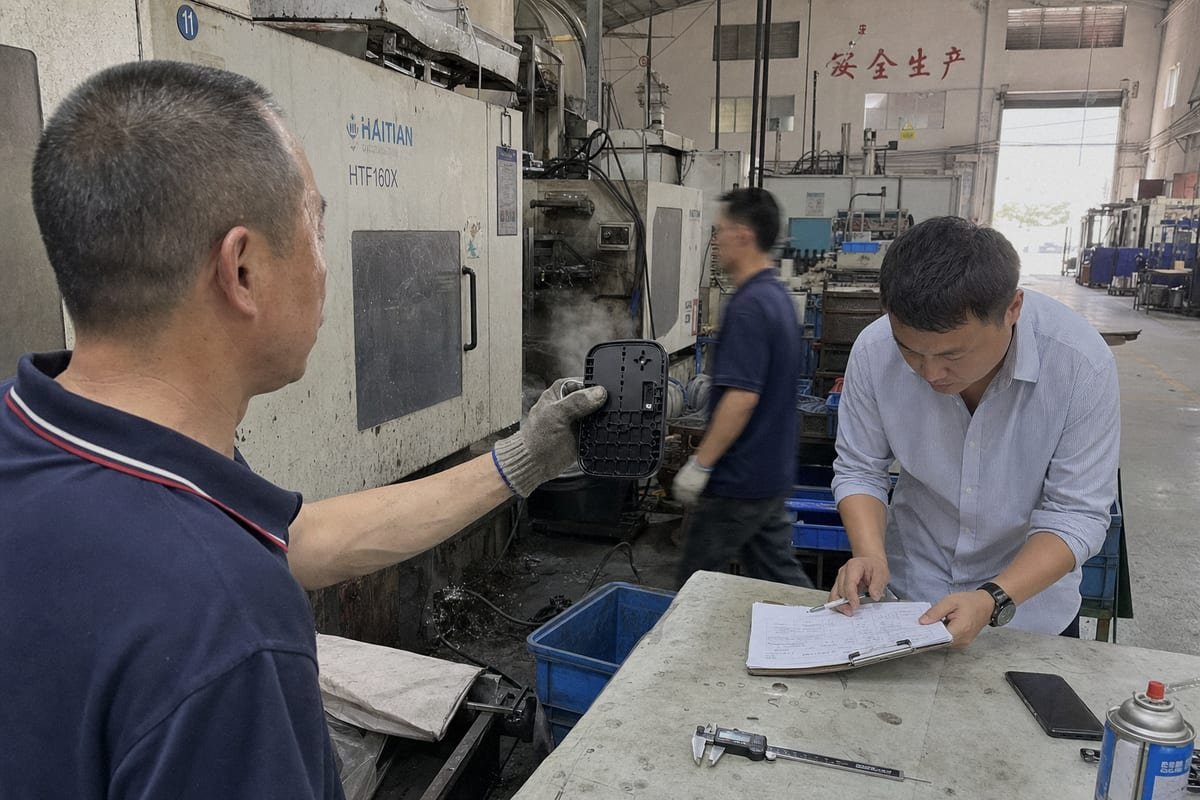
Our team follows a strict sequence because skipping steps is where money dies. Here is how a typical project flows when we manage it.
The Six-Stage Workflow
| Stage | What Happens | Agent's Role |
|---|---|---|
| 1. RFQ | CAD files, materials, critical dimensions, product specification sheet compiled | Translate requirements into a clear technical brief |
| 2. DFM | Design for Manufacturing 5 review, mold flow simulation | Catch sink marks, weld lines, ejector conflicts before steel cutting |
| 3. Tooling | Steel selection 6, cavity machining, EDM work | Verify steel grade, cavity count, and cycle-life match the contract |
| 4. T1 Trial | First shots test basic mold function | Collect photos, videos, dimensional data, mold trial report |
| 5. T2/T3 | Revisions for dimensions, surface, fit | Confirm every revision point before the next shot |
| 6. Golden Sample | Final approved reference sample | Lock material, color, size, function as the production standard |
The DFM stage deserves emphasis. Before any steel is cut, we push the factory to simulate how plastic will flow through the tool. This exposes problems on a screen instead of in expensive hardened steel. We also clarify the mold usage plan early. Will the mold stay in China or ship abroad? That answer changes steel selection, expected mold life, and the entire cost structure.
We negotiate revision policies upfront too. Most factories offer one or two free revision rounds. We define turnaround times for each round in writing, because vague revision terms are where hidden costs breed.
How Do Sourcing Agents Verify Sample Quality Before Mass Production Begins?
During a smart home device project, our inspector caught a two-millimeter warp on a T2 sample that photos had hidden. On-site verification saved that client's entire launch window.
Agents verify sample quality through First Article Inspection after T1, CMM dimensional reports against the product specification sheet, on-site supervision of mold trials, third-party quality control inspection at T2 or T3, and rigorous golden sample approval covering material, color, size, function, and assembly.
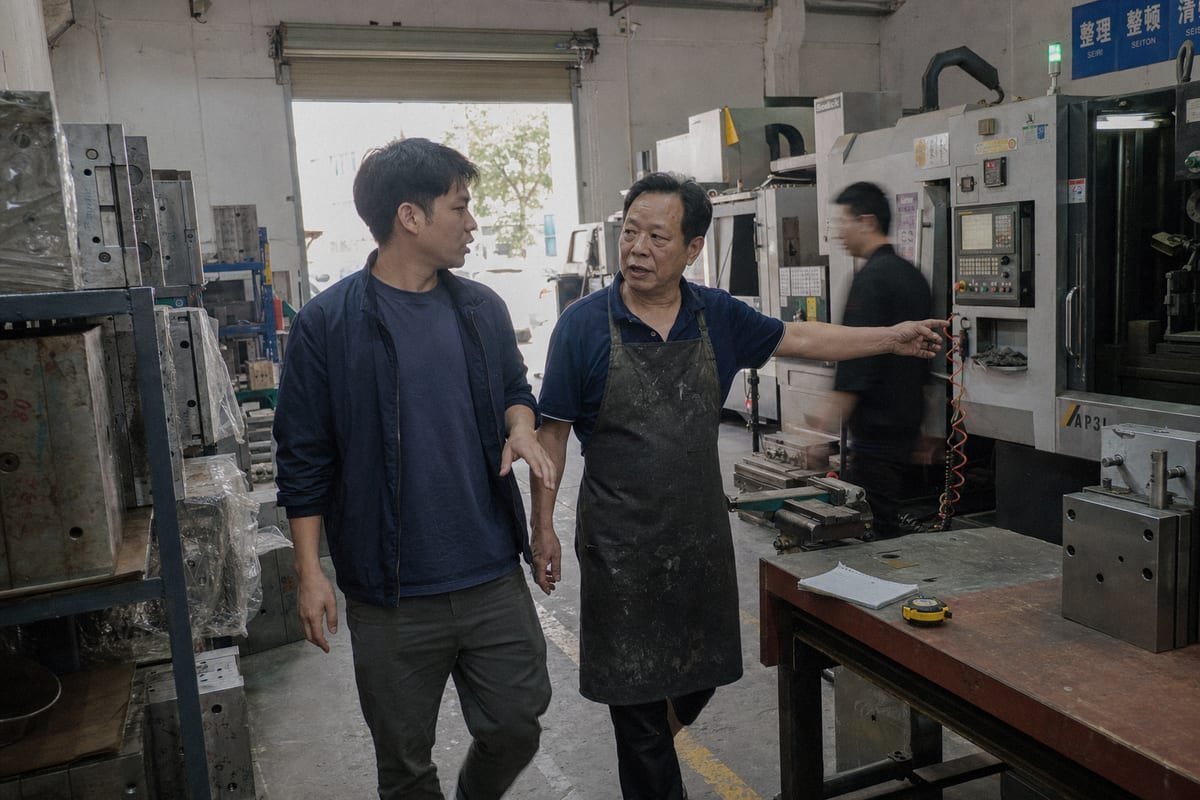
Verification is not one event. It is a chain of checkpoints, and each one has a purpose.
First Article Inspection After T1
After the first trial shots, we require a full mold trial report. This includes dimensional data, machine parameters, cycle times, and macro photos of every surface. We compare each critical dimension against the drawings. If the factory cannot produce CMM data, that itself is a red flag about their quality system.
On-Site Supervision and Third-Party Audits
For T2 and T3 trials, we either attend in person or send a local third-party inspector. They watch for flashing, warping, short shots, and sink marks while the parts come off the machine. They also verify the machine settings match what was documented, because parameters that drift produce parts that drift. Our clients in the US and Europe receive real-time updates from their purchasing agent: video feeds, close-up photography, and inspection notes directly from the factory floor, usually over WhatsApp because that is what founders like our client Katle prefer.
The Golden Sample Protocol
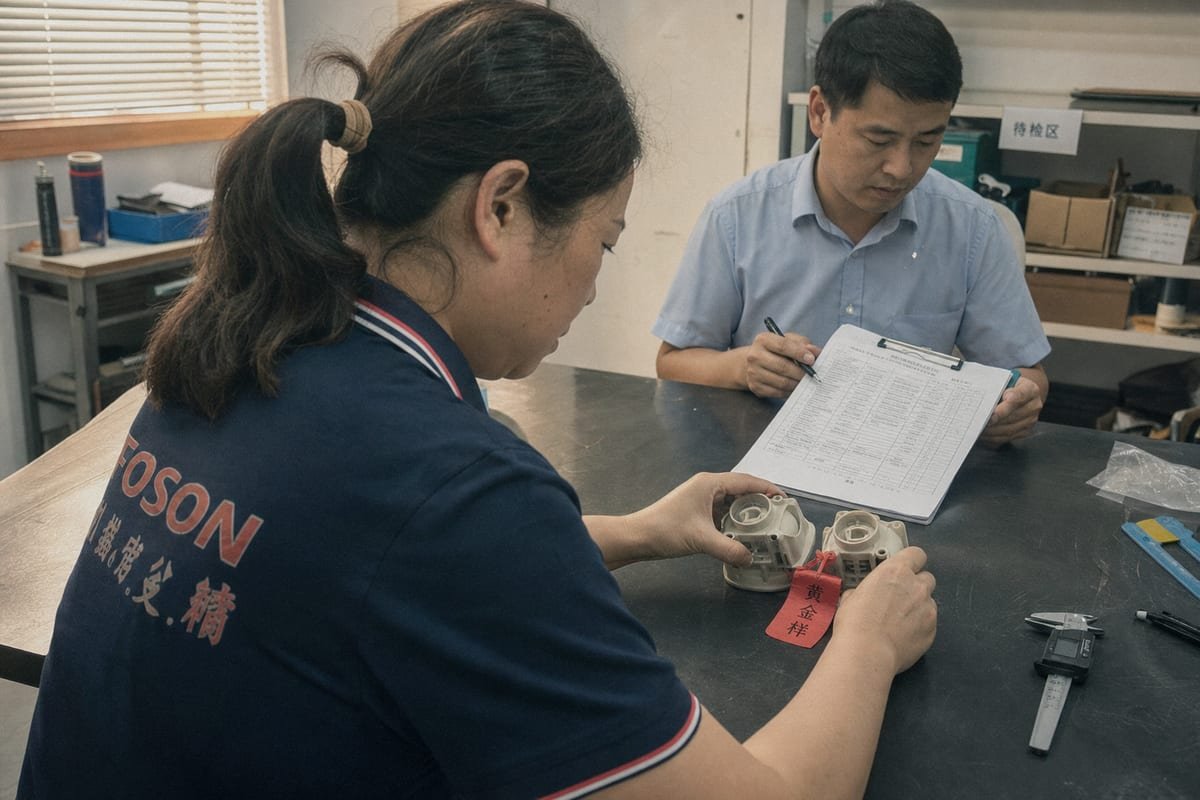
The pre-production sample (PPS) that passes every check becomes the golden sample. We seal and sign it. It then serves as the binding reference for mass production. Every future quality control inspection compares production units against this physical standard, not against memory or email descriptions. Material, finish, color, function, and assembly fit are all locked at this moment. Nothing ships until production matches it.
What Should I Expect in Terms of Costs and Timelines for Mold Making and Sample Approval?
The hardest lesson we teach first-time founders: your calendar is probably wrong. Almost every new client underestimates tooling lead time, and glass products are the classic example.
Expect two to eight weeks for mold fabrication depending on complexity, plus multiple revision rounds. For materials like glass, budget at least two months for mold making and sampling combined, because first-shot approval almost never happens and revisions are the norm, not the exception.
Let me give you the realistic numbers we quote our own clients, based on projects across consumer electronics, beauty products, and outdoor gear.
Typical Timelines
| Mold Type | Time to First Sample | Realistic Total (With Revisions) |
|---|---|---|
| Simple aluminum mold | 10–18 days | 3–5 weeks |
| Standard steel mold | 20–30 days | 5–8 weeks |
| Glass product mold | 4–6 weeks | 2+ months minimum |
| Multi-cavity complex tooling | 5–8 weeks | 2–3 months |
We tell every glass-product client the same thing: reserve at least two months for the mold and sampling phase. Mold trials for glass almost always require modification. Planning for a one-shot success is planning to miss your launch date.
What Drives the Cost
Several factors move the price up or down:
- Steel grade and hardness. Export molds and high-volume tools need better steel. We require steel certificates and hardness reports 7 at handover to prevent quiet substitution with cheaper material.
- Cavity count. More cavities cost more upfront but cut your unit price later.
- Revision policy. One or two free revision rounds are standard. Get extra-revision pricing in writing before you sign.
- 3D modeling and prototyping. If your agent controls modeling in-house or through managed partners, this cost stays predictable. Blind outsourcing inflates it.
- Mold ownership terms. A proper contract confirms you own the tool and can relocate it. This protects both your investment and your intellectual property.
Finally, the handover package matters. We make sure clients receive 2D and 3D mold drawings, trial reports, steel certificates, and a spare parts list. That documentation keeps your mold running for years and keeps you independent of any single factory.
Conclusion
Mold manufacturing punishes shortcuts. A skipped DFM review or rushed sample approval can erase your budget and launch date. A capable sourcing agent turns that risk into a controlled, verified process.
Our team at GoSource treats every tooling project as supply chain consulting, not just buying. From 3D modeling support to golden sample approval, we manage the details first-time founders cannot see. If you are developing an original product and want the mold done right the first realistic time, reach out. I am happy to walk through your design personally.
Want to see this in person? Photos of a mould never tell you how well it is maintained. Standing next to one does. If you are coming to China, we run a one-day Shenzhen sourcing tour: we visit shortlisted suppliers together, check the things a report cannot capture, and you leave with a written plan.
Footnotes
1. Defines CMM technology used for dimensional verification against product specs. ↩︎
2. ISO is the authoritative standards body underlying quality control inspection practices. ↩︎
3. Background reference for the tooling and mold manufacturing process discussed. ↩︎
4. WTO TRIPS agreement is the authoritative source on international IP protection standards. ↩︎
5. Explains the DFM concept referenced as a core mold review step in the article. ↩︎
6. Explains tool steel grades and properties that affect mold life and manufacturing cost. ↩︎
7. ISO standard governing steel hardness testing referenced for mold handover verification. ↩︎