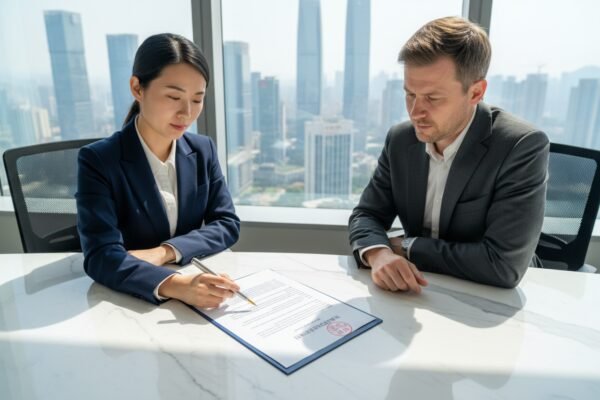
Every week, our team at Go Source reviews product specs from new clients—and too often, those specs arrive without any legal protection in place intellectual property leaks 1. The problem is real: once your designs reach a Chinese factory floor without a proper agreement, there is no rewind button. The pain hits hardest when a copycat product shows up on Alibaba six months later, undercutting your price by 40%.
When hiring a China sourcing agent, you need Non-Disclosure, Non-Use, and Non-Circumvention (NNN) agreements signed with both your agent and every supplier in the chain. These must be bilingual, governed by Chinese law, and executed before any product details are shared.
Below, I will walk you through the exact types of agreements you need, when to sign them, and how to make sure they actually hold up in a Chinese court. Let's start with the most common mistake importers make on day one.
Why do I need an NDA before sharing my product specifications with a China sourcing agent?
When we onboard a new client at Go Source, the first question we ask is: "Do you have your NNN agreements 2 ready?" Most say no. That silence is where intellectual property leaks begin.
You need an NDA or NNN agreement before sharing product specifications because once your designs, molds, or technical drawings reach a sourcing agent or factory without legal protection, Chinese law offers very limited recourse to stop unauthorized copying or use of that information.
The Information Flow Problem
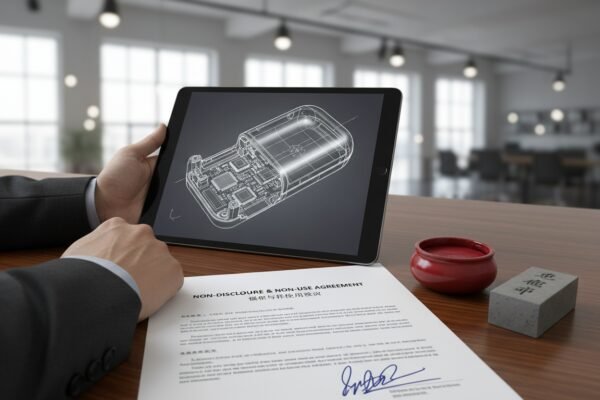
Think about what happens the moment you email a product drawing to a sourcing agent. That agent may forward it to five, ten, or even twenty factories for quoting. Each factory has engineers, sales teams, and sometimes sub-contractors who all see your design. Without a signed agreement, none of these parties have a legal obligation to keep your information confidential.
In our experience coordinating sourcing for U.S. and European SMEs, we have seen cases where a factory received a unique product design during the quoting phase, declined the order, and then produced a near-identical product under a different brand within months. This is not rare. Copycat manufacturing in China 3 is, as legal experts put it, "deservedly famous."
What Information Is at Risk?
It is not just product designs. Here is a breakdown of the types of confidential information 4 that need protection:
| Information Type | Risk If Leaked | Priority Level |
|---|---|---|
| Product drawings and CAD files | Direct copying by competitors | Critical |
| Pricing and cost structures | Competitors undercut your margins | High |
| Customer and buyer lists | Suppliers bypass you to sell directly | Critical |
| Tooling and mold specifications | Factory reuses molds for other clients | High |
| Marketing strategies and launch dates | Knockoffs hit the market before you | Medium |
| Packaging and branding details | Counterfeit products appear online | High |
The Timing Rule
The rule is simple: sign before you share. Not after the first sample. Not after you pick a supplier. Before you send a single email with product details. Our team sends the NNN agreement as part of the initial onboarding package. No signed agreement, no access to specs. This protects both the client and us.
Why a Generic NDA Falls Short
A basic NDA only covers non-disclosure. It says "don't tell anyone." But it does not say "don't use this information yourself" or "don't go around me to contact my customers." In China's manufacturing ecosystem, the bigger risks are unauthorized use and circumvention—not just gossip. That is why the NNN framework exists, and why it should replace your standard NDA from the start.
Should I sign a standard NDA or a China-specific NNN agreement to protect my intellectual property?
Our legal team in Shenzhen fields this question almost daily. Clients often arrive with a beautifully drafted NDA from their U.S. or European attorney. Unfortunately, that document is often worth less than the paper it is printed on—at least in a Chinese courtroom.
You should sign a China-specific NNN agreement rather than a standard Western NDA. An NNN agreement covers non-disclosure, non-use, and non-circumvention under Chinese law, making it enforceable in Chinese courts where your supplier's assets are located and where disputes will actually be resolved.
NDA vs. NNN: A Direct Comparison
Let me lay out the differences clearly. This is the table I share with every new Go Source client:
| Feature | Standard Western NDA | China-Specific NNN Agreement |
|---|---|---|
| Non-Disclosure | ✔ Covered | ✔ Covered |
| Non-Use (prevents supplier from using your IP for their own products) | ✘ Not covered | ✔ Covered |
| Non-Circumvention (prevents supplier from contacting your buyers directly) | ✘ Not covered | ✔ Covered |
| Language | English only | Bilingual (Chinese controls) |
| Governing Law | Western jurisdiction | Chinese law 6 |
| Enforceable Court | Your home country courts | Chinese courts near supplier assets |
| Practical Enforcement | Extremely difficult in China | Directly enforceable |
| Liquidated Damages Clause | Rare | Standard and recommended |
Why Non-Use Matters
A standard NDA says: "Don't tell anyone about my product." An NNN agreement adds: "Don't make this product yourself or for anyone else." Without the non-use clause, a factory can legally argue, "We didn't tell anyone—we just made the product ourselves." This loophole is real. I have personally seen it exploited.
Why Non-Circumvention Matters
Circumvention is extremely common in China sourcing. Here is how it works: you share your buyer list or end-customer details with a factory during negotiations. The factory then contacts your buyers directly, offering the same product at a lower price. Without a non-circumvention clause, there is no legal basis to stop this.
The Language and Jurisdiction Trap
This is where most Western NDAs fail completely. If your agreement is in English, governed by New York or London law, and specifies arbitration in your home country, here is what happens in practice: nothing. A Chinese court will not enforce a foreign-language agreement governed by foreign law. The supplier knows this. Their lawyer knows this.
My strong recommendation—and this comes from working with Chinese IP attorneys daily—is to hire a lawyer based in China to draft this agreement. The contract should be bilingual, with Chinese and your home language, and the Chinese version should be the controlling language. Governing law must be Chinese, and the jurisdiction should be a Chinese court located near the supplier's registered assets. This gives you actual leverage.
Liquidated Damages: Your Real Deterrent
Include a specific monetary penalty for each breach. Chinese courts respect liquidated damages clauses 7 when they are reasonable and clearly defined. Vague language like "all damages incurred" is weak. A specific figure—say, RMB 500,000 per breach—sends a clear message and gives the court a concrete enforcement target.
How can my sourcing agent help me manage non-disclosure agreements with multiple Chinese suppliers?
When our procurement team at Go Source begins supplier qualification for a client, we may contact fifteen to thirty factories before shortlisting three to five. That means fifteen to thirty potential exposure points for your intellectual property. Managing NDAs across this many parties is where a good sourcing agent earns their value.
Your sourcing agent should serve as the legal gatekeeper between your IP and the supply chain. They manage the signing of NNN agreements with every supplier and sub-factory before sharing your specs, verify each signer's legal authority, and control the flow of confidential information at every stage.
The Step-by-Step Process
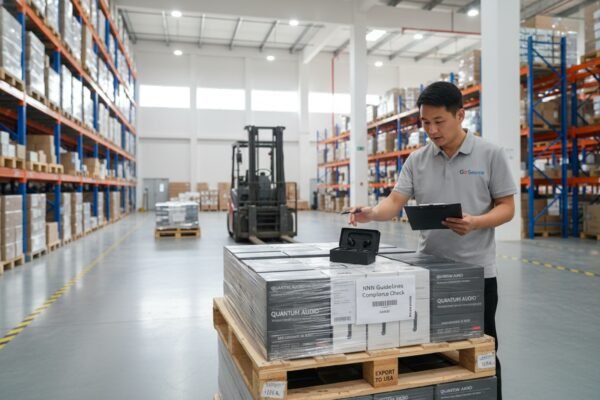
Here is the exact workflow we follow at Go Source. I share this so you can evaluate whether your current agent follows a similar protocol:
- Client signs NNN with Go Source first. Before we see any product details, we sign an NNN agreement with the client. This protects both sides.
- We qualify suppliers without sharing full specs. During initial screening, we use general product descriptions, not detailed drawings. We verify factory credentials: business license, registered legal name, office location, and certifications like ISO or CE.
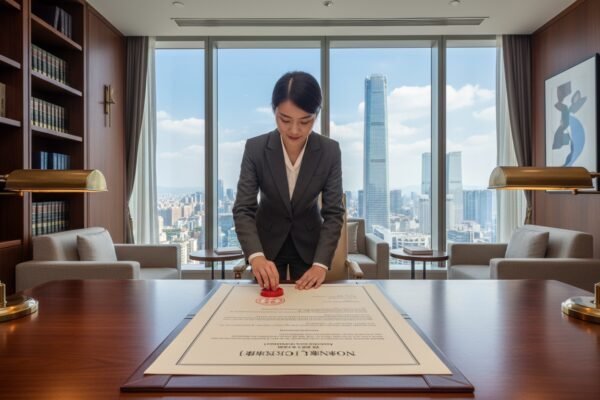
- Shortlisted suppliers sign NNN agreements. Only after a factory passes our vetting do we present the NNN agreement for their signature. We verify that the signer has legal authority and that the company chop (official seal) 8 is applied.
- Sub-factories sign separate NNN agreements. If the main supplier outsources any process—molding, electroplating, assembly, packaging—each sub-factory must also sign an NNN agreement.
- Only then do we share detailed specs. Product drawings, CAD files, and technical requirements flow only to signed parties.
Why Sub-Factories Are the Weak Link
Most importers forget about sub-factories. Your main supplier may be trustworthy, but they often outsource specialized processes. Each sub-factory is a separate company with its own interests. If they are not bound by an NNN agreement, they can freely use your mold designs or product specs for other clients. Our team maps the entire supply chain and ensures every link is covered.
Verifying Signer Authority
A signed agreement is worthless if the person who signed it had no authority to bind the company. Here is what we verify before accepting any signed NNN:
| Verification Item | What We Check | Why It Matters |
|---|---|---|
| Legal company name | Matches business license exactly | Prevents signing by shell companies |
| Company chop (official seal) | Red seal applied to agreement | Required for legal validity in China |
| Signer identity | Name and title match authorized representative | Ensures binding authority |
| Business license status | Active and not expired | Confirms the company legally exists |
| Registered address | Matches factory location or known office | Reduces fraud risk |
Controlling Information Flow
A skilled agent does not dump all your information on every factory at once. We use a tiered disclosure approach:
- Tier 1 (Quoting phase): General product category, rough dimensions, target price range. No drawings.
- Tier 2 (After NNN signed): Detailed specifications, material requirements, tolerances.
- Tier 3 (After supplier confirmed): Proprietary designs, mold files, branding elements, customer details.
This limits exposure at each stage. If a factory declines the project after Tier 1, they have seen nothing proprietary.
Requiring Supply Chain Transparency
As a 2025 best practice, require your agent to provide and regularly update a full supply chain map. This document lists every factory and sub-factory involved in your production, their roles, and their NNN agreement status. If your agent cannot or will not provide this, that is a serious red flag.
Additionally, consider adding a clause to your NNN agreements that explicitly prohibits any party in the chain from using your shared data, designs, or market insights to train artificial intelligence models or for competitive AI-driven analysis. This is a newer concern, but it is growing rapidly as factories adopt AI tools in product development.
Will my Western-style NDA actually protect my brand if a Chinese factory violates the contract?
In our years of helping clients navigate disputes with Chinese suppliers, one painful truth keeps repeating: a Western-style NDA gives you a false sense of security. Clients wave their American or British NDA and expect results. Then reality hits.
No, a Western-style NDA will not effectively protect your brand in China. Chinese courts are not obligated to enforce agreements governed by foreign law, written only in English, or specifying foreign jurisdictions. To protect your brand, you need a China-enforceable NNN agreement combined with registered IP rights in China.
Why Western NDAs Fail in Chinese Courts
Let me be direct. If your NDA specifies Delaware law, English language, and arbitration in New York, here is what a Chinese factory owner sees: zero risk. They know you would need to win a judgment in the U.S., then attempt to have it recognized in China—a process that is expensive, slow, and frequently unsuccessful.
Chinese courts operate under Chinese law. They enforce Chinese-language contracts with Chinese jurisdiction clauses. Everything else is, as one IP attorney in Shanghai told me, "a paper tiger."
What Actually Works
Here is a practical framework based on what we recommend to Go Source clients:
1. Draft the NNN under Chinese law. Hire a China-based attorney. Not a Western firm with a China desk—a licensed Chinese attorney who practices in the jurisdiction where your supplier operates.
2. Use bilingual contracts, Chinese controlling. The agreement should be in both Chinese and English (or your language). Specify that in case of any conflict, the Chinese version prevails. This is critical for court interpretation.
3. Specify jurisdiction near the supplier's assets. If your supplier is in Dongguan, the agreement should specify a court in Dongguan or the relevant Guangdong province court. Why? Because even if you win a judgment, enforcement requires access to the defendant's assets. A judgment from a Beijing court against a Shenzhen factory creates unnecessary complications.
4. Register your IP in China. An NNN agreement is a contract. It protects you against the specific parties who signed it. But trademark registration, patent registration, and copyright registration in China protect you against everyone. China operates on a first-to-file system 9 for trademarks—meaning whoever files first owns it, regardless of who used it first. Register before you start sourcing.
5. Include a digital forensics cooperation clause. This is a newer recommendation for 2025 and beyond. Add a clause requiring all parties to cooperate with digital forensics investigations if a data breach or IP leak is suspected. This gives you legal footing to investigate, rather than just suspect.
The Cost of Getting It Wrong
I have seen clients lose entire product lines because they relied on a template NDA downloaded from the internet. One client shared a proprietary design with a factory in Yiwu, protected only by a one-page English NDA. Six months later, that exact product appeared on Amazon under a different brand, sold at half the price, shipped from the same city. The client had no enforceable agreement and no registered trademark in China. The legal options were effectively zero.
ESG and IP Protection: An Emerging Connection
An interesting trend we are seeing in 2025 is the integration of IP protection with ESG compliance. Factories that maintain high ethical standards—fair labor practices, environmental compliance, transparent governance—tend to have lower rates of IP theft. This makes sense: a factory willing to cut ethical corners in one area is more likely to cut them in others. When we audit factories for Go Source clients, ESG compliance is now part of our IP risk assessment.
Your Action Checklist
Before you engage any China sourcing agent 10 or supplier, make sure you have:
- A China-specific NNN agreement drafted by a Chinese attorney
- Bilingual contracts with Chinese as the controlling language
- Chinese jurisdiction specified near the supplier's assets
- Trademarks, patents, and copyrights registered in China
- A tiered information disclosure plan
- A digital forensics cooperation clause
- A full supply chain map with NNN coverage at every level
Conclusion
Protecting your intellectual property in China sourcing requires more than a handshake or a Western template. Use China-specific NNN agreements, hire a local attorney, register your IP, and ensure your sourcing agent enforces protections across the entire supply chain.
Footnotes
1. Provides an overview of intellectual property infringement in China. ↩︎
2. Comprehensive guide defining NNN agreements and their components. ↩︎
3. Explains the phenomenon of copycat products and manufacturing in China. ↩︎
4. Defines confidential information and its legal protection in business. ↩︎
5. Explains what product specifications are and their applications. ↩︎
6. Replaced HTTP 404 PDF link with an authoritative Wikipedia overview of intellectual property in China. ↩︎
7. Defines liquidated damages clauses and their purpose in contracts. ↩︎
8. Explains the legal significance and use of company chops in China. ↩︎
9. Explains China's first-to-file trademark system and its implications. ↩︎
10. Defines sourcing, a core function performed by sourcing agents. ↩︎