Managing our production lines in Shenzhen taught us that a great product is worthless if it stays stuck at the border. You risk heavy fines and lost sales if your agent fails.
To verify a China sourcing agent's US import knowledge, request specific case studies of past shipments, test them on HTS code classification, and ask for a breakdown of mandatory certifications like FCC or FDA. A reliable agent provides documented proof of compliance and understands current CBP enforcement trends.
The following guide details exactly how to vet your partner to ensure your goods reach your warehouse safely.
What specific questions should I ask to test their knowledge of FCC and UL safety standards?
When we source electronic components for our smart home clients, we start with safety certifications. An agent who ignores electromagnetic interference rules [^1] can cause your entire inventory to be seized by US Customs.
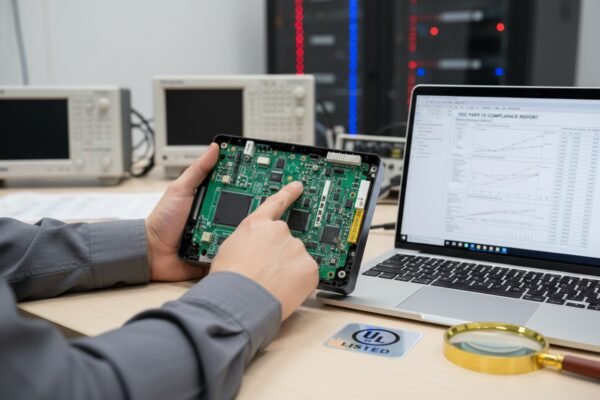
Test an agent by asking which FCC Part 15 subpart applies to your device and whether UL listing or recognition is required. They should explain the difference between Supplier’s Declaration of Conformity (SDoC) and Certification, plus provide examples of valid test reports.
Understanding the Technical Nuances
To truly verify an agent's expertise, you must look beyond their "yes" or "no" answers. In the electronics industry, many Chinese suppliers focus on the CE mark for Europe. However, the US market relies on FCC for radio frequency and UL (or ETL) for electrical safety. A common red flag is an agent who claims CE is "good enough" for the United States. It is not.
Ask them to explain the difference between an intentional radiator and an unintentional radiator. If you are importing a Bluetooth speaker, it is an intentional radiator requiring a more complex FCC certification process [^2] involving a TCB (Telecommunication Certification Body). If they cannot explain this, they likely lack the depth needed for high-compliance electronics.
UL Listing vs. UL Recognition
Safety standards like UL are often voluntary from a legal standpoint but mandatory for insurance and retail contracts. You should ask your agent to verify if the components inside your product (like power adapters) are "UL Recognized" versus the final product being "UL Listed." This distinction is critical for your liability as a US brand owner.
Comparing Key Standards
Use the table below to see if your agent knows the basic differences between these two major US requirements.
| Feature | FCC (Federal Communications Commission) | UL (Underwriters Laboratories) |
|---|---|---|
| Legal Requirement | Mandatory for electronics in the US. | Often voluntary, but required by retailers. |
| Primary Focus | Radio frequency interference. | Fire and electrical safety. |
| Documentation | SDoC or Grant of Certification. | UL Listing report and "Circle UL" mark. |
| Testing Lab | Must be an FCC-recognized lab. | Must be a Nationally Recognized Testing Lab (NRTL). |
The Verification Process
Ask the agent for a sample test report from a previous project. Check if the laboratory name appears on the official FCC or OSHA (for NRTLs) website [^3]. If the agent provides a fake or expired certificate, you know they are not performing due diligence on their suppliers. A professional agent will also check the "scope" of the test report to ensure it matches the specific model you are buying.
✔ FCC compliance requires specific testing based on whether a device emits radio waves intentionally.
True: Bluetooth and Wi-Fi devices must undergo rigorous FCC Certification, while simple digital devices only need an SDoC.✘ A CE certificate from a Chinese factory is an acceptable substitute for FCC testing in the US.
False: CE is a European standard and has no legal standing for electronic interference compliance with the US FCC.
Can my sourcing agent accurately calculate the impact of Section 301 tariffs on my landed cost?
In our daily procurement operations, we have seen 25% tariff surprises destroy a brand's yearly profit in a single shipment. Predicting your bottom line requires more than just looking at the factory's price list.
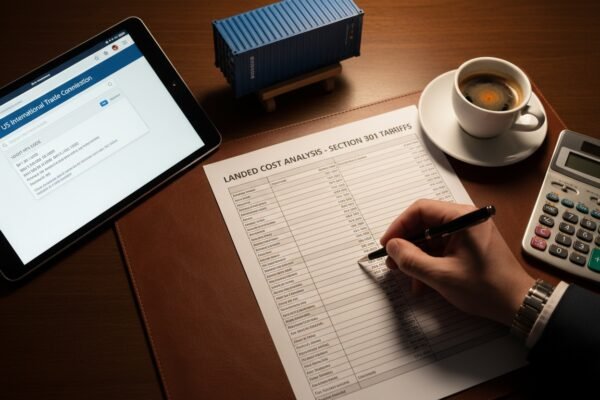
A professional agent identifies the correct 10-digit HTS code and checks for Section 301 exclusions or additional duties. They calculate landed cost by combining the FOB price, freight, insurance, and specific US duty rates, ensuring your final retail price remains profitable.
The HTS Code Foundation
Everything starts with the Harmonized Tariff Schedule (HTS) [^4]. If your agent gives you a 6-digit code, they are only halfway there. The US uses 10-digit codes for specific duty assessments. A slight change in material composition—for example, a toy made of 100% plastic versus one with metal parts—can move the product into a different HTS category [^5] with a vastly different tax rate.
Ask your agent: "How did you determine this HTS code?" A knowledgeable agent will reference the General Rules of Interpretation (GRIs) and perhaps even search for "Customs Rulings" (CROSS) to see how similar items were classified by US Customs and Border Protection (CBP).
Section 301 and Anti-Dumping Duties
Since 2018, most goods from China are subject to Section 301 tariffs [^6], which can range from 7.5% to 25% or more. Furthermore, products like aluminum extrusions or certain chemicals may face Anti-Dumping (AD) or Countervailing Duties (CVD). These can exceed 100%. If your agent doesn't proactively check for AD/CVD, you could face bankruptcy upon the shipment's arrival.
Sample Landed Cost Calculation
A competent agent should be able to provide a table similar to the one below before you place your order.
| Cost Component | Calculation Basis | Estimated Amount (USD) |
|---|---|---|
| FOB Price | 1,000 units @ $10.00 | $10,000.00 |
| Ocean Freight | Current market rate to US port | $1,200.00 |
| Standard Duty | 3.5% (HTS Example) | $350.00 |
| Section 301 Tariff | 25% (China specific) | $2,500.00 |
| MPF / HMF | Harbor/Merchandise Processing Fees | $55.00 |
| Total Landed Cost | Sum of all above | $14,105.00 |
| Unit Landed Cost | Total / 1,000 units | $14.11 |
Critical Thinking on Tariffs
Ask the agent about the 2024 updates to China tariffs. If they aren't aware of the latest changes regarding EVs, batteries, or medical supplies, they aren't staying current. You want a partner who monitors the USTR (United States Trade Representative) announcements. They should also understand the "De Minimis" (Section 321) rule for shipments under $800, which is currently under heavy scrutiny in US-China trade.
✔ Landed cost must include Section 301 duties to accurately reflect the true cost of China imports.
True: Failing to account for these additional 7.5% to 25% tariffs will lead to unexpected invoices and potential business losses.✘ Sourcing agents are legally responsible for paying your US import duties.
False: The Importer of Record (you) is legally responsible; the agent only provides the calculations and facilitates the process.
What documentation will they provide to ensure my shipment clears US Customs without delays?
We prepare shipping manifests long before the container leaves the port. Missing a single ISF filing [^7] can trigger massive fines and "Exam" holds that cost thousands of dollars per day in storage fees.
Your agent must provide a Commercial Invoice with correct HTS codes, a Packing List, Bill of Lading, and the ISF (10+2) filing data. For regulated goods, they should include CPC certificates, FDA registration numbers, or FCC IDs to ensure smooth CBP entry.
The ISF 10+2 Requirement
For ocean shipments to the US, the Importer Security Filing (ISF) must be submitted at least 24 hours before the cargo is loaded onto the vessel in China. If your agent is slow, you will get a $5,000 "Liquidated Damages" penalty from CBP. Ask your agent: "Who handles the ISF filing, and when is the deadline?" A pro will have a workflow that triggers the ISF as soon as the container is booked.
Document Accuracy
The Commercial Invoice is the most important document. Many Chinese factories try to "help" by undervaluing the goods to save you on taxes. This is a crime in the US. A trustworthy agent will refuse to undervalue goods and will ensure the description on the invoice matches the HTS code exactly. For example, instead of just "Parts," the invoice should say "Plastic parts for handheld vacuum cleaners, HTS 8508.70."
Mandatory Document Checklist
Verify that your agent uses a checklist like this for every US-bound shipment.
| Document Name | Purpose | Responsibility |
|---|---|---|
| Commercial Invoice | Declares value, HTS, and COO | Agent/Supplier |
| Packing List | Details weights, dimensions, and quantity | Agent/Supplier |
| Bill of Lading (BOL) | Proof of carriage and title to goods | Freight Forwarder |
| ISF (10+2) | Security filing for ocean freight | Agent/Importer Broker |
| CPC / GCC | Compliance certificate for kids/general goods | Agent/Test Lab |
| Form 7501 | Entry Summary (Post-clearance) | US Customs Broker |
Handling Specific Certifications
If you are importing food-contact items or cosmetics, your agent must provide the FDA manufacturer registration number and the "Prior Notice" confirmation. For children's toys, they must provide the Children’s Product Certificate (CPC) [^8] based on testing from a CPSC-accepted laboratory. Ask them to show you a CPC they have drafted before. If it doesn't include the US importer's contact info or the date/location of testing, it is invalid.
✔ The ISF filing must be completed 24 hours before the ship departs the Chinese port.
True: Late ISF filings are a top reason for $5,000 fines and increased inspection rates by US Customs.✘ You can use a single "General Description" for all items on a Commercial Invoice to save time.
False: Vague descriptions trigger "Requests for Information" (CF28) from CBP, delaying your shipment and risking seizures.
How do I verify their experience with US-specific product labeling and packaging requirements?
When we design packaging for our electronics, we obsess over the small print. A missing "Country of Origin" label is the easiest way for Customs to stop your goods and force an expensive "marking" session at the port.
Verify an agent’s expertise by asking about 19 CFR requirements for "Made in China" markings and FTC rules for fiber or material content. They should provide label templates that include tracking labels for children’s products and specific warning icons for lithium batteries.
Country of Origin (COO) Marking
Every single item imported into the US must be marked with its Country of Origin in a conspicuous place. This is governed by 19 CFR Part 134 [^9]. Ask your agent where they plan to put the "Made in China" mark. If they say "only on the outer carton," they are wrong. It must be on the product itself and the immediate retail packaging unless the product is too small to be marked.
CPSC Tracking Labels
If your target audience is children under 12, the Consumer Product Safety Improvement Act (CPSIA) requires a tracking label. This label must contain the manufacturer's name, location, date of production, and cohort information (batch number). Ask your agent to design a sample tracking label for you. If they don't know what a "batch number" is, they shouldn't be sourcing toys for you.
Specialized Labeling Needs
Different products have different "bosses" in the US government. A good agent knows who is in charge of your specific label.
- Apparel: Needs fiber content, care instructions, and RN number (monitored by the FTC).
- Electronics: Needs FCC ID and sometimes the "Do Not Trash" symbol.
- Batteries: Needs UN38.3 warning labels and Watt-hour ratings.
- California Prop 65: Needs specific warning text if the product contains chemicals like lead or phthalates.
Quality Control and Label Checks
During the pre-shipment inspection, your agent should specifically check the labels. They should verify the font size (some regulations require 1/16 of an inch minimum) and the durability of the sticker. Ask your agent for a copy of a previous inspection report. Look for a section dedicated to "Packaging and Labeling Verification." If that section is missing, they are likely only checking for cosmetic defects and ignoring legal requirements.
✔ "Made in China" must be permanently marked on most products and their retail packaging.
True: Failure to comply can result in the shipment being held until every individual unit is hand-labeled at your expense.✘ Sourcing agents are responsible for ensuring your product meets California Prop 65 standards automatically.
False: Prop 65 is a state-level requirement that you must explicitly request your agent to test for; it is not a standard factory check.
Conclusion
Verifying a China sourcing agent requires asking technical, high-stakes questions. By testing their knowledge of HTS codes, safety certifications, and US labeling laws, you protect your brand from costly legal delays.
Footnotes
[1]: Details FCC regulations for electronic devices to prevent harmful interference.
[2]: Clarifies the rigorous approval process for intentional radiators under FCC rules.
[3]: Original URL was 404, replaced with OSHA's official Nationally Recognized Testing Laboratory (NRTL) Program page.
[4]: Official source for the Harmonized Tariff Schedule used for US import duties.
[5]: Explains how product changes can affect HTS classification and tax rates.
[6]: Original URL was 404, replaced with USTR's official Section 301 Investigations page, which covers tariffs related to these investigations.
[7]: Explains the Importer Security Filing (10+2) requirement for ocean shipments.
[8]: Official CPSC guidance on the mandatory Children's Product Certificate for toys.
[9]: Provides the official regulations for country of origin marking on imported goods.