
Every week, our team reviews product concepts from founders who are excited, ambitious, and often stuck Bill of lading 1. They have a great idea. Maybe even a 3D model. But they have no idea how to get it made at scale — or whether it can even be manufactured the way they imagine. The worst scenario we see? A founder spends months perfecting a CAD file, sends it to a factory, and hears: "This cannot be produced." Then everything starts over from zero. That painful reset is avoidable if you bring in the right sourcing partner early.
Sourcing agents transform product ideas into mass production by managing every step between concept and delivery — from refining designs for manufacturability, vetting qualified factories, overseeing prototyping and sampling, enforcing quality control during production, and coordinating international logistics to your warehouse door.
This article walks you through the exact stages a sourcing agent handles when turning your rough product concept into finished goods on a shipping pallet. Whether you are a first-time founder or a seasoned brand owner looking for a better process, each section below breaks down what happens, why it matters, and where things commonly go wrong.
How can a sourcing agent help me turn my rough product sketches into a functional prototype?
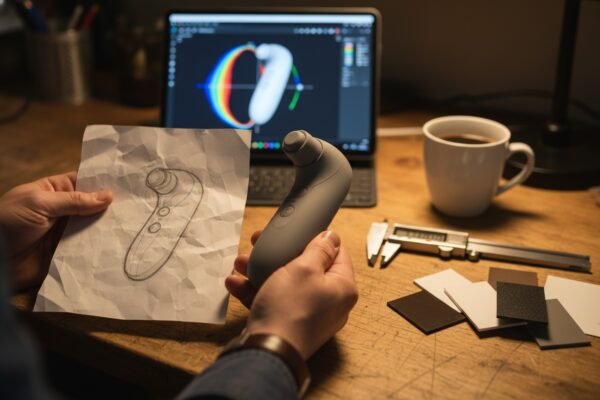
Most founders come to us with ideas in different formats — some have napkin sketches, others bring detailed 3D renders. The common thread is uncertainty. They do not know if their design can actually be produced in a Chinese factory at a reasonable cost. That gap between imagination and manufacturing reality is where products either take shape or fall apart.
A sourcing agent bridges your rough sketches and a working prototype by connecting you with the right engineers and factories early, refining your design for manufacturability, managing material selection, and coordinating iterative sample rounds until the prototype matches your vision and is production-ready.
Why You Should Involve a Sourcing Agent Before Finalizing Your Design
Here is a truth our team has learned the hard way over hundreds of projects: the earlier you involve your sourcing partner, the smoother everything goes. Many founders think they should finish the design first, then find a factory. That sounds logical. But it causes a specific and expensive problem.
Factories have limitations. Every manufacturing process — injection molding 2, die casting, CNC machining, PCB assembly — has constraints. Wall thickness, draft angles, undercuts, material shrinkage rates — these are all factors that affect whether your design is producible. When our engineers review a new client's files, about 60% of the time we find features that need modification before any factory can quote the job accurately.
A sourcing agent with real manufacturing knowledge will coordinate a Design for Manufacturability (DFM) review 3 with the factory's engineering team. This review flags issues early and saves you from costly redesigns later.
The Prototyping Workflow
Here is a simplified view of how we typically move from a rough sketch to an approved prototype:
| Stage | What Happens | Who Is Involved | Typical Timeline |
|---|---|---|---|
| Concept Review | Agent reviews your sketches, CAD files, or reference products and asks clarifying questions | You + Sourcing Agent | 1–3 days |
| DFM Analysis | Factory engineers assess producibility and suggest modifications | Agent + Factory Engineers | 3–7 days |
| Material Selection | Agent helps choose materials based on function, cost, and compliance | You + Agent + Factory | 2–5 days |
| First Prototype | Factory produces an initial sample (3D printed, CNC, or soft tooling) | Factory + Agent oversight | 7–21 days |
| Review & Revision | You evaluate the prototype; agent coordinates changes with factory | All parties | 5–14 days per round |
| Final Approved Sample | Signed-off prototype becomes the "golden sample 4" for production | You + Agent | 1–3 days |
Do Not Skip the DFM Step
I cannot stress this enough. The single most common and most costly mistake we see is founders who skip the DFM review. They invest thousands in tooling based on an unreviewed 3D model. Then the factory discovers problems mid-production. Molds need rework. Timelines slip by weeks. Costs balloon.
A proper DFM review costs very little — often nothing if the factory is serious about winning your business. But it saves enormous amounts of time and money. Your sourcing agent should push for this step. If they do not, that is a red flag.
Communication Is Half the Battle
When working with Chinese factories, the language and cultural gap can cause misunderstandings that derail prototyping. Our bilingual project managers translate not just words, but intent. When a founder says "I want it to feel premium," we translate that into specific surface finishes, material grades, and tolerance ranges that a factory engineer can act on. This kind of cultural and technical translation is a core part of what a sourcing agent does at this stage.
How does my sourcing partner vet manufacturers to ensure they can handle my specific technical requirements?
Finding a factory in China is easy. Finding the right factory — one that can actually deliver what you need, on time, at the right quality level — is the hard part. Our sourcing team has visited hundreds of factories across Guangdong, Zhejiang, and Jiangsu provinces. Some look impressive on Alibaba but cannot handle anything beyond basic assembly. Others are hidden gems with world-class capabilities but zero online presence.
Your sourcing partner vets manufacturers through a structured process that includes verifying business credentials, conducting on-site factory audits, assessing production capacity and equipment, reviewing past project portfolios, testing sample quality, and evaluating the factory's quality management systems against your specific technical requirements.

The Multi-Layer Vetting Process
Effective factory vetting is not a single action. It is a layered process. Research shows that 85% of successful sourcing outcomes include a supplier qualification audit before contracts are signed. Here is how we structure the vetting:
Step 1: Desktop Research and Shortlisting
Before anyone visits a factory, our team conducts background checks. We verify business licenses, export history, registration details, and any certifications (ISO 9001 5, ISO 14001, BSCI, etc.). We cross-reference information from multiple sources — not just Alibaba Gold Supplier badges, which can be purchased.
Step 2: On-Site Factory Audit
Nothing replaces walking the factory floor. During an audit, our team evaluates:
| Audit Area | What We Check | Why It Matters |
|---|---|---|
| Production Equipment | Age, condition, and capability of machinery | Old or inadequate equipment cannot hold tight tolerances |
| Quality Control Systems | Incoming material inspection, in-process checks, outgoing QC | Weak QC systems mean inconsistent product quality |
| Workforce & Training | Worker skill levels, training programs, labor compliance | Skilled workers produce fewer defects |
| Production Capacity | Monthly output, current order load, lead times | Overloaded factories miss deadlines |
| Raw Material Storage | Material sourcing, storage conditions, traceability | Poor material handling leads to hidden quality issues |
| Certifications & Compliance | Valid certificates, testing reports, regulatory awareness | Non-compliant products get rejected at customs |
Step 3: Sample Evaluation
We request samples — not just showroom pieces, but production-representative samples made on the same equipment and with the same materials that would be used in your order. Our QC team inspects these against your specifications. If the sample fails, the factory is removed from consideration. No exceptions.
Step 4: Reference Checks
We ask factories for references from previous international clients. We also check if the factory has experience with products similar to yours. A factory that makes great plastic toys may not be the right fit for precision electronic enclosures.
What About Intellectual Property?
IP protection is a valid concern. Before sharing any detailed designs, our team ensures Non-Disclosure Agreements (NDAs) 6 are signed with every factory we engage. For clients with patented products, we also recommend manufacturing agreements that include IP ownership clauses and non-compete terms. This is not optional — it is essential.
Red Flags That Disqualify a Factory
Through years of auditing, we have compiled a list of warning signs:
- Factory refuses an on-site audit
- No documented quality control process
- Cannot provide references from international buyers
- Quotes that are dramatically lower than competitors (often means cut corners)
- Inconsistent answers about capacity and lead times
Your sourcing agent should be your eyes and ears on the ground. If they are not visiting factories in person, they are not doing the job properly.
What steps will my agent take to ensure mass production quality stays consistent with my approved sample?
This is where the real anxiety lives. You approved a beautiful sample. It felt right, looked right, and passed every test. Now the factory is producing 10,000 units. How do you know unit 7,342 will be just as good as the sample you held in your hands? In our experience shipping to the U.S., Germany, and Australia, we have seen the gap between sample quality and production quality destroy product launches. Preventing that gap is one of the most important jobs a sourcing agent does.
Your agent maintains production quality by establishing a golden sample benchmark, implementing pre-production meetings, conducting in-line inspections during manufacturing, performing pre-shipment inspections on finished goods, and arranging third-party lab testing when required — creating multiple quality checkpoints between your approved sample and final shipment.
The Golden Sample System
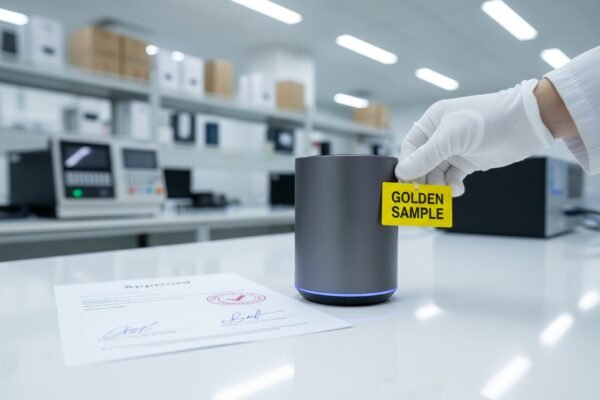
The approved sample — what the industry calls the "golden sample" — is the quality benchmark for the entire production run. Our team keeps one copy, the factory keeps one copy, and the client keeps one copy. Every inspection during production is compared against this reference. If there is any dispute about quality, the golden sample is the final authority.
Multi-Stage Quality Control Framework
Quality control is not a single inspection at the end. It is a system of checkpoints throughout the production process:
| Inspection Stage | When It Happens | What Is Checked | Action if Failed |
|---|---|---|---|
| Pre-Production Meeting | Before production starts | Raw materials, color standards, component specs, packaging requirements | Production does not begin until all materials are approved |
| First Article Inspection | After first 50–100 units | Dimensions, appearance, function against golden sample | Corrections made before full production continues |
| In-Line Inspection | At 20–30% production completion | Random sampling of units on the line for defects | Defective units isolated; root cause analysis conducted |
| Pre-Shipment Inspection (PSI) | When 80–100% of order is packed | AQL sampling per ISO 2859 standard 7 | Shipment held if defect rate exceeds acceptable level |
| Third-Party Lab Testing | Before or after PSI | Safety, compliance, performance testing by certified lab | Products reworked or rejected if they fail |
Understanding AQL Standards
AQL stands for Acceptable Quality Level 8. It is the international standard (ISO 2859) used to determine how many defects are tolerable in a production batch. We typically recommend:
- Critical defects (safety hazards): AQL 0 — zero tolerance
- Major defects (functional failures): AQL 1.0
- Minor defects (cosmetic imperfections): AQL 2.5
These numbers define how many units from a random sample can have defects before the entire batch is rejected. Your sourcing agent should clearly explain the AQL criteria before production begins and ensure the factory agrees to them in writing.
Why In-Line Inspections Matter Most
Many businesses only do a pre-shipment inspection. That is too late. By the time all 10,000 units are packed in cartons, finding a systemic defect means reworking the entire order — or worse, scrapping it. In-line inspections catch problems while production is still running. Our QC inspectors visit the factory floor when production is about 25% complete. If we find an issue — say, a color mismatch or a loose component — we can fix it immediately. The remaining 75% of production benefits from that correction.
The Human Factor
Factories run on people. Worker fatigue, shift changes, and rushing to meet deadlines all introduce variability. Our production managers maintain regular communication with factory floor supervisors to monitor conditions. If a factory is running overtime to meet a deadline, we flag the risk of increased defect rates and discuss options with the client — whether to extend the timeline slightly or accept the risk.
This hands-on production management is what separates a real sourcing agent from a middleman who simply places orders and hopes for the best.
How do I manage the transition from the factory floor to final delivery at my international warehouse?
Goods that pass quality inspection are only halfway home. The logistics chain from a factory in Shenzhen or Ningbo to a warehouse in Los Angeles or Hamburg involves a complex sequence of steps. When we coordinate shipments for our clients, we see the same problem over and over: founders who think production is the hard part, and logistics is "just shipping." It is not. One wrong HS code, one missing certificate, or one poorly packed container can delay delivery by weeks and cost thousands in storage fees or customs penalties.
Managing the factory-to-warehouse transition requires coordinating export documentation, booking freight (sea, air, or rail), arranging customs clearance in both origin and destination countries, ensuring regulatory compliance for your product category, and organizing last-mile delivery to your warehouse — all tasks a sourcing agent handles end-to-end.

The Logistics Chain, Step by Step
Once production is complete and the pre-shipment inspection is passed, the logistics phase begins. Here is the typical sequence:
Packaging and Palletizing
Before goods leave the factory, packaging must meet both product protection standards and destination country requirements. For clients selling on Amazon, this means FBA-compliant labeling, barcoding, and carton specifications. Our warehouse team reviews all packaging before shipment to ensure nothing gets rejected at the receiving end.
Export Documentation
Chinese customs requires specific documents for export clearance. Your sourcing agent prepares or collects:
- Commercial invoice 9
- Packing list
- Bill of lading or airway bill
- Certificate of origin 10
- Any required test reports or compliance certificates (CE, FCC, UL, etc.)
Missing or inaccurate documents cause delays. Our documentation team double-checks every detail before submission.
Freight Booking and Shipping
The choice between sea freight, air freight, and rail depends on your budget, timeline, and order volume. Here is a quick comparison:
| Shipping Method | Cost Level | Transit Time (China to U.S. West Coast) | Best For |
|---|---|---|---|
| Sea Freight (FCL) | Lowest | 14–25 days | Large orders, not time-sensitive |
| Sea Freight (LCL) | Low–Medium | 18–30 days | Smaller orders sharing container space |
| Air Freight | Highest | 5–10 days | Urgent orders, lightweight products |
| Rail (China to Europe) | Medium | 18–22 days | European destinations, mid-size orders |
Our logistics team books freight with vetted carriers and tracks shipments in real time. We provide clients with tracking numbers and estimated arrival dates so they can plan inventory accordingly.
Customs Clearance at Destination
When goods arrive at the destination port, they must clear customs. This involves:
- Paying applicable duties and tariffs
- Presenting correct HS codes
- Providing any required import certificates or safety documentation
- Addressing any customs holds or inspections
For U.S.-bound shipments, the current tariff landscape (especially regarding China-origin goods) requires careful HS code classification to ensure accurate duty calculation. A small HS code error can mean overpaying by thousands — or triggering an audit. Our team works with licensed customs brokers in each destination market to handle clearance efficiently.
Last-Mile Delivery
After customs clearance, goods are transported to your warehouse, Amazon FBA center, or 3PL facility. We coordinate trucking or local delivery and confirm receipt with the warehouse team. The job is not done until your goods are checked in and inventory counts match.
Risk Mitigation in Logistics
Supply chain disruptions happen. Port congestion, carrier delays, weather events, and regulatory changes can all impact timelines. We build buffer time into logistics plans and maintain relationships with multiple freight forwarders so we can reroute shipments quickly when problems arise. For high-value shipments, we recommend cargo insurance — a small cost relative to the value it protects.
Conclusion
Turning a product idea into mass production is not a single leap — it is a chain of deliberate, skilled steps. The right sourcing agent manages every link in that chain so you can focus on building your brand and growing your business.
Footnotes
- Replaced HTTP 403 with an authoritative Wikipedia page defining a Bill of Lading. ↩︎
- Explains the industrial process of injection molding, a key manufacturing method. ↩︎
- Replaced HTTP 404 with an authoritative Wikipedia page providing a comprehensive overview of Design for Manufacturability. ↩︎
- Defines 'golden sample' as a benchmark in quality control, essential for consistent production. ↩︎
- Official information on ISO 9001, an international standard for quality management systems. ↩︎
- Legal definition and explanation of Non-Disclosure Agreements, crucial for intellectual property protection. ↩︎
- Official details on ISO 2859, the international standard for acceptance sampling procedures. ↩︎
- Replaced HTTP 403 with an authoritative Wikipedia page defining Acceptable Quality Limit (AQL). ↩︎
- Replaced HTTP 403 with an authoritative .gov source (International Trade Administration) explaining commercial invoices. ↩︎
- Replaced HTTP 403 with an authoritative source (International Chamber of Commerce) providing information on Certificates of Origin. ↩︎