
We often see clients arrive at our Shenzhen office frustrated after being overcharged by previous partners Acceptable Quality Limit (AQL) 1. You might feel uncertain about whether the 10% fee you were quoted is standard or if you are leaving money on the table. Finding the balance between a fair price and reliable service is critical for your supply chain's success 2.
Most reliable China sourcing agents charge a commission rate between 5% and 10% of the total order value. Negotiating a reasonable rate depends heavily on your order volume, with fees often dropping to 3–5% for larger orders, while flat fees or hybrid models provide alternatives for specific project needs.
Let’s explore the specific numbers and strategies you need to secure a fair deal without compromising quality.
What is the typical commission range I should expect to pay a reliable China sourcing agent?
When our team calculates quotes for new clients, we look at the market data to ensure our pricing remains competitive yet sustainable original factory invoices 3. Many buyers feel overwhelmed by the wide variance in quotes they receive from different agencies.
You should expect to pay a commission range of 5% to 10% for standard sourcing services. Rates typically settle around 5% to 8% for mid-sized orders involving supplier verification and quality control. For high-volume orders exceeding $50,000, rates can often be negotiated down to between 3% and 5%.
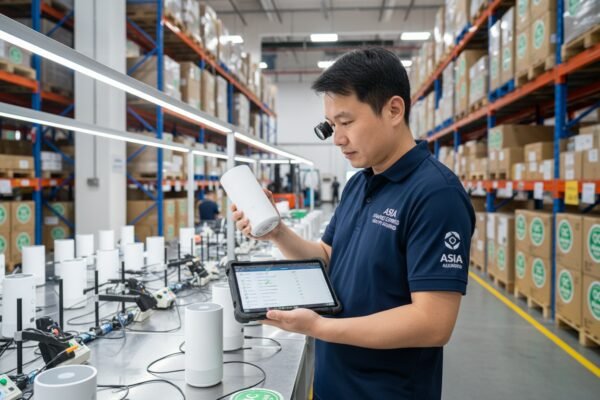
Understanding the market standard is the first step in any negotiation. In the sourcing industry, the commission model is the most prevalent payment structure. This fee is usually a percentage of your total Free on Board (FOB) order value 4.
From our perspective on the ground in China, we see a clear tiered structure based on the size of the project. A flat percentage does not work for every scenario. If you are ordering $1,000 worth of goods, an agent cannot survive on 5% ($50). Conversely, on a $1 million order, 10% is excessive.
Standard Fee Tiers
Most professional agencies operate on a sliding scale. This aligns the agent's incentive with your growth. Here is a breakdown of what we typically see in the industry:
- Small Orders (Under $5,000): Agents often charge a minimum flat fee (e.g., $200–$500) or a high percentage (10–15%) because the workload for sourcing, verifying, and shipping a small order is almost the same as a large one.
- Medium Orders ($5,000 – $50,000): This is the "sweet spot" for the 5–10% range. At this level, the commission covers the agent's time for communication, sample consolidation, and basic inspection.
- Large Orders (Over $50,000): Once you hit this volume, you have significant leverage. Rates usually drop to 3–6%.
Hybrid and Flat Fee Models
We also see a shift toward hybrid models. Some sourcing companies charge a small upfront fee to start the work (deductible from the final order) plus a lower commission percentage. This protects the agent from "window shoppers" who ask for quotes but never buy.
For purely service-based tasks, like a factory audit 5 without procurement, you might pay a flat fee per day (e.g., $150–$300 per man-day) rather than a percentage.
Comparing Pricing Models
The following table illustrates how costs scale with different models.
| Order Value | Commission Model (Standard) | Flat Fee Model (Estimated) | Effective Rate |
|---|---|---|---|
| $2,000 | 10% ($200) or Min Fee | $300 - $500 | 15% - 25% |
| $20,000 | 8% ($1,600) | $1,000 - $1,500 | 5% - 8% |
| $100,000 | 4% ($4,000) | $3,000 - $5,000 | 3% - 5% |
Understanding these benchmarks protects you from overpaying. If an agent quotes you 15% for a $50,000 order, they are likely gouging you. If they quote 1% for a $2,000 order, they are likely taking hidden kickbacks 6 from the factory, which increases your product cost silently.
How can I negotiate a better rate based on my specific order volume and product complexity?
We appreciate clients who come to the table with a clear forecast of their annual needs, as it helps us allocate resources efficiently. Negotiating is not about squeezing every penny but finding a volume-based agreement that benefits both sides.
You can negotiate a better rate by demonstrating long-term value through projected annual order volume rather than focusing on a single transaction. Committing to a tiered commission structure, where the percentage drops as cumulative spending rises, or bundling services like logistics and warehousing, provides significant leverage to lower fees.
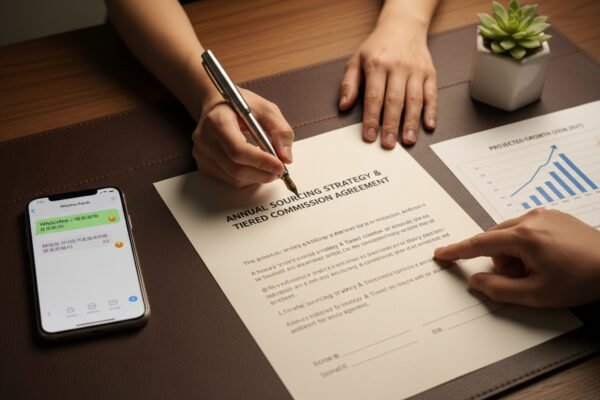
Negotiation is an art, especially in China where relationships (Guanxi) matter. However, business is still business. To lower your commission rate, you need to lower the agent's perceived risk or effort, or increase the potential reward.
Leverage Your Annual Volume
Agents love consistency. A one-off order of $10,000 takes a lot of effort to set up. However, if you can show a track record or a solid business plan indicating you will order $10,000 every month, the agent sees a $120,000 annual account.
We recommend proposing a "Tiered Commission Agreement." This contract states that your commission rate will decrease as your total order volume increases over the year. For example, you might start at 7% for the first order, but if you exceed $100,000 in spend, the rate retroactively applies or drops to 4% for future orders.
Product Complexity Matters
Not all products are created equal. Sourcing a standard USB cable is easy; sourcing a custom-molded consumer electronic device with specific PCB requirements is hard.
- Low Complexity (Standard Goods): You have high leverage here. The agent simply needs to find a stock factory. You can push for rates closer to 3–5%.
- High Complexity (ODM/Custom): This requires engineering support, repeated sampling, and strict QC. We often have to charge 7–10% because our engineers spend weeks on these projects. If you want a lower rate here, you must provide extremely clear tech packs and specifications to reduce the agent's workload.
Negotiation Tactics Checklist
When you are on a call with a potential agent, use these specific points to drive the rate down:
- Consolidate Suppliers: If you use one agent to manage five different suppliers, you save them administrative time compared to five separate agents. Ask for a bundle discount.
- Referral Promises: If you are part of a Mastermind group or a seller community, mention that you refer reliable partners. This potential for new business is highly valuable.
- Provide "Ready-to-Go" Data: If you have already identified potential factories and just need the agent to audit and finalize, the fee should be lower than if they have to search from scratch.
Volume vs. Complexity Matrix
Use this table to determine where your negotiation target should be.
| Product Type | Low Volume (<$10k) | High Volume (>$50k) | Negotiation Strategy |
|---|---|---|---|
| Off-the-shelf | 8% - 10% | 3% - 5% | Focus on ease of transaction and repeat orders. |
| Custom / ODM | 10% - 15% | 5% - 8% | Focus on providing clear specs to reduce agent workload. |
Will a lower commission rate negatively impact the quality control and factory audit services I receive?
Our engineers prioritize quality above all else, but we know that thorough inspections require significant man-hours and travel costs. If the budget is slashed too aggressively, something in the service scope inevitably has to give.
A significantly lower commission rate often negatively impacts quality control and factory audits because agents must reduce their time investment to maintain profitability. If the fee is too low, agents may resort to "desktop audits" instead of on-site visits, or skip essential inspection steps, increasing the risk of receiving defective products.
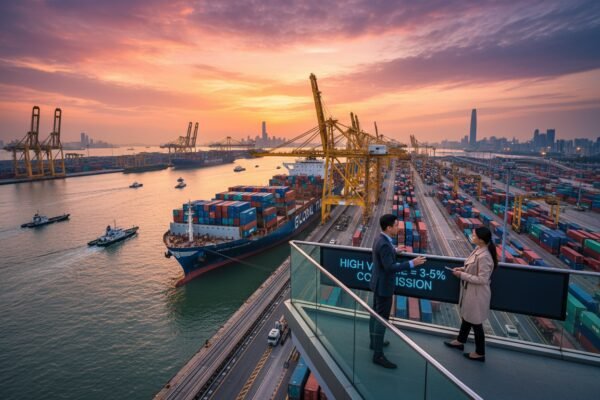
There is a popular saying in China: "You get what you pay for." This is painfully true in the service industry. Sourcing agents are businesses with overheads—salaries, travel expenses, office rent, and technology costs.
The Economics of Quality Control
If an agent agrees to a 3% commission on a $10,000 order, they earn $300.
A proper factory audit typically involves:
- Travel time to the factory (often 2–4 hours round trip).
- 4–6 hours of on-site inspection.
- Reporting time.
- Travel expenses (train tickets, fuel).
It is mathematically impossible to perform a rigorous on-site audit for $300 and still make a profit. If you force the rate this low on a small order, the agent will likely cut corners. They might do a "remote check" via WeChat video instead of visiting the factory, or they might only inspect 1% of the goods instead of the standard AQL (Acceptable Quality Limit).
The Danger of the "Yes Man"
Some agents will agree to any low price just to get your business. This is dangerous. They agree to 2%, but they have no intention of visiting the factory. When you receive a container full of defective goods, the money you saved on commission will be insignificant compared to the cost of unsellable inventory.
Protecting Your Quality at Low Rates
If you have negotiated a low rate, you must clarify what is included. You should insist on a Service Level Agreement (SLA) 7.
- Define the Scope: Does the 5% include a Pre-Shipment Inspection (PSI) 8? Or is PSI charged separately?
- Third-Party Option: A smart strategy is to negotiate a lower sourcing commission (e.g., 4%) for finding the supplier and negotiation, but hire a separate third-party inspection company 9 (like SGS or Intertek) or pay the agent a separate flat fee for the QC day. This decouples the sourcing incentive from the quality check.
Service Impact Table
Here is how commission levels typically correlate with service depth.
| Commission Level | Supplier Vetting | Quality Control (QC) | Risk Level |
|---|---|---|---|
| Low (1-3%) | Online verification only (Alibaba check). | No on-site QC. Photos provided by factory. | High |
| Standard (5-8%) | Phone interviews, document verification. | AQL Level II Inspection (On-site). | Low/Medium |
| Premium (10%+) | Physical factory audit, production monitoring. | Full inspection (100% check) or complex testing. | Very Low |
In our dealings with international partners, we find that total transparency regarding costs builds the strongest long-term relationships. However, the industry is unfortunately rife with agents who hide their true profits behind opaque pricing models.
Ensure transparency by signing a sourcing agreement that explicitly mandates the disclosure of original factory invoices and forbids unauthorized rebates. To avoid hidden kickbacks, you should pay the factory directly whenever possible and pay the agent their commission separately, rather than funneling the entire product payment through the agent.
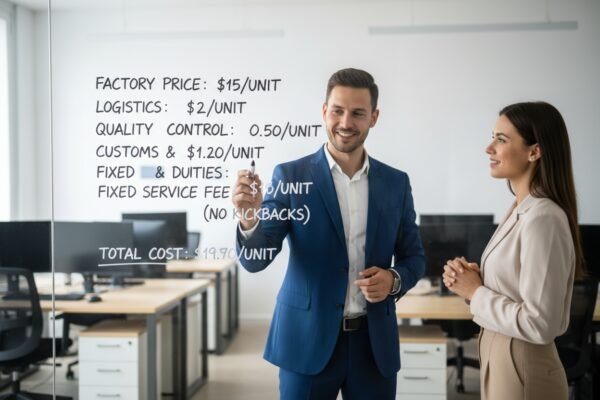
The biggest fear for any importer is the "double dip." This happens when an agent charges you a commission (say, 5%) but also secretly arranges a deal with the factory to add 10% to the product price, which the factory kicks back to the agent.
The Kickback Mechanism
Kickbacks are common in the industry. Sometimes factories offer them unsolicited to agents to win the bid. Unethical agents will steer you toward the factory offering the highest kickback, not the one with the best quality or price.
Tactics to Ensure Transparency
To protect your business, you need to structure the financial flow correctly.
- Demand Original Invoices: Always ask for the VAT invoice or the original proforma invoice from the manufacturer. If the agent refuses to show you the supplier's name or contact details, they are likely hiding a margin.
- Direct Payment to Factory: The most effective method is to pay the goods' cost (COGS) directly to the manufacturer's bank account and pay the commission separately to the agent. This removes the agent's ability to skim off the top of the product payment.
- The "Open Book" Policy: Look for agents who advertise an "open book" policy. This means they share all supply chain costs—freight, duties, raw materials—openly.
Red Flags of Hidden Fees
Be wary if you encounter the following:
- "Free Sourcing": If an agent says they work for free, run. They are getting paid by the factory, which means they represent the factory, not you.
- Refusal to Arrange Factory Visits: If an agent blocks you from visiting the factory, they are afraid you will discuss pricing directly with the owner.
- Fixed Exchange Rates: Some agents charge in USD but pay factories in RMB. If they use a bad exchange rate (e.g., 6.8 when the market is 7.2), they are pocketing the difference (often 3–5%).
Transparency Checklist Table
Use this to vet your agent's honesty.
| Feature | Transparent Agent | Opaque/Risky Agent |
|---|---|---|
| Supplier Identity | Disclosed fully. | Hidden or "Trade Secret." |
| Payment Flow | Client pays Factory directly (optional). | Client MUST pay Agent. |
| Factory Invoice | Original copy provided. | Re-typed invoice on Agent letterhead. |
| Commission | Clearly stated %. | "0%" or Vague. |
Conclusion
Negotiating a reasonable commission rate is about aligning incentives. A rate of 5–8% is a healthy standard that ensures your agent is motivated to protect your quality while remaining cost-effective for you. Remember that the lowest rate is not always the cheapest option if it leads to poor quality control or hidden kickbacks. Transparency, clear contracts, and volume-based leverage are your best tools for securing a fair partnership.
Footnotes
1. Defines AQL as a statistical sampling method for quality control inspections. ↩︎
2. Explains the importance of effective supply chain management. ↩︎
3. Emphasizes the importance of invoices for tracking expenses and transparency. ↩︎
4. Defines FOB Incoterms and responsibilities in international shipping. ↩︎
5. Explains the purpose, process, and types of factory audits. ↩︎
6. Explains the concept of hidden kickbacks and their negative impact on transparency. ↩︎
7. Explains what an SLA is and its importance in defining service expectations. ↩︎
8. QIMA is an authoritative source for quality control and provides a clear explanation of Pre-Shipment Inspection (PSI). ↩︎
9. Explains the role and benefits of using an independent third-party for inspections. ↩︎