
Every month, our team in Shenzhen coordinates container loads that pull goods from five, sometimes eight factories at once CCTV monitoring 1. When even one supplier misses a deadline, the whole shipment stalls—and your customers feel it.
To evaluate a China sourcing agent for multi-factory container consolidation, verify their consolidation track record, inspect their warehousing infrastructure, review their multi-factory quality control process, and test their communication responsiveness across all suppliers before signing any contract.
Choosing the wrong agent for consolidation is not the same as choosing the wrong agent for a simple order. The stakes are higher, the coordination is harder, and the mistakes are more expensive. Below, we break down exactly what to look for—and what to avoid—when you evaluate a sourcing agent for this specific job. supply chain management 2
How can I verify if a sourcing agent has the actual experience to manage my multi-factory consolidation without delays?
We have watched dozens of importers lose weeks of lead time because their agent had never actually managed a consolidation before. The sales pitch sounded great, but the execution fell apart at the first sign of a factory delay.
Verify a sourcing agent's consolidation experience by requesting documented case studies of past multi-factory projects, contacting client references directly, checking their business license, and asking detailed process questions about how they sequence factory pickups and handle timeline conflicts.

Ask for Specific Consolidation Case Studies
Do not accept vague answers. A good agent should be able to walk you through a real consolidation project step by step. Ask them: How many factories were involved? What products were consolidated? How did they handle a delay from one factory? What was the total timeline from order placement to container departure?
If they cannot give you concrete examples, that is a red flag. An agent who has truly managed consolidation will talk about it with detail and nuance. They will mention specific challenges—like a factory that was three days late with packaging, or a quality issue that forced a re-inspection before loading.
Check Their Business Registration and Background
Never skip the legal review stage. Confirm their business license 3, verify their registered address, and check if they have any negative reviews on platforms like Trustpilot or Reddit. A lack of official registration or refusal to share license numbers is a warning sign. A reliable agent will be happy to provide references and documentation.
Use a Structured Interview
When you interview a potential agent, use a consistent set of questions. Here is a framework we recommend:
| Question | What a Good Answer Looks Like | Red Flag |
|---|---|---|
| How many consolidation projects have you managed in the past 12 months? | Specific number with examples (e.g., "12 projects, averaging 4 factories each") | Vague or evasive ("We do many projects") |
| Walk me through your process for coordinating production across multiple factories. | Step-by-step explanation with timelines and checkpoints | Generic answer with no process detail |
| How do you handle production delays at one factory? | Describes contingency plans, buffer time, and communication protocol | "It rarely happens" or no clear plan |
| Can you provide three references from consolidation clients? | Immediate willingness with contact details | Hesitation or excuses |
| What freight forwarders do you work with for consolidation? | Names specific partners with consolidation experience | Cannot name any or is vague |
Verify Their Supplier Network Depth
A consolidation agent needs a broad and deep supplier network. If they only work with a handful of factories, they lack the flexibility to manage complex consolidation. Ask how many vetted suppliers are in their database for your product category. Agents with fewer than 20–30 factories in a given industry may struggle to find complementary suppliers whose production timelines align.
In our work at Go Source, we maintain relationships with hundreds of suppliers across consumer electronics, smart home, and toy categories. This network allows us to match factories not just on price and quality, but on production speed and reliability—two factors that are critical when multiple suppliers must deliver to the same consolidation warehouse within a tight window.
What warehousing and storage infrastructure should I expect from an agent to keep my consolidated goods safe?
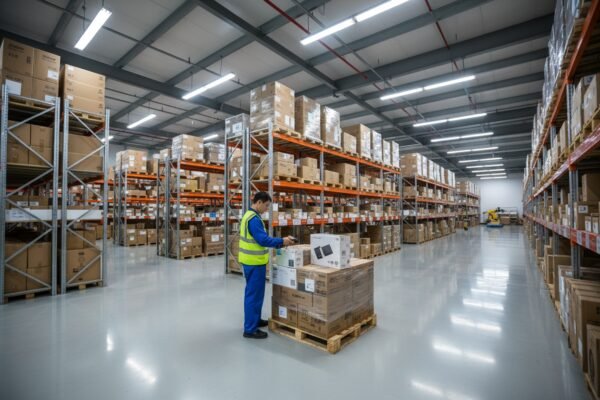
Our warehouse in Shenzhen processes goods from multiple factories every week, and we have learned firsthand that the difference between a smooth shipment and a disaster often comes down to how goods are stored before loading.
Expect your sourcing agent to provide a dedicated consolidation warehouse with climate control where needed, clear inventory tracking systems, organized segregation by order and supplier, CCTV monitoring, and transparent storage fee policies that allow reasonable free storage periods before charging.
Why Warehousing Matters for Consolidation
In a multi-factory consolidation, goods arrive at different times from different suppliers. Some shipments may arrive days or even weeks before others. Without proper warehousing, your goods sit in uncertain conditions—exposed to humidity, mishandling, or even mixing with other clients' products.
A professional consolidation agent either owns or leases warehouse space near major ports or manufacturing hubs. The warehouse should have clear systems for receiving, labeling, and storing goods from each factory separately until the container is ready to load.
What to Look for in a Warehouse
Here are the key infrastructure elements you should verify:
| Warehouse Feature | Why It Matters | How to Verify |
|---|---|---|
| Dedicated receiving area | Prevents mix-ups when goods arrive from different factories | Ask for a warehouse tour or video walkthrough |
| Inventory management system 4 | Tracks which goods have arrived, from which factory, and in what quantity | Request screenshots or demo of their system |
| Climate control 5 (if applicable) | Protects sensitive electronics, beauty equipment, or other climate-sensitive goods | Ask about temperature and humidity monitoring |
| CCTV and security | Prevents theft and provides evidence if disputes arise | Confirm cameras are active and footage is retained |
| Clear labeling and segregation | Ensures your goods are not mixed with other clients' shipments | Ask for photos of how they organize stored goods |
| Loading dock access | Enables efficient container loading without double-handling | Confirm the warehouse is designed for container-level logistics |
Watch Out for Unreasonable Storage Fees
Here is a personal insight from our experience: if a sourcing agent tells you they will start charging warehouse storage fees within just one week, they are clearly unfamiliar with how consolidation actually works. Multi-factory consolidation inherently requires a buffer period. Goods from different factories rarely arrive on the same day. A professional consolidation agent understands this and builds a reasonable free storage window—typically 15 to 30 days—into their service.
Agents who charge storage fees after just a few days are either not experienced with consolidation, or they are using storage fees as a hidden revenue stream. Either way, it is a sign you should look elsewhere.
Ask for a Warehouse Visit or Virtual Tour
If you are sourcing from overseas, you may not be able to visit in person. But any reputable agent will offer a video tour of their warehouse. During the tour, pay attention to cleanliness, organization, lighting, and how clearly goods are labeled. If the warehouse looks chaotic on video, imagine what it looks like when no one is filming.
How will the agent handle quality control inspections across different suppliers before my container is loaded?
When we coordinate inspections across four or five factories for a single consolidated container, we know that one missed defect at one factory can compromise the entire shipment. Quality control for consolidation is not just harder—it is fundamentally different.
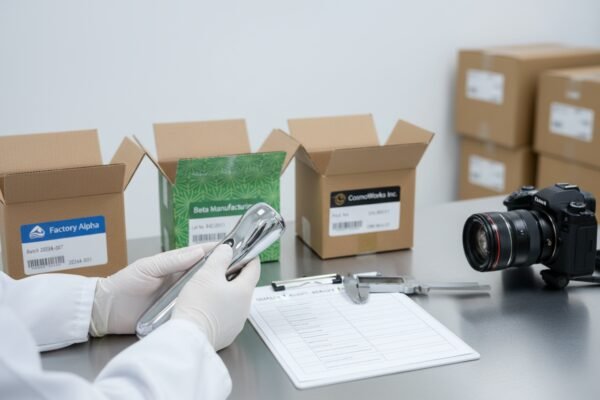
Your agent should implement multi-phase quality control across every participating factory, including pre-production material checks, in-process inspections, pre-shipment evaluations, and a final container loading inspection at the consolidation warehouse to catch any issues before sealing.
The Four Phases of Consolidation Quality Control
Quality control for multi-factory consolidation must happen at multiple stages. Skipping any stage creates risk.
Phase 1: Initial Factory Qualification. Before any production begins, the agent should verify each factory's business license, ISO 9001 certificates 6, safety approvals, and production capacity. This is not a one-time check—it should be repeated annually for ongoing suppliers.
Phase 2: Pre-Production Inspection (PPI). Once raw materials arrive at each factory, the agent should verify material quality, color, dimensions, and specifications. Pre-Production Inspection 7 This catches problems before production starts, saving time and money.
Phase 3: During Production Inspection (DPI). Mid-production checks ensure that factories are following agreed specifications. During Production Inspection 8 This is especially important for consolidation because if one factory drifts off-spec, the goods will not match others in the same container.
Phase 4: Pre-Shipment and Container Loading Inspection. This is the final gate. The agent inspects finished goods at each factory before they ship to the consolidation warehouse. Then, at the warehouse itself, a final check ensures everything matches the packing list, labels are correct, and cartons are undamaged before loading into the container.
How to Evaluate an Agent's QC Capabilities
| QC Capability | Questions to Ask | What Good Looks Like |
|---|---|---|
| In-house inspectors | Do you have your own QC team or use third parties? | Has a dedicated in-house team, supplemented by third-party firms for peak periods |
| Inspection reports | Can I see a sample inspection report? | Detailed reports with photos, measurements, defect counts, and pass/fail criteria |
| Defect resolution | What happens when you find defects at one factory? | Clear escalation process: rework, replacement, or timeline adjustment |
| Consistency across factories | How do you ensure products from different factories meet the same standard? | Uses standardized checklists and specifications for all participating factories |
| Container loading supervision | Do you supervise the actual container loading? | Agent or inspector is physically present during loading with photo documentation |
What Happens When Quality Issues Arise
This is where many agents fall short. It is easy to inspect goods. It is hard to make the right decision when you find problems.
A strong consolidation agent will have a clear protocol. If defects are found at one factory, they assess whether rework is possible within the timeline. If not, they communicate immediately with you and propose alternatives—perhaps sourcing replacement goods from a backup supplier, or adjusting the container loading plan to ship partial quantities while the issue is resolved.
At Go Source, we have encountered situations where a factory passed its initial inspection but delivered goods to our warehouse with damaged outer cartons. Because we conduct a warehouse-level inspection before loading, we caught the problem, contacted the factory, and had replacement cartons delivered within 48 hours. Without that final checkpoint, the damaged goods would have gone straight into the container.
The key takeaway: never accept an agent who only inspects at the factory. The consolidation warehouse inspection is your last line of defense.
Can I rely on the agent to coordinate complex communication and logistics between all my Chinese factories?
We manage communication with Chinese factories every single day, and the biggest lesson we have learned is this: most consolidation failures are not caused by bad products—they are caused by bad communication.
You can rely on your agent for complex multi-factory coordination only if they demonstrate strong multilingual communication skills, use real-time tracking and reporting tools, maintain established freight forwarder relationships, and provide you with consolidated status updates that cover every factory and every shipment in one view.

The Communication Challenge in Consolidation
When you source from one factory, communication is straightforward. You talk to one contact, track one production timeline, and manage one shipment. But consolidation multiplies every communication touchpoint. If your container pulls goods from five factories, you have five production timelines, five sets of shipping documents, five potential delays, and five different factory contacts—each with their own communication style, response speed, and English proficiency.
Your sourcing agent must act as the central hub. They absorb all that complexity and give you one clean, consolidated picture.
What Good Communication Looks Like
A professional consolidation agent should provide:
- Weekly consolidated status reports showing each factory's production progress, expected completion date, and any issues.
- Immediate escalation when a problem at one factory threatens the overall timeline.
- Multilingual fluency in both English and Chinese, with the ability to translate not just words but context and cultural nuances.
- Multiple communication channels: WeChat for factories, WhatsApp or email for you, and video calls when complex issues need face-to-face discussion.
Logistics Coordination: The Backbone of Consolidation
Beyond communication, the agent must coordinate the physical movement of goods. This includes:
Pickup scheduling. The agent arranges transport from each factory to the consolidation warehouse. These pickups must be sequenced so that goods arrive within the storage window, not too early (wasting warehouse space) and not too late (missing the container departure).
Freight forwarder management. The agent should have established relationships with freight forwarders who specialize in consolidation. freight forwarder management 9 These forwarders understand the unique documentation requirements for containers carrying goods from multiple suppliers. Ask your agent to name specific forwarders they work with and how long they have partnered.
Customs documentation. Consolidated containers require careful documentation. Each factory's goods need separate commercial invoices, packing lists, and potentially different HS codes 10. The agent must compile and cross-check all documentation before the container ships. A single documentation error can cause customs delays at the destination port.
Container loading optimization. The agent should plan how goods are loaded into the container. Heavier items go on the bottom, fragile items are protected, and goods are arranged so they can be efficiently unloaded at the destination. This is not random—it requires planning and experience.
How to Test Their Coordination Skills Before Committing
Before you sign a contract, give the agent a small test. Ask them to create a sample consolidation timeline for a hypothetical order involving three factories. A competent agent will produce a detailed plan showing factory order dates, production durations, inspection dates, pickup schedules, warehouse arrival windows, and container loading date. If they cannot produce this for a hypothetical scenario, they certainly cannot do it for a real one.
You should also ask how they handle the most common consolidation disruption: one factory running late. Their answer reveals their experience level. Inexperienced agents will say they will "push the factory." Experienced agents will describe specific contingency plans—building buffer days into the schedule, having backup suppliers on standby, or adjusting the loading plan to ship a partial container while waiting for the delayed goods.
At Go Source, our international team bridges the gap between Chinese manufacturing culture and Western business expectations. Our team members understand both sides, which means we can communicate urgency to a factory without damaging the relationship, and we can explain a delay to a client without sugarcoating the situation. That kind of honest, cross-cultural communication is what keeps consolidation projects on track.
Conclusion
Evaluating a sourcing agent for multi-factory consolidation comes down to four things: proven experience, solid warehouse infrastructure, rigorous multi-phase quality control, and seamless cross-factory communication and logistics coordination.
Footnotes
1. Explains how CCTV systems enhance warehouse security, deter crime, and aid in loss prevention. ↩︎
2. Defines supply chain management and its key components for business optimization. ↩︎
3. Explains how to verify a Chinese business license and its importance for legitimacy. ↩︎
4. Provides a comprehensive definition and overview of warehouse management systems and their functions. ↩︎
5. Details why climate control is crucial for warehouse management and product preservation. ↩︎
6. Provides an overview of ISO 9001 and its requirements for quality management systems. ↩︎
7. Defines Pre-Production Inspection and its benefits in assessing raw materials and production readiness. ↩︎
8. Explains During Production Inspection (DUPRO) and its importance for early defect detection. ↩︎
9. Describes the functions and responsibilities of a freight forwarder in coordinating logistics. ↩︎
10. Explains Harmonized System (HS) codes for product classification in international trade. ↩︎