
Sourcing from China is risky without eyes on the ground. We have seen too many buyers lose money to phantom factories because they skipped proper verification. It is vital to know if your partner is doing the real work.
You evaluate a sourcing agent’s factory audit by checking if they verify business licenses against the NECIPS database and use a comprehensive ISO 9001-based checklist. Ensure they provide geotagged photos, real-time video evidence, and a detailed corrective action plan to confirm the manufacturer's legitimacy and production capabilities.
Let’s break down the specific steps to ensure your agent is protecting your supply chain and not just ticking boxes.
How do I assess if my sourcing agent’s factory audit checklist covers all my requirements?
In our own production facilities, we know quality control starts before the machine turns on. ISO 9001 quality management 1 A weak checklist misses critical flaws that ruin entire shipments, so we always insist on granular detail.
Assess the checklist by ensuring it includes at least 400 data points covering Quality Management Systems (QMS), production capacity, and social compliance. It must align with your specific product standards, detailing incoming material inspections, in-process controls, and final testing procedures to guarantee consistent product quality.

To truly evaluate your agent's checklist, you must look beyond the surface. A simple "Pass/Fail" summary is never enough. In our daily operations, we utilize checklists that dig deep into the manufacturing process 2, and your agent should do the same. If the checklist looks like a generic one-page form, it is a major warning sign. A professional audit document should be a playbook that reveals the factory's true operational health.
The Anatomy of a Robust Checklist
A professional checklist generally follows the ISO 9001 framework. You need to verify that your agent is evaluating the "Three Vital Stages" of quality control. If they are only checking the finished product, they are not auditing the factory; they are just inspecting goods. A real factory audit assesses the system that creates the goods.
- Incoming Quality Control (IQC): Does the factory check raw materials when they arrive? Do they have a quarantine zone for bad materials?
- In-Process Quality Control (IPQC): Are there checks at every station on the assembly line?
- Outgoing Quality Control (OQC): How do they test the final unit before packaging?
If your agent's checklist does not explicitly ask for records of machine calibration or employee training logs, it is incomplete.
Customization is Key
Every product is different. When we handle electronics, our checklist focuses heavily on anti-static precautions 3 and soldering standards. If you are sourcing textiles, the checklist must focus on fabric storage and needle detection. Ask your agent to show you where they have added your specific requirements to their standard template.
Comparing Audit Levels
To help you understand what you should be paying for, here is a comparison of what different audit levels typically cover.
| Feature | Basic Factory Verification | Comprehensive Technical Audit |
|---|---|---|
| Duration | 1 Day or less | 2–5 Days |
| Focus | Existence & Legality | Process Capability & Quality Systems |
| Data Points | ~50–100 points | 400+ points |
| Equipment Check | Visual count only | Calibration & Maintenance logs check |
| Production Capacity | General estimate | Time-motion study & yield analysis |
| Outcome | Confirms "It is a factory" | Confirms "They can make YOUR product" |
If you are placing a large order, a Basic Verification is insufficient. You need the Comprehensive Technical Audit to ensure the factory can scale without sacrificing quality.
What steps should my agent take to verify a Chinese factory’s business and production licenses?
We often see trading companies pretending to be factories to secure orders. When we vet partners for our clients, digging into government records is the only way to uncover the truth behind the marketing.
Your agent must cross-reference the Chinese business license with the National Enterprise Credit Information Publicity System (NECIPS). They should verify the Unified Social Credit Code, confirm the legal representative matches bank records, and check that the "Business Scope" explicitly lists manufacturing, not just sales or trading activities.

Verifying a license is not just about looking at a PDF sent by the supplier. In China, Photoshop is a common tool for scammers. Your agent must take proactive, digital steps to validate the entity. The most critical tool in this process is the NECIPS (National Enterprise Credit Information Publicity System). This is the official Chinese government database.
Decoding the Business Scope
The "Business Scope" (经营范围) on a license is the most telling detail. In our experience, this section tells you exactly what a company is legally allowed to do.
- Manufacturers: The scope will contain words like "Production" (生产), "Manufacturing" (制造), or "Processing" (加工).
- Traders: The scope will focus on "Wholesale" (批发), "Retail" (零售), or "Import and Export" (进出口).
If your agent sends you a report saying "Verified Manufacturer" but the business scope only lists "Sales of Electronics," they have failed their duty. The factory might exist, but this company does not own it.
The Unified Social Credit Code
Every legitimate Chinese company has an 18-digit Unified Social Credit Code. Your agent should enter this code into the government database. The results should match the paper document exactly—down to the address and the name of the Legal Representative.
Red Flags in License Verification
There are specific discrepancies that should trigger an immediate halt to negotiations. A diligent agent checks for these specific warning signs during the license phase.
| License Element | Safe Indicator | Warning Sign (Red Flag) |
|---|---|---|
| Registered Capital | > 1 Million RMB | < 100,000 RMB (Too small for a factory) |
| Establishment Date | > 2–3 Years old | Founded last month (Risk of "Burner" company) |
| Registered Address | Industrial Zone / Park | Residential Building / Office Tower |
| License Status | "Existing" (存续) | "Abnormal Operations" (经营异常) |
Legal Representative and Bank Accounts
Finally, your agent must verify that the bank account 4 name matches the company name on the license. We never transfer money to personal accounts. If the license belongs to "Shenzhen ABC Tech" but the agent says to pay "Mr. Wang," it is a major compliance failure. This often indicates tax evasion or a middleman trying to hide their margin.
How can I tell if my sourcing agent actually visited the factory for the audit?
Driving to a remote industrial park takes time and money. We strictly forbid "desk audits" because photos from the internet cannot verify a machine's calibration or a worker's skill.
Verify the visit by demanding a real-time video call while the agent is on the factory floor. Request a timestamped report containing unique "proof of life" photos, such as the agent holding a specific object or today's newspaper next to the factory signage and production equipment.

Trust is good, but verification is better. In the industry, some unscrupulous agents might charge you for a factory visit but never actually leave their office. They might ask the factory to send photos and then compile them into a report. To ensure you are getting the on-site intelligence you paid for, you need to implement a "Proof of Presence" protocol.
Real-Time Video Verification
The most effective method is a live video call. When our team is on-site, we often hop on WeChat or WhatsApp video 5 with the client. We walk through the production line, zoom in on specific machines, and let the client hear the noise of the factory.
- The Unscripted Walk: Ask the agent to walk to a specific area (e.g., the warehouse loading dock) during the call. A fake agent cannot do this.
- Interaction: Ask the agent to speak to a line manager on camera. This proves they are physically there and have access to staff.
The "Selfie" and Metadata Test
If time zones make a live call impossible, rely on digital forensics.
- Geotagging: Ask for the raw image files, not just the PDF report. Check the EXIF data. The GPS coordinates should match the factory's registered address.
- The "Proof of Life" Photo: Before the audit, give your agent a specific, random instruction. For example, "Take a photo of your hand holding a blue pen in front of the factory gate" or "Place a coin on the injection molding 6 machine." These requests are impossible to fake using stock photos.
Evaluating the Depth of the Visit
A real visit generates specific types of observations that a remote check cannot.
- Smell and Sound: A report from a real visit might mention, "The ventilation was poor in the painting workshop," or "The noise level exceeded safety standards."
- The Trash Bin Test: We often look at the scrap bins. Are they full of defective products? A remote "desk audit" will never catch high defect rates hidden in the trash.
If your agent's report contains perfectly framed, professional marketing photos 7 rather than gritty, candid shots of corners and floors, they likely did not go there. Real factory photos are often messy because real manufacturing is messy.
What red flags should I look for in my sourcing agent’s factory verification findings?
We review hundreds of supplier reports annually to protect our supply chain. Experienced eyes spot inconsistencies quickly, like a factory claiming to make electronics while their warehouse is full of shoes.
Watch for red flags such as identical photos used in reports for different factories or a business scope that only mentions "wholesaling." Be wary if the factory refuses to show equipment maintenance records or if the agent cannot provide independent third-party verification for claimed ISO certifications.
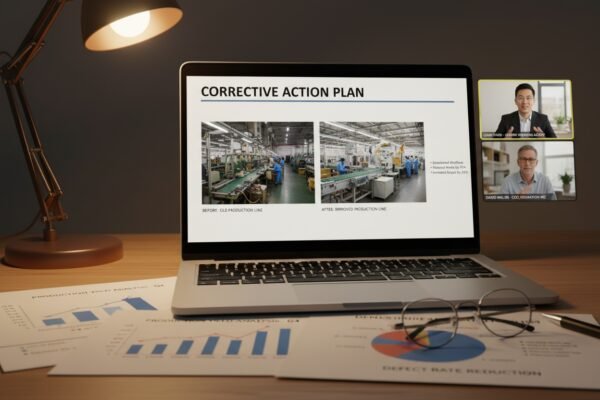
Detailed analysis of the audit findings is where you save money. You are looking for inconsistencies that suggest the supplier is not who they say they are. The biggest giveaway is usually found in the product mix.
The "Jack of All Trades" Product Line
This is a detail that reveals a lot. Real manufacturers are specialists. A factory that invests millions in injection molding machines for plastic toys 8 cannot easily switch to making ceramic mugs or leather bags.
- The Red Flag: If your agent’s report shows a showroom displaying headphones, phone cases, yoga mats, and kitchen knives, you are dealing with a trading company.
- The Reality: A true factory focuses on a single category or material type. If the product diversity is too wide, they are outsourcing everything.
Inconsistent Production Capacity
Does the math work? If the factory claims they can produce 100,000 units a month, but your agent counts only 20 workers on the line, something is wrong.
- Calculation: 100,000 units / 20 workers / 22 days = ~227 units per person per day. Is that physically possible for your product?
- Ghost Workers: Sometimes factories claim to have 500 workers, but the audit photos show empty chairs. They might claim "it is lunch break" or "low season," but this is often a sign of instability.
Documentation Refusals
A legitimate factory is proud of its system. If they hide things, they have problems.
- Maintenance Records: If the agent notes "Factory refused to show machine maintenance logs," it usually means the machines are old, uncalibrated, and prone to breaking down.
- QC Records: If there are no records of rejected items, it means they are likely shipping defects to customers.
Common Red Flags Summary table
Here is a quick reference guide to interpreting these warning signs.
| Observation | What It Means | Risk Level |
|---|---|---|
| Product Variety | Selling diverse, unrelated categories | High (Trader disguised as factory) |
| Stock Photos | Photos look too perfect or staged | High (Fake audit or deceptive marketing) |
| No QC Data | No records of past defects found | Critical (No quality control system) |
| English Invoice | Invoice from a HK or Offshore entity | Medium (Check for hidden margins) |
| Clean Floors | Workshop is spotless, no oil/dust | Medium (Factory might be staged/fake) |
Conclusion
Evaluating your sourcing agent’s audit process is the best insurance for your business. By insisting on NECIPS verification, comprehensive checklists, and proof of physical presence, you strip away the risks of fraud. Do not settle for vague reports; demand the evidence that protects your investment.
Footnotes
1. Replaced HTTP 403 with an authoritative BSI page explaining ISO 9001 quality management systems. ↩︎
2. Definition and stages of the manufacturing production process. ↩︎
3. OSHA safety standards for managing electrostatic discharge. ↩︎
4. Wikipedia definition and types of commercial bank accounts. ↩︎
5. Wikipedia overview of the WhatsApp messaging platform features. ↩︎
6. Technical overview of the injection molding process. ↩︎
7. Wikipedia overview of commercial and marketing photography. ↩︎
8. CPSC safety regulations and standards for plastic toys. ↩︎