
When our team first started helping overseas buyers navigate Huaqiangbei 1, the 38% failure rate on non-vetted agent orders was already a well-known problem.
To evaluate a China sourcing agent's Huaqiangbei experience, verify their on-ground presence in Shenzhen, test their electronics technical knowledge, request client references with case studies, conduct a joint video audit of their office and supplier visits, and check if they offer end-to-end logistics from warehouse to your door.
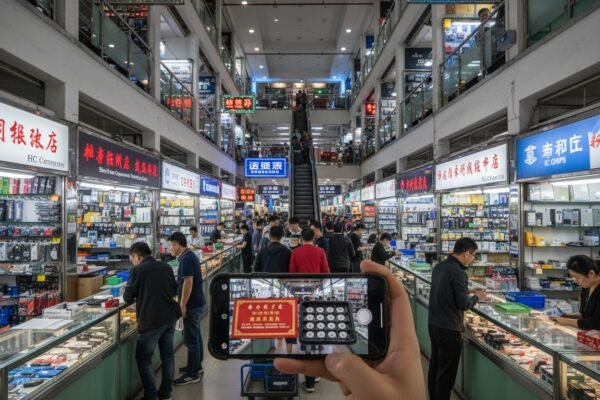
Huaqiangbei is not just another wholesale market Futian district 2. It is the world's largest electronics bazaar with over 400 laptop vendors, dozens of Apple parts specialists per floor, and thousands of component stalls. Finding a sourcing agent who truly knows this maze can save you from counterfeits, compliance failures, and costly delays technical specifications 3. Let me walk you through exactly what to look for.
How do I verify if a sourcing agent has deep connections within the Huaqiangbei electronics market?
Our warehouse sits just minutes from Huaqiangbei, and we walk those floors weekly. Yet many agents claim local expertise without ever stepping inside the market buildings.
Verify a sourcing agent's Huaqiangbei connections by requesting video proof of supplier visits, asking for specific building and floor references, checking their years of operation in Shenzhen's Futian district, and demanding at least three client references who purchased electronics through them.
Why "Deep Connections" Matter Less Than You Think
Here is an honest truth most agents will not tell you. Almost every vendor inside Huaqiangbei shares the same inventory pool. The components you see at Stall A on the third floor of SEG Plaza are often the exact same batch available at Stall B in Huaqiang Electronics World. The supply chain 4 is deeply interconnected. Vendors pull from common distributors and warehouses.
So what does this mean for you? It means the agent who brags about "exclusive supplier relationships" in Huaqiangbei is likely exaggerating. The real question is not who they know. The real question is whether they are honest about how this market works. If your agent tells you there are deep, mysterious differences between identical components from different stalls, that is a red flag. They are creating complexity to justify higher fees.
A trustworthy agent will tell you plainly: "Most vendors here carry the same stock. What matters is finding an honest vendor who will not swap your order with lower-grade parts after you pay."
What to Ask During Your Vetting Call
When you interview a prospective agent, ask specific questions that only a local would know. For example:
- Which building has the best concentration of MCU distributors?
- What floor should I go to for bulk sensor modules versus retail gadgets?
- Can you name three vendors you have personally visited this month?
If they stumble on these basics, they are not local.
A Simple Vetting Framework
| Evaluation Step | What to Do | Time Needed |
|---|---|---|
| Video office audit | Ask for a live video call showing their Shenzhen office, staff IDs, and QC tools | Day 1-2 |
| Huaqiangbei walk-through | Request a recorded walk-through of specific market buildings with vendor introductions | Day 3-5 |
| Client reference check | Contact at least 3 past clients who sourced electronics through them | Day 5-7 |
| Business license verification | Confirm their Shenzhen company registration on the National Enterprise Credit System | Day 7-10 |
| Joint supplier visit | Arrange a live video call during an actual supplier meeting | Day 10-14 |
This two-week process may feel slow. But it costs nothing compared to a failed shipment. With over 14,000 registered sourcing agencies in Shenzhen alone—and countless unregistered brokers—taking shortcuts on vetting is the most expensive mistake you can make.
Vertical Sourcing: The Insider Tip
Experienced agents know that street-level stalls in Huaqiangbei cater to tourists and small retail buyers. The real B2B deals happen on upper floors. Second floor and above is where you find bulk pricing, proper invoices, and vendors willing to negotiate MOQs. If your agent only takes you to ground-floor shops, they lack the depth you need.
What technical standards should my agent use to spot counterfeit or refurbished parts in Shenzhen?
When we inspect incoming components for our clients' production runs, counterfeit detection 5 is not optional. It is the first line of defense against product recalls 6 and brand damage.
Your agent should use batch code cross-referencing, manufacturer date verification, X-ray inspection for IC chips, GSX validation for Apple components, multimeter testing for passive parts, and visual inspection under magnification to identify remarked, recycled, or refurbished electronics in Huaqiangbei.
The Counterfeit Problem Is Real
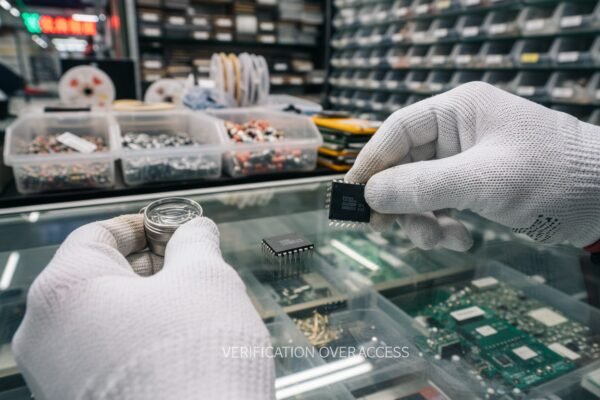
Huaqiangbei is famous for two things: incredible variety and counterfeit risk. Some estimates suggest that a significant portion of components in certain market zones are remarked, recycled, or outright fake. This is especially true for high-value ICs, capacitors, and connectors. A sourcing agent without technical inspection skills is essentially buying blind on your behalf.
Core Detection Methods Your Agent Must Know
Here are the key techniques a competent agent should use:
Visual Inspection. Under a 10x loupe or digital microscope, an experienced inspector checks for inconsistent laser markings, sanded-down chip surfaces, misaligned logos, and ink that smudges with acetone. Remarked chips often have slightly uneven text or a surface texture that differs from genuine parts.
Batch Code Verification. Every legitimate component has a date code and lot number. Your agent should cross-reference these codes against the manufacturer's database or authorized distributor records. If the date code says 2024 but the part was supposedly manufactured in a factory that closed in 2021, you have a problem.
Electrical Testing. For passive components like resistors and capacitors, a simple multimeter check confirms values match the datasheet. For ICs, functional testing on a breakout board or test fixture is the gold standard. Your agent should either have in-house testing capability or use a third-party lab in Shenzhen.
GSX Validation for Apple Parts. Huaqiangbei has 30 to 50 Apple parts specialists per floor. If you source Apple screens, batteries, or logic boards, your agent must run GSX checks to verify whether parts are genuine, refurbished, or aftermarket. Services like Mingtong certification checks are commonly used by local professionals.
Counterfeit Detection Methods at a Glance
| Method | What It Detects | Equipment Needed | Cost Level |
|---|---|---|---|
| Visual inspection (magnified) | Remarked chips, sanded surfaces, logo inconsistencies | Digital microscope or 10x loupe | Low |
| Batch code cross-referencing | Date code mismatches, discontinued parts sold as new | Manufacturer database access | Low |
| Acetone test | Ink-based remarking on IC packages | Acetone, cotton swab | Very low |
| Multimeter testing | Incorrect values on passive components | Digital multimeter | Low |
| X-ray inspection | Internal die structure, wire bonding anomalies | X-ray machine (lab service) | Medium-high |
| Functional IC testing | Dead chips, wrong firmware, incorrect pinout | Test fixture, breakout board | Medium |
| GSX validation | Apple part authenticity and repair history | GSX access or third-party service | Low-medium |
Compliance Certifications Matter Too
Beyond counterfeit detection, your agent should verify that components meet your target market's compliance standards. In 2023, 38% of non-vetted agent export orders failed compliance checks for RoHS, UL, or labeling requirements. Ask your agent directly: "How do you confirm RoHS compliance 7 for the components you source?" If they cannot answer clearly, move on.
A strong agent will have relationships with Shenzhen-based testing labs like SGS 8, TÜV, or Bureau Veritas. They should be able to arrange compliance testing before shipment, not after your customs broker flags a problem at the port.
How will my agent bridge the communication gap with Huaqiangbei suppliers to ensure my quality requirements are met?
In our daily operations coordinating between American buyers and Chinese suppliers, we see the same miscommunication patterns over and over. Specs get lost in translation. Quality expectations remain vague.
Your agent must be fluently bilingual in English and Mandarin, capable of translating technical specifications into Chinese manufacturing terminology, skilled in writing enforceable QC checklists in both languages, and experienced in navigating Chinese business culture to hold suppliers accountable without damaging the relationship.

The Root Cause of Most Quality Failures
Most quality problems from Huaqiangbei do not start on the production line. They start in a WeChat message. A buyer in the US sends a spec sheet in English. The agent translates it loosely. The supplier reads the Chinese version and interprets it differently. Nobody catches the gap until the goods arrive at the buyer's warehouse 6,000 miles away.
This is why "bilingual" is not enough. Your agent needs to be technically bilingual. They must understand terms like "tolerance stack-up," "surface mount versus through-hole," and "impedance matching" in both English and Chinese. A general translator will miss these nuances. A technically fluent agent will catch them before they become defects.
How to Test Your Agent's Communication Skills
Before signing a contract, run a simple test. Send your agent a moderately complex spec sheet—something with tolerances, material requirements, and finish specifications. Ask them to translate it into Chinese and send it back to you alongside the English original. Then have a native Chinese speaker review the translation for accuracy. This one step can save you thousands of dollars.
The QC Checklist: Your Quality Insurance Policy
A good sourcing agent will create a bilingual QC checklist for every order. This checklist should include:
- Exact part numbers and descriptions
- Acceptable tolerance ranges
- Visual standards with reference photos
- Testing procedures and pass/fail criteria
- Packaging and labeling requirements
The checklist goes to the supplier before production starts. It goes to the QC inspector during inspection. And it goes to you as a record of what was agreed upon. Without this document, quality disputes become "he said, she said" arguments that you will always lose from overseas.
Cultural Navigation Is Not Optional
Chinese business culture 9 values relationships. Confronting a supplier aggressively about a quality issue can backfire. The supplier may agree to fix the problem verbally but do nothing. Or worse, they may quietly drop your order priority in favor of a less confrontational buyer.
An experienced agent knows how to apply pressure while preserving face. They escalate issues through the right channels. They use the relationship to get results, not destroy it. This soft skill is invisible but incredibly valuable.
Communication Effectiveness Comparison
| Communication Approach | Outcome | Risk Level |
|---|---|---|
| Buyer communicates directly in English via email | Supplier misunderstands specs, delivers wrong parts | High |
| General translator relays messages on WeChat | Technical terms lost in translation, vague QC standards | Medium-high |
| Technically fluent agent with bilingual QC checklist | Specs accurately conveyed, quality expectations documented and enforced | Low |
| Agent conducts on-site QC with live video to buyer | Real-time verification, immediate issue resolution | Very low |
Real-Time Oversight Through Technology
In 2026, there is no excuse for an agent who cannot offer real-time video inspections. Tools like WeChat video, Zoom, and dedicated QC apps allow your agent to walk through an inspection live while you watch from your office. This is not a luxury feature. It is a baseline expectation for any serious sourcing agent working in Huaqiangbei.
Ask your agent: "Can you do a live video inspection before shipment?" If the answer is anything other than an immediate yes, keep looking.
Can my sourcing agent provide the end-to-end logistics support I need to prevent delivery delays from Shenzhen?
Our fulfillment team in Shenzhen handles consolidation, customs paperwork, and freight booking every single day. We have seen firsthand how a logistics gap between sourcing and shipping can derail an entire product launch.
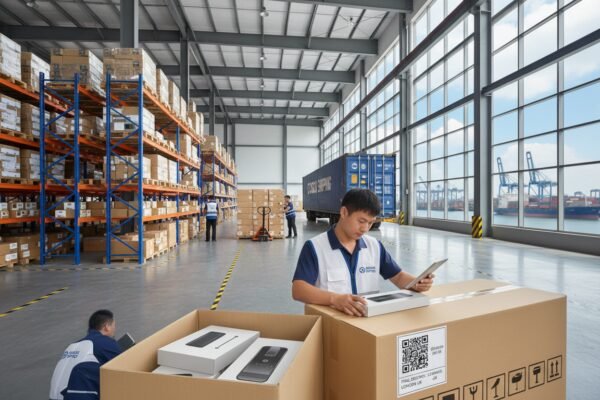
Your sourcing agent should offer warehousing in Shenzhen for order consolidation, coordinate with freight forwarders for sea, air, or express shipping, handle Chinese export customs documentation, provide real-time shipment tracking, and manage contingency plans for port congestion or carrier delays to keep your deliveries on schedule.
Why Logistics Is the Weakest Link
Most buyers focus their agent evaluation on sourcing and QC. That makes sense. But the most common complaint we hear from clients who switch to us from other agents is not about product quality. It is about delivery delays.
Here is how it typically goes wrong. The agent sources the product. The QC passes. Then the agent hands you a box of goods and says, "Here, find a freight forwarder." You scramble to arrange shipping. The goods sit in a Shenzhen warehouse for two weeks. By the time they reach your port, you have missed your sales window.
An end-to-end agent eliminates this gap. They treat logistics as part of the service, not an afterthought.
What "End-to-End" Actually Means
Let me break down what comprehensive logistics support looks like from Shenzhen:
Warehousing and Consolidation. If you source from multiple Huaqiangbei vendors in one trip, your agent should have a warehouse to receive, inspect, and consolidate all items into a single shipment. This reduces shipping costs and simplifies customs clearance on your end.
Freight Coordination. Your agent should have established relationships with freight forwarders 10 who specialize in Shenzhen exports. They should advise you on the best shipping method—sea freight for large volume, air freight for urgency, or express courier for small parcels. They should book the shipment, not just recommend a carrier.
Export Documentation. Chinese export customs require commercial invoices, packing lists, and sometimes certificates of origin or compliance certificates. Your agent should prepare all of these. If they ask you to handle Chinese-side paperwork, they are not providing full service.
Tracking and Communication. Once the shipment leaves Shenzhen, your agent should provide you with tracking numbers, estimated arrival dates, and proactive updates if there are delays. You should not have to chase them for status updates.
Contingency Planning. Shenzhen's ports occasionally face congestion, especially around Chinese New Year and the October Golden Week holiday. An experienced agent plans around these peaks. They may recommend shipping earlier, using alternative ports like Guangzhou or Hong Kong, or splitting shipments to reduce risk.
Logistics Readiness Checklist
| Logistics Capability | Questions to Ask Your Agent | Red Flag If Missing |
|---|---|---|
| Shenzhen warehouse | "Do you have your own warehouse or a contracted one? Can I see it on video?" | No warehouse means no consolidation |
| Freight forwarder network | "Which forwarders do you work with? Can you quote sea and air options?" | Agent suggests you find your own forwarder |
| Export documentation | "Will you prepare the commercial invoice, packing list, and CO?" | Agent asks you to handle Chinese customs docs |
| Shipment tracking | "How will you keep me updated after the shipment leaves?" | No tracking system, only responds when asked |
| Holiday planning | "How do you handle orders around Chinese New Year?" | No mention of lead time adjustments |
The Hidden Cost of Logistics Gaps
When delivery is late, the damage extends far beyond the shipping delay itself. Your downstream customers lose trust. They may cancel orders or switch to competitors. If you are selling on Amazon, late inventory means lost Buy Box position and wasted PPC spend. One client told us that a three-week delay on a holiday product launch cost them over $40,000 in lost revenue.
An experienced agent builds buffer time into every timeline. They do not promise "fastest shipping" to win your business. They give you realistic dates and then beat them. That is the kind of logistics discipline that separates a professional agent from a middleman with a phone.
Dropshipping and Fast Fulfillment Trends
As of 2026, many Shenzhen-based agents now offer dropshipping integration for small and mid-volume electronics orders. This means your agent can ship directly to your end customers or Amazon FBA warehouse without the goods ever touching your hands. If your business model supports this, ask your agent whether they offer direct-to-FBA or direct-to-customer fulfillment. It can dramatically reduce your lead times and warehousing costs.
Conclusion
Evaluating a Huaqiangbei sourcing agent comes down to honesty, technical skill, communication ability, and logistics discipline. Test them rigorously before trusting them with your money.
Footnotes
1. Provides general information about the Huaqiangbei electronics market. ↩︎
2. Offers geographical and administrative details about Shenzhen's Futian District. ↩︎
3. National Institute of Standards and Technology explanation of standards, relevant to specifications. ↩︎
4. Explains the fundamental concept and components of a supply chain. ↩︎
5. U.S. Customs and Border Protection information on combating counterfeit goods. ↩︎
6. Official government resource for consumer product safety and recalls. ↩︎
7. Official European Commission page detailing the Restriction of Hazardous Substances Directive. ↩︎
8. Official website of SGS, a leading inspection, verification, testing, and certification company. ↩︎
9. Provides insights into etiquette and cultural nuances for doing business in China. ↩︎
10. Explains the role and services of freight forwarders in logistics. ↩︎