
In our Shenzhen office, we frequently encounter international buyers who are anxious about wiring large deposits to new suppliers National Enterprise Credit Information Publicity System 1. This fear is valid; sending fifty thousand dollars to a company you have never met is a massive risk. Without proper verification, you might face production delays, poor quality, or outright fraud.
A professional China sourcing agent protects your capital by conducting a multi-layered audit that includes verifying the supplier's legal registration in government databases, analyzing their financial stability through bank records, and performing on-site inspections to confirm that physical assets match their claimed credit status.
Let’s break down exactly how we validate a supplier’s creditworthiness to keep your funds safe.
How does my sourcing agent verify a factory's legal standing and financial health before I commit to a large payment?
We know that a flashy Alibaba profile does not always equal a legitimate business. In our experience managing procurement for US electronics brands, we start every vetting process by looking past the marketing photos and diving into the legal data. If the foundation is weak, the whole deal will collapse.
Your sourcing agent verifies legal standing by querying the National Enterprise Credit Information Publicity System using the supplier's Unified Social Credit Code. They confirm the business status is active, check the registered capital amount, verify the legal representative, and screen for any history of administrative penalties or frozen assets.
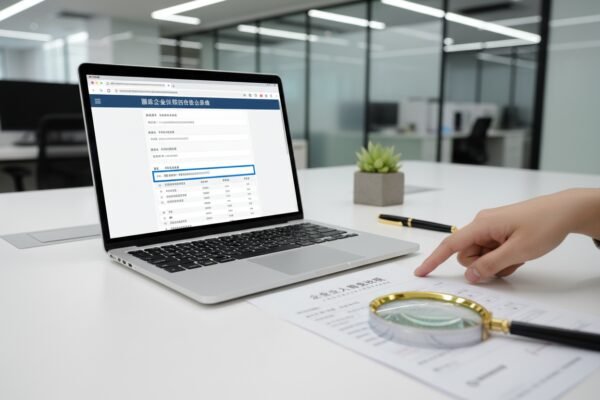
The first step in any robust credit audit is peeling back the layers of a company's legal identity. A competent sourcing agent does not rely on documents sent by the supplier, which can be photoshopped. Instead, we access the National Enterprise Credit Information Publicity System (NECIPS). This is the official Chinese government database that records every legally registered company.
Understanding the Unified Social Credit Code
Every legitimate company in China has a unique 18-digit Unified Social Credit Code 2. Your agent uses this code to pull the company's "file." We look for specific indicators of health. For example, a company with a status listed as "Abnormal Operations" (经营异常) is a major red flag. This status often means they are not located at their registered address or have failed to submit annual reports.
Analyzing Registered Capital
Registered capital 3 is another critical metric. While China has moved to a subscription-based capital system (meaning owners don't always have to pay all capital upfront), a very low registered capital (e.g., 30,000 RMB) for a factory claiming to manufacture complex electronics is suspicious. It suggests they have very limited liability if things go wrong.
Checking the Business Scope
We also scrutinize the "Business Scope 4" (经营范围). If you are buying Bluetooth speakers, but the business scope only lists "consulting" or "sales of general merchandise" without mentioning "manufacturing" or "production," you are likely dealing with a trading company or a shell company, not the source factory.
Legal Disputes and Penalties
Finally, a deep dive into the legal history is essential. Your agent should check specifically for "Civil Judgments 5" or "Enforcement Notices." If the supplier has been sued by other suppliers for non-payment or by employees for wage arrears, this is a clear sign of financial instability. We want to ensure they are not using your deposit to pay off old debts.
Table 1: Key Legal Indicators: Factory vs. High-Risk Trader
| Indicator | Legitimate Factory | High-Risk Trader / Shell Company |
|---|---|---|
| Business Scope | Includes "Production," "Manufacturing," "Processing." | Only lists "Wholesale," "Sales," "Consulting." |
| Registered Capital | Typically 1 Million RMB or higher. | Often low (e.g., 30k - 100k RMB). |
| Established Date | Usually 3+ years for stability. | Often < 1 year (High "burn and turn" risk). |
| Registered Address | Located in an industrial zone or park. | Located in a residential building or co-working space. |
What specific credit audit documents should I expect my agent to provide to prove a supplier is trustworthy?
When we finalize a supplier list for our clients, we don't just say "they look good." We provide a dossier of evidence. You need tangible proof to justify a large transfer, and requesting these documents is a standard part of our due diligence process to separate professionals from amateurs.
You should expect your agent to provide a copy of the Business License, the Bank Account Opening Permit, a Tax Registration Certificate, and relevant ISO certifications. Crucially, the bank account name on the proforma invoice must perfectly match the company name on the Business License.
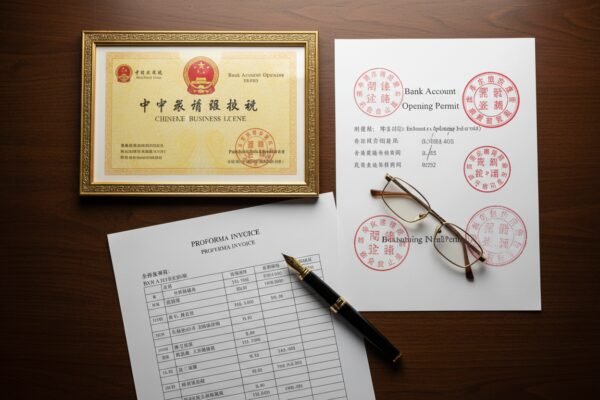
To protect a large payment, your agent must gather a specific set of documents that collectively prove the supplier is who they say they are. Here is the breakdown of what we look for and why it matters.
The Business License (Ying Ye Zhi Zhao)
This is non-negotiable. It contains the company name, establishment date, and scope. Your agent should provide a translated version of this. The most critical check here is the Company Name. In China, the official company name is in Chinese characters. The English name they use for marketing is not legally binding. Your agent must confirm that the Chinese name on the license matches the beneficiary name for the bank transfer.
Bank Account Opening Permit
This document proves the company has a verified corporate bank account. Bank Account Opening Permit 6 In China, opening a corporate account requires the legal representative to be physically present and verified. If a supplier tries to have you pay into a personal account or an account in Hong Kong with a slightly different name, this permit serves as the "source of truth" to expose the discrepancy.
Tax Registration and General Taxpayer Status
We look for proof that the supplier is a "General Taxpayer 7" (一般纳税人). This status allows them to issue VAT invoices and claim tax rebates on exports. Small-scale taxpayers cannot do this easily. A General Taxpayer status implies a certain level of revenue and accounting compliance, suggesting greater financial stability.
ISO and Industry Certifications
While ISO 9001 8 (Quality Management) is common, checking its validity is vital. Fake certificates are rampant. Your agent should verify the certificate number on the issuing body's website (like CNAS). A valid, active certificate shows the supplier invests in their management systems, which correlates with long-term business intent rather than a "hit and run" scam operation.
Table 2: Essential Audit Documents Checklist
| Document Name | What It Verifies | Why It Protects Your Payment |
|---|---|---|
| Business License | Legal existence, Age, Scope. | Ensures the entity is a legal company, not an individual. |
| Bank Account Permit | Official Corporate Bank Account. | Prevents payment to personal accounts where fraud is easy. |
| Export License | Right to export goods directly. | Avoids reliance on third-party export agents (intermediaries). |
| ISO 9001 Certificate | Quality Management System. | Indicates operational maturity and lower risk of quality failure. |
| Tax Payer Certificate | Tax compliance status. | Reduces risk of government shutdowns due to tax evasion. |
How can my sourcing agent use on-site factory audits to cross-reference the supplier's official credit records?
Paperwork can be forged, but it is much harder to fake a bustling factory floor. When our team visits a facility, we aren't just looking at machines; we are comparing the physical reality against the financial story the supplier told us. This cross-referencing is the ultimate truth serum.
Your sourcing agent uses on-site audits to count production lines, verify inventory levels, and interview staff, ensuring these physical assets align with the registered capital and sales figures claimed in credit reports. This confirms the factory has the actual capacity to fulfill your order.

An on-site audit acts as a physical "fact check" of the credit report. A credit report might say a company has 10 million RMB in registered capital and 200 employees, but the reality on the ground can be very different. Here is how we bridge that gap.
Verifying Operational Scale
If the credit report suggests a high-volume manufacturer, we expect to see a corresponding number of production lines and workers. If we arrive and find only 10 people assembling goods by hand in a small room, despite the documents claiming a massive operation, we know the "registered capital" was likely inflated or withdrawn. This discrepancy is a huge risk factor for large payments because the supplier lacks the resources to correct mistakes if production goes wrong.
Inventory as a Cash Flow Indicator
During the audit, we inspect the warehouse. We look at the raw materials (inputs) and finished goods (outputs).
- Too much old stock: Suggests they are having trouble selling, which might mean cash flow issues.
- Zero stock: Suggests they might be purchasing "just in time" or outsourcing everything, which increases the risk of delay.
A healthy factory has a balanced flow of material. We also check the brands on the boxes in the warehouse. If they claim to supply big US retailers, we should see those boxes. If we don't, they lied about their client base.
The "Ghost Worker" Check
We often ask to see the attendance records or a random sample of payroll slips during an audit. We match this against the headcount we see on the floor. If a factory claims 500 workers for insurance purposes but we only see 50, they are either outsourcing your order to a cheaper, unverified factory (subcontracting) or lying about their size. Both are dangerous for your quality control and timeline.
Machinery Maintenance Logs
A financially stable supplier maintains their assets. We look at the maintenance tags on key machinery (like injection molding machines or SMT lines). If the machines are dusty, broken, or haven't been serviced in months, it indicates the company is cutting costs due to financial stress. A factory that cannot afford oil for its machines cannot afford to refund your deposit.
Table 3: On-Site Red Flags vs. Paper Claims
| Feature | Paper Claim (Credit Report) | On-Site Reality (Red Flag) |
|---|---|---|
| Workforce | "200 Full-time Employees" | Less than 50 workers; mostly temporary labor. |
| Equipment | "Advanced Automated SMT Lines" | Old, manual equipment; machines idle or covered in dust. |
| Production | "100% In-house Manufacturing" | No raw materials visible; finished goods from other factories. |
| Location | "Owned Industrial Park" | Shared floor in a rented building; signage is temporary. |
What are the red flags I should look for if my agent's supplier credit report seems incomplete or suspicious?
In our years of negotiating contracts, we have learned that silence or vagueness is often louder than a direct refusal. When a supplier tries to hide details during the audit process, it triggers our internal alarm bells. Recognizing these subtle signs protects you from entering a bad partnership.
Red flags include the supplier refusing on-site inspections, providing a personal bank account for deposits, or having a business license address that differs from the actual factory location. Additionally, be wary of newly registered companies with vague business scopes or inconsistent contact information.

When reviewing the credit report provided by your agent, you need to adopt a skeptical mindset. Scammers are sophisticated, but they often leave small clues. Here are the specific red flags that should make you pause the payment immediately.
The "Personal Account" Trap
This is the single biggest red flag. If the supplier asks you to wire money to a personal name (e.g., "WANG LI") instead of the company name (e.g., "SHENZHEN ELECTRONICS CO., LTD"), stop. They might claim it is for "tax avoidance" or "faster processing." In reality, once money hits a private account, it is legally considered a gift or personal loan, and you have zero recourse to get it back if they disappear. Legitimate businesses always use corporate accounts.
Inconsistent Addresses (The "Office" vs. "Factory")
It is common for factories to have a separate sales office, but they should be transparent about it. If the business license address leads to a residential apartment or a virtual office in a skyscraper, but they claim to be a 5,000 sqm factory, something is wrong. Your agent must verify that the production address is listed as a branch or is legally tied to the main company.
Refusal of Third-Party Audits
If a supplier says, "Trust us, we don't need an audit," or "Our factory is secret," run away. A confident, financially healthy supplier welcomes audits because it proves their quality. Resistance usually means they are hiding child labor, poor conditions, or the fact that they are just a middleman with no factory at all.
Frequent Changes in Legal Representative or Shareholders
Your agent's credit report will show the history of the company structure. If the company has changed its legal representative or major shareholders three times in the last two years, it suggests internal instability or a company that is being sold off repeatedly to avoid debts. Stability in management usually equates to stability in production.
Table 4: Common Scams Detected by Credit Audits
| Scam Type | The Setup | The Credit Audit Reveal |
|---|---|---|
| The Middleman Mask | Claims to be a factory; offers low prices. | Business scope only says "Sales"; audit shows no machinery. |
| The Bait and Switch | Sends perfect samples; demands 100% upfront. | Bank account is personal; company is <6 months old. |
| The Phoenix Company | Owner closes debt-ridden company, opens new one. | Legal Rep history shows failed past companies; same address. |
| The Cyber-Squatter | Hacks email of real factory; changes bank details. | Bank account name does not match the reputable factory's name. |
Conclusion
Protecting your capital in international trade requires more than trust; it requires verification. By ensuring your sourcing agent conducts a deep dive into government records, demands the right corporate documents, and physically validates the factory's capacity, you build a fortress around your investment. Do not rush the deposit. A thorough credit audit might take a few days and cost a small fee, but compared to the loss of your entire payment, it is the cheapest insurance policy you will ever buy.
Footnotes
1. Explains the official Chinese government database for company registration and credit information. ↩︎
2. Details the unique 18-digit identifier for businesses in China, crucial for verification. ↩︎
3. Explains the concept of registered capital in China and its legal implications for companies. ↩︎
4. Defines the legal activities a company is authorized to conduct in China, as listed on its license. ↩︎
5. Replaced with an article on the enforcement of civil judgments in China. ↩︎
6. Replaced with a guide on how to open a bank account in China from China Briefing. ↩︎
7. Explains the classification and benefits of General Taxpayer status for businesses in China. ↩︎
8. Provides information on the international standard for quality management systems. ↩︎
9. Explains the essential document legally authorizing a company to operate in China. ↩︎