
Every week, our team at Go Source fields calls from buyers who got burned by a supplier that promised the moon but couldn't deliver half the order on time on-site factory audits 1. The factory tour looked impressive, the sales pitch was polished, and the quoted lead time seemed reasonable—until reality hit. Delayed shipments, inconsistent quality, and excuses that pile up faster than finished goods FDA, UL, or CE certifications 2. The root cause is almost always the same: nobody verified whether the factory could actually produce what they claimed.
A professional China sourcing agent evaluates supplier production capacity through on-site factory audits, real-time production line observation, machinery and workforce assessments, order history verification, and scalability analysis—giving buyers ground-truth data instead of relying on supplier self-reported claims.
In this guide, we break down the exact process our agents use to separate real production capability from sales theater. Whether you are a brand founder sourcing consumer electronics 3 or a purchasing manager handling seasonal spikes, these methods will help you avoid costly capacity miscalculations.
How can a sourcing agent help me verify if a factory's real output matches their sales pitch?
We have walked through hundreds of factory floors across Guangdong, Zhejiang, and Fujian provinces. One thing we have learned is that the gap between what a supplier says and what a supplier does can be enormous—sometimes a 50% or greater discrepancy.
A sourcing agent verifies real output by physically observing production lines, timing actual unit throughput, cross-referencing claimed capacity with order records, interviewing floor managers, and checking whether automation levels match the supplier's stated efficiency—exposing inflated claims before you commit.

Why Sales Pitches Are Unreliable
Supplier sales teams are incentivized to win your order. They will quote optimistic lead times and exaggerate daily output. In one case we handled last year, a factory claimed they could produce 5,000 units per day of a consumer electronics product. When our agent visited and timed the actual line, the real number was closer to 1,800. That single discrepancy would have caused a 3-month delay for the buyer.
The Observation Method
Our agents use a simple but effective technique. They identify a production line making a product similar to yours. They watch production for 15–30 minutes and count actual output. Then they compare that number against the factory's claim. The math does not lie.
| Verification Step | What the Agent Does | What It Reveals |
|---|---|---|
| Line observation | Times production of units over 15–30 minutes | Actual throughput vs. claimed throughput |
| Floor manager interview | Asks about shift schedules, overtime policies, reject rates | Realistic daily and monthly capacity |
| Order log review | Requests shipping records from the past 6 months | Historical proof of volume handled |
| Client reference check | Asks which brands they supply (look for well-known enterprises) | Credibility and experience level |
| Automation assessment | Checks if lines are fully automatic, semi-automatic, or manual | True efficiency and consistency potential |
Look at the Workshop Floor Directly
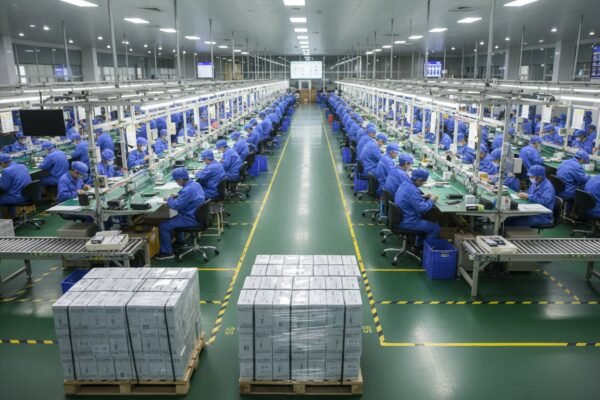
One thing I always tell our team: look directly at the workshop production lines. Is it fully automated or semi-automated? A fully automated line with CNC machines 4 and robotic arms tells a very different story than rows of workers doing manual assembly. Also, find out who their existing clients are. If they supply well-known large enterprises, that is a strong credibility signal. Big brands do not tolerate capacity shortfalls, so the factory has been tested under pressure.
Distinguishing Manufacturers from Trading Companies
A real factory can walk you through every production step. They know the raw materials, the tooling, and the bottlenecks. Trading companies 5, on the other hand, get vague when you ask technical questions. Our agents probe for specific details about machinery models, maintenance schedules, and in-house capabilities. If the "factory" subcontracts most of the work, their real capacity is out of their control—and out of yours.
What specific capacity metrics should my agent evaluate during a physical factory audit?
When our audit team prepares for a factory visit, they carry a structured checklist that goes far beyond counting machines and workers. We have seen too many buyers get fooled by impressive-looking facilities that crumble under real order pressure.
During a physical factory audit, your agent should evaluate machinery condition and age, workforce skill levels and shift capacity, warehouse efficiency, quality control equipment calibration, reject and rework rates, material inventory levels, and production planning systems—covering at least eight operational factors for accurate capacity assessment.

The Eight Core Metrics
Production capacity is not one number. It is the result of multiple interacting systems. Here are the metrics our agents assess on every audit:
| Capacity Metric | How It Is Measured | Why It Matters |
|---|---|---|
| Machine utilization rate | Observe how many machines are running vs. idle | Idle machines signal overclaimed capacity or maintenance issues |
| Workforce skill level | Interview workers and review training records | Skilled workers produce more with fewer defects |
| Shift structure | Confirm number of shifts, hours per shift, overtime policy | Determines maximum sustainable daily output |
| Reject/rework rate | Request QC records; observe reject bins on the floor | High reject rates reduce effective capacity significantly |
| Raw material stock | Walk the warehouse; check stock levels and supplier contracts | Low stock means production stops when materials run out |
| Equipment maintenance logs | Review maintenance schedule and recent repairs | Poorly maintained machines break down and halt production |
| Quality inspection equipment | Check if calipers, CMMs, and testers are calibrated | Uncalibrated tools mean quality cannot be consistently verified |
| Production planning system | Ask how orders are scheduled and prioritized | No planning system means chaos during multi-order periods |
Certification as a Quality Tier Indicator
Certifications matter. An ISO 9001-certified factory 6 has documented processes and, on average, 63% lower defect rates than uncertified ones. Our agents classify factories into quality tiers:
- A-Grade: ISO 9001 plus industry certifications like FDA, UL, or CE, along with social compliance audits.
- B-Grade: Basic ISO certification with some industry credentials.
- C-Grade: Only Chinese national certifications.
- D-Grade: Minimal or no formal certifications.
Higher-tier factories generally have more predictable capacity because their systems are standardized. Lower-tier factories may quote attractive prices but present much higher risk of capacity failure.
Facility Size vs. Claimed Dimensions
We always verify the actual factory floor area against what the supplier claims in their company profile. Discrepancies are common. A factory that says it has 10,000 square meters but actually operates in 4,000 square meters is a red flag. It suggests the supplier is inflating their profile to attract larger orders they cannot fulfill.
The FMEA Check
Professional factories use Process Failure Mode and Effect Analysis (P-FMEA) 7 to anticipate and prevent production problems. Our agents ask to see FMEA documentation. If the factory has it and can explain how it was developed internally, that is a strong sign. If the document looks generic or was clearly created just to pass an audit, it tells us the factory lacks genuine risk management—and their capacity claims are likely unreliable under stress.
How does my sourcing agent ensure the supplier can scale production for my peak season orders?
Peak season can make or break a brand. Our clients in consumer electronics and smart home products often see demand spike 200–300% heading into Q4. We have learned that the time to test a supplier's scalability is not during the rush—it is months before.
Your sourcing agent ensures scalability by evaluating the supplier's shift expansion capability, subcontractor network, raw material procurement lead times, historical peak season performance, and equipment headroom—confirming they can ramp production 2–3x without sacrificing quality or missing deadlines.

The Scalability Assessment Framework
Scaling production is not just about adding workers. It requires coordination across materials, machines, quality systems, and logistics. Here is how our agents evaluate each factor:
| Scalability Factor | Agent Evaluation Method | Risk If Missing |
|---|---|---|
| Shift expansion | Can the factory add a second or third shift? Are workers available? | Production ceiling hit during peak demand |
| Material procurement | How quickly can the supplier source additional raw materials? | Material shortages halt production mid-run |
| Subcontractor network | Does the factory have vetted subcontractors for overflow work? | Quality drops when unvetted subs are used last-minute |
| Equipment headroom | Are machines running at 60% or 95% utilization currently? | No room to increase output without new equipment |
| QC staffing | Can the factory add inspectors proportional to increased output? | Defect rates spike as volume increases |
| Historical peak data | Has the factory successfully scaled for other clients' peak seasons? | No proven track record means unproven promises |
The Chinese New Year Factor
Every experienced sourcing agent knows that Chinese New Year 8 is the single biggest disruption to production schedules in China. Factories close for 2–4 weeks, and many workers do not return. Production before CNY is rushed, and production after CNY is slow to restart. Our agents build this into every capacity plan. If your peak season falls within two months of CNY, we flag it immediately and work with the supplier to front-load production.
Order Significance and Supplier Prioritization
Here is something most buyers do not think about: if your order represents only 0.5% of the factory's total capacity, you are not a priority. When peak season hits and the factory has to choose whose order gets attention, yours goes to the back of the line. Our agents assess whether your order volume is significant enough for the supplier to prioritize. Sometimes a mid-sized factory that treats your order as 10–15% of their business is a better partner than a massive factory where you are invisible.
Smart Manufacturing and Automation
We also look at whether the supplier has invested in smart manufacturing 9—IoT sensors on production lines, real-time data dashboards, and automated material handling. Factories with these systems can scale more efficiently because they identify bottlenecks in real time rather than discovering them after a production run fails. This is not about having the latest technology for its own sake. It is about operational resilience when volume pressure increases.
Contingency Planning
Finally, our agents ask about contingency plans. What happens if a key material supplier fails? What if there is a power outage? What about a natural disaster? Professional factories have documented answers. Unprepared factories shrug and say "it won't happen." That answer alone tells you everything you need to know about their ability to handle peak season stress.
What evidence should I request from my agent to confirm a manufacturer can meet my delivery deadlines?
Delivery delays are the number one pain point we hear from buyers—especially brand founders like our clients who resell to downstream partners in the United States. When a shipment is late, their customers switch to competitors. The damage is not just financial; it is reputational.
Request production schedule timelines, weekly progress photos and videos, raw material purchase receipts, shipping record history from past orders, QC inspection reports at each production milestone, and a documented delivery commitment with penalty clauses—this evidence package confirms real deadline capability.
The Evidence Package Explained
Words are cheap. Evidence is what protects your business. Here is what our agents collect and deliver to clients:
Production Schedule with Milestones
Before production begins, our agent obtains a detailed production schedule from the factory. This includes raw material arrival dates, production start and end dates for each batch, QC checkpoints, and packing and shipping dates. Each milestone becomes a checkpoint our agent monitors.
Weekly Progress Reports
Our agents visit the factory or request photo and video evidence weekly during production. They verify that the actual progress matches the schedule. If production falls behind by even a few days, we flag it immediately so corrective action can happen before the delay compounds.
Raw Material Purchase Receipts
One of the most common causes of delay is material shortages. Our agents verify that the factory has ordered and received all necessary materials before production is supposed to start. A factory that has not purchased materials but claims production is "on schedule" is lying.
Historical Shipping Records
We ask for shipping records from the supplier's past 6–12 months of orders. This shows us their actual on-time delivery rate. If they claim 95% on-time delivery but records show frequent delays, we know the risk level.
The Stocktaking Reality Check
In one case we documented, a supplier claimed that half their inventory for our client's order was packed and ready to ship. Our agent conducted a physical stocktaking and found only 25% was actually ready. The root cause was a raw material sourcing issue that, once identified, could be resolved in two weeks. Without the on-site check, the client would have waited months wondering why the shipment was late.
Sample Quality vs. Production Quality
A critical point: the samples you received represent the best the factory can do. Average production quality is always lower. Our agents conduct in-process inspections at the beginning, middle, and end of a production run. They also perform destructive testing on random units to verify durability matches the approved sample. This is how you catch quality drift before it becomes a delivery disaster—because reworking defective goods eats directly into your delivery timeline.
Delivery Commitment with Teeth
Finally, we recommend negotiating a delivery commitment with penalty clauses into the purchase agreement. A supplier who is confident in their capacity will accept reasonable penalties for late delivery. A supplier who pushes back aggressively on penalties is telling you they do not trust their own timeline.
Conclusion
Evaluating Chinese supplier production capacity 10 is not optional—it is the foundation of every successful sourcing project. A professional China sourcing agent gives you ground-truth data through factory audits, real-time monitoring, and documented evidence, turning supplier promises into verified capability.
Footnotes
- Provides a comprehensive guide to factory audits and their importance. ↩︎
- Replaced HTTP unknown link with an explanation of manufacturing certifications including FDA, UL, and CE from E-Business International. ↩︎
- Offers a general overview of the consumer electronics industry. ↩︎
- Explains what CNC machining is and its manufacturing process. ↩︎
- Replaced HTTP unknown link with an article detailing the key differences between trading and manufacturing companies from Mckallen. ↩︎
- Details the importance and benefits of ISO 9001 certification for quality. ↩︎
- Describes P-FMEA as a systematic approach for identifying process risks. ↩︎
- Explains the significant impact of Chinese New Year on global supply chains. ↩︎
- Defines smart manufacturing and its role in modern production. ↩︎
- Defines and explains supplier capacity assessment, a crucial evaluation. ↩︎