Two things happened at US Customs and Border Protection in October 2026 that both change how a parcel from China gets declared, and they point in opposite directions. One is a proposed rule that would tighten filing requirements for every informal entry valued at USD 2,500 or less. The other is a final rule that gave certain postal shipments almost three more months to comply.
If you ship small parcels to the United States, both land on the same desk. The practical work is not in reading them. It is in working out which documents you need to produce, who produces them, and by when.

What CBP actually proposed, and what it has not decided
A proposed rule is not a rule yet
The main document is "Low-Value Shipments," published in the Federal Register on October 8, 2026 as document 2026-20650, at 91 FR 64532. It is a notice of proposed rulemaking under docket USCBP-2026-0298, and comments are open until December 7, 2026. It would amend 19 CFR parts 113, 128, 141, 143 and 145. Its subject is the filing requirements for informal entries of goods valued at USD 2,500 or less, plus a new electronic entry type for merchandise arriving through the international mail network.
Nothing in it is final. There is no effective date on the page because none has been proposed. The comment period is the one window where a company with an operational stake can still influence what lands, and the two changes most likely to be contested are the ones that create cost: a bonding requirement and a liquidated damages floor.
Why the proposal exists
The reasoning is in the rule's own background. CBP says the availability of the de minimis exemption is suspended and will be terminated on July 1, 2027. When a tariff exemption disappears, the volume that used to clear under it does not disappear with it. It shifts into informal entry procedures, and CBP expects low-value shipment volume to stay high. More parcels means more entry filings, and CBP is restructuring the process around data it can check before the goods land.
The filing deadline moves from 15 days after arrival to the day of importation
The grace period disappears
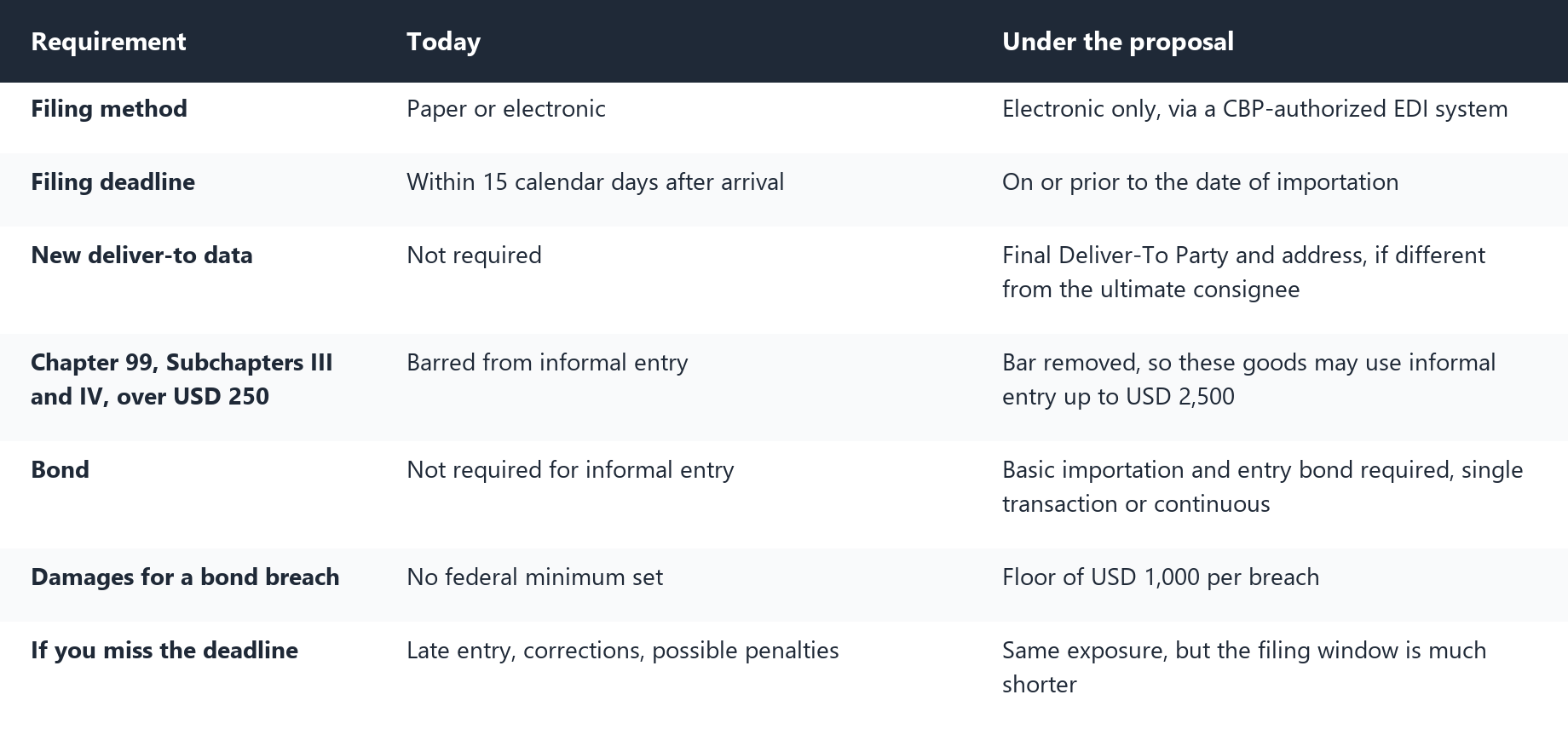
Today, an informal entry for goods valued at USD 2,500 or less can generally be filed within 15 calendar days after the goods arrive or reach their destination port. The proposal changes this. The deadline for making entry for entry type 11 becomes upon or prior to the date of importation.
For anyone who has been treating those 15 days as working room to fix a description, chase a supplier for a document, or wait for a customer to confirm the final value, that window closes.
What the date of importation actually means
The term is defined in 19 CFR 101.1. For merchandise arriving by vessel, it is the day the vessel arrives within the limits of the port and is ready to unload. For all other modes, it is the day the merchandise arrives within the Customs territory of the United States. Either way, the filing is keyed to arrival, not to a post-arrival window. The data has to exist before the parcel is in flight.
Paper filing goes away, and one data element arrives
Entry type 11 can currently be filed on paper or electronically. The proposal would require electronic filing through a CBP-authorized electronic data interchange system, carrying the data elements of CBP Form 3461 and CBP Form 7501, or of CBP Form 7501 alone.
CBP justifies this on volume grounds, and the numbers are in the rule. Between September 1, 2025 and May 31, 2026 there were 52,450,418 entry type 11 filings, of which 73,534 were on paper. That is 0.14 percent.
The proposal also adds a new data element: the Final Deliver-To Party, including that party's address. It is required only when that party is different from the ultimate consignee already on the entry summary. For most shipments the answer is the same address, and for a meaningful share it is not.
| Requirement | Today | Under the proposal |
|---|---|---|
| Filing method | Paper or electronic | Electronic only, via CBP EDI |
| Filing deadline | 15 calendar days after arrival | On or prior to date of importation |
| Deliver-to data | Not required | Final Deliver-To Party, if not the consignee |
| Chapter 99 over USD 250 | Barred from informal entry | Bar removed, up to USD 2,500 |
| Bond | Not required | Basic import and entry bond required |
| Bond breach damages | No federal minimum | Floor of USD 1,000 per breach |
One change runs in your favour. Goods valued above USD 250 but not more than USD 2,500, classified under Subchapters III and IV of Chapter 99 of the HTSUS, would no longer be barred from using informal entry, even where Section 232 duties or temporary trade remedies apply.
Entry Type 13 and the data your mail shipments now need
A new entry type for the mail channel
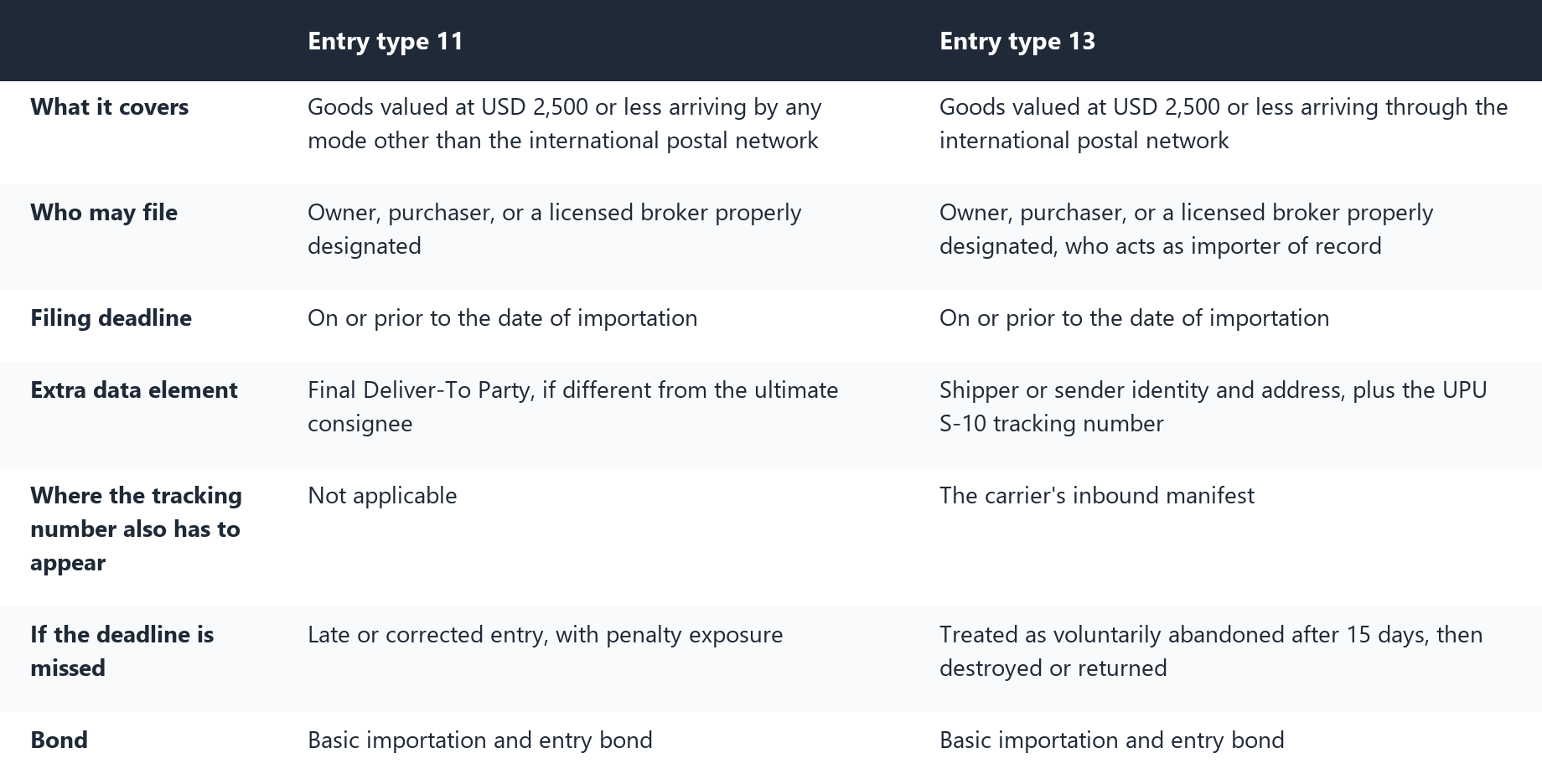
The proposal creates entry type 13, an Informal Mail Entry, for merchandise valued at USD 2,500 or less that arrives through the international postal network and would have been eligible for entry type 11 by any other means. It largely mirrors the amended entry type 11, and it has to be filed electronically in ACE.
Entry type 13 already exists as a test. CBP announced it on June 24, 2026 and it commenced in ACE production on September 22, 2026. The October 8 proposal would put that arrangement into the regulations.
Two data elements most shippers do not have yet
Entry type 13 adds two requirements on top of the amended entry type 11 set. The first is the shipper or sender: the identity of the party causing the goods to be shipped, and that party's address. The second is the tracking number assigned by the foreign postal operator, specifically the Universal Postal Union S-10 number.
The tracking number creates a matching chain that did not exist before. The same number has to appear on the entry type 13 filing and on the manifest the carrier files with CBP. Matching the two lets CBP determine the precise arrival time of each mail shipment and confirm an entry was filed on time. In practice, the number on the parcel, in the carrier's manifest and on the declaration all have to agree.
The 15-day abandonment rule
This is the part with teeth. Under the proposal, mail articles valued at USD 2,500 or less for which an entry has not been timely and properly filed are considered voluntarily abandoned by CBP once 15 days pass from the date of importation. It also adds a new section 145.6 covering unentered packages.
The reason is capacity, not punishment. Because the entry must now be filed before or on the date of importation, a parcel that arrives with no valid filing is unentered, and unentered parcels occupy warehouse and postal handling capacity. After 15 days they are treated as abandoned, and USPS then handles them under its own rules, which can include destruction or return to the sender.
| Entry type 11 | Entry type 13 | |
|---|---|---|
| Covers | Low-value goods, non-postal modes | Low-value goods, international mail |
| Who may file | Owner, purchaser or broker | Same, broker acts as importer of record |
| Filing deadline | On or prior to date of importation | On or prior to date of importation |
| Extra data | Final Deliver-To Party | Shipper identity, address, UPU S-10 number |
| Tracking number | Not applicable | Must also appear in carrier manifest |
| Deadline missed | Late entry, penalty exposure | Abandoned after 15 days |
| Bond | Basic import and entry bond | Basic import and entry bond |
The filing options also narrow in practice. CBP's trade information notice for the entry type 13 test states that shipments exceeding USD 2,500 in value, shipments subject to quota, and shipments subject to antidumping or countervailing duty orders must be cleared as a formal entry.
The bond, the importer of record, and the USD 1,000 floor
Every informal entry would need a bond
The proposal would require a basic importation and entry bond for all entry type 11 and entry type 13 filings, either a single transaction bond or a continuous bond. CBP's stated reasons are that without a bond its ability to recover duties, taxes and fees is limited, that the bond ensures goods can be redelivered if more information is needed, and that it pressures the importer of record to correct non-compliant behavior.
For a company filing entry type 11 for individual parcels, this is the largest structural change in the proposal. It turns a per-shipment administrative act into a per-shipper financial relationship with a surety.
The liquidated damages floor
The proposal also sets a floor of USD 1,000 for liquidated damages arising from a breach of the terms of a customs bond securing an informal entry. Generally the damages are the greater of the merchandise value or USD 1,000. Where the merchandise is prohibited, restricted or alcohol, the standard is three times the merchandise value or USD 1,000, whichever is higher.
A USD 1,000 floor on a USD 40 parcel is the arithmetic that makes this matter. The exposure stops being proportional to what you shipped.
Who can be the importer of record
The proposal clarifies a point that has caused friction. Where the consignee is going to make the entry and the consignee is neither the owner nor the purchaser of the merchandise, a licensed customs broker must act as the importer of record. This applies to entries of merchandise valued at USD 2,500 or less, which previously sat outside that requirement.
The entities this touches are specific: foreign postal operators, USPS, freight forwarders and carriers. It matters for buyers who ship through a platform or a freight forwarder and assume their own name on the paperwork, because under the proposal the broker named in the entry has to carry the importer of record role.
What the delay to January 20 covers, and what it does not
The three categories that got extra time
The final rule published on October 22, 2026, at 91 FR 66638, document 2026-21600, extends the compliance date for two provisions of 19 CFR 145.12(a)(2) from October 22, 2026 to January 20, 2027. It covers merchandise arriving through the international postal network in three groups: merchandise subject to partner government agency requirements, meaning the requirements of agencies such as the Food and Drug Administration or the Consumer Product Safety Commission; merchandise subject to duties under Chapter 98 or Chapter 99 of the HTSUS; and merchandise claiming duty-free treatment under Chapter 98 or under a free trade agreement.
Those three groups are excluded from the interim postal informal entry process established on June 24, 2026, which is why they needed the formal-entry deadline moved. CBP gave two reasons: importers, brokers and logistics providers need more time to update internal systems, write data submission policies and build the technical infrastructure, and without the extension international mail shipments to US consumers would be disrupted.
What did not get delayed
The delay is narrow. It moves a compliance date on two paragraphs. It does not postpone the suspension of the de minimis exemption for mail, which took effect on June 24, 2026, with the remainder of that interim final rule effective July 24, 2026. It does not touch the entry type 13 test, which started September 22, 2026 and keeps running. And it does not delay the October 8 proposal, which is a separate document with its own comment period ending December 7, 2026.
CBP issued the final rule under the good cause exception in 5 U.S.C. 553(b)(B), without prior notice and comment. The stated reason is that the original compliance date would have passed within the time needed to solicit public comment, and that the rule adds no new substantive regulatory requirements.
One more change worth knowing about
On the same day, CBP published a notice modifying the entry type 13 test to temporarily accept a filing that is not accompanied by complete electronic partner government agency data, so filers can begin using entry type 13 while they work toward full submissions. CBP says it will announce when that temporary acceptance ends.
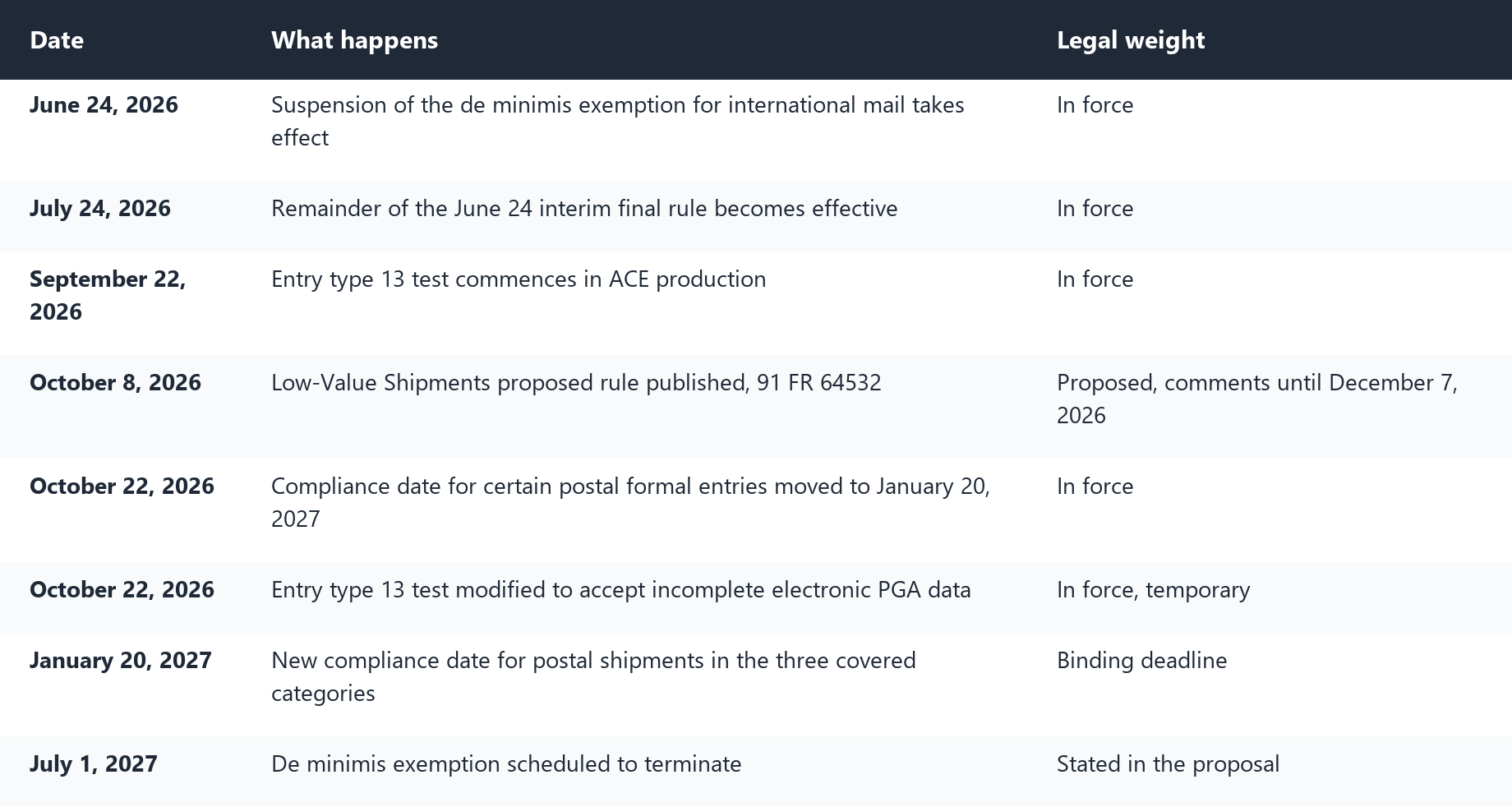
| Date | What happens | Legal weight |
|---|---|---|
| June 24, 2026 | Mail de minimis suspension takes effect | In force |
| July 24, 2026 | Remainder of June 24 rule effective | In force |
| September 22, 2026 | Entry type 13 test starts in ACE | In force |
| October 8, 2026 | Low-Value Shipments rule published, 91 FR 64532 | Proposed, comments to December 7 |
| October 22, 2026 | Postal compliance date moved to January 20, 2027 | In force |
| October 22, 2026 | ET13 test accepts incomplete PGA data | In force, temporary |
| January 20, 2027 | New compliance date for the three categories | Binding deadline |
| July 1, 2027 | De minimis exemption scheduled to terminate | Stated in the proposal |
What this looks like from inside a buying office
We sit on the China side, so we are not the importer of record and we do not hold a bond. Our part happens before anything ships: making sure the data the importer will have to file already exists, and matches what is physically in the box.
We now ask factories for three things on every small shipment: a description of the merchandise specific enough to classify, the country of origin, and a value the buyer will actually confirm. A packing list that says sample or gift or parts does not survive contact with an entry filing.
We also keep the postal acceptance receipt with the tracking number and send it to the importer the same day. Because the number has to match across the parcel, the manifest and the declaration, treating it as a shipping detail rather than a compliance detail is how parcels end up abandoned.
What buyers need to sort out on their side is the importer of record and the bond. If parcels are going out one at a time, the bonding requirement changes the cost structure more than anything else in this rule, and it needs a decision before it needs a filing agent.
A short list before January 20, 2027
1. Identify which of your shipments fall into the three categories that got the extension, and which do not.
2. Confirm whether your consignee is the owner or purchaser. If not, the broker becomes the importer of record.
3. Start collecting shipper identity, sender address and the UPU S-10 tracking number as standing fields.
4. Put the description, country of origin and value onto a single sheet per SKU.
5. Price the bond before you price anything else.
6. If your per-parcel landed cost no longer works, revisit the structural side before optimizing the filing.
Footnotes
1. U.S. Customs and Border Protection, "Low-Value Shipments," proposed rule, Federal Register document 2026-20650, 91 FR 64532, published October 8, 2026, docket USCBP-2026-0298, comments due December 7, 2026: https://www.federalregister.gov/documents/2026/10/08/2026-20650/low-value-shipments
2. U.S. Customs and Border Protection, "Indefinite Suspension of the De Minimis Exemption for Mail Shipments and New Postal Informal Entry Process; Delayed Compliance Extension," final rule, Federal Register document 2026-21600, 91 FR 66638, published October 22, 2026, docket USCBP-2026-1288: https://www.federalregister.gov/documents/2026/10/22/2026-21600/indefinite-suspension-of-the-de-minimis-exemption-for-mail-shipments-and-new-postal-informal-entry-process-delayed-compliance-extension
3. U.S. Customs and Border Protection, "Modification of the Test of the New Electronic Informal Entry Process for Mail," general notice, Federal Register document 2026-21570, 91 FR 66707, published October 22, 2026: https://www.federalregister.gov/documents/2026/10/22/2026-21570/modification-of-the-test-of-the-new-electronic-informal-entry-process-for-mail
4. U.S. Customs and Border Protection, "Test of the New Electronic Informal Entry Process for Mail," Federal Register document 2026-12668, 91 FR 38007, published June 24, 2026: https://www.govinfo.gov/content/pkg/FR-2026-06-24/pdf/2026-12668.pdf
5. U.S. Customs and Border Protection, Trade Information Notice INT-057 / CBP-290, "Implementation of Entry Type 13 Test in ACE for U.S. Mail Processing," July 20, 2026: https://www.cbp.gov/sites/default/files/2026-07/26_0720_trade_information_notice_INT_057.pdf
6. U.S. Customs and Border Protection, CSMS message 69289734, "Implementation of Entry Type 13 Test in ACE for U.S. Mail Processing," ACE production deployment September 22, 2026: https://content.govdelivery.com/accounts/USDHSCBP/bulletins/4214706
7. Code of Federal Regulations, Title 19, Part 145, Postal Shipments: https://www.ecfr.gov/current/title-19/chapter-I/part-145
If you are still working out what a China order costs you once duties and entry handling are in the picture, our guide on how customs clearance and import duties work sets out the basics, and the piece on calculating total landed cost from China to US warehouses shows where entry handling fits into the number.