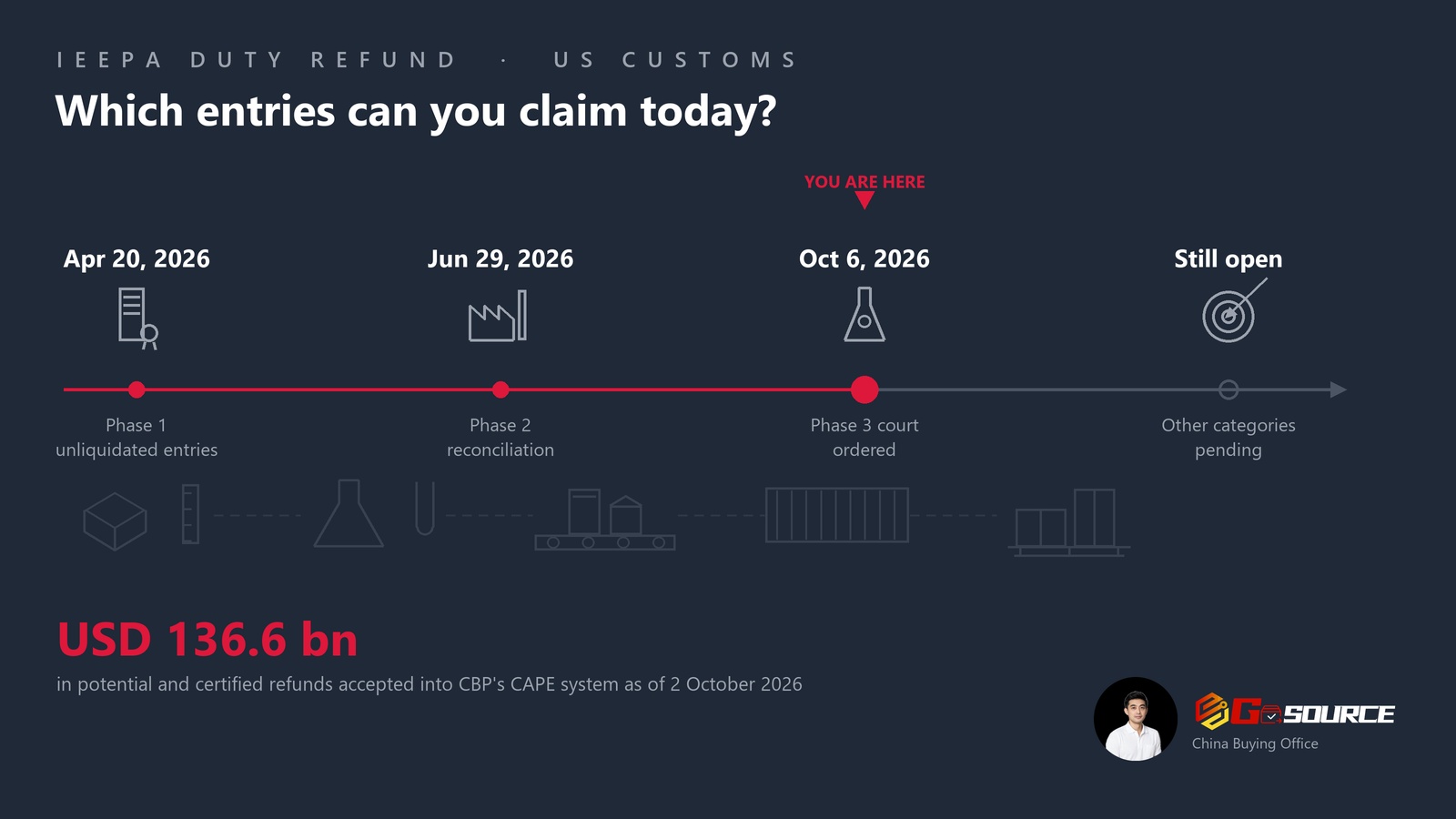
US Customs and Border Protection started handing back the IEEPA tariffs it collected in 2025. By October 2, 2026, CBP had accepted roughly USD 136.6 billion in potential and certified refunds into its CAPE system, and about USD 126 billion had been certified and sent to the US Treasury for disbursement. That is money importers paid on Chinese orders and can partly get back.
The problem is that "am I owed money" is not one question. It is three questions stacked on top of each other, and each has a different answer depending on when your goods cleared customs.
What the refund actually is, and why it is not a simple claim form
The tariffs were struck down, not refunded by request
The IEEPA tariffs were invalidated by the US Supreme Court in February 2026. CBP did not issue cheques to everyone who paid them. Importers have to ask, entry by entry, through a system CBP built called CAPE: the Consolidated Administration and Processing of Entries, inside the ACE Secure Data Portal.
The mechanics are deliberately narrow. You submit a CSV containing nothing but a list of entry numbers, capped at 9,999 entries per declaration, with no other information required. You can submit multiple declarations, but not through the Automated Broker Interface, and you cannot amend or cancel one once accepted.
That last point catches people badly. Entries you file that turn out to need correction stay on that declaration, and CBP rejects them on any later one.
The three lanes that are open right now
CAPE has been rolled out in phases, and each phase opened a different population of entries.
Phase 1, deployed April 20, 2026, covers unliquidated entries and entries liquidated within the preceding 80 days. That window is not arbitrary: it gives CBP room to reliquidate inside its own 90-day statutory authority for voluntary reliquidation under 19 U.S.C. § 1501.
Phase 2, deployed June 29, 2026, covers entries flagged for reconciliation where the reconciliation entry (Entry Type 09) has not yet been filed. The 80-day rule still applies, and once the reconciliation entry is filed those underlying entries become ineligible in this phase.
Phase 3, deployed at 5:10 a.m. Eastern on October 6, 2026, covers finally liquidated entries, but only for importers who filed at the Court of International Trade, received an order directing CBP to reliquidate their entries, and supplied a valid importer of record number to CBP by July 30, 2026. CBP accepted 477 Phase 3 declarations covering 425,517 entries by noon on launch day.
A fourth lane is in the works but not open. CBP is still evaluating entries under open protests, on drawback claims, warehouse entries of type 21 and 22, reconciliation-flagged entries with the reconciliation entry already on file, entries not filed in ACE, entries subject to antidumping or countervailing duty liquidation instructions, and entries whose liquidation is final without a court order.
Who is allowed to file
Only the importer of record, or the licensed customs broker who actually filed those entries, may submit a CAPE declaration. Attorneys cannot. The filer must also be directly associated with the entries through the three-digit prefix of their ACE filer code.
This matters commercially for anyone buying from China. The importer of record is whoever is named on the entry, usually the US buyer. The Chinese supplier has no standing in this process.
How to actually check whether you are owed anything
Step one: find the entries that carried IEEPA duty
You are not looking for "IEEPA" written in a box on your paperwork. You are looking for IEEPA Harmonized Tariff Schedule Chapter 99 provision codes on the entry summary lines. Those are the dutiable lines. If a line has no Chapter 99 code used to assess IEEPA duty, there is nothing to claim on it.
In ACE, the ES-003 Entry Summary Line Tariff Details report does this job. Add the IEEPA tariff indicator and it displays every entry line with assessed duties, so you can see which lines carry the Chapter 99 codes you paid. If you do not have an ACE Portal account with Importer sub-account access, your customs broker can pull this. Ask for ES-003 with the IEEPA indicator on, not a generic duty summary.
Step two: sort your entries into claimable and not yet claimable
Take the list of entries with IEEPA codes and sort it by liquidation status. The table below is the decision rule.
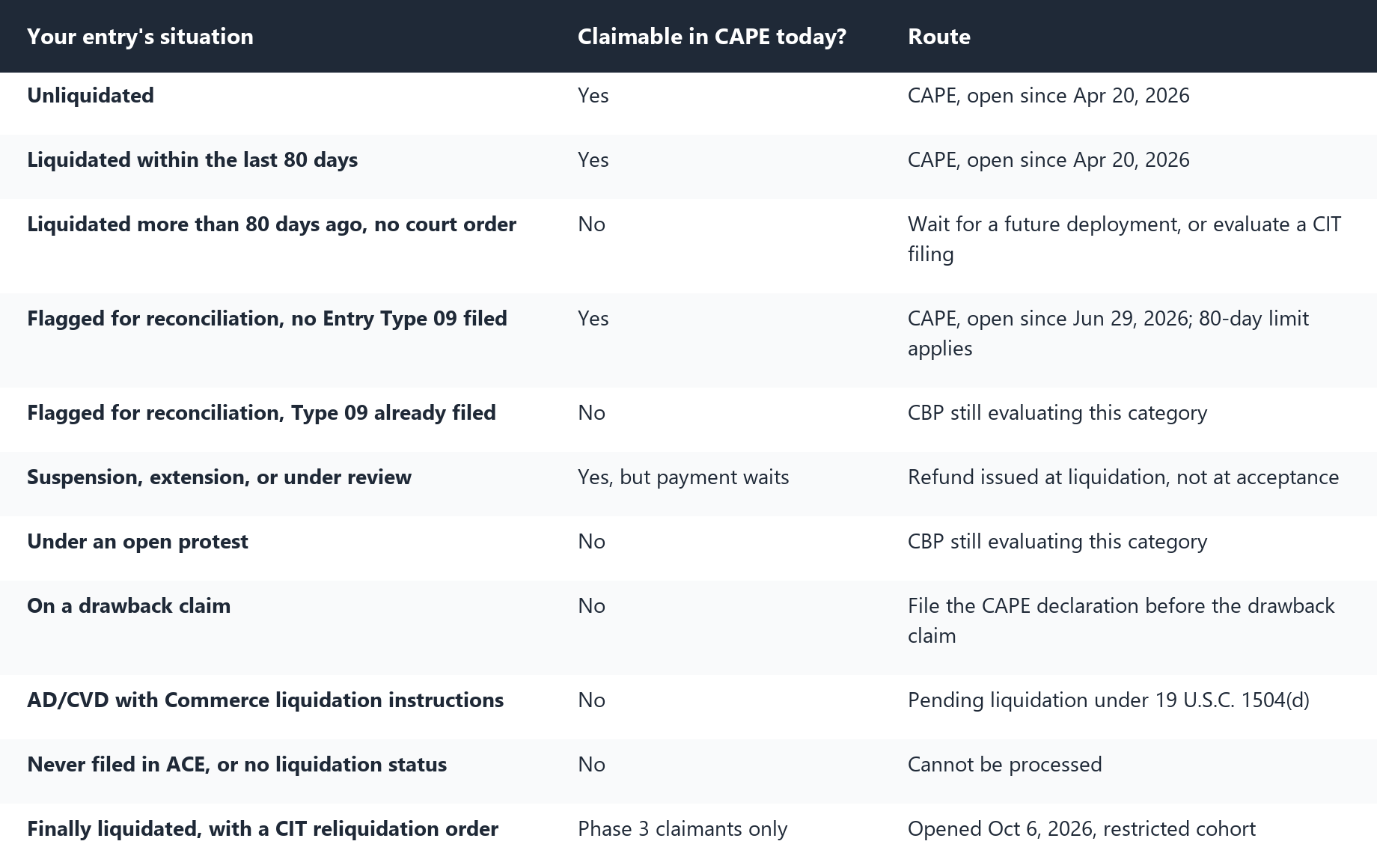
| Your entry's situation | Can you claim it in CAPE today | Route |
|---|---|---|
| Unliquidated | Yes | CAPE, open since Apr 20, 2026 |
| Liquidated within the last 80 days | Yes | CAPE, open since Apr 20, 2026 |
| Liquidated more than 80 days ago, no court order | No | Wait for further CBP deployment, or evaluate a CIT filing |
| Flagged for reconciliation, no Entry Type 09 filed | Yes | CAPE, open since Jun 29, 2026, 80-day limit still applies |
| Flagged for reconciliation, Entry Type 09 already filed | No | CBP is still evaluating this category |
| Suspension, extension, or under review status | Yes, but refund waits | Refund is issued at liquidation, not at CAPE acceptance |
| Under an open protest | No | CBP is still evaluating this category |
| On a drawback claim | No | File the CAPE declaration before the drawback claim |
| Subject to AD/CVD with Commerce liquidation instructions | No | Pending liquidation under 19 U.S.C. § 1504(d) |
| Never filed in ACE, or no liquidation status in ACE | No | Cannot be processed |
| Finally liquidated, with a CIT reliquidation order | Only Phase 3 claimants | Opened Oct 6, 2026, restricted cohort |
The single most useful thing you can do this week is pull the liquidation date for every entry that carried an IEEPA code. That one field tells you which row of this table you are in.
Step three: check the three things that silently kill claims
Most rejected declarations are not rejected because the importer was ineligible. They are rejected for administrative reasons visible in advance.
No ACH refund enrollment. All CBP refunds are electronic via Automated Clearing House. Paper cheques are gone. If your bank information for refunds is not on file in the ACE Portal, CBP holds the refund until you provide it. As of October 2, 2026, 20,362 refunds totalling about USD 1.1 billion were sitting in exactly this state. The fix takes minutes: log into the top account as the Trade Account Owner, open the ACH Refund Authorization tab under the Importer sub-account view, and add your US bank details. If your bank does not process FedACH payments, CBP will reject the information.
Filer code mismatch. For Filer and Organizational Broker accounts, the first three characters of each entry number must match the Filer Code of the account. Entry numbers must be exactly 11 characters with no dashes. If any entry number begins with a zero, you must put an apostrophe directly in front of the zero or the leading digit disappears.
Already filed. Each entry may appear on only one accepted declaration. CBP rejected 6.2 million entries at the entry-level validation stage as of October 2, 2026, for three primary reasons: the entry date is past CBP's 90-day reliquidation authority, the entry contains no Chapter 99 HTS number used to assess IEEPA duties, or the entry was already filed on an earlier declaration.
Step four: know where to watch the money
Once you have an ACE Portal account with Importer sub-account access, you can track everything yourself. If you do not, your broker files and you have to ask them, because CBP does not email CAPE updates.
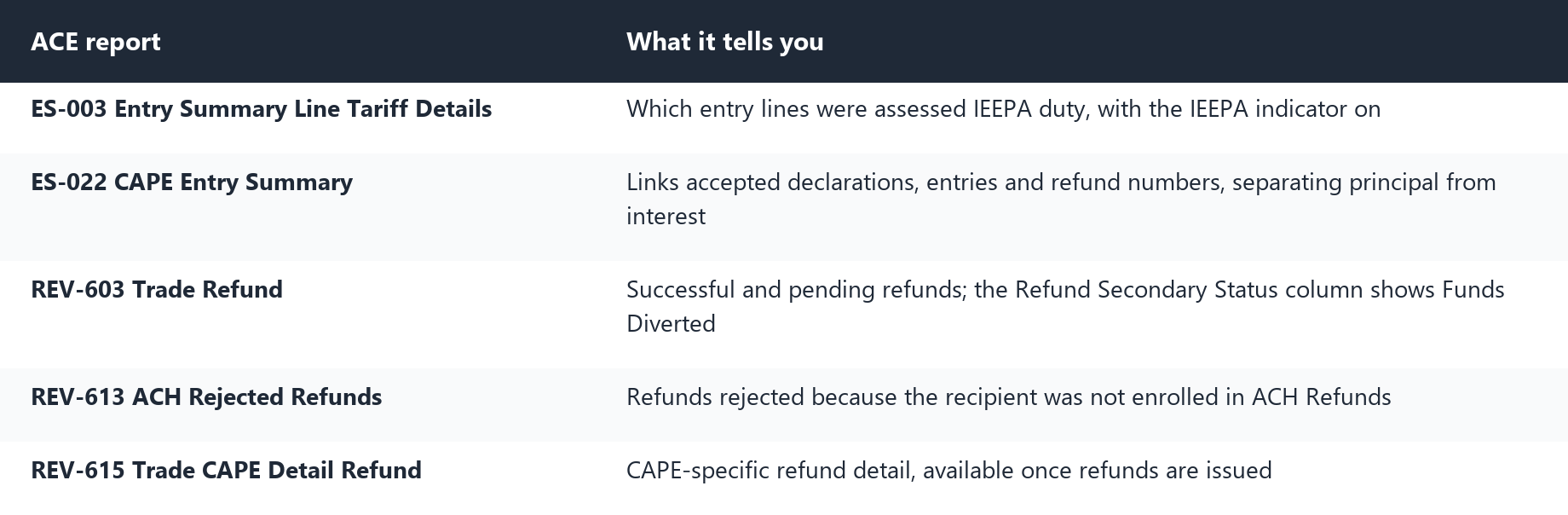
| ACE report | What it tells you |
|---|---|
| ES-003 Entry Summary Line Tariff Details | Which entry lines were assessed IEEPA duty, with the IEEPA indicator on |
| ES-022 CAPE Entry Summary | Links accepted declarations, entries and refund numbers, separating principal from interest |
| REV-603 Trade Refund | Successful and pending refunds; the Refund Secondary Status column shows "Funds Diverted" |
| REV-613 ACH Rejected Refunds | Refunds rejected because the recipient was not enrolled in ACH Refunds |
| REV-615 Trade CAPE Detail Refund | CAPE-specific refund detail, available once refunds are issued |
Two things will reduce the amount you receive even when the claim succeeds. CBP nets all over-payments and under-payments across the entire entry at liquidation under 19 CFR § 159.1. And if you owe CBP a legally fixed and undisputed unpaid debt, CBP may divert the refund against it under 19 CFR § 24.72, which shows up in REV-603 or REV-615 as "Funds Diverted".
Valid refunds are generally issued within 60 to 90 days of CBP accepting your declaration, including 45 days of CBP processing plus Treasury certification time. Suspended, extended and under-review entries keep their status until resolved, and warehouse entries pay at liquidation.
Why your refund is often smaller than the duty you paid
The IEEPA lines were never the only duties
Buyers who run the numbers on their own entry summaries are routinely surprised, and the reason is almost never an error by CBP. The IEEPA Chapter 99 lines were not the only duties on the entry. A landed cost on a Chinese order typically stacks several regimes: ordinary MFN rates, Section 301 lists on much Chinese-origin goods, Section 232 on steel and aluminium content, and antidumping or countervailing duties on specific products. IEEPA Chapter 99 lines sit on top of some of those, never instead of them.
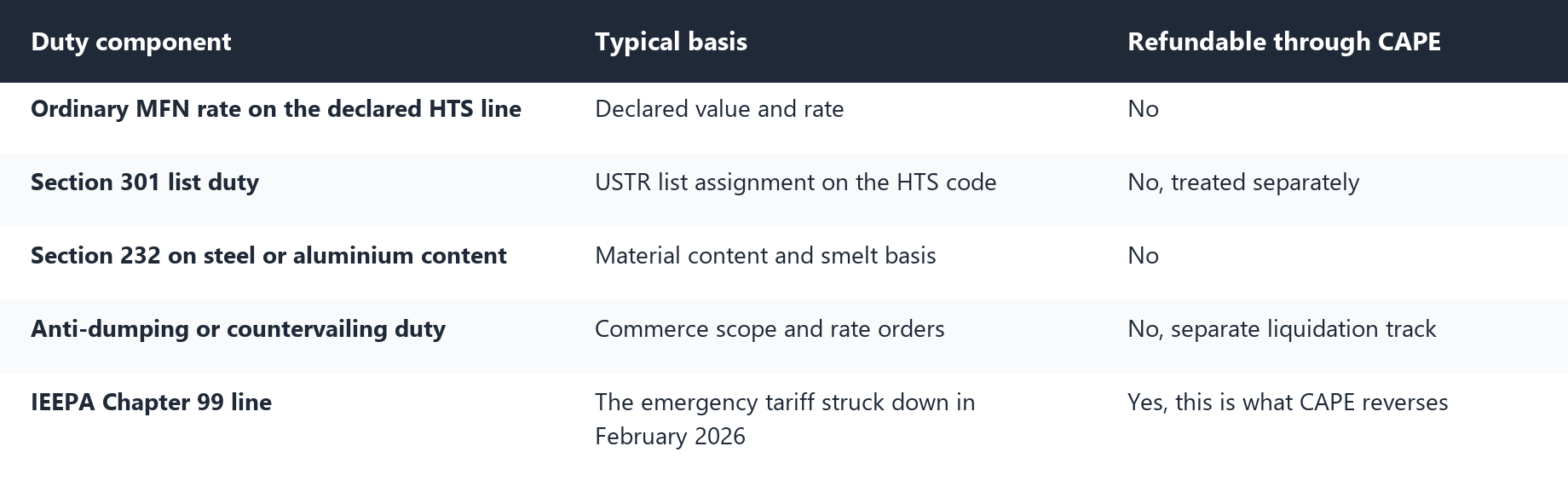
| Duty component | Typical basis | Refundable through CAPE |
|---|---|---|
| Ordinary MFN rate on the declared HTS line | Declared value and rate | No |
| Section 301 list duty | USTR list assignment on the HTS code | No, treated separately |
| Section 232 on steel or aluminium content | Material content and smelt basis | No |
| Anti-dumping or countervailing duty | Commerce scope and rate orders | No, separate liquidation track |
| IEEPA Chapter 99 line | The emergency tariff struck down in February 2026 | Yes, this is what CAPE reverses |
Netting and debt diversion shrink the number further
Under 19 CFR § 159.1, CBP nets all over-payments and under-payments across the entire entry at liquidation. A classification change on one line and a value increase on another become a single net revenue change, so the refund is calculated on the net figure rather than the gross IEEPA amount you remember paying. Interest is included, but it runs from the original deposit to the reliquidation, not from the date you file.
What this looks like from inside a buying office
We sit on the China side of these transactions, so we are not the importer of record and cannot file a claim. What we do is the unglamorous part that determines whether a claim is worth filing at all.
The first thing we do is check whether the order terms put the IOR in a position to claim. When we quote landed cost, we separate out which lines carried IEEPA Chapter 99 codes and which did not, because a lot of the tariff burden people remember was Section 301 or Section 232, and those duties are not part of this refund at all.
The second is entry-number hygiene. Entry numbers beginning with a zero are the most common cause of a rejected CSV upload we see, and it is entirely avoidable if the file is prepared correctly rather than typed by hand. We have had buyers pull a duty report from their ERP that padded entry numbers with leading zeros or dashes, and every one of those rows has to be cleaned before upload.
The third is timing discipline around reconciliation. If a reconciliation entry gets filed before the buyer submits the CAPE declaration, those entries become ineligible in the current phase. We ask clients for their reconciliation status before we advise on filing, not after.
The last is the least technical and the most expensive to get wrong: verify the Form 5106 record. CBP began voiding importer numbers in mid-September 2026 when that information was inaccurate or incomplete. A voided importer number does not slow a refund, it stops it.
Nobody legitimate will email you about a refund
CBP has been warning about refund fraud since it opened the portal. The stated pattern is emails, notices and social media contact aimed at importers, designed to extract company and personal information under the guise of a refund. A legitimate claim requires nothing from you except entry numbers you already hold, submitted through a portal you log into yourself. Anyone asking for credentials, bank details, or a fee to release a refund is not CBP.
What happens if you are not in any of those lanes today
Wait, or go to court
The category most importers fall into is simply: liquidated more than 80 days ago, no court order, no open phase. CBP has not built a path for them yet.
There are two ways forward, and both carry risk. The first is to wait: CBP is evaluating functionality for the remaining entry categories but has published no timeline, and the litigation below makes a broad rollout less certain rather than more.
The second is to evaluate filing at the Court of International Trade. CBP's position is that finally liquidated entries require a court order directing reliquidation before CBP will pay. Importers filing there are obtaining those orders within weeks, and CBP has told the court it does not intend to appeal them. Phase 3 is the only route connecting such an order to actual payment, and it carries a two-year limitation period: for Chinese-origin entries the clock may begin running around February 2027, for Canadian and Mexican entries around March 2027, and for the rest of countries around April 2027.
The two legal tracks running alongside
The government has appealed to the Federal Circuit, arguing the Court of International Trade lacked authority to order relief for importers who never sued. And in early October 2026, that court granted class certification in the lead IEEPA refund case, which could open a path for qualifying importers who never filed individually. Class certification is not a refund. It may be the mechanism, but how a class member actually receives money is not settled.
For anyone outside the United States, none of this is directly actionable. The claim belongs to the importer of record. What a supplier or agent can do is make sure the US buyer has the entry data, knows which lane each entry falls in, and has not mistaken Section 301 exposure for IEEPA exposure.
Footnotes
1. CBP, "International Emergency Economic Powers Act (IEEPA) Duty Refunds," official program page including phase definitions, filing rules, ACH requirement and excluded entry types: https://www.cbp.gov/trade/programs-administration/trade-remedies/ieepa-duty-refunds
2. CBP, "Consolidated Administration and Processing of Entries (CAPE)" Trade Information Notice, July 23, 2026, covering CSV limits, validations and excluded entry categories: https://www.cbp.gov/sites/default/files/2026-07/26_0723_trade_information_notice_CAPE.pdf
3. CBP, "ACE Portal and ACH Refunds FAQs," covering ACE account requirements, ACH enrollment mechanics and the Rev-603, Rev-613 and Rev-615 reports: https://www.cbp.gov/trade/automated/ace-portal-and-ach-refunds-faqs
4. CBP, "ACH Refund," establishing that electronic refunds via ACH are required for ACE Portal account holders and describing the enrollment tab: https://www.cbp.gov/trade/automated/ach/refund
5. Declaration of Brandon Lord, Executive Director, Trade Programs, Office of Trade, U.S. Customs and Border Protection, filed October 6, 2026 in Freestyle World, Inc. v. United States, Court No. 26-01088, source of the declaration, entry and refund figures as of October 2, 2026 and the Phase 3 deployment details: https://storage.courtlistener.com/recap/gov.uscourts.cit.19175/gov.uscourts.cit.19175.58.0.pdf
6. CBP, "Electronic Refunds Interim Final Rule," Federal Register document 2025-24171, the basis for mandatory electronic refunds: https://www.federalregister.gov/documents/2026/01/02/2025-24171/electronic-refunds-interim-final-rule
7. CBP, "Electronic Refund Enrollment in CBP's ACE Portal" one-page overview, covering the ACH Refund Authorization tab and refund monitoring reports: https://www.cbp.gov/sites/default/files/2026-04/electronic-refund-enrollment-one-pager_508c.pdf
If you are still working out what a China order costs you after duties, our guide on how customs clearance and import duties work sets out the basics, and the piece on what to assume about Section 301 tariffs when pricing explains which duties are not part of this refund.