
Every week, our team fields calls from buyers who lost thousands to unverified Chinese suppliers government business registration databases 1. The stories are painful—wrong products, vanished factories, ghosted payments. It doesn't have to be this way.
China sourcing agents verify supplier credibility by cross-referencing government business registration databases, conducting on-site factory audits, authenticating certifications and export permits, checking public credit scores and trade platform histories, and performing pre-shipment quality inspections to confirm operational legitimacy before any order is placed.
Verification is not a single step. It is a layered process that catches problems at different stages quality management systems 2. Below, we break down exactly how a professional sourcing agent protects your money and your brand when buying from China.
How can a sourcing agent help me conduct a thorough on-site factory audit in China?
When our team walks onto a factory floor in Shenzhen or Dongguan, we know within the first thirty minutes whether the operation matches the supplier's sales pitch. Many buyers never get that chance.
A sourcing agent conducts on-site factory audits by physically visiting the supplier's facility, inspecting production lines, evaluating equipment condition, interviewing workers and managers, reviewing quality management systems, and comparing actual capabilities against the supplier's documented claims using standardized audit checklists.

What Happens During a Factory Audit?
A factory audit is not a casual visit. It is a structured evaluation. Our auditors arrive with a checklist that covers dozens of items. They walk through every section of the factory—raw material storage, production lines, assembly areas, quality control stations, and the shipping dock.
We look at the age and condition of machinery. Old, poorly maintained equipment signals quality risk. We check if workers wear proper safety gear. We ask to see production logs and defect records. We count the workforce and compare it to the supplier's claims. If a factory says they have 200 workers but only 40 are on site, something is wrong.
Key Areas Covered in a Factory Audit
| Audit Area | What We Check | Why It Matters |
|---|---|---|
| Production Capacity | Number of machines, shifts per day, monthly output | Confirms the supplier can handle your order volume |
| Quality Management | QC stations, defect tracking, testing equipment | Shows whether quality is built into the process |
| Raw Material Storage | Inventory levels, material sourcing records, storage conditions | Reveals supply chain stability and material quality |
| Worker Conditions | Safety equipment, working hours, cleanliness | Indicates ethical practices and workforce stability |
| Certifications | ISO certificates 3, product compliance documents on display | Validates claimed certifications are current and real |
Why Remote Verification Alone Is Not Enough
Video calls and virtual tours help for initial screening. But they cannot replace being there in person. A supplier can angle a camera to hide a messy warehouse. They can show you a showroom that has nothing to do with their actual production floor. Our experience tells us that about one in five factories we visit for the first time do not match what they presented online. That gap between promise and reality is exactly what an on-site audit catches.
We also pay attention to things a camera cannot capture—the smell of chemicals, the noise level on the floor, how workers react when a foreign visitor walks in. These subtle cues reveal a lot about daily operations.
Unannounced vs. Scheduled Audits
Scheduled audits give suppliers time to prepare. That is useful for formal evaluations. But unannounced visits show you the factory on a normal day. We recommend both. Start with a scheduled audit to build the relationship, then follow up with unannounced spot checks during production.
What specific documents will my agent check to prove a supplier is legitimate?
Our sourcing team once traced a supplier's business license number through three different government databases before discovering the company had been deregistered six months earlier. The supplier's Alibaba store was still active. Documents tell the truth when salespeople won't.
A sourcing agent checks the supplier's business license (营业执照), Unified Social Credit Code, export permits, ISO and product compliance certifications, bank references, tax registration records, and patent or trademark filings—all cross-referenced against China's National Enterprise Credit Information Publicity System and other public databases.
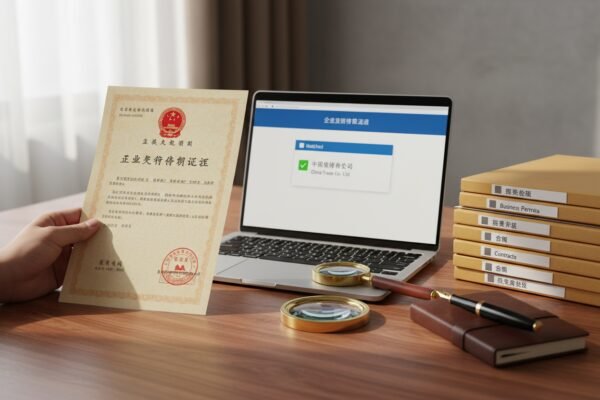
The Business License Is Your Starting Point
Every legally registered company in China has a business license issued by the local Administration for Market Regulation. This document contains the company name, legal representative, registered capital, business scope, establishment date, and the 18-digit Unified Social Credit Code 5. Your sourcing agent should request a copy of this license and then verify every detail on the National Enterprise Credit Information Publicity System 6 (NECIPS) at www.gsxt.gov.cn.
If the business scope on the license does not include the products you are buying, that is a red flag. If the registered capital is suspiciously low for the claimed scale of operations, that deserves further investigation.
Public Data Sources in China
Here is something many international buyers do not know: all Chinese companies have publicly accessible data. You can check their credit scores through government platforms. You can verify their transaction reputation on 1688.com, which is Alibaba's domestic B2B marketplace. Patents and trademarks are also publicly searchable through China's National Intellectual Property Administration. A good sourcing agent knows how to navigate all of these systems in Chinese and interpret what the data means for your specific situation.
Essential Documents Checklist
| Document | What It Proves | Where to Verify |
|---|---|---|
| Business License (营业执照) | Legal registration, business scope, establishment date | NECIPS (gsxt.gov.cn) |
| Unified Social Credit Code | Unique company identifier, active status | NECIPS, SAMR website |
| Export License / Permit | Authorization to export goods internationally | Ministry of Commerce records |
| ISO 9001 Certificate 7 | Quality management system compliance | Issuing certification body's website |
| Product Certifications (CE, FCC, CCC) | Product meets safety and regulatory standards | Relevant regulatory authority databases |
| Tax Registration | Tax compliance and financial legitimacy | Local tax bureau records |
| Patent / Trademark Filings | Intellectual property ownership | CNIPA (China National Intellectual Property Administration 8) |
| 1688 Transaction History | Domestic trade reputation and buyer reviews | 1688.com platform |
What Fake Documents Look Like
Fraudulent suppliers sometimes forge ISO certificates or inflate registered capital figures. Our team verifies certificates directly with the issuing body. We also check if the certificate number appears in the certification body's online database. A legitimate ISO 9001 certificate will list the auditing firm, the certificate number, the scope of certification, and the expiration date. If any of these details are missing or cannot be confirmed, we walk away.
Beyond Documents: Credit Scores and Platform Reputation
China's corporate credit system has matured significantly. Platforms like Tianyancha and Qichacha aggregate public data on lawsuits, overdue debts, administrative penalties, and shareholder changes. We check these platforms for every supplier we evaluate. A company with multiple lawsuits or a history of failed debt obligations is not someone you want handling your $50,000 order.
On 1688, you can see how long the supplier has been active, their transaction volume, buyer ratings, and response rates. This data is in Chinese, which is why having a bilingual sourcing agent is essential.
How does my sourcing agent manage quality control to ensure my electronic products meet my standards?
When we manage production for consumer electronics—circuit boards, smart home devices, beauty tools—the margin for error is almost zero. One defective batch can trigger returns, bad reviews, and regulatory headaches that cost far more than the product itself.
A sourcing agent manages quality control by defining clear product specifications upfront, conducting in-line inspections during production, performing pre-shipment inspections using AQL sampling standards, testing electronic products for functionality and safety compliance, and providing detailed photo and video reports before authorizing final payment and shipment.
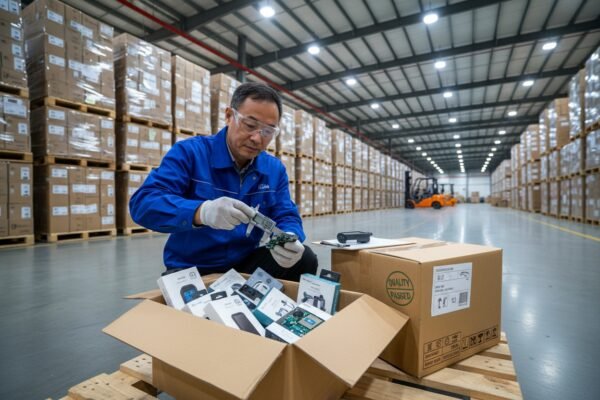
Setting the Standard Before Production Begins
Quality control starts long before the factory turns on a machine. Our team works with the buyer to create a detailed product specification sheet. This document covers dimensions, materials, color codes, component brands, functional requirements, packaging instructions, and labeling. For electronic products, it also includes voltage ratings, safety certifications required for the destination market, and testing protocols.
We share this spec sheet with the factory and confirm they understand every line item. Misunderstandings at this stage multiply into defects later.
The Three Stages of Quality Inspection
Quality control is not a one-time event. We break it into three stages:
During production (in-line inspection): Our QC team visits the factory while production is underway. We check if the correct materials are being used, if assembly follows the approved process, and if early units meet the spec sheet. Catching a problem at 20% completion is far cheaper than catching it at 100%.
Pre-shipment inspection: This is the final gate. We inspect a random sample of finished goods using AQL (Acceptable Quality Limit) standards 9. For consumer electronics, we typically use AQL 2.5 for major defects and AQL 4.0 for minor defects. Every unit in the sample is tested for functionality. We check power-on, button response, charging, Bluetooth connectivity—whatever applies to the product.
Loading inspection: Before containers are sealed, we verify the correct quantity is loaded, packaging is undamaged, and carton markings match shipping documents.
Common Electronic Product Defects We Catch
| Defect Type | Example | Detection Method |
|---|---|---|
| Functional Failure | Device does not power on, buttons unresponsive | Power-on testing of sample units |
| Cosmetic Defect | Scratches, color mismatch, misaligned labels | Visual inspection under standard lighting |
| Safety Issue | Exposed wiring, overheating, incorrect voltage | Electrical safety testing, thermal testing |
| Packaging Error | Wrong user manual, missing accessories, damaged box | Unboxing inspection of sample units |
| Labeling Non-Compliance | Missing CE/FCC marks, incorrect model number | Label verification against spec sheet |
Reporting and Buyer Approval
After every inspection, we compile a detailed report. This includes photos of defects, measurements, test results, and an overall pass/fail recommendation. The buyer reviews this report and decides whether to approve shipment, request rework, or reject the batch. No goods leave the factory without the buyer's written approval.
This process is especially critical for electronic products destined for the U.S. market, where FCC compliance 10 and consumer safety expectations are strict. A sourcing agent who understands both Chinese manufacturing and Western regulatory requirements bridges that gap effectively.
Why Relying on Factory QC Alone Is Risky
Many factories have their own QC departments. But their incentives are different from yours. Their priority is shipping on time and getting paid. Your priority is receiving products that won't get returned. Independent third-party inspection removes that conflict of interest. Our QC inspectors work for you, not the factory.
How do I know my sourcing agent is protecting me from common supplier scams and delivery delays?
We have seen every trick in the book—bait-and-switch samples, middlemen posing as factories, deposits disappearing overnight. Protecting our clients from these scenarios is not optional. It is the core reason they hire us.
A reliable sourcing agent protects you by verifying supplier identity through multiple databases, structuring payment terms that reduce risk, maintaining direct communication with factory management, tracking production milestones against agreed schedules, and flagging red flags like refusal to provide documentation or sudden price changes before you commit funds.

Common Supplier Scams and How Agents Prevent Them
The most frequent scam is the bait-and-switch. A supplier sends a perfect sample, you approve it, you pay, and the bulk order arrives with inferior materials or different components. Our defense is simple: we retain the approved sample, and our QC team compares bulk production against it during in-line and pre-shipment inspections.
Another common scam involves trading companies pretending to be factories. They add a markup and have less control over quality and timelines. We verify the actual production facility by visiting it. If the "factory" cannot show us a production line making our client's product, we know they are a middleman.
Payment Structure as a Protection Tool
How you pay matters as much as who you pay. We advise our clients to use a structured payment approach:
- 30% deposit to start production
- 70% balance only after pre-shipment inspection is passed
This structure keeps the supplier motivated to deliver quality goods because they need to pass inspection to receive the majority of the payment. We never recommend paying 100% upfront, regardless of how trustworthy a supplier appears.
For new supplier relationships, we sometimes recommend even more conservative terms—like using escrow services or paying via letter of credit through a bank.
Delivery Delay Prevention
Delivery delays are the second biggest pain point for our clients. Delays happen because of raw material shortages, production scheduling conflicts, or the supplier simply overcommitting their capacity. Here is how we manage this:
We establish a production timeline with clear milestones before the order starts. Our project managers check in with the factory at each milestone—material procurement, production start, mid-production, finishing, and packaging. If any milestone is missed by more than two days, we escalate immediately.
We also build buffer time into the schedule. If the buyer needs goods by a certain date, we work backwards and add a one-to-two-week cushion for unexpected issues.
Red Flags Our Team Watches For
Here are warning signs that trigger deeper investigation:
- Supplier refuses to share their business license or factory address
- Pricing is significantly below market average without clear justification
- Communication suddenly becomes slow or evasive after payment
- The supplier pushes for Western Union or personal bank transfers instead of corporate accounts
- Factory photos on their website are stock images or stolen from other companies
- They claim certifications but cannot provide certificate numbers for verification
How We Hold Ourselves Accountable
A sourcing agent who is not transparent is no better than a shady supplier. At Go Source, we provide our clients with full documentation at every stage—supplier verification reports, audit summaries, inspection results, and shipping tracking. Our clients have direct access to the information we gather. We do not hide behind vague updates. If a problem arises, we report it immediately along with our recommended solution.
Trust is built through transparency, not promises.
Conclusion
Verifying Chinese supplier credibility requires multiple layers—document checks, factory audits, quality inspections, and scam prevention strategies. A skilled sourcing agent handles all of this so you can focus on growing your business.
Footnotes
1. Explains the role and importance of China's official business registry for due diligence. ↩︎
2. Defines Quality Management Systems (QMS) and outlines their components and benefits. ↩︎
3. Replaced with IAF CertSearch, the official global database for accredited ISO certificates, providing a direct and authoritative verification tool. ↩︎
4. Provides a comprehensive explanation of what a factory audit is and its importance. ↩︎
5. Defines the USCC and explains its role in identifying Chinese businesses. ↩︎
6. Explains the purpose and usage of China's official NECIPS platform. ↩︎
7. Provides an overview of the ISO 9001 standard and its certification requirements. ↩︎
8. Official website of China's intellectual property regulator, providing information on patents and trademarks. ↩︎
9. Explains AQL standards and their application in quality control inspections. ↩︎
10. Details the requirements and process for FCC approval for electronic devices in the U.S. market. ↩︎