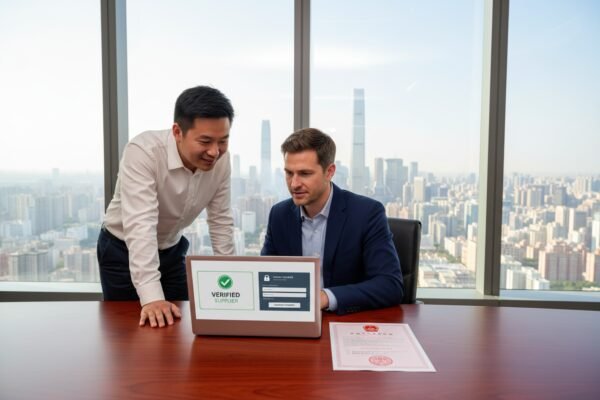
In our Shenzhen office, we often see buyers lose thousands to "private" accounts. It is a painful problem that stalls growth, but local expertise can secure your capital effectively.
A China sourcing agent mitigates private payment and order risks by verifying supplier legitimacy, managing secure escrow-like payments, and conducting rigorous quality inspections. They act as a local intermediary to ensure funds reach verified business accounts and products meet specific standards before the final balance is released.
Navigating the Chinese market requires more than just an internet connection. Let's look at how professional agents build a wall of security around your investment.
How can a sourcing agent protect my funds from being sent to fraudulent private accounts?
When we manage procurement for our American clients, we prioritize verifying the recipient's bank details. Sending money to a salesperson's private account is the fastest way to lose your entire budget.
Sourcing agents protect your funds by verifying that bank accounts match the supplier’s official business license. They facilitate payments through corporate accounts or secure platforms, preventing transfers to unauthorized personal accounts and ensuring a legal paper trail exists for every dollar sent to China.
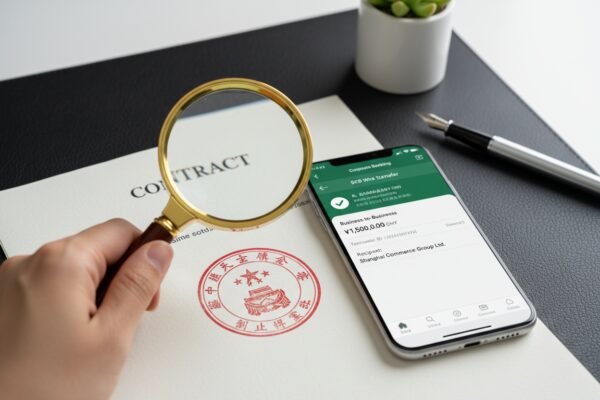
The Danger of Private Transfers
In the world of Chinese trade, a "private account" (personal bank account) offers zero legal protection. If a salesperson asks you to send money to their personal WeChat, Alipay, or private bank card, it is a massive red flag. Our team in Shenzhen always insists on public corporate accounts 1 (Duiwai Zhanghu). This ensures the company is legally responsible for the funds.
How Agents Validate Bank Details
A sourcing agent does not just take a Proforma Invoice 2 at face value. We perform several checks to ensure your money stays safe:
- Business License Matching: We compare the name on the bank account with the official Chinese name on the government-issued business license.
- On-site Verification: During factory audits, we confirm the finance department's official payment instructions.
- Small Amount Testing: For new high-value partnerships, we sometimes suggest a small test transfer to verify the account's active status.
Payment Methods Comparison
Different payment methods carry different risk levels. We guide our clients based on the following framework:
| Payment Method | Risk Level | Agent's Role |
|---|---|---|
| Wire Transfer (TT) to Private Account | Extreme | Strictly Forbidden. Agents block these requests. |
| Wire Transfer (TT) to Corporate Account | Moderate | Agents verify the license matches the account name. |
| Alibaba Trade Assurance 3 | Low | Agents manage the dispute process if quality fails. |
| Local RMB Transfer | Low | Agent pays the factory in local currency after inspection. |
Using an agent allows you to leverage their local entity. We can pay the factory in RMB (Chinese Yuan). This is often safer because Chinese banks have stricter monitoring for domestic business-to-business transactions than for incoming international wires.
What steps will my agent take to ensure my order quality is verified before final payment?
On our production lines, we know that things can go wrong during any stage of assembly. Relying on a supplier's "promise" of quality is a gamble that no CEO should take.
Agents ensure order quality by implementing a multi-stage inspection process, including pre-production, mid-production, and pre-shipment checks. They use Acceptable Quality Levels (AQL) to verify specifications, holding the final 70% payment until the goods pass a rigorous physical inspection and functional testing.
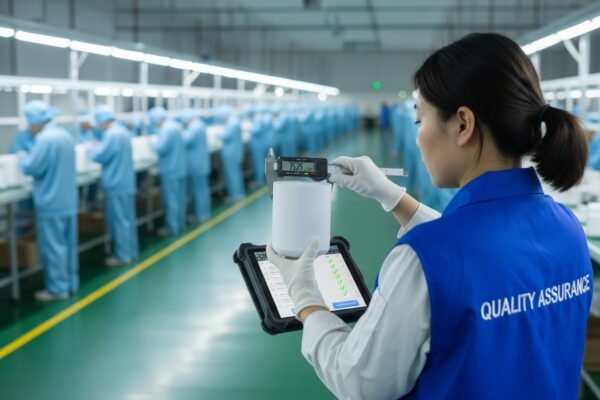
The Inspection Timeline
Quality is not an accident; it is a process. A professional sourcing agent stays involved from day one. We don't just show up when the boxes are sealed. We monitor the entire lifecycle of the order.
- Pre-Production Inspection (PPI): We check the raw materials. If you ordered aluminum and they are using cheap alloy, we catch it before the machines start.
- During Production Inspection (DPI): Once 20% of the order is finished, we check for consistency. This is where we catch "mass production" errors that didn't appear in the sample.
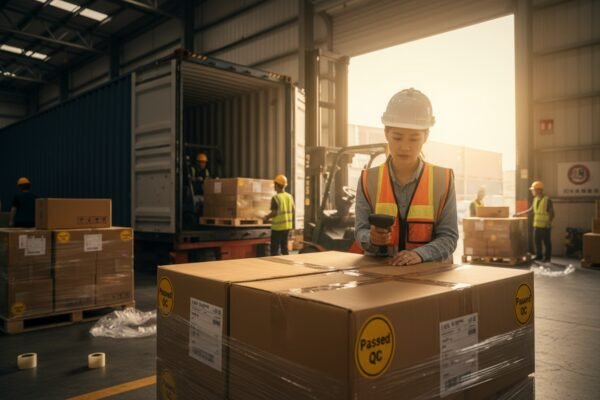
- Pre-Shipment Inspection (PSI): This is the most critical step. We randomly select cartons based on AQL standards (usually 2.5/4.0) to check for defects, packaging, and labeling. Acceptable Quality Levels (AQL) 4
Leveraging the "Final Payment" Power
The most effective tool an agent has is your money. We advise clients to pay a 30% deposit and hold the 70% balance. The factory knows that if our inspectors find issues, they will not receive the balance until the goods are reworked or replaced.
Detailed Inspection Criteria
We create a custom checklist for every product. For consumer electronics, our checks might look like this:
| Inspection Category | Specific Checkpoints |
|---|---|
| Functional Test | Power on/off, battery life, Bluetooth connectivity, button responsiveness. |
| Physical Appearance | Scratch checks, logo alignment, color consistency (Pantone match). |
| Packaging & Labeling | Barcode scan test, drop test, "Made in China" label presence. |
| Safety Compliance | High-voltage tests, cable pull tests, CE/FCC marking verification. |
By having an agent on the ground, you get "eyes" in the factory. We send you high-resolution photos and videos of the actual products being tested, so you aren't surprised when the container arrives in the US or Germany.
How do I know my supplier is legitimate and financially stable before I place my order?
When we evaluate new partners for our clients, we look beyond the glossy photos on their website. Many "factories" online are actually small trading companies operating out of an apartment.
A sourcing agent verifies legitimacy by conducting on-site factory audits, checking government registration records (NECIPS), and reviewing financial health indicators. They confirm the supplier has the necessary export licenses and production capacity to handle your specific order volume without defaulting.
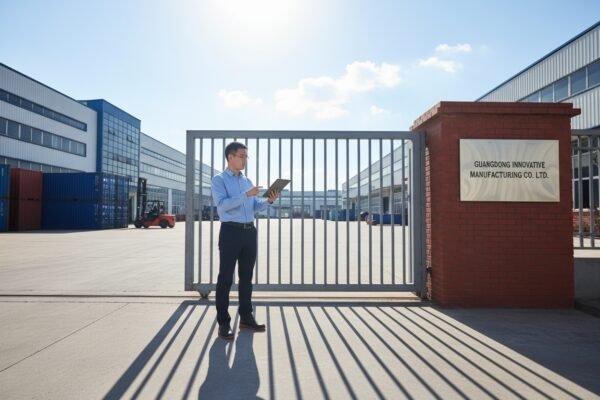
Verifying the Legal Entity
In China, every legal business is registered with the National Enterprise Credit Information Publication System (NECIPS) 5. We use this to check:
- Registered Capital: A company with $5,000 in capital is unlikely to be a real manufacturer.
- Business Scope: Does their license actually allow them to manufacture electronics, or are they only licensed for "consulting"?
- Legal Representative: We check if the owner has a history of lawsuits or "blacklisting" by the government.
The On-Site Reality Check
Nothing beats a physical visit. Our team walks the factory floor. We look for things that a website can't tell you. Is the equipment modern or rusted? Are the workers following safety protocols? Does the factory actually have a warehouse, or is it just a middleman's office?
Red Flags for Financial Instability
Financial instability leads to "ghosting" once a deposit is paid. We look for these warning signs:
- High Employee Turnover: If the faces change every week, the company is in trouble.
- Aggressive Demands for Cash: If they suddenly ask for a 50% or 100% deposit for "raw materials," they may be having cash flow issues.
- Subcontracting Without Permission: If they try to move your order to a smaller, cheaper factory, it means they can't manage their own overhead.
Supplier Type Comparison
| Supplier Type | Pros | Cons | Agent's Advice |
|---|---|---|---|
| Original Factory | Lowest price, direct control. | High MOQs, poor English. | Best for large, custom orders. |
| Trading Company | Low MOQs, many products. | Higher prices, less quality control. | Good for small variety packs. |
| Sourcing Agent | Expert vetting, local QC. | Service fee (5-10%). | Essential for high-risk/high-value. |
A sourcing agent bridges the gap by shortlisting 2-3 verified candidates. This gives you a "Plan B" if your primary choice shows signs of instability during negotiation.
Can a sourcing agent help me recover my money if the supplier fails to meet our contract?
In our years of managing exports to the US, we have learned that "winning" a legal battle in China is difficult. Prevention is better, but an agent is your best defense if a dispute arises.
Sourcing agents help recover funds by using their local legal presence to exert pressure on suppliers. They leverage bilingual NNN agreements and local trade contracts to negotiate refunds or re-productions, often resolving disputes through mediation before expensive litigation becomes necessary.
Local Pressure and Mediation
If you are sitting in the US, a factory might ignore your emails. If we show up at their front gate in Shenzhen or Ningbo, they have to talk to us. Most Chinese suppliers want to avoid a "bad reputation" within the local industry. An agent can negotiate a solution—such as a credit on the next order or a partial refund—that a foreign buyer could never get alone.
The Role of the NNN Agreement
A standard Western contract is often useless in a Chinese court. We use "NNN Agreements 6" (Non-use, Non-disclosure, Non-circumvention). These are written in Chinese, governed by Chinese law, and enforceable in local courts. Because we are local, the factory knows we have the power to actually file a claim.
Steps to Resolution
When an order goes wrong, we follow a strict escalation path:
- Evidence Gathering: We document all defects with photos, videos, and lab reports.
- Formal Demand Letter: We issue a letter in Chinese stating the breach of contract and the required remedy.
- Negotiated Rework: We often find that getting the factory to fix the goods is faster than getting cash back.
- Platform Dispute: If the order was via Alibaba, we use our records to win the Trade Assurance claim for you.
Having a local partner means you aren't just a "foreign voice" on the phone; you are a local entity with the ability to involve the AIC (Administration for Industry and Commerce) if the factory commits fraud.
Conclusion
Using a China sourcing agent 7 transforms procurement from a risky gamble into a managed process. By verifying identities, controlling payments, and inspecting production, we protect your brand and your bottom line.
Footnotes
1. Emphasizes verifying bank details against official business licenses for secure payments. ↩︎
2. Defines a pro forma invoice as a preliminary quote for international trade. ↩︎
3. Provides official information on how Alibaba Trade Assurance protects buyers' orders. ↩︎
4. Defines AQL as the maximum number of defective items allowed in a product batch. ↩︎
5. Explains the official Chinese government platform for corporate information disclosure and verification. ↩︎
6. Explains the three core components (Non-Disclosure, Non-Use, Non-Circumvention) of these critical IP protection agreements in China. ↩︎
7. Defines the role of a sourcing agent in managing the entire sourcing process in China. ↩︎