
Every week, our team fields calls from first-time importers who just lost money on hidden duties, surprise demurrage fees, or cargo stuck at port — all because they picked the wrong shipping term without understanding what it meant.
For beginners using a China sourcing agent, DDP (Delivered Duty Paid) is generally the better choice. It offers an all-inclusive price, eliminates customs headaches, and lets you focus on selling your product rather than navigating complex international logistics. FOB becomes valuable once you gain experience and want more cost control.
Choosing between FOB and DDP shapes your entire import experience — from how much you pay to how much stress you carry DDP (Delivered Duty Paid) 1. Let me walk you through both options so you can make the right call for your first shipment from China.
Which shipping term will give me the most accurate total landed cost for my budget?
When we quote clients at Go Source, the number one frustration we hear is "the final cost was way more than I expected." That gap between the quoted price and the real landed cost has killed more first-time import projects than bad product quality ever has FOB (Free On Board) 2.
DDP gives you the most accurate total landed cost upfront because it bundles product price, freight, insurance, customs duties, and destination delivery into one single number. FOB only covers the cost up to the port of loading in China, leaving freight, duties, and last-mile delivery for you to figure out separately.
What Does "Landed Cost" Actually Mean?
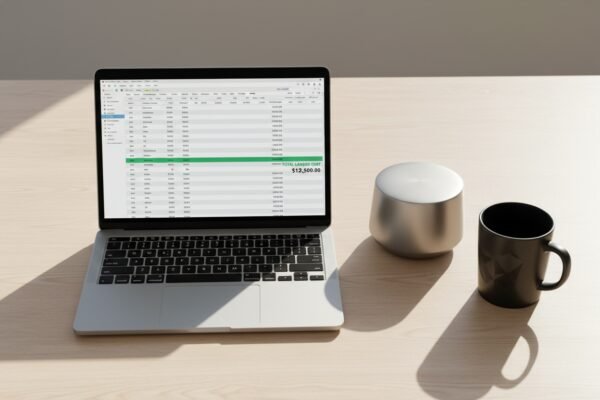
Landed cost is the total price you pay to get a product from a Chinese factory to your warehouse door US customs clearance 3. It includes the product price, inland transport in China, export fees, ocean or air freight 4, insurance, customs duties, import taxes, and final delivery. Many beginners only look at the unit price on their supplier's quote. That is a costly mistake.
Breaking Down FOB vs DDP Cost Structures
With FOB, you pay the supplier for the product and export handling up to the vessel at the Chinese port. Everything after that — ocean freight, marine insurance 5, US customs clearance, duties, and trucking — comes as separate invoices from separate companies. Each line item is a chance for a surprise.
With DDP, your sourcing agent or supplier rolls everything into one price. You see one number. You pay one invoice. The goods show up at your door.
Here is a real-world comparison based on a typical $10,000 order of consumer electronics shipped from Shenzhen to Los Angeles:
| Cost Component | FOB Breakdown | DDP Breakdown |
|---|---|---|
| Product Cost | $10,000 | Included in DDP price |
| Inland Transport (China) | Included in FOB | Included in DDP price |
| Ocean Freight (20ft container) | $3,500 (buyer pays) | Included in DDP price |
| Marine Insurance | $150 (buyer arranges) | Included in DDP price |
| US Customs Brokerage | $200 (buyer arranges) | Included in DDP price |
| Import Duties 6 (e.g., 25% tariff) | $2,500 (buyer pays) | Included in DDP price |
| Last-Mile Trucking | $400 (buyer pays) | Included in DDP price |
| Total Landed Cost | $16,750 (estimated) | $14,500–$15,500 (one price) |
You might notice the FOB total can sometimes be higher. That is because beginners without volume or freight contracts pay retail rates. A good sourcing agent offering DDP leverages bulk freight agreements and established customs broker relationships.
Why Surprises Happen with FOB
When you choose FOB, you must coordinate with a freight forwarder 7, an insurance provider, a customs broker, and sometimes a trucking company. Each one sends a separate bill. Currency fluctuations, port congestion surcharges 8, fuel adjustments, and container detention fees can all appear without warning. In 2025, Red Sea shipping disruptions 9 have inflated ocean freight rates by 20–50%, and those costs hit the FOB buyer directly.
DDP shields you from this volatility. Your agent absorbs the rate fluctuations and delivers a fixed price. Yes, there is a markup — typically 10–20% above what you might pay piecing it together yourself. But for a beginner budgeting their first import, predictability is worth more than potential savings.
When FOB Makes Sense for Cost
FOB becomes the smarter financial move when you ship larger volumes (above $50,000 per order), when you have an established freight forwarder relationship, or when your sourcing agent helps you consolidate multiple orders into one container. At that point, the cost transparency of FOB lets you negotiate each line item and drive down your total landed cost 10 below what any DDP quote would offer.
How much risk and responsibility am I taking on if I choose FOB instead of DDP?
In our years of coordinating shipments from factories across Guangdong and Zhejiang, we have seen first-time importers underestimate just how many things can go wrong between a Chinese port and an American warehouse.
With FOB, you take on significant risk and responsibility. You own the cargo the moment it crosses the ship's rail at the Chinese port. From that point, you are responsible for ocean transit damage, insurance claims, customs clearance, duty payments, and final delivery. DDP shifts all of these burdens to the seller or your sourcing agent until goods reach your door.
Understanding the Risk Transfer Point
The single most important concept in Incoterms is the risk transfer point — the exact moment when liability for the goods shifts from the seller to the buyer. With FOB, that moment happens at the port of origin in China when your goods are loaded onto the vessel. With DDP, the seller carries risk all the way to your specified delivery location.
This difference matters enormously. If a container falls off a ship, gets water-damaged in a storm, or sits for three weeks at a congested port accumulating fees — under FOB, that is your problem. Under DDP, your agent handles it.
What Responsibilities Fall on a FOB Buyer?
Here is a clear breakdown of who handles what under each term:
| Responsibility | FOB (Buyer's Job) | DDP (Agent/Seller's Job) |
|---|---|---|
| Export customs in China | Seller | Seller |
| Loading onto vessel | Seller | Seller |
| Ocean freight booking | Buyer | Seller/Agent |
| Marine cargo insurance | Buyer | Seller/Agent |
| Import customs clearance | Buyer | Seller/Agent |
| Payment of duties and taxes | Buyer | Seller/Agent |
| Destination port handling | Buyer | Seller/Agent |
| Last-mile delivery | Buyer | Seller/Agent |
| Demurrage and detention fees | Buyer | Seller/Agent |
For a beginner, the right side of this table is a relief. Every item on the left side requires knowledge, contacts, and quick decision-making — skills most first-time importers simply have not developed yet.
Real-World Risk Scenarios
Let me share a pattern we see regularly. A new importer chooses FOB to save money. The container arrives at the US port. Customs flags the shipment because the HS code on the paperwork is incorrect. The container sits in the port for two weeks while the importer scrambles to find a customs broker. Demurrage fees pile up at $150–$300 per day. By the time the goods clear, the importer has spent an extra $3,000–$5,000 they never budgeted for.
With DDP, your sourcing agent's logistics partner handles the HS code classification before the goods even leave China. If there is a customs issue at destination, the agent's broker resolves it. You are not making panicked phone calls at 2 AM trying to figure out what a "hold notification" means.
Insurance Gaps That Catch Beginners
Under FOB, you need to arrange your own marine cargo insurance. Many beginners skip this step or buy inadequate coverage. Standard policies cover about 110% of the invoice value, but you need to make sure the policy covers your specific route, cargo type, and risk level. Under DDP, the seller typically includes insurance as part of the package. It may be basic coverage, but it exists — and for a beginner, basic coverage beats no coverage every time.
The Learning Trade-Off
There is one argument for FOB risk: it forces you to learn. When you handle freight booking, insurance, and customs yourself — even with your agent advising you — you build knowledge that makes you a sharper importer long-term. But the question is whether your first shipment is the right time to learn those lessons. For most beginners with limited cash flow, one bad FOB experience can end the business before it starts.
Why is DDP often considered the most "hands-off" option for my first import?
When we onboard new clients at Go Source — especially founders running lean teams — the first thing they tell us is they do not have time to become shipping experts. They need products on their shelves or in their Amazon FBA warehouse, and they need it done without a logistics crash course.
DDP is the most hands-off option because your sourcing agent manages every step from factory floor to your front door. You do not book freight, file customs paperwork, calculate duties, or coordinate trucking. You pay one price, wait for delivery, and focus entirely on selling your product and growing your brand.
The DDP Workflow: What Actually Happens Behind the Scenes
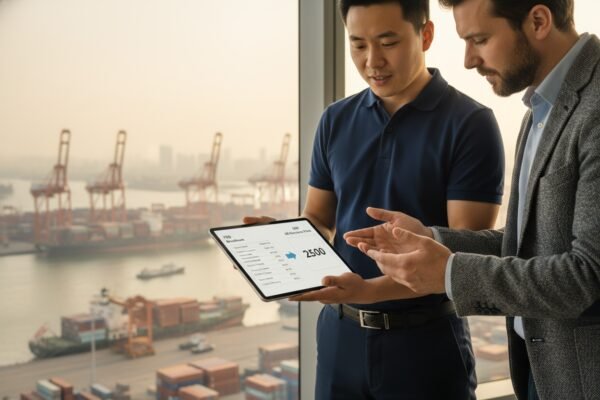
Many beginners assume DDP is simple because their experience is simple. But behind that simplicity, a lot is happening. Here is what your sourcing agent manages when you choose DDP:
- Factory pickup — Arranging inland transport from the manufacturer in cities like Shenzhen, Dongguan, or Yiwu to the nearest export port.
- Export customs — Filing the export declaration with Chinese customs, including commercial invoices, packing lists, and certificates of origin.
- Freight booking — Selecting the shipping line, booking container space, and managing loading schedules.
- Ocean transit — Monitoring the shipment during the 15–35 day voyage, handling route changes due to disruptions like Red Sea diversions.
- Import customs clearance — Working with a licensed customs broker at your destination port to file entry documents, provide correct HS codes, and pay applicable duties and taxes.
- Last-mile delivery — Coordinating trucking from the port or bonded warehouse to your specified address, whether that is your personal warehouse or an Amazon FBA facility.
You see none of this complexity. You get tracking updates and a delivery date.
Why Beginners Need "Hands-Off"
First-time importers juggle dozens of priorities: product photography, website launch, marketing campaigns, customer service setup, and inventory planning. Adding international logistics management on top of that is a recipe for burnout and errors.
The data supports this. Industry reports suggest that around 60% of small ecommerce importers in 2025 prefer DDP specifically because it aligns with the Amazon FBA door-to-door model. They need goods delivered to a fulfillment center. They do not want to manage port pickups or customs filings.
The Cost of "Hands-Off"
DDP convenience comes at a price. Sellers and agents typically mark up logistics costs by 10–20% to cover their coordination efforts and risk exposure. On a $10,000 order, that could mean $1,500–$2,000 extra compared to a perfectly executed FOB shipment.
But here is the question beginners should ask: what is the cost of getting it wrong? A single customs hold can cost $3,000 in demurrage. A missed duty payment can trigger penalties. An uninsured cargo loss can wipe out your entire investment. The DDP premium is essentially an insurance policy against your own inexperience.
The DDP-to-FOB Transition Strategy
The smartest approach we recommend to new clients is a phased strategy:
| Phase | Shipping Term | Order Value | Goal |
|---|---|---|---|
| Phase 1 (Orders 1–3) | DDP | Under $20,000 | Learn the product, validate the market, zero logistics stress |
| Phase 2 (Orders 4–8) | FOB with agent support | $20,000–$50,000 | Start managing freight with agent guidance, build forwarder relationships |
| Phase 3 (Orders 9+) | FOB independent | Above $50,000 | Full cost control, negotiate rates directly, maximize margins |
This progression lets you grow your logistics knowledge gradually without risking your early capital. You start hands-off with DDP, learn from watching your agent, and eventually take the reins when you are ready.
Limitations of DDP You Should Know
DDP is not perfect. You have less control over routing and timing. If your agent books the cheapest ocean carrier to maximize their margin, your goods might take a slower route. You also have limited visibility into individual cost components, which makes it harder to benchmark prices later. And if your agent's customs broker makes an error on the import side — say, classifying your product under the wrong HS code — the resulting delay still affects your inventory timeline even though the agent bears the financial penalty.
The key takeaway: DDP is the best starting point, but it should not be your forever strategy.
How can my sourcing agent help me manage the logistics and customs hurdles for each term?
Our team sits at the intersection of Chinese factories and international buyers every single day. We see the exact points where shipments stall, paperwork fails, and costs spiral — and those points are almost always at transitions between parties who do not communicate well.
A good sourcing agent acts as your logistics translator and project manager under both FOB and DDP. With DDP, they handle everything end-to-end. With FOB, they prepare export documents, coordinate factory loading, recommend reliable freight forwarders, advise on HS code classification, and help you avoid costly customs mistakes at your destination port.
What Your Agent Does Under DDP
Under DDP, your sourcing agent essentially becomes your full-service logistics department. They have contracts with freight forwarders, customs brokers in your destination country, and trucking companies. They negotiate rates based on the combined volume of all their clients — not just your single shipment — which gives you access to pricing you could never get on your own as a small importer.
Your agent also manages compliance. For US-bound shipments, this means ensuring your goods meet FDA, FCC, or CPSC requirements depending on the product category. They verify that all documentation — commercial invoice, packing list, bill of lading, certificate of origin — is accurate before the container leaves China. They handle Section 301 tariff classifications and know which products face 25% duties versus lower rates.
When problems arise — a port delay, a customs query, a damaged carton — your agent resolves it without you even knowing there was an issue.
What Your Agent Does Under FOB
Under FOB, your agent's role is more focused but equally critical. They manage the China side: factory inspection, quality control, export documentation, and loading supervision at the port. This is actually where most problems originate. A product that leaves China with incorrect paperwork will cause headaches at every subsequent step.
Your agent can also recommend freight forwarders and customs brokers at your destination. The best agents maintain partner networks in major import markets. They do not just hand you the goods at the port and disappear. They connect you with the right people on the other end.
Here is how agent involvement compares under each term:
| Agent Service | Under DDP | Under FOB |
|---|---|---|
| Factory quality inspection | ✅ Full service | ✅ Full service |
| Export documentation | ✅ Full service | ✅ Full service |
| Port loading supervision | ✅ Full service | ✅ Full service |
| Ocean freight booking | ✅ Agent handles | ❌ Buyer handles (agent advises) |
| Marine insurance | ✅ Agent arranges | ❌ Buyer arranges (agent recommends) |
| Destination customs clearance | ✅ Agent's broker handles | ❌ Buyer's broker handles (agent can refer) |
| Duty and tax payment | ✅ Agent fronts payment | ❌ Buyer pays directly |
| Final delivery coordination | ✅ Agent arranges trucking | ❌ Buyer arranges pickup/delivery |
| Problem resolution at destination | ✅ Agent manages | ⚠️ Agent advises but buyer acts |
Choosing the Right Agent for Your Shipping Term
Not all sourcing agents are equal. Some are strong on the China export side but weak on destination-country logistics. This matters more for DDP than FOB. If you choose DDP, you need an agent with proven experience in your specific destination market. For US imports, that means they must understand CBP requirements, Section 301 tariffs, FDA product holds, and ISF filing deadlines.
Ask your agent these five questions before choosing a shipping term:
- Do you have a licensed customs broker at my destination port?
- What is your process if customs holds my shipment?
- Can you provide a landed cost breakdown showing duties and freight separately?
- How do you handle tariff rate changes mid-shipment?
- What is your average DDP delivery time from factory to my warehouse?
The Agent-Hybrid Approach
The strategy we recommend most often is what we call the "agent-hybrid" approach. You start with DDP for your first two or three orders. Your agent manages everything. You watch and learn. You see the freight rates, the duty calculations, the timeline. Then, for your fourth order, you switch to FOB and use your agent's recommended freight forwarder. Your agent still handles the China side, but now you are managing the destination logistics — with a safety net of your agent's guidance.
This approach builds your competence without throwing you into the deep end. And as digital freight platforms like Flexport and Freightos make FOB management more accessible, the transition gets smoother every year. AI-powered logistics tools now help even novice importers track shipments, estimate duties, and flag compliance issues in real time.
The bottom line is simple: let your agent carry the load while you are learning. Graduate to more control when you are ready.
Conclusion
Start with DDP for your first few imports from China. Let your sourcing agent handle the complexity. Then transition to FOB as your confidence and order volumes grow.
Footnotes
1. Defines DDP Incoterms, seller's responsibilities, and risk transfer. ↩︎
2. Explains FOB Incoterms, buyer's responsibilities, and risk transfer point. ↩︎
3. Outlines the basic import and export process for goods entering the U.S. ↩︎
4. Describes different types of freight shipping, including ocean and air. ↩︎
5. Defines marine cargo insurance and its coverage for goods in transit. ↩︎
6. Explains what customs duties are, their purpose, and how they are calculated. ↩︎
7. Describes the role and functions of a freight forwarder in international shipping. ↩︎
8. Defines port congestion surcharges and their impact on shipping costs. ↩︎
9. Discusses the impacts of the Red Sea shipping crisis on global supply chains. ↩︎
10. Provides a comprehensive definition of landed cost and its components. ↩︎