For a non-EU brand selling consumer products into the EU, the responsible person is usually a paid authorised representative appointed by written mandate: your EU importer or fulfilment provider only qualifies automatically, and only when no EU manufacturer and no appointed representative exists.
Since 13 December 2024, every consumer product placed on the EU market needs an economic operator established inside the EU who answers to market surveillance authorities. Sellers notice this the moment a marketplace asks. If you are not an EU company, the immediate question is who fills that role, and most of the confusion comes from assuming there is only one answer. There are four operator types, and the order in which they qualify is fixed by law. Here is the map, then the decision.
What the responsible person actually is
It is not a certificate and not a marketing badge. It is a named EU-established legal entity that market surveillance authorities can contact about your product, and that holds the documents proving your product is safe.
The requirement comes from two regulations working together. Article 16 of the General Product Safety Regulation, Regulation (EU) 2023/988, says a product covered by the GPSR may only be placed on the Union market if there is an economic operator established in the EU responsible for the tasks set out in Article 4 of Regulation (EU) 2019/1020 on market surveillance. The GPSR extended that operator requirement to non-harmonised products, which is why it now catches the ordinary consumer goods most China sellers ship rather than only CE-marked toys and electronics.
Three things make this concrete. First, "established in the EU" means a real presence: a registered office, a headquarters, a permanent place of business. A PO box does not qualify, and neither does a mail-forwarding address you pay monthly for. Second, the operator keeps the technical documentation available to authorities for ten years from the date the product was placed on the market, so this is a long custody obligation, not a listing detail. Third, and this is the part that gets misread, being the responsible person does not transfer your duty to design a safe product. It is a contact point and a document holder, not a shield.
It is a role, not a product
You are not buying compliance. You are naming a party who can be reached and who holds a file. The substance to check is whether they will actually review your technical documentation against production, or whether they will store a folder and read you an address when something happens.
GPSR does not replace product-specific law
A product under its own harmonisation legislation still needs whatever that legislation requires, and the operator duties are layered on top of the existing conformity duties rather than substituting for them.
The four candidates, in the order the law sets
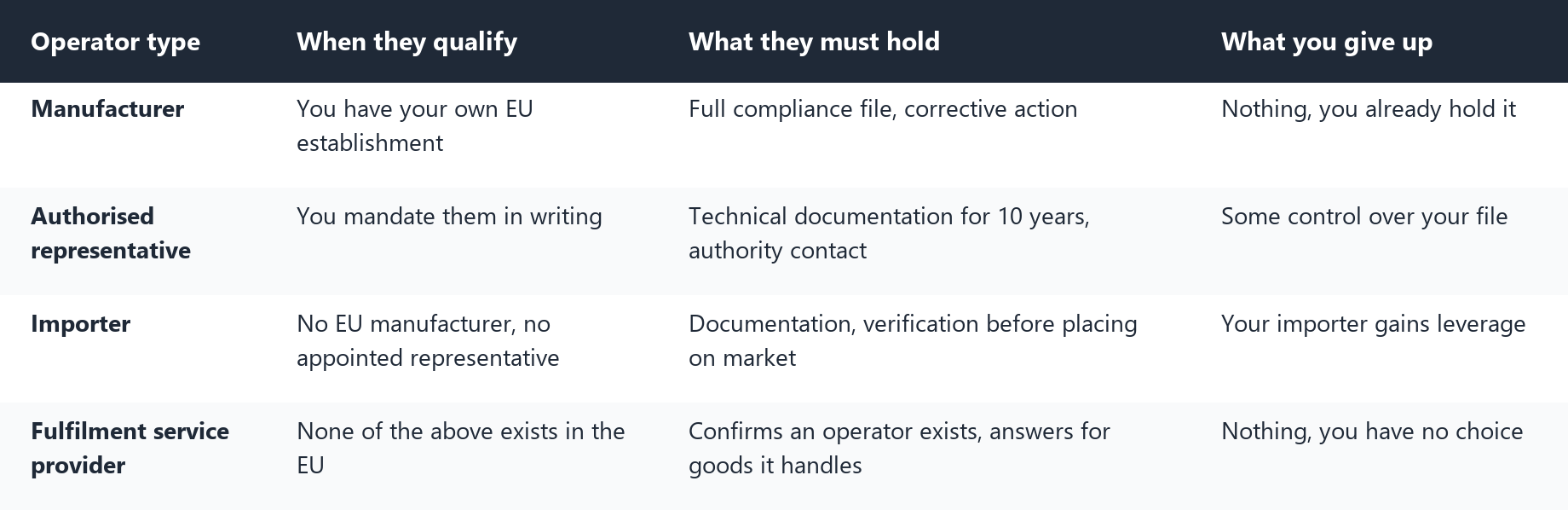
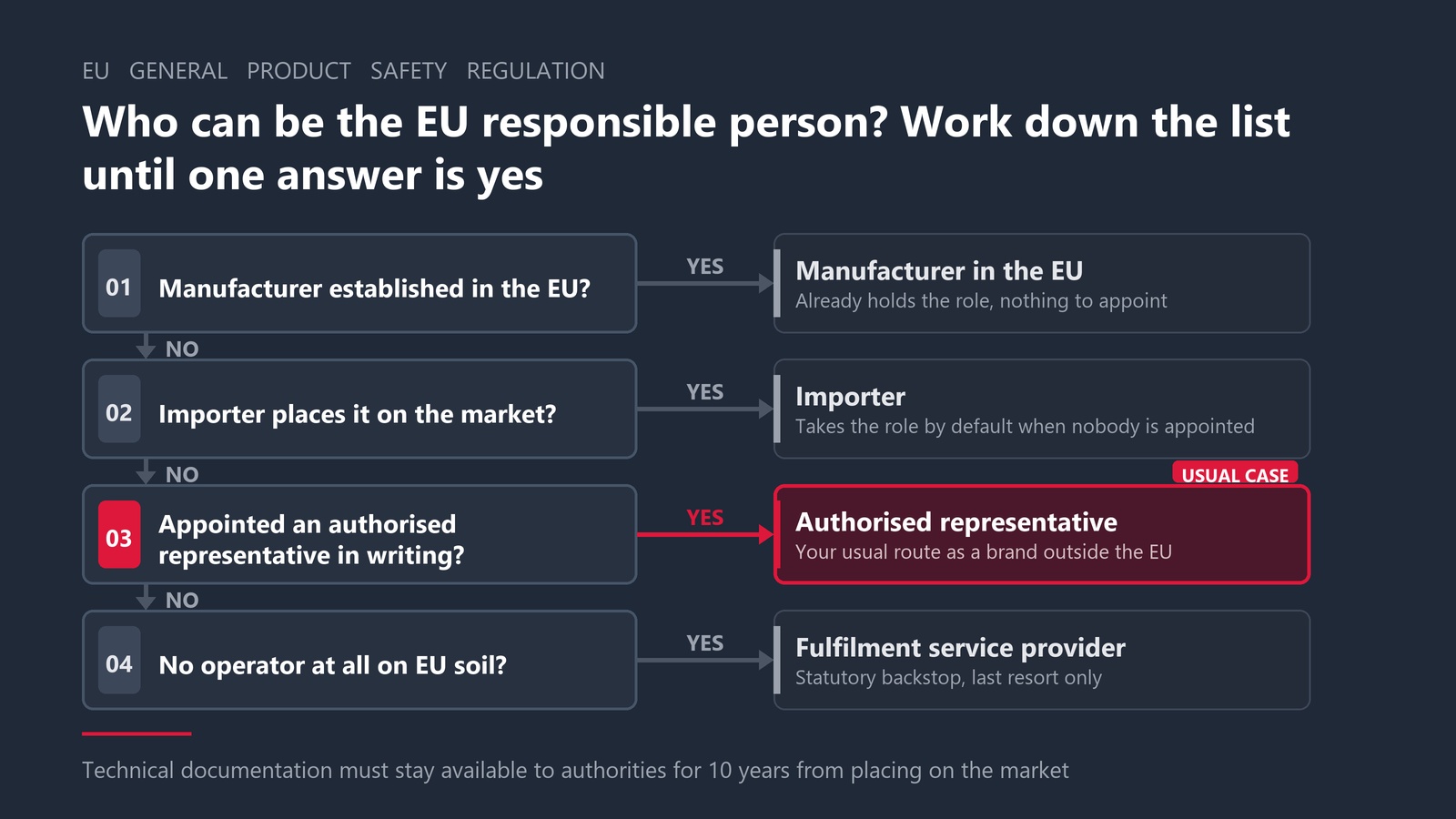
The law does not leave this open. Article 4(2) of the market surveillance regulation lists who can hold the role, and the list is a priority order, not a menu. The responsible economic operator is, in sequence, the manufacturer where it is established in the EU; the importer where the manufacturer is not; an authorised representative holding a written mandate; and finally a fulfilment service provider, as the statutory backstop.
| Operator type | When they qualify | What they must hold | What you give up |
|---|---|---|---|
| Manufacturer | You have your own EU establishment | Full compliance file, corrective action | Nothing, you already hold it |
| Authorised representative | You mandate them in writing | Technical documentation for 10 years, authority contact | Some control over your file |
| Importer | No EU manufacturer, no appointed representative | Documentation, verification before placing on market | Your importer gains leverage |
| Fulfilment service provider | None of the above exists in the EU | Confirms an operator exists, answers for goods it handles | Nothing, you have no choice |
Note who is missing from that list. A distributor is not in it, even though a distributor is an economic operator under the GPSR definition and carries its own duties. A marketplace is not in it either. You see online platforms advertising responsible-person services, and some of them genuinely provide one, but listing your product on a marketplace does not by itself appoint an operator, and a platform's automated compliance check does not become your compliance.
The distinction that trips up most sellers
A "responsible person" and an "authorised representative" are not the same thing. The responsible person is the regulatory function: an EU-established operator must exist before the product goes on the market. The authorised representative is one legal route to filling that function, created by a written mandate from the manufacturer. An importer or a fulfilment provider can be the operator without ever becoming your representative. Reading the two as interchangeable is how people end up with a mandate that does not actually cover the tasks and therefore covers nothing.
Why fulfilment is last, not first
It surprises buyers that the backstop comes fourth. The reason is that a fulfilment provider does not own your product and did not choose its design, so it can confirm an operator exists and answer for the goods it handles, but it is not a compliance partner. If you have ever seen a warehouse describe itself as your responsible person because your stock sits in their building, that is a reading of the rule that will not survive an authority asking for your technical file.
What the operator is legally required to do
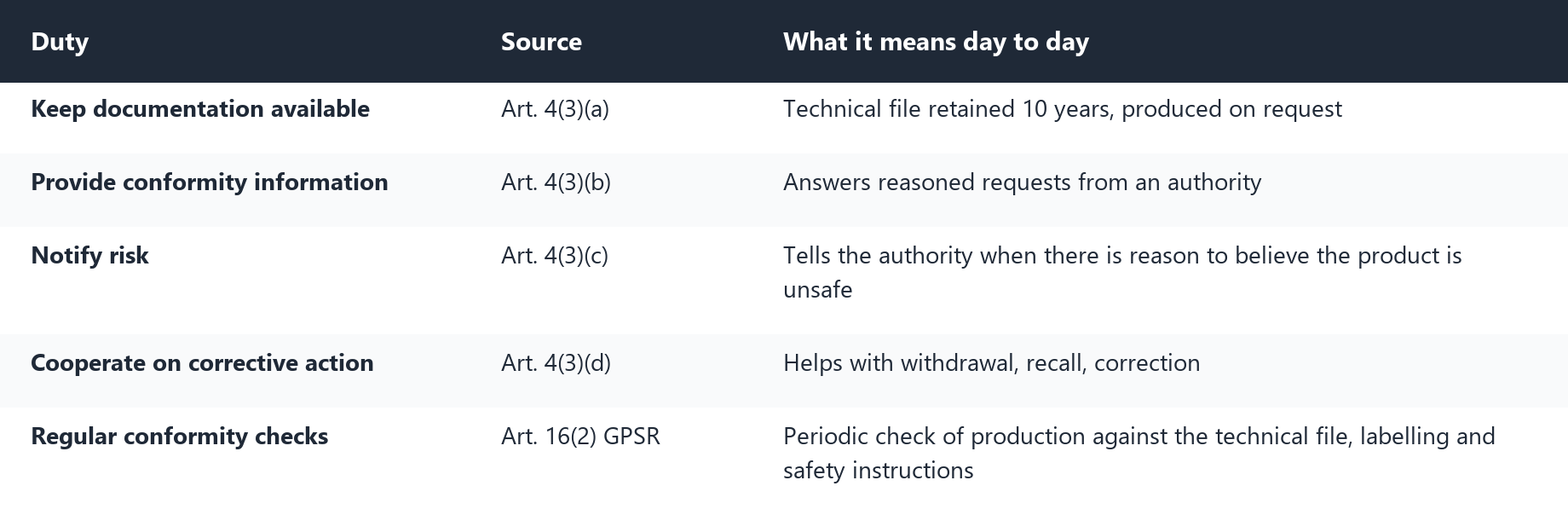
The tasks are not vague. Article 4(3) of the market surveillance regulation, extended by Article 16(2) of the GPSR, gives the operator four duties, and the GPSR adds a fifth that catches most people: regular checks.
| Duty | Source | What it means day to day |
|---|---|---|
| Keep documentation available | Art. 4(3)(a) | Technical file retained 10 years, produced on request |
| Provide conformity information | Art. 4(3)(b) | Answers reasoned requests from an authority |
| Notify risk | Art. 4(3)(c) | Tells the authority when there is reason to believe the product is unsafe |
| Cooperate on corrective action | Art. 4(3)(d) | Helps with withdrawal, recall, correction |
| Regular conformity checks | Art. 16(2) GPSR | Periodic check of production against the technical file, labelling and safety instructions |
That last row is why the cheapest option is often the wrong one. Some sellers assume a letterbox address in Germany satisfies the rule. It does not, because a registered office does not by itself review your production against your technical documentation. The person must actually be able to receive a batch, compare it to the file, and tell you when a label, a warning, or a component changed without the file being updated. That is a workflow, and it has to be somebody's job.
The duties run backwards too
Written mandate obligations flow from your representative to you as well, and they are worth reading before you sign. Your representative must inform you if they consider the product presents a risk, must keep you updated on the tasks performed, and must be able to show what they did and when. A representative who never tells you anything about your own product is not protecting you; they are holding a folder. Ask for the reporting cadence in the mandate, in writing, before you sign rather than after you need it.
Where the details must appear
On the product, or on the packaging, or on the parcel, or in a document that accompanies the product, and additionally on your online listing. The wording is deliberately broad so that returns flows and third-party fulfilment do not create a gap, but the practical rule for you is simpler: put the same operator name and address everywhere the product can be seen.
The name, registered trade name or trademark, and contact details including a postal and electronic address must all appear. The details must match the entity named in your mandate document. A mismatch between the label and the mandate is treated as a genuine finding, not a typo.
Four blocks your listing needs
For e-commerce, Article 19 of the GPSR sets four separate blocks that must be clearly visible in the offer itself: manufacturer name and contact details, EU responsible person details when the manufacturer is outside the EU, product identification including a picture and an identifier, and any warnings or safety information in a language consumers in that market can easily understand. A generic "EU compliant" badge satisfies none of it. Neither does a document sent only after purchase, and neither does a compliance page linked from the site footer. These are the most common reasons a listing gets pulled, and all three are fixable before the shipment leaves the factory, which is exactly when it is cheap.
Language is part of the requirement
The warnings and safety information must be in a language the consumer in the market of sale can easily understand, as determined by that member state. This is the item that surprises brands with a single global packaging design: an English-only safety panel sold into France, Germany, and the Netherlands is three separate compliance gaps, not one shared asset. Solving it at artwork stage costs a line of typesetting. Solving it after production costs new labels and a re-pick.
What actually happens if you skip it
Access first. Marketplaces and customs treat an untraceable product as a product that cannot enter, and you find out at the border or the week your listing is suppressed. Money second. Penalties for breaches are set at member state level and vary by country, so the same violation produces very different exposure depending on where it is caught.
There is a third consequence that is more expensive than either. If you have no EU operator, the obligation does not vanish; it falls on whoever is nearest in the chain. Your importer or, failing that, the EU fulfilment provider handling your goods is pushed into the operator role whether they agreed to it or not, and a serious distributor will simply refuse your product rather than carry that exposure for free. Sophisticated buyers run this check during supplier onboarding, usually alongside questions about your quality control arrangements and your ability to handle a product safety evidence package. The real cost is not the fine. It is losing the accounts you were trying to win.
The date already scheduled in your calendar
There is one coming. The new Product Liability Directive, Directive (EU) 2024/2853, has to be transposed by member states by 9 December 2026 and applies to products placed on the market after that date. It widens the set of parties who can be held liable for defective products, including importers and authorised representatives. The same representative you appoint to satisfy GPSR today may, from December 2026, sit inside a liability chain that reaches further than a regulatory contact role. That does not change who you must appoint. It does change how much you should read the mandate before you sign, and it is worth asking your representative directly how they handle a claim forwarded from a consumer rather than a letter from an authority.
How we set this up, and how to choose
Our team runs this for buyers every quarter, and the pattern in the questions we get is consistent: nobody wants a middleman between themselves and their product data. So we start from the mandate, not from the service catalogue.
Concretely, what we do is this. First we map the actual supply chain, per SKU and per sales channel, because the correct operator depends on who imports and who fulfils, and a brand selling direct to consumers in Germany while wholesaling through a Dutch distributor has two different answers. Second we assemble the technical documentation package the operator will be asked for, and we get it from the factory before the print run rather than after a customs hold. We ask for the risk analysis, the test reports, the material declarations, and the labels exactly as they will be printed, then we check that the name on the label matches the name in the mandate. Third we price the options against each other in writing, so the buyer can see what each one actually commits them to.
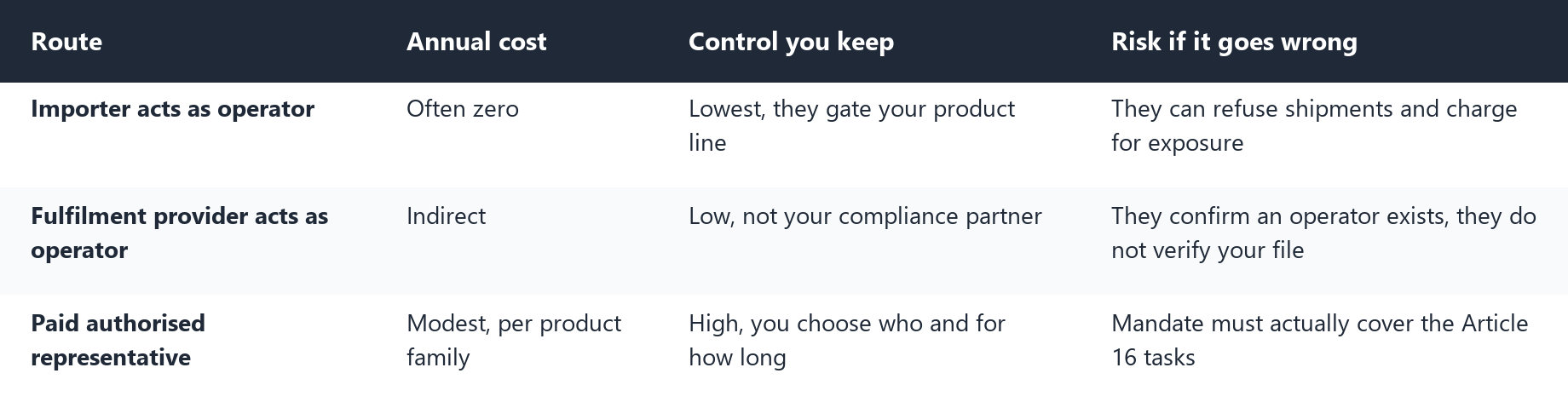
| Route | Annual cost | Control you keep | Risk if it goes wrong |
|---|---|---|---|
| Importer acts as operator | Often zero | Lowest, they gate your product line | They can refuse shipments and charge for exposure |
| Fulfilment provider acts as operator | Indirect | Low, not your compliance partner | They confirm an operator exists, they do not verify your file |
| Paid authorised representative | Modest, per product family | High, you choose who and for how long | Mandate must actually cover the Article 16 tasks |
What we get wrong on the first pass
The mistake we see most is treating the operator question as a paperwork question and leaving the underlying data untouched. A representative is handed a file built for the 2019 regime, with no risk analysis, no batch identification scheme, and a safety panel that does not match the current artwork. The appointment is then technically valid and practically useless, because the operator's first conformity check finds nothing to compare production against. Building the file properly costs less than the gap it closes, and it is the same work that makes your EU standards question, your customs classification, and your EU conformity work answerable from the same set of documents.
Confidentiality is hygiene, not paranoia
One more practical point, because it comes up every time. Whoever holds your technical documentation will see your supplier list and your costs. That is a structural consequence of the role, not a breach of it. A confidentiality clause in the mandate is not an unusual request, and any representative worth appointing will accept it without being asked twice. What is unusual, and worth walking away from, is an operator who wants the file but refuses to describe who inside their company can produce it.
What to do this week
Four steps, in order. Write down, per SKU and per channel, who places the product on the EU market and who is established in the EU. If any row has nobody, you have your answer: appoint an authorised representative by written mandate covering the Article 4(3) and Article 16 tasks explicitly. Then get the technical file built for your top products and hand it over, because a representative who receives nothing cannot hold anything. Finally, put the operator details into your labels, packaging, parcel documents, and every listing, and check that all four say the same thing.
None of this requires an EU office, an EU incorporation, or a European employee. It requires one identified entity that can be reached, plus a mandate that actually says what it is being asked to do. Do it once, correctly, and every shipment that follows is covered by a structure you already own.
Footnotes
1. Regulation (EU) 2023/988 (General Product Safety Regulation), Article 16, and Regulation (EU) 2019/1020 on market surveillance and compliance of products, Article 4. Official reference list, application dates and standard references: European Commission, General product safety (harmonised standards page). https://single-market-economy.ec.europa.eu/single-market/goods/european-standards/harmonised-standards/general-product-safety_en 2. European Commission, Product safety: obligations for businesses, Safety Gate rapid alert system, online marketplace registration requirement, and the product safety sweep mechanism. https://commission.europa.eu/topics/business-and-industry/product-safety_en 3. Safety Gate: the EU rapid alert system for dangerous non-food products, used to check whether a product has been notified or withdrawn. https://ec.europa.eu/safety-gate-alerts/screen/webReport 4. Safety Gate, Obligations for businesses: the Commission guidance on what the responsible economic operator must verify, keep, provide, notify and cooperate on. https://ec.europa.eu/safety-gate/#/screen/pages/obligationsForBusinesses 5. European Commission, Product liability: Directive (EU) 2024/2853 on liability for defective products, transposition deadline and scope of liable economic operators. https://commission.europa.eu/topics/business-and-industry/product-safety-and-requirements/product-liability_en 6. European Commission, E-surveillance Product Safety: the IT application used to detect dangerous products still sold on websites and online marketplaces. https://esurveillance.ec.europa.eu/product_safety/home