Featured answer: Four duties already apply to your packaging as of 12 August 2026: a 100 mg/kg combined limit on lead, cadmium, mercury and hexavalent chromium, a PFAS restriction on food-contact packaging, an EU declaration of conformity, and EPR registration in every member state where your packaged goods are placed on the market. Everything else in the regulation runs on a phased timeline to 2040.
The EU spent three decades governing packaging through a directive that each of the 27 member states implemented slightly differently. That ended when Regulation (EU) 2025/40, the Packaging and Packaging Waste Regulation, entered into force on 11 February 2025 and started applying on 12 August 2026. It is a regulation, not a directive, so it lands identically everywhere, with no national transition periods and no sector exemptions. Every packaged product placed on the EU market, made inside the EU or imported, carries the same obligations.
For a buyer sourcing from China, the practical question is no longer whether this regulation exists. It is which requirements your packaging has to clear before the shipment leaves the factory, and which ones can wait. That distinction matters more than it sounds, because the regulation deliberately separates duties that apply unconditionally today from duties that only start running once a technical act has been published. Getting that separation wrong in either direction is expensive: push too early and you pay for tests nobody requires yet, push too late and you are holding a container at a border.
What already applies to your packaging today
Four requirements went live on 12 August 2026 without waiting for any secondary legislation. They are unconditional, which means no implementing act can move them.
Heavy metals
The combined concentration of lead, cadmium, mercury and hexavalent chromium in any packaging material must not exceed 100 mg/kg. This is a material-level limit, so it applies per component: a corrugated carton, a plastic film window and an ink or adhesive layer each need to sit inside the limit on their own, not on average across the pack.
PFAS in food-contact packaging
Perfluoroalkyl and polyfluoroalkyl substances are restricted in packaging intended to come into contact with food. The compliance sequence matters here. A fluorine screening comes first, and PFAS analysis is only triggered if the screening trips. Buyers who order the full analysis upfront without screening are paying for tests that may not be required for their specific material.
The EU declaration of conformity
Alongside the technical documentation, the party placing a packaged product on the EU market draws up a declaration of conformity identifying the packaging, the rules it meets and the responsible party. This is the same conformity architecture that product safety rules already use, which is why teams that have been through EU regulations and standards already know the shape of the file.
EPR registration and the authorised representative
Extended Producer Responsibility obligations run per country. Registration in a member state's producer register, reporting of packaging volumes, and a written mandate appointing an authorised representative in each member state where you are not established, if your goods reach end users there directly.
Everything else has a date attached. The table below is the working map.
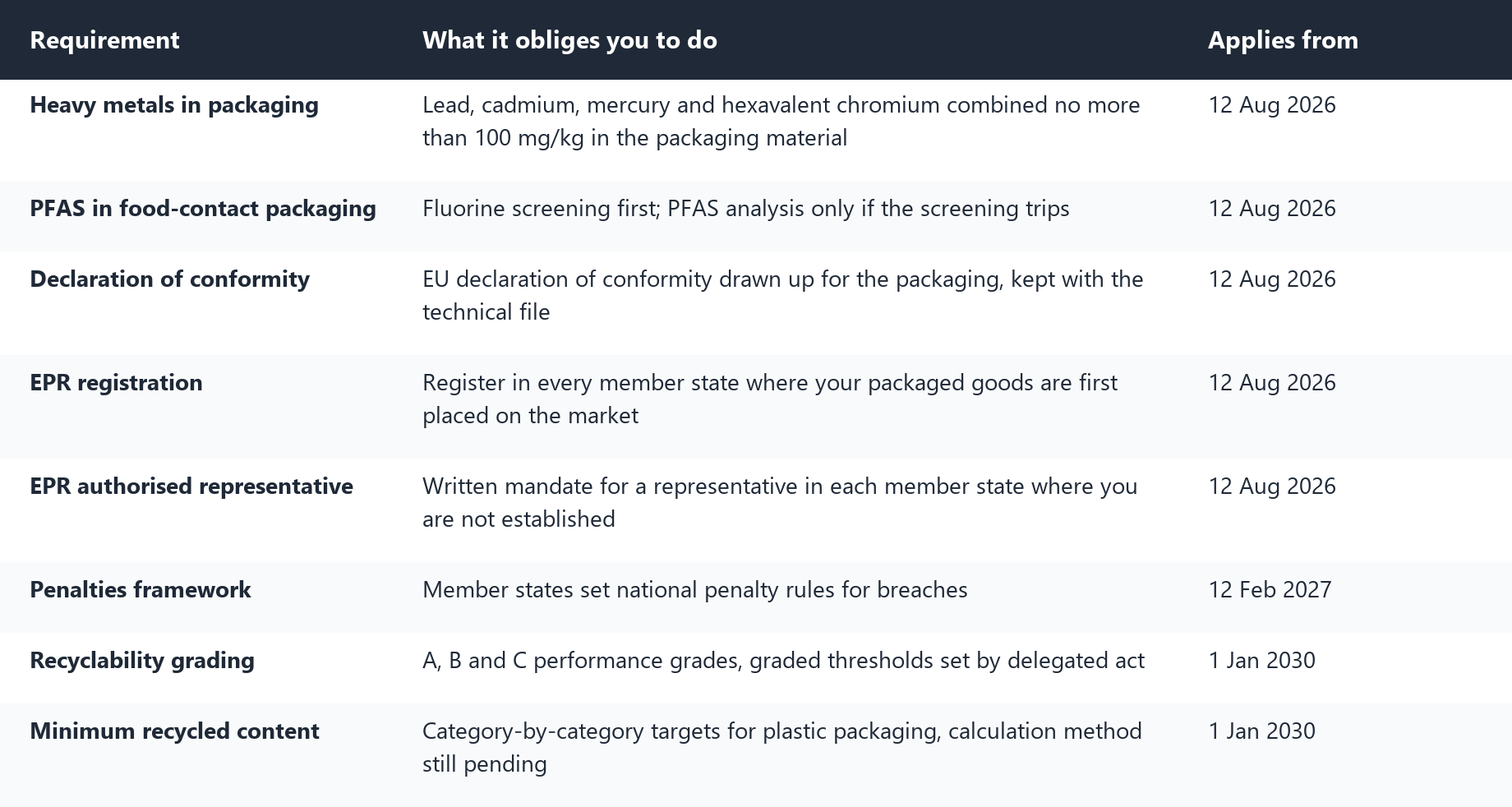
| Requirement | What it obliges you to do | Applies from |
|---|---|---|
| Heavy metals in packaging | Pb, Cd, Hg and Cr6+ combined no more than 100 mg/kg in the packaging material | 12 Aug 2026 |
| PFAS in food-contact packaging | Fluorine screening first; PFAS analysis only if the screening trips | 12 Aug 2026 |
| Declaration of conformity | EU declaration of conformity drawn up for the packaging, kept with the technical file | 12 Aug 2026 |
| EPR registration | Register in every member state where your packaged goods are first placed on the market | 12 Aug 2026 |
| EPR authorised representative | Written mandate for a representative in each member state where you are not established | 12 Aug 2026 |
| Penalties framework | Member states set national penalty rules for breaches | 12 Feb 2027 |
| Recyclability grading | A, B and C performance grades, graded thresholds set by delegated act | 1 Jan 2030 |
| Minimum recycled content | Category-by-category targets for plastic packaging | 1 Jan 2030 |
What was proposed, and what happened to it
There is a persistent belief that the EPR authorised representative obligation has been suspended, and it is worth being precise about the current position because the difference decides whether you need to appoint someone today.
The European Commission did propose suspending it. On 10 December 2025 the Commission tabled a package of environmental simplification measures, and one proposal would have suspended application of the EPR authorised representative rules until 1 January 2035. That proposal was not adopted. The Council discontinued negotiations on the package's two EPR proposals, citing strong reservations from a large majority of member states, and Parliament has not completed a first reading. Until an amending act is published, Article 45(3) applies as written.
Two further points sharpen the picture. The suspension proposal only concerned producers established in another EU member state. Rules for producers established outside the EU were not the target. And even under the original text, the obligation attaches to producers established in another member state, which is why some member states additionally require a representative from third-country producers and others do not. That is a national question, not a European one.
Separately, and independently of PPWR, member states were required to set their national penalty rules by 12 February 2027. From that date, non-compliance has a defined financial consequence in every member state, and being a non-EU company exempts neither your goods nor your representative.
So the practical question is not whether the law is suspended. It is which countries your packaged goods actually reach, and what each of those countries requires of a non-EU producer. Deliver into three member states and you are looking at three registers, three reporting relationships and three fees, because the EU harmonised the packaging rules and left the EPR registries national.
If you sell through an EU fulfilment warehouse or a marketplace that ships across borders, map which countries your goods physically touch before deciding where to register. Delivery scope, not commercial intention, defines the obligation.
What recyclable actually means
Mono-material is the direction of travel
Design for recycling is not a recycling symbol on a box. It is a judgement about whether the packaging can genuinely re-enter a material stream given its materials, their combinations, and what is attached to them. Labels, inks, adhesives and coatings all count.
In practice that pushes you toward mono-material solutions and away from the composites buyers tend to prefer. A paper structure bonded to a plastic film, a mixed-material closure, a laminated pouch and a paper carton with a plastic window are four different recycling cases, and only one of them is straightforward.
The textile question importers ask
Textile packaging deserves a separate note because it is commonly misunderstood. There is no general textile exemption from the definition of packaging. Textile packaging sold for packaging purposes is excluded from the recyclability duties, but it still counts as packaging for the rest of the regulation. Dust bags supplied with clothing and footwear, for example, are addressed in the Commission's guidance as items that can qualify as packaging when they serve to contain, protect or deliver the product to the end user, unless they form an integral part of the product or are sold separately.
The grading structure is where this becomes concrete.
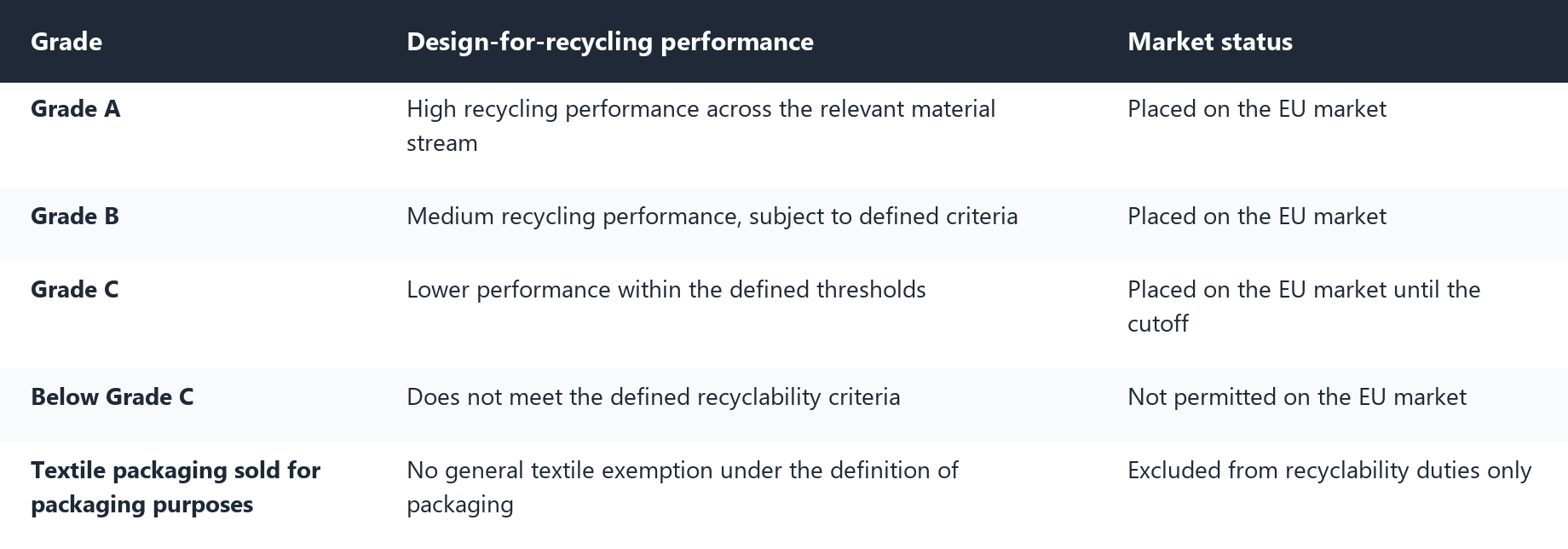
| Grade | Design-for-recycling performance | Market status |
|---|---|---|
| Grade A | High recycling performance across the relevant material stream | May be placed on the EU market |
| Grade B | Medium recycling performance, subject to defined criteria | May be placed on the EU market |
| Grade C | Lower performance within the defined thresholds | May be placed on the EU market until the cutoff |
| Below Grade C | Does not meet the defined recyclability criteria | Not permitted on the EU market |
| Textile packaging sold for packaging purposes | No general textile exemption from the definition of packaging | Excluded from recyclability duties only |
The thresholds themselves arrive by delegated act, and that act has not yet been published. This is the second place where buyers routinely get ahead of the regulation. Recyclability performance grades are defined by a delegated act due by 1 January 2028. Until it is in the Official Journal, you cannot be graded A, and it is worth being sceptical of any supplier who tells you their packaging is already Grade A certified.
What you can do now is make the design decisions that determine your grade later. Mono-material construction, minimal laminate layers, minimal mixed-material closures, and a clear material declaration from the converter. Those choices are cheap in 2026 and expensive in 2028.

The evidence package that has to exist before the container leaves
Five documents, five different issuers
A compliance claim is not compliance. When a market surveillance authority or a marketplace asks, the only thing that answers is a document.
The evidence package has five parts, and each one has a different issuer and a different point in the timeline.
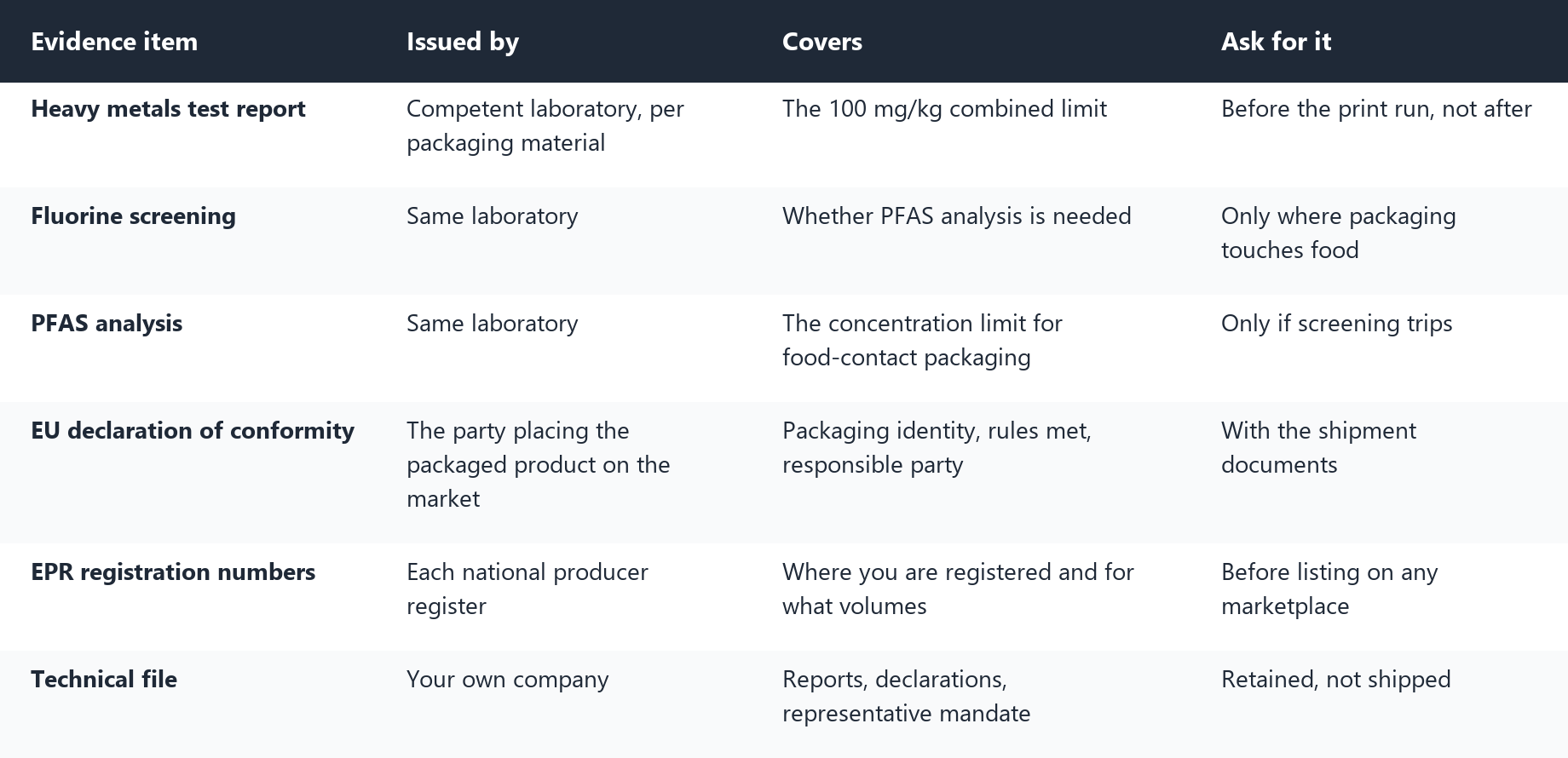
| Evidence item | Issued by | Covers | Ask for it |
|---|---|---|---|
| Heavy metals test report | Competent laboratory, per packaging material | The 100 mg/kg combined limit | Before the print run |
| Fluorine screening | Same laboratory | Whether PFAS analysis is needed | Only where packaging touches food |
| PFAS analysis | Same laboratory | The concentration limit for food-contact packaging | Only if screening trips |
| EU declaration of conformity | The party placing the packaged product on the market | Packaging identity, rules met, responsible party | With the shipment documents |
| EPR registration numbers | Each national producer register | Where you are registered, and for what volumes | Before listing on any marketplace |
| Technical file | Your own company | Reports, declarations, representative mandate | Retained, not shipped |
The order matters more than the list. Test reports are produced per packaging material, so they are determined by the artwork and the material specification. If you order them after the print run, you are testing something you already shipped. If you order them before, the same report can cover the next several production runs against the same material specification, which changes the unit economics entirely.
That is also where the difference between a factory that has done this work and one that has not shows up. A supplier who already maintains heavy metals reports per material can usually send them within a day. A supplier encountering the requirement for the first time needs to identify a laboratory, send samples and wait for a test cycle, which in practice means weeks. That difference belongs in your supplier evaluation conversation, not in the discovery phase after you have already committed. If you are still building that supplier list, it belongs alongside factory audits and capability checks rather than after the first purchase order.
What we actually do when a client has packaging crossing into the EU
Our team sits on the China side of this, so the sequence we work through is a production sequence rather than a legal opinion.
First, we ask for the packaging bill of materials by component, not as a single line. Heavy metals compliance is per material, and a supplier who reports a single figure for "the carton" is averaging across components that each need to sit inside the limit independently. Getting the component list early usually reveals inks, coatings and adhesives that nobody had tested separately.
Second, we ask what the converter has on file before we ask the factory to produce anything. Many Chinese packaging converters have been supplying EU-bound customers for years and hold existing reports for standard stock. A plain brown kraft carton from an established converter may already have a report, which turns a testing cost into a document request.
Third, we separate what must be done now from what can wait, and we write it into the purchase order rather than into an email. The client's compliance consultant and our production team end up working from the same list, which removes the most expensive failure mode we see: a packaging change made in production that nobody in the commercial team knew about, discovered at the border rather than at the factory.
Fourth, we ask about the EPR footprint at quotation stage, not at listing stage. Which member states will this specific shipment reach, and who is the producer in each of them. This is a question about logistics routing and channel structure, and the answer is often that the importer in Germany is the producer there, which changes everything about who needs to be registered. Getting that answer before the shipment is booked is worth more than any document we could file afterwards.
What we do not do is issue compliance opinions. We assemble the evidence package, put it in the client's name, and hand it to the party who signs the declaration.
What happens if packaging fails
The consequences arrive in sequence and each step costs more than the last.
Three stages, each worse than the last
Customs comes first. Shipments without a declaration of conformity and supporting documents face detention at the border, which means storage charges and missed selling windows. In a peak season, a two-week delay can cost more than the entire packaging redesign.
Market surveillance comes second. Authorities can force withdrawal, and marketplaces enforce faster than governments. A listing suspension takes your sales channel offline while the paperwork is being fixed.
Penalties come third. Member states set national penalty rules by 12 February 2027, and the rules can attach to whoever placed the packaged product on the market. Being a non-EU company does not create a shield.
The reasonable response is to notice that packaging is the easiest compliance surface you own. Product safety often means a redesign measured in months. Packaging changes are a print run away, test reports are fast, and the cost difference between a compliant carton and a non-compliant one is usually a small number of cents per unit. Failing on packaging is not a regulatory problem. It is a procurement attention problem.
The sequence to work through now
Two things need to be true before your next packaging order, and neither of them needs a law firm.
Before the next print run
Get the component-level material declaration for every packaging material in the order, and a test report covering the 100 mg/kg combined heavy metals limit per material. If packaging touches food, run the fluorine screening and escalate to PFAS analysis only if it trips.
Map the countries your goods physically reach, confirm who the producer is in each one, and check whether you hold or need an EPR registration in each. If you sell direct to end users in a member state where you are not established, look at the authorised representative question now rather than assuming the December 2025 suspension proposal settled it.
Design decisions you can take today
Then treat everything from 2030 onward as design decisions rather than deadlines. Mono-material construction, fewer laminate layers, minimal mixed-material closures. None of that requires a technical standard you do not have yet, and all of it becomes expensive to retrofit later.
Your next print run is the cheapest compliance deadline you will ever meet.
---
Footnotes
- Regulation (EU) 2025/40 on packaging and packaging waste, application date and obligations: European Commission, packaging and packaging waste. https://environment.ec.europa.eu/topics/waste-and-recycling/packaging-waste_en
- Simplifying for sustainable competitiveness, COM(2025) 980, setting out the Commission's commitment to issue PPWR guidance on PFAS testing, application dates, labelling and reuse targets: https://www.europarl.europa.eu/RegData/docs_autres_institutions/commission_europeenne/com/2025/0980/COM_COM(2025)0980_EN.pdf
- Environmental simplification package of 10 December 2025, including the proposal on EPR authorised representatives: European Commission press release IP/25/2997. https://ec.europa.eu/commission/presscorner/detail/en/ip_25_2997
- Proposal suspending application of the EPR authorised representative rules until 1 January 2035 (COM/2025/983): https://environment.ec.europa.eu/document/download/b7fc3a60-6895-441c-9a12-d9c37de5f3bb_en?filename=COM_2025_983_1_EN_ACT_part1_v5_0.pdf
- Proposal on simplification of environmental legislation and reduction of administrative burden (COM/2025/986): https://environment.ec.europa.eu/document/download/b45b4ac2-7f40-4b82-acb3-815e134807b6_en?filename=COM_2025_986_1_EN_ACT_part1_v6.pdf&prefLang=uk
- Harmonised standards and their role in EU market access: European Commission, single market and standards. https://single-market-economy.ec.europa.eu/single-market/european-standards/harmonised-standards_en
- Contaminants and food contact materials, including PFAS requirements: European Commission, food safety. https://food.ec.europa.eu/food-safety/chemical-safety/contaminants/legislation_en