
What Changed for EU Shipments on 1 July 2026, and How to Restructure Your Shipping Now
Featured answer: Since 1 July 2026 there is no duty-free threshold for parcels under EUR 150: every distance-sale consignment entering the EU carries a flat EUR 3 duty per category of goods, charged until normal tariff rates resume on 1 July 2028. The fix is to move your best sellers into a single EU bulk import rather than keep paying per parcel.
US sellers worked this out the hard way when the de minimis channel closed. Europe is now doing the same thing, and the change is narrower than most headlines suggest but harder to plan around. On 1 July 2026 the EU removed the customs duty exemption for parcels valued at or below EUR 150. Since then, every distance-sale consignment from outside the EU carries duty. The rule applies regardless of origin country, so a Shenzhen supplier and a Ho Chi Minh supplier are treated identically. What replaces the exemption is not the normal tariff rate yet: it is a transitional flat EUR 3 per category of goods, which stays in place until 1 July 2028 when the EU Customs Data Hub goes live and normal rates resume.
The detail that catches most sellers is that the EUR 3 is charged per category of goods, not per parcel and not per item. A parcel holding ten identical pairs of socks is one category, so it pays EUR 3. A parcel holding five pairs of wool socks and five pairs of cotton socks is two categories, so it pays EUR 6. One parcel with two toys, one wool coat and three bottles of shampoo pays EUR 9. This is the single most important line in the reform for anyone shipping mixed baskets, because it changes what belongs in one box far more than it changes your headline cost.
If you have not yet priced duty and freight together for a European order, start with how customs clearance and import duties work, then layer the freight on top. Separating the two is what makes the new flat rate look either catastrophic or irrelevant, depending on which half you look at first.
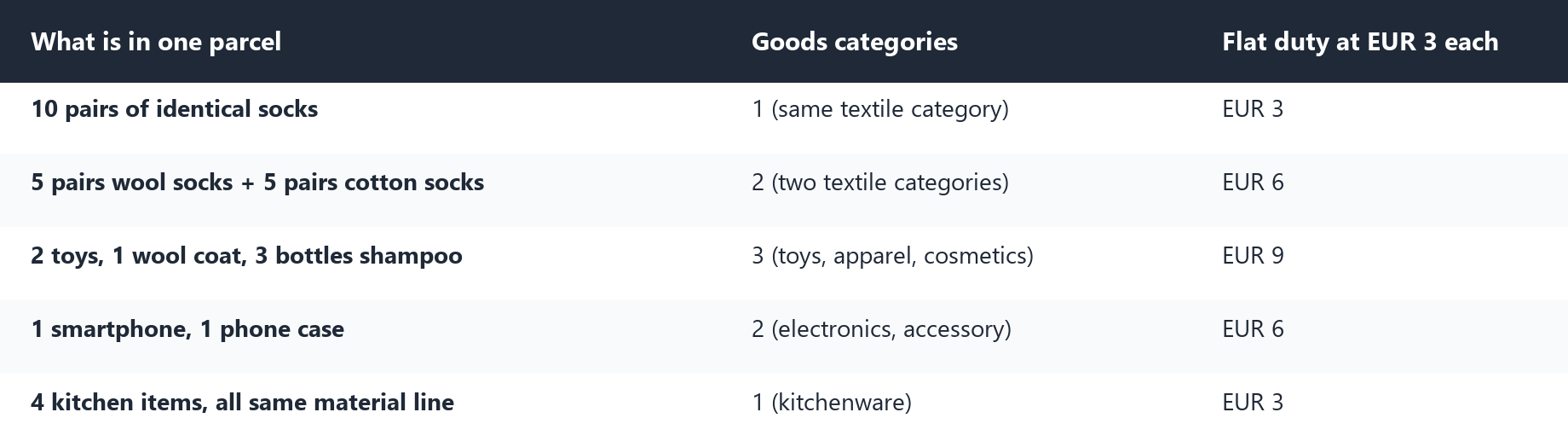
What actually changed on 1 July 2026
Two separate measures are landing in the EU right now, and they are routinely confused with each other. The first is the customs duty. The EUR 150 threshold is gone, replaced by the flat EUR 3 per category, applicable from 1 July 2026 until 1 July 2028. It applies to all goods in consignments up to EUR 150 sold in distance sales, regardless of which VAT arrangement you use. It does not apply to goods qualifying for preferential trade agreements where VAT was not collected through IOSS and the goods were declared in the first half of the year.
The second is the handling fee. The Council gave final approval to a separate EU-wide handling fee on small consignments in September 2026, which member states will start applying no later than 1 November 2026. It is a fee, not a customs duty, and it covers the cost of customs control and monitoring. The level is set by the Commission through a delegated act and was not fixed at the time of writing, so model it as a placeholder and re-check before your next Q4 shipment. The practical order of operations is: EUR 3 duty now, handling fee from November, normal tariff rates from July 2028.
VAT is not part of this change. VAT has been collected on distance sales in the EU since 2021 through the IOSS, and that arrangement continues to work. If you are registered in IOSS, the flat duty covers 93% of e-commerce flows into the EU. If you are not registered, the Commission will periodically assess whether the measure should be extended to cover your flows too, which means sitting outside IOSS is now a commercial risk rather than a neutral choice.
What this does to your landed cost
The EUR 3 sounds trivial, and for a single high-value item it is. The problem is that it is a floor, not a rate, and the costs around it are what actually break the direct-mail model.
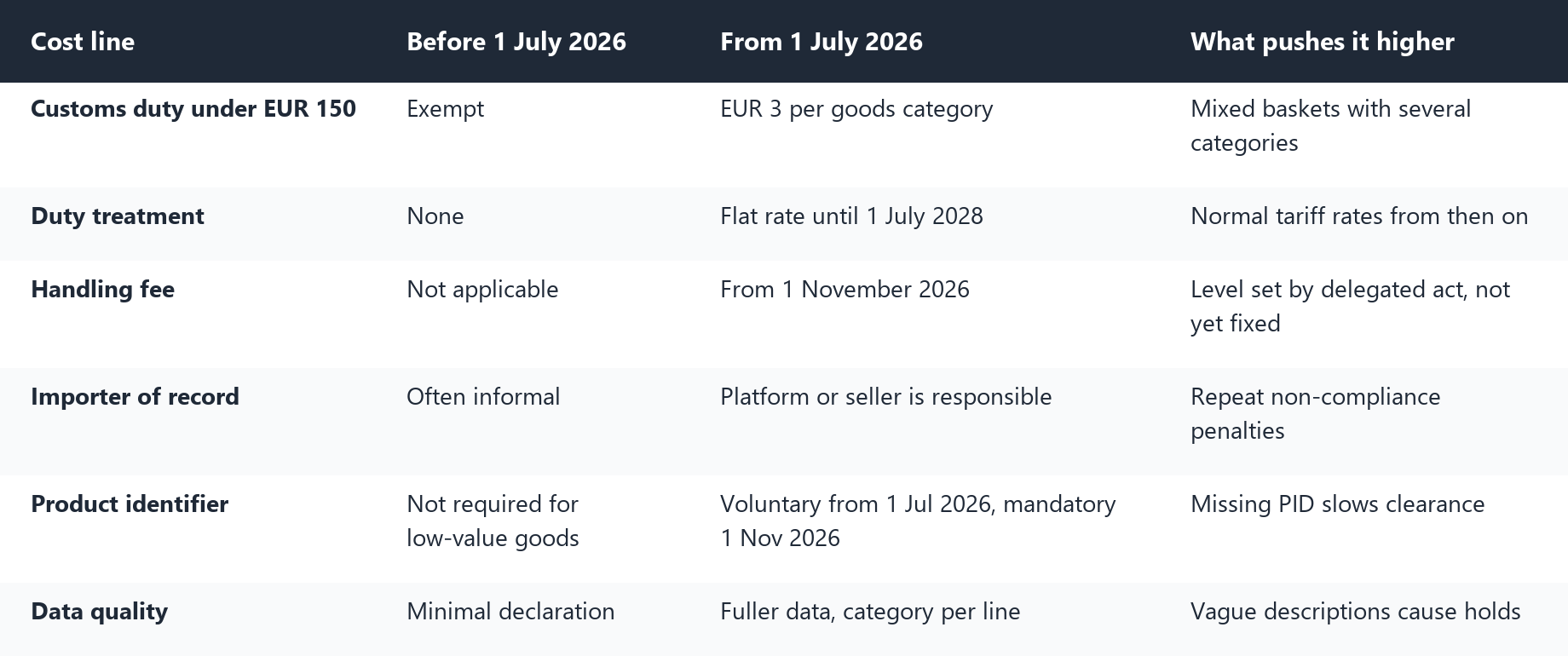
Two things in that table are worth pausing on. The first is the importer of record. Under the updated Union Customs Code, non-EU e-commerce platforms and sellers are responsible for customs formalities and duty payment, not the EU consumer at the door. Repeat non-compliance carries penalties that can reach 6% of the company's annual import value in the preceding year, plus loss of certain customs privileges and, in the most serious cases, access restrictions. The duty did not move to your customer; it moved onto you.
The second is the product identifier. It became declarable on a voluntary basis on 1 July 2026 and mandatory on 1 November 2026. If your product catalogue has never carried a stable identifier per item, this is the deadline that turns a data problem into a clearance problem.

How we restructure a shipping plan around this
When a client asks us to rework EU logistics after a rule change like this, we do not start with freight rates. We start with the goods themselves, because the duty is charged per category and the category comes from how you pack.
Step one is a tariff heading review. For each SKU we pull the intended commodity code and confirm it, because the category you declare is what drives the charge once normal rates resume in 2028. A product declared vaguely today is cheap today and expensive in 2028, and the same vague declaration is what triggers a hold in the meantime. We fold this into the same classification work we already do for freight, rather than treating it as a separate customs project.
Step two is basket design. Once you can see how many categories each order generates, the packing rule writes itself: keep one order to one category wherever the product allows, and where it does not, decide deliberately whether the extra EUR 3 is cheaper than splitting the shipment. The most common mistake we see is sellers who never counted categories at all, then discover their average basket carries four and their unit economics are three euros worse than modelled.
Step three is deciding who is the importer of record, and this is the decision with the longest lead time. Your options are your own EU entity, your fulfilment provider, or a broker acting for you. Whoever it is owns the declaration and can answer a customs question with documents. We push clients to settle this before goods leave China, because moving an importer of record mid-stream means re-declaring everything already in transit.
Step four is the volume test. Run your real order data through both models, parcel by parcel against one consolidated entry, and compare. For sellers doing a few hundred orders a month of a single-category product, the answer is often that restructuring is not yet worth the working capital. For sellers running mixed baskets across several countries, it usually is. The mistake we used to see was assuming one answer fits everyone, so we build the comparison per account.
What to do about returns and the three costs nobody budgets
Returns are the quiet one. A returned parcel that already crossed a border with duty paid needs either a re-import or a refund process that did not exist when the threshold existed. Sellers who treat a return as a simple refund end up paying duty twice on the same item, or absorbing a re-import bill on a margin they already spent. Decide your returns flow before you scale, not after the first month of negative numbers.
Carrier disbursement fees are the second. When a courier advances duty on your behalf and recovers it from your customer, the carrier charges for the convenience, and that fee annoys buyers more than the duty amount ever did. Clearing in bulk means you pay once, at import, and the last mile inside the EU becomes a domestic delivery with nothing for the recipient to settle.
The third is catalogue data, and it compounds. A vague product description used to be a shrug; under fuller entry data it becomes a hold. Fix your titles and material descriptions at catalogue level, not parcel by parcel.
If your cost model still treats the freight quote as your landed cost, it is understating you by whatever the new duty adds. The total landed cost method is the right place to rebuild it, and the FOB or DDP question decides who carries the new cost in your contract, so settle it with the supplier rather than discovering it in a carrier invoice.
Conclusion
The EUR 150 duty exemption ended on 1 July 2026, and what replaced it is a flat EUR 3 per category of goods until 1 July 2028, with a handling fee landing by 1 November 2026 and normal tariff rates to follow. The move that survives all three stages is the same one: consolidate your goods into a single EU import, keep one order to one category where you can, and settle the importer of record before the goods ship. Structure it once and the duty becomes a cost you control. Leave it and it becomes a surprise that arrives every single week.
Footnotes
- Council of the EU, agreement to apply a fixed customs duty of EUR 3 on small parcels valued under EUR 150 from 1 July 2026: https://ec.europa.eu/commission/presscorner/detail/en/ip_25_3045
- European Commission, DG Taxation and Customs Union, guidance and legal text on the temporary flat duty for low-value imports, applying until 1 July 2028 (Council Regulation (EU) 2026/382): https://taxation-customs.ec.europa.eu/news/guidance-and-legal-text-temporary-flat-fee-low-value-imports-which-will-apply-until-1-july-2028-2026-06-08_en
- European Commission, DG Taxation and Customs Union, EU Customs Reform: removal of the EUR 150 threshold, handling fee, importer responsibility and the Data Hub timeline: https://taxation-customs.ec.europa.eu/customs/eu-customs-reform_en