
Running production lines on tight schedules has taught our team one hard truth: procurement plans rarely survive first contact with reality.
China sourcing agents handle urgent procurement plan revisions by triaging the change, assessing production stage feasibility, negotiating with factories using established relationships, updating quality control protocols, re-planning logistics, and managing cost tradeoffs — all while protecting delivery timelines and product quality for the buyer.
Whether it is a sudden spec change, a quantity increase after a viral sales spike, or a compliance correction 1 discovered mid-production, the way your sourcing agent responds in those first critical hours determines whether the revision becomes a managed exception or a full-blown crisis. Let me walk you through exactly how this works, step by step, based on real situations we handle regularly at GoSource.
How quickly can my sourcing agent coordinate with the factory when I need to change my order specs?
Our production management team has seen spec changes land in our inbox at every possible stage — from pre-production sampling all the way to final packing. Speed matters, but the right kind of speed matters more.
A competent sourcing agent can typically initiate factory coordination within hours of receiving a spec change, but actual turnaround depends on the production stage, revision complexity, and whether retooling or new materials are needed — minor changes may resolve in 1–2 days while major ones take a week or more.

The First Step Is Not Action — It Is Triage
When a buyer sends us an urgent spec change, the instinct is to call the factory immediately. But the fastest path forward is not always the most obvious one. Before we pick up the phone, we answer four questions internally:
- What exactly changed?
- How far along is production?
- Which materials, molds, or processes are affected?
- What is the cost and risk if we do nothing versus act now?
This triage step usually takes less than an hour. It prevents miscommunication with the factory and avoids triggering unnecessary panic on the production floor.
Production Stage Determines Everything
The timing of your spec change matters more than the change itself. Here is a simple breakdown:
| Production Stage | Can Specs Be Changed? | Typical Response Time | Risk Level |
|---|---|---|---|
| Pre-production (before golden sample) | Yes, usually straightforward | 1–3 days | Low |
| Golden sample approved, materials ordered | Possible, but may need re-quoting | 3–7 days | Medium |
| Mass production 2 started | Difficult; depends on what changed | 5–14 days | High |
| Packing / ready to ship | Very limited; cosmetic changes only | Case by case | Very High |
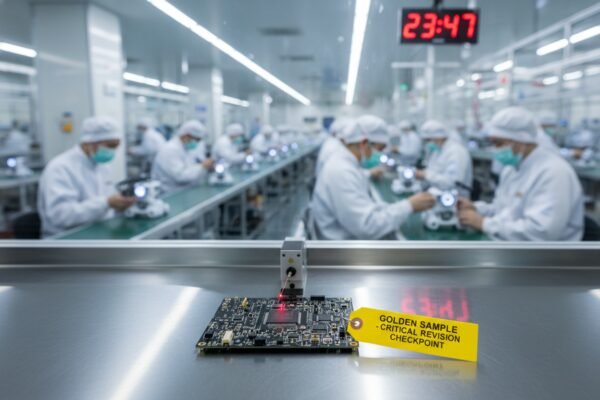
In our experience managing orders for consumer electronics 3 and smart home products, the golden sample approval stage is the most critical checkpoint. Before any major action — like starting mass production — we always have the supplier photograph the pre-production golden sample and send those photos to the client for formal confirmation. This step has near-legal weight. Once the client approves and the production line starts, it does not stop easily. That is why we treat this confirmation with extreme seriousness, and so should every buyer.
How We Communicate Changes to the Factory
Language and cultural nuance play a huge role here. We do not just translate the buyer's email into Chinese. We reframe the change in factory terms. For example, if a buyer says "I want the button to feel softer," we translate that into a specific durometer value 4 for the silicone, a reference to an existing sample, and a clear visual comparison.
We also confirm feasibility with the production manager — not just the sales contact. Sales teams at Chinese factories sometimes say "yes" too quickly without checking with the actual workshop. Our on-the-ground presence lets us push past that and get real answers fast.
Why Relationships Speed Things Up
When we ask a factory to accommodate an urgent change, we are essentially asking them to disrupt their schedule for us. Factories that we have worked with for years are far more willing to do that than a factory filling its first order for a new client. This is where long-term supplier relationships become a true competitive advantage. We have built trust over hundreds of orders, and that trust translates directly into faster response times, more honest feasibility assessments, and better negotiation outcomes.
Will an urgent revision to my procurement plan lead to unexpected price hikes from Chinese suppliers?
We have managed enough mid-production revisions to know that cost surprises are the number one fear buyers have when changes arise. That fear is justified — but it is also manageable with the right approach.
Urgent procurement revisions often increase costs, but the magnitude depends on the type of change, production stage, and your agent's negotiation leverage. Common cost drivers include expedited production fees, material waste, retooling charges, and air freight premiums — a skilled agent minimizes total landed cost, not just the supplier quote.

Where Do the Extra Costs Come From?
Not every revision triggers a price hike. A minor packaging text change before printing starts may cost nothing. But a material substitution after raw materials have been purchased will almost certainly add cost. Here are the most common cost drivers:
| Cost Driver | When It Applies | Typical Impact |
|---|---|---|
| Material waste | Raw materials already cut or processed | 5–15% of material cost |
| Retooling or mold modification | Spec changes affecting shape or fit | $500–$5,000+ depending on complexity |
| Expedited production surcharge | Factory must rearrange schedule | 5–10% premium |
| Air freight instead of sea | Delivery deadline unchanged despite delay | 4–8x sea freight cost |
| QC reinspection | New specs require re-inspection | $200–$500 per inspection |
| Overtime charges | Factory runs extra shifts | Varies by factory |
How We Protect Your Budget
Our job is not to eliminate all costs from a revision — that is usually impossible. Our job is to minimize the total landed cost. That means we look at the full picture: the supplier quote change, the logistics cost change 6, the QC cost, and the risk cost of doing nothing.
For example, if switching from sea freight to air freight saves a $20,000 stockout penalty at your end, the $3,000 air freight premium is a smart tradeoff. We help buyers see these decisions clearly.
Negotiation Leverage Matters
When we negotiate revision costs with a factory, our leverage comes from three places: the volume of business we bring them over time, our understanding of their actual cost structure, and our willingness to be fair. Factories respect agents who understand production economics 7. If we know that a packaging change costs the factory $0.03 per unit but they quote $0.15, we push back with specifics. If the change genuinely costs more, we explain that to the buyer honestly.
This honesty in both directions — toward the factory and toward the buyer — is what keeps costs reasonable even under pressure.
The Hidden Cost of Not Revising
Sometimes the most expensive decision is not making the change. If your product ships with a compliance error, or the wrong labeling, or a functional defect that your market will not accept, the cost of returns, refunds, and brand damage is far greater than any revision surcharge. We always frame revision costs against the alternative: what happens if we do nothing?
How does my sourcing partner maintain strict quality control when we make last-minute functional changes?
Our quality inspection team has a saying: "Speed creates shortcuts, and shortcuts create defects." When a functional change arrives mid-production, the biggest risk is not the change itself — it is the gap between what was approved and what gets produced.
When last-minute functional changes occur, a reliable sourcing partner re-documents updated specs, secures new sample approval, updates inline and pre-shipment QC checklists, and monitors production checkpoints to ensure the revised product meets the same quality standards as the original plan.
Why Functional Changes Are the Riskiest Type
A packaging tweak or a color shift is one thing. A functional change — say, altering a circuit board layout 8, changing a motor spec, or modifying a locking mechanism — touches the core of the product. It affects how the item performs, how it passes safety testing, and how end users experience it.
In our work with consumer electronics and beauty equipment clients, functional FDA-regulated beauty devices 9 changes are where most quality failures originate. The factory may understand the old spec perfectly after weeks of production, but a new spec introduced in a hurry can be misinterpreted, partially implemented, or applied inconsistently across different production batches.
The Re-Documentation Step
Every functional change must be documented. This sounds obvious, but under time pressure, it is the step most often skipped. We update the following:
- The product specification sheet with highlighted changes
- The Bill of Materials (BOM) with any new components
- The QC checklist with revised pass/fail criteria
- The golden sample photo record with side-by-side comparison
We send this updated documentation to the factory production manager, the QC team, and the buyer — all at the same time. Everyone must be on the same page before production resumes.
Staged QC Checkpoints
We do not wait until the goods are packed to check quality. Our QC process has multiple stages:
| QC Stage | What We Check | Why It Matters for Revisions |
|---|---|---|
| Pre-production check | Materials, components, updated molds | Catches wrong inputs before they enter the line |
| Inline inspection (during production) | Assembly accuracy, functional testing | Detects drift or misinterpretation early |
| Pre-shipment inspection (final) | Full spec compliance, packaging, labeling | Last chance to catch errors before shipping |
When a functional change happens, we often add an extra inline inspection specifically for the revised feature. For example, if a client changed the torque setting on a motorized beauty tool, we test torque on a random sample at the 30% production mark, not just at the end.
Preventing Factory Reversion
One subtle risk we have learned to watch for: factories sometimes revert to the old specification. This happens when the production worker follows habit rather than the updated instruction. It also happens when a night shift team does not receive the updated spec. We address this by physically marking updated instructions on the production floor and verifying compliance on unannounced visits.
Balancing Speed and Standards
There is a real tension between "get it done fast" and "get it done right." We resolve this tension by being very clear with both the buyer and the factory about what is negotiable and what is not. Timeline can flex. Price can flex. Quality standards do not flex. That principle guides every decision we make during an urgent revision.
Can my agent still guarantee on-time delivery if I update my packaging requirements mid-production?
We coordinate packaging across dozens of orders every month, and packaging changes are among the most common mid-production revisions we handle. They seem simple on the surface but can cascade through the entire supply chain.
On-time delivery after a mid-production packaging change is achievable but depends on the scope of the change, availability of new packaging materials, and how far production has progressed. Minor text or artwork revisions typically add 3–5 days, while structural packaging changes can add 1–3 weeks or more.

Not All Packaging Changes Are Equal
A packaging revision can mean many things. Changing a barcode, swapping a color on the box, adding a regulatory sticker — these are minor and usually manageable. But changing box dimensions, switching from a blister pack to a gift box, or adding custom inserts — these are structural changes that affect die-cutting, printing plates, material sourcing, and packing line setup.
Here is how we categorize packaging changes and their typical impact on delivery:
| Type of Packaging Change | Materials Impact | Timeline Impact | Delivery Risk |
|---|---|---|---|
| Text correction on existing artwork | None (reprint only) | 2–4 days | Low |
| New barcode or regulatory label | Label printing lead time | 3–5 days | Low |
| Color or graphic redesign | New printing plates | 5–10 days | Medium |
| Box size or structure change | New die-cut molds, new materials | 10–21 days | High |
| Switch to entirely new packaging type | Full re-sourcing of packaging | 14–30 days | Very High |
How We Protect Your Delivery Date
When a packaging change comes in, we immediately check two things: what packaging materials have already been produced, and what is the lead time for the revised packaging. If the product itself is still in production and will not be ready for packing for another week, we may have enough buffer to get new packaging printed and delivered to the factory in time.
If the buffer is too tight, we look at alternatives. Can we use generic stock packaging for the first batch and switch to custom packaging for the second shipment? Can we ship the product unboxed to the buyer's local warehouse and do the final packaging there? Can we split the order?
The Logistics Ripple Effect
Packaging changes do not only affect the factory. They can affect container loading plans 10, packing lists, carton dimensions, pallet configurations, and customs documentation. A different box size may mean fewer units per carton, which changes the total number of cartons, which changes the container space required. We recalculate all of this before confirming a revised delivery date.
Communication Is the Real Bottleneck
In most cases, the actual packaging revision is not what causes the delay. The delay comes from slow approval cycles. The buyer sends a new design, the factory produces a sample, the buyer takes three days to review it, requests another tweak, and suddenly a week has passed. We compress this cycle by setting clear deadlines for buyer approval and by sending packaging mock-ups via photo and video so decisions can happen over WhatsApp in hours, not days.
Because we understand production workflows deeply, we know exactly which stage of packing allows for adjustments and which does not. That knowledge makes negotiation with the supplier much smoother. Of course, there are still plenty of headaches — which is exactly why our long-term relationships with suppliers matter so much. A factory that trusts us will rearrange their packing schedule. A factory meeting us for the first time will not.
Conclusion
Urgent procurement revisions are not failures of planning — they are tests of operational maturity. The best sourcing agents turn panic into managed exceptions by protecting production feasibility, product quality, and landed cost at the same time.
Footnotes
Related Reading
Related Reading
1. Broad background on the regulatory compliance process mentioned in the introduction. ↩︎
2. ISO provides international standards for manufacturing and production processes. ↩︎
3. Primary marketplace for sourcing consumer electronics from Chinese manufacturers. ↩︎
4. Technical explanation of the measurement used for material hardness in manufacturing. ↩︎
5. WTO information regarding international trade tariffs on raw materials. ↩︎
6. Overview of logistics management within the global supply chain. ↩︎
7. Replaced with an authoritative source from the National Bureau of Economic Research (NBER) on the theory and empirical analysis of production. ↩︎
8. Authoritative body for standards in electronics and circuit board design. ↩︎
9. Replaced HTTP 404 link with the current, relevant FDA page on Aesthetic (Cosmetic) Devices, which outlines their regulation. The anchor text was updated for clarity and accuracy. ↩︎
10. Government resource for export requirements and international customs documentation. ↩︎