
Managing ten or more suppliers across different product categories at the same time can feel like juggling blindfolded Customs brokerage fees 1. Deadlines clash, quality standards slip, and communication breaks down in ways that cost real money.
China sourcing agents simplify multi-project procurement by acting as a centralized control tower. They coordinate supplier vetting, communication, quality inspections, and logistics across multiple factories and product lines simultaneously, turning a fragmented and high-risk process into a single managed workflow.
In our work at Go Source, we see this every week. A client needs beauty tools from one factory, consumer electronics 2 from another, and custom packaging from a third. Each supplier quotes differently, ships differently, and communicates differently. Below, we break down exactly how a sourcing agent brings order to that chaos.
How can I streamline communication when managing multiple Chinese suppliers at once?
When our team coordinates procurement across eight or ten factories for a single client, we see firsthand how fast communication spirals out of control without a central point of contact.
You streamline multi-supplier communication by routing all conversations through a single bilingual sourcing agent who translates technical specs, follows up on deadlines, manages sample revisions, and escalates issues before they become costly delays across every supplier simultaneously.

The Real Problem with Direct Communication
Most overseas buyers start by contacting factories directly through Alibaba, Made-in-China, or email. That works fine for one supplier. But when you scale to five, ten, or fifteen suppliers for different SKUs, the system breaks fast.
Here is what typically happens. You send a spec sheet to Factory A on Monday. Factory B replies with a question about packaging on Tuesday, but the message is unclear because the sales rep's English is limited. Factory C goes silent for three days. Factory D sends a sample that does not match your drawing, and it takes four emails to figure out why. Meanwhile, Factory E changed your quoted price without telling you.
Each of those conversations lives in a different chat thread. Nobody is cross-referencing timelines. Nobody is catching conflicts. You are the bottleneck.
How a Sourcing Agent Fixes This
A sourcing agent acts as a single communication hub. Every instruction, revision, and follow-up goes through one team that speaks both languages fluently and understands manufacturing terminology.
Here is a comparison of what changes:
| Communication Task | Without Agent | With Agent |
|---|---|---|
| Sending specs to suppliers | Buyer contacts each factory individually | Agent distributes specs to all factories at once |
| Following up on delays | Buyer chases each supplier separately | Agent monitors all timelines centrally |
| Resolving misunderstandings | Buyer guesses at translated responses | Agent clarifies in Mandarin on the spot |
| Coordinating sample revisions | Buyer tracks samples across multiple threads | Agent consolidates sample status in one report |
| Escalating urgent issues | Buyer may not discover problem for days | Agent flags issues in real time |
Why This Matters for Multi-Project Procurement
When different projects are at different stages — one in sampling, one in production, one ready to ship — the communication load multiplies. Our team handles this daily. We assign a dedicated project coordinator for each client, but that coordinator manages all of the client's suppliers in one dashboard. That means the client gets one weekly update instead of chasing fifteen different people.
The hidden cost of managing this yourself is not just time. It is errors. A misunderstood tolerance, a missed packaging change, or a delayed reply can push an entire project off schedule. And when you have several projects running in parallel, one delay creates a domino effect.
In our experience, the clients who benefit most from centralized communication are those managing custom or OEM products 3. These orders involve more back-and-forth on specs, materials, and samples. technical specs 4 The more complex the conversation, the more value a bilingual intermediary provides.
How will a sourcing agent help me maintain consistent quality across my different product categories?
In our daily production management work, we have seen clients receive perfect electronics from one factory and completely off-spec packaging from another — on the same order. Quality consistency is the hardest part of multi-project procurement 5.
A sourcing agent maintains consistent quality across product categories by applying standardized inspection protocols, conducting factory audits, managing sample approvals, and performing pre-shipment checks at every supplier, ensuring each factory meets the same quality benchmarks regardless of product type.

Why Quality Falls Apart Across Multiple Suppliers
Each factory has its own internal quality standards. A consumer electronics factory may test every unit. A packaging supplier may only spot-check. A metal parts factory may have no formal QC process at all. When you source from all three for the same project, you inherit three different quality cultures.
Without someone on the ground enforcing your standards at every factory, you will discover problems only when goods arrive at your warehouse. By then, it is too late. Returns, rework, and customer complaints follow.
The Agent's Quality Control Toolkit
A good sourcing agent does not just inspect finished goods. They manage quality at every stage. Here is how that process typically works across multiple projects:
| QC Stage | What the Agent Does | Why It Matters |
|---|---|---|
| Factory Audit | Visits the factory to verify capacity, certifications, and processes | Prevents working with unreliable or under-equipped factories |
| Sample Approval | Reviews and tests samples against buyer specs before mass production | Catches design or material errors before scale |
| Inline Inspection | Checks production quality during manufacturing | Identifies defects early enough to correct them |
| Pre-Shipment Inspection | Examines finished goods using AQL standards | Confirms the final product meets agreed-upon quality |
| Packaging Verification | Checks labels, barcodes, carton specs, and packing lists | Prevents Amazon prep errors, customs issues, or retail rejection |
Adapting QC to Different Product Types
One of the things we do at Go Source is tailor QC checklists to each product category. A beauty device requires electrical safety testing and surface finish checks. A toy requires safety certifications like ASTM F963 6 or EN 71. A smart home device needs functional testing under real-world conditions.
A single, generic checklist does not work. standardized inspection protocols 7 The agent's job is to build project-specific inspection criteria while maintaining a consistent overall framework. That means every factory gets audited the same way, but the inspection details reflect the product.
When Clients Cannot Travel to Factories
Most SME founders and purchasing managers cannot fly to China every time a production run starts. That is the practical reality. A sourcing agent acts as your eyes and hands on the ground. They visit factories, photograph production lines, test samples, and send evidence-based reports.
This is especially critical when you are managing several product categories at once. You cannot be in three cities in one day. But your agent's team can. We have had projects where we inspected goods at four different factories in Guangdong in a single week — all for the same client.
The result is that quality becomes predictable. You set the standard once. The agent enforces it everywhere.
Can I reduce my shipping costs by consolidating multiple orders into a single shipment?
Our logistics coordinators handle consolidation for clients almost every week. When goods from three or four factories arrive at our warehouse in Shenzhen at different times, we combine them into one container. The savings are significant.
Yes, you can substantially reduce shipping costs by using a sourcing agent to consolidate orders from multiple factories into a single shipment, which lowers per-unit freight costs, reduces the number of customs entries, minimizes handling fees, and simplifies last-mile logistics.
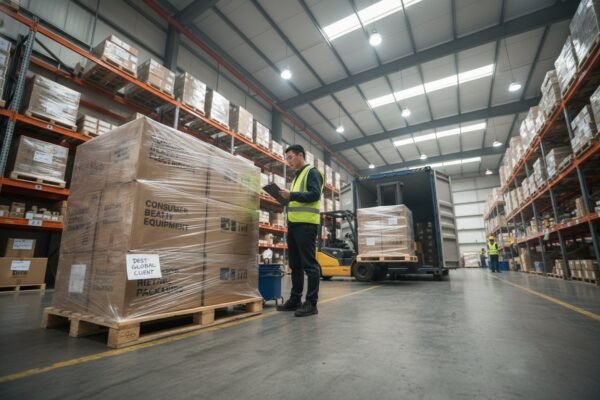
Why Fragmented Shipping Is So Expensive
When each factory ships independently, you pay separately for each shipment's freight, documentation, customs clearance, and delivery. Small shipments often go by air or LCL (less than container load) 8, both of which carry higher per-unit costs than a full container.
Here is a simplified comparison:
| Shipping Method | Estimated Cost per CBM (USD) | Customs Entries | Handling Complexity |
|---|---|---|---|
| Separate LCL from 4 factories | $80–$150 per CBM each | 4 separate entries | High — four tracking numbers, four BOLs |
| Consolidated FCL from agent warehouse | $40–$70 per CBM total | 1 entry | Low — one container, one BOL |
| Separate air freight from 4 factories | $6–$10 per kg each | 4 separate entries | Very high — four airway bills, four pickups |
The numbers shift based on routes and seasons, but the pattern is clear. Consolidation almost always wins on cost and simplicity.
How Consolidation Actually Works
The process starts when your sourcing agent coordinates production timelines with each factory. The goal is to get all goods delivered to a central warehouse within a defined window. Here is a typical flow:
- Agent confirms production completion dates with each supplier.
- Factories ship goods to the agent's consolidation warehouse.
- Agent inspects incoming goods and verifies quantities and quality.
- Agent arranges palletizing, labeling, and container loading.
- One container ships to the destination port or Amazon FBA warehouse.
This sounds straightforward, but the coordination behind it is not. Production delays at one factory can hold up the entire container. That is why the agent's role in managing timelines is so critical. At Go Source, we build buffer days into our consolidation schedule. If Factory A finishes three days late, we still hit the shipping window because we planned for it.
Beyond Freight Savings
Consolidation saves more than just freight costs. It also reduces:
- Customs brokerage fees — one entry instead of four.
- Port handling charges — one container pickup instead of multiple.
- Warehousing at destination — goods arrive together, not in scattered batches.
- Administrative time — one set of shipping documents, not four.
For Amazon sellers, consolidation has an additional benefit. When goods arrive as one shipment, FBA prep and labeling can be handled in one batch. That means faster check-in and fewer inventory gaps.
When Consolidation Does Not Make Sense
There are cases where consolidation adds risk. If one order is urgent and another is not, holding the urgent goods to wait for the slow ones defeats the purpose. A good agent will advise you when to consolidate and when to ship separately. The decision should be based on landed cost, timeline pressure, and storage costs — not a blanket rule.
As a problem-solver for our clients, our job is to find the approach that actually saves money in total, not just on paper. Sometimes that means two smaller shipments are cheaper than one delayed full container. Context matters.
How do I ensure my project timelines stay on track when I have several complex orders in production?
When we manage concurrent production runs for clients with five or more active SKUs, timeline management becomes the most critical service we provide. One missed deadline can cascade across every other project.
You keep multiple project timelines on track by having a sourcing agent create a unified production schedule, monitor each factory's progress weekly, flag delays early, coordinate buffer time for consolidation, and proactively adjust shipping plans so downstream deadlines are protected.

Why Timelines Collapse in Multi-Project Procurement
The core issue is interdependency. When you have five orders from five factories, each with different lead times, and you plan to consolidate them into one shipment, the slowest factory controls your entire schedule.
Add to that the common problems: factories overcommit capacity, raw material suppliers deliver late, holidays interrupt production, and nobody tells you until you ask. If you are managing this from overseas with a twelve-hour time difference, problems compound before you even wake up.
Building a Master Timeline
The first thing we do for multi-project clients is build a master production timeline. unified production schedule 9 This is a single document that tracks every project's key milestones side by side.
Here is a simplified example of what that looks like:
| Milestone | Product A (Electronics) | Product B (Packaging) | Product C (Beauty Tools) |
|---|---|---|---|
| Order confirmed | Jan 5 | Jan 5 | Jan 8 |
| Material procurement | Jan 5–15 | Jan 5–10 | Jan 8–18 |
| Sample approval | Jan 20 | Jan 14 | Jan 25 |
| Mass production start | Jan 22 | Jan 16 | Jan 28 |
| Mass production end | Feb 20 | Feb 5 | Feb 18 |
| QC inspection | Feb 22 | Feb 7 | Feb 20 |
| Delivery to warehouse | Feb 25 | Feb 10 | Feb 23 |
| Consolidation & ship | Mar 1 | Mar 1 | Mar 1 |
With this view, you can immediately see where the bottleneck is. Product C finishes latest, so the consolidation window is built around that timeline. If Product C slips by a week, the entire shipment moves. The agent's job is to prevent that slip or adjust the plan before it costs money.
Proactive Monitoring vs. Reactive Problem-Solving
The difference between a good sourcing agent and a mediocre one is proactive monitoring. A mediocre agent waits for the factory to report a delay. A good agent checks production status every few days — by phone, by WeChat, or by visiting the factory.
At Go Source, we request production photos and progress updates from each factory at least twice a week during active production. If a factory falls behind by even two or three days, we escalate immediately. That gives us time to negotiate overtime, adjust the consolidation window, or rearrange the shipping schedule.
Handling the Unexpected
No plan survives contact with reality. Raw materials get delayed. Machines break down. A factory takes on too many orders. Chinese New Year 10 or National Day holidays create annual production freezes.
The agent's value is not eliminating these events. It is responding fast. When our team discovers a delay at one factory, we immediately assess the impact on the entire schedule. Can we ship the other products first? Can we split the consolidation into two batches? Can we switch to air freight for the delayed items? These are decisions that need to happen within hours, not days.
When Direct Sourcing Struggles with Timelines
Buyers who manage timelines directly often lack the leverage and local presence to push factories. A factory may deprioritize your order if you are a small client. An agent with ongoing relationships and regular orders has more pull. They can walk into the factory, inspect the production line, and have a face-to-face conversation about deadlines. That kind of pressure is hard to replicate from twelve time zones away.
For businesses handling custom products, multi-SKU orders, or seasonal launches, timeline management is where a sourcing agent earns their fee many times over. The cost of a missed launch date — lost sales, unhappy retailers, broken pre-orders — almost always exceeds the agent's service cost.
Conclusion
Multi-project procurement from China does not have to mean chaos. A sourcing agent turns scattered supplier relationships into a managed, transparent workflow — saving you time, money, and risk across every project.
Footnotes
Related Reading
Related Reading
1. Defines customs brokerage fees and their role in international shipping. ↩︎
2. Provides industry analysis and context for consumer electronics manufacturing. ↩︎
3. Explains what Original Equipment Manufacturer (OEM) products are in manufacturing. ↩︎
4. Defines technical specifications in manufacturing and product development. ↩︎
5. Explains the process of managing procurement across multiple projects. ↩︎
6. Provides information on the specific safety standard for toys in the U.S. ↩︎
7. Details the importance and implementation of consistent quality inspection methods. ↩︎
8. Explains the shipping method for less than container load freight. ↩︎
9. Describes the benefits of a single, coordinated production timeline. ↩︎
10. Explains the impact of Chinese New Year on manufacturing and supply chains. ↩︎