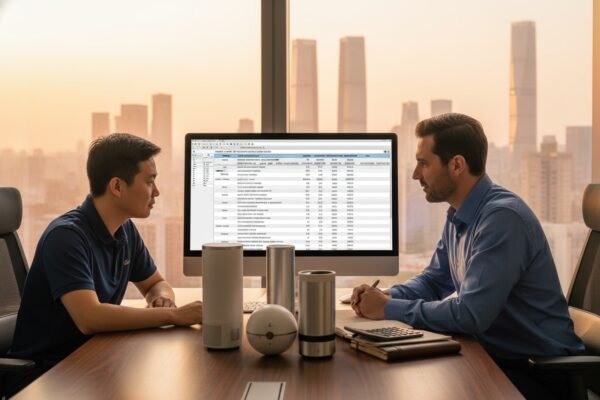
Every year, our team at Go Source watches importers lose thousands of dollars on a single shipment because they missed one line item on their cost sheet international freight 1. The product price looked great at the factory gate in Shenzhen. But by the time it landed at a warehouse in Los Angeles, the real cost had ballooned by 80% or more customs brokerage fee 2. The worst part? Most of those extra charges were entirely predictable.
To calculate total landed cost from China to US warehouses, you must add your product cost, international freight, cargo insurance, US customs duties and tariffs, brokerage fees, port handling charges, domestic trucking, and your sourcing agent's service fee, then divide by total units to get a per-unit landed cost for accurate pricing.
The journey from a Chinese factory to your American warehouse involves more steps than most first-time importers expect Port handling charges 3. Let me walk you through every cost node on that path, show you where hidden fees live, and explain how a sourcing agent turns this complex equation into a manageable spreadsheet.
What specific fees should I include when calculating my total landed cost from China?
When we prepare cost breakdowns for our clients at Go Source, the list of line items surprises almost everyone. Most buyers only think about the product price and shipping. That gap in awareness is where profit disappears.
You should include the product purchase price, packaging and tooling costs, international ocean or air freight, cargo insurance, US customs duties and Section 301 tariffs, customs brokerage fees, merchandise processing fees, port terminal handling charges, domestic trucking to your warehouse, and your sourcing agent's commission or service fee.
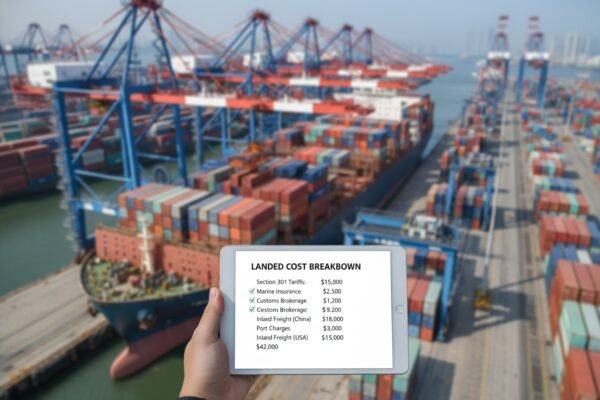
The Full Cost Chain: Factory Floor to Warehouse Door
Think of the journey from China to your US warehouse as a chain with at least ten links. If you forget even one link, your profit margin calculation is wrong. Here is the complete picture.
The starting point is always your product cost. This is the FOB (Free On Board) price your supplier quotes. It usually includes raw materials, labor, factory overhead, and basic packaging. But it does not include any mold or tooling fees if your product is customized. Those are often charged separately and amortized over your first order.
Next comes international freight. Ocean freight is the most common choice for bulk shipments from China. A full container load (FCL) from Shanghai or Shenzhen to Los Angeles costs roughly $2,500–$4,000 for a 40-foot container in 2025–2026 market conditions. Less-than-container-load (LCL) rates run $0.50–$2.00 per kilogram. Air freight is five to ten times more expensive but gets your goods there in days instead of weeks.
Then you have cargo insurance. This typically costs 0.5%–2% of your CIF (Cost, Insurance, Freight) value. It protects you against loss or damage during transit. Some buyers skip this to save money. That is a gamble we never recommend.
Once your goods arrive at a US port, the customs duty clock starts ticking. Every product has a Harmonized Tariff Schedule 4 (HTS) code that determines the base duty rate. On top of that, many Chinese goods carry an additional Section 301 tariff 5 of 7.5%–25%. Your customs brokerage fee covers the paperwork to clear your goods through US Customs and Border Protection (CBP). This runs $100–$300 per shipment. There is also a Merchandise Processing Fee (MPF) of 0.3464% of the declared value.
Port handling charges (also called Terminal Handling Charges or THC) cover unloading, storage, and dock fees. Budget $100–$200 per shipment.
Finally, domestic trucking from the port to your warehouse adds $200–$500 or more depending on distance. And your sourcing agent fee, typically 3%–8% of the order value, covers negotiation, quality control, logistics coordination, and documentation.
Standard Landed Cost Breakdown Table
| Cost Component | Typical Range | Who Handles It |
|---|---|---|
| Product Cost 6 (FOB) | $2–$50/unit | Supplier, negotiated by agent |
| Tooling / Mold Fees | $500–$10,000 (one-time) | Supplier, managed by agent |
| Ocean Freight (FCL) | $2,500–$4,000/container | Freight forwarder via agent |
| Air Freight | $5–$10/kg | Freight forwarder via agent |
| Cargo Insurance 7 | 0.5%–2% of CIF value | Agent arranges policy |
| US Customs Duties 8 | 0%–25% of CIF value | Customs broker via agent |
| Section 301 Tariffs | 7.5%–25% additional | Customs broker via agent |
| Customs Brokerage | $100–$300/shipment | Agent's broker partner |
| Merchandise Processing Fee 9 | 0.3464% of value | US CBP |
| Port Handling (THC) | $100–$200/shipment | Port terminal |
| Domestic Trucking | $200–$500+ | Agent's logistics partner |
| Sourcing Agent Fee | 3%–8% of order value | Your sourcing agent |
Why Per-Unit Calculation Matters
The grand total means little until you divide it by the number of units. Per-unit landed cost is the number you use to set your retail or wholesale price. If your product costs $4 at the factory and your per-unit landed cost comes to $7.16, you know your real cost basis. From there, you can calculate margin, compare against competitors, and decide if the product is viable.
In our daily work coordinating shipments out of Shenzhen, we catch cost surprises that would have blindsided the buyer. These are not exotic fees. They are mundane charges that factories and freight companies assume you already know about.
A sourcing agent identifies hidden costs by auditing the factory's quotation for omitted fees like packaging upgrades, labeling compliance, palletization, export documentation, inland trucking to the port, and peak-season freight surcharges—catching these before production starts so you can budget accurately and avoid last-minute cost shocks.

The Factory Quote Is Never the Whole Story
When a supplier in China sends you a price quote, it covers the product. Sometimes it covers basic poly-bag packaging. But there are several costs that live in the gray zone between the factory and the port.
Packaging and labeling compliance is a big one. If you sell on Amazon or to US retailers, your product needs UPC barcodes, FCC marks, or specific packaging that meets retailer requirements. Factories may quote the product without these add-ons. A sourcing agent reviews your sales channel requirements and flags what packaging upgrades you need before the order starts.
Inner carton and master carton specifications matter for freight cost. Poorly packed goods take up more space in a container, which means you pay more per unit for ocean freight. Our team works with factories to optimize carton dimensions so your shipment fits efficiently into a 40-foot container. This alone can save 10%–15% on freight.
Inland transportation within China is another commonly missed cost. FOB means the supplier delivers goods to the port. But if your factory is in an inland city like Yiwu or Dongguan, the trucking cost from factory to port is built into the FOB price—sometimes generously. An experienced agent verifies this and negotiates it down when the factory has padded it.
Common Hidden Costs Your Agent Should Catch
| Hidden Cost | Why It Gets Missed | Agent's Role |
|---|---|---|
| Packaging upgrades (retail-ready) | Not in standard FOB quote | Specifies requirements before PO |
| Export documentation (fumigation, CO) | Assumed included but often extra | Confirms and budgets upfront |
| Inland trucking (factory to port) | Buried in FOB price | Audits and negotiates |
| Peak-season surcharges | Freight forwarder adds later | Locks rates early or warns buyer |
| Quality inspection rework | Failed QC means rework cost | Manages QC to prevent failures |
| Container loading supervision | Sloppy loading damages goods | Agent present at loading |
| Currency exchange fluctuation | RMB/USD shifts between PO and payment | Agent advises on timing |
| Mold maintenance fees | Charged after first production run | Negotiates into contract terms |
The Pre-Shipment Checklist
Before goods leave the factory, your sourcing agent should provide a final cost reconciliation. This document compares the original quotation against actual costs incurred. It catches overcharges, unexpected fees, and scope changes. Without this step, buyers often discover extra charges only when the freight forwarder sends the final invoice. By then, you have zero leverage.
A good agent also tracks seasonal freight fluctuations. Rates spike during Chinese New Year pre-rush (November–January) and again during back-to-school season (July–August). If you can shift your production timeline by two to three weeks, your agent might save you $500–$1,000 per container. That kind of planning only happens when someone on the ground in China is watching the market daily.
Documentation That Costs Money If Done Wrong
Export documents like the Certificate of Origin, commercial invoice, packing list, and bill of lading must be accurate. Errors cause customs delays. Delays cause demurrage fees at the port—sometimes $50–$100 per day. Your agent ensures every document matches the actual shipment before the container is sealed.
How do I accurately factor in US tariffs and final-mile delivery to my warehouse?
When our logistics team calculates duties for a client's electronics shipment, we start by looking up the exact HTS code. Getting this wrong by even one digit can mean a 15% difference in your duty rate. That kind of error does not just hurt—it kills your margin.
To accurately factor in US tariffs, identify your product's correct HTS code on the USITC database, calculate duties as a percentage of your CIF value, add any applicable Section 301 tariffs, include the Merchandise Processing Fee, and then add domestic trucking or drayage costs from the US port to your warehouse for the complete last-mile figure.
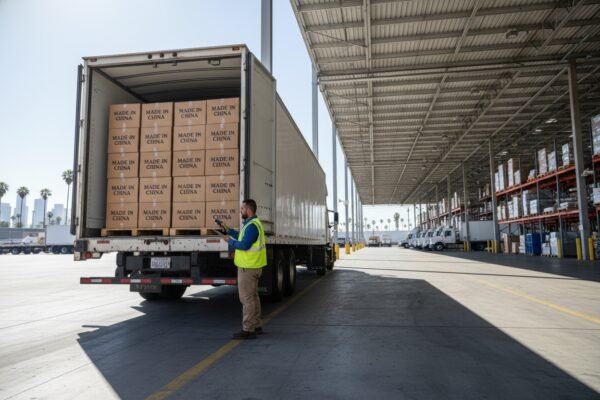
Step 1: Find Your HTS Code
The Harmonized Tariff Schedule is maintained by the US International Trade Commission (USITC). You can search it online at hts.usitc.gov. Every product has a specific 10-digit code. Your base duty rate depends on this code. For example, a Bluetooth speaker might fall under HTS 8518.22, with a base duty of 4.9%. A silicone phone case might fall under HTS 3926.90, with a base duty around 5.3%.
Getting the classification wrong is one of the most expensive mistakes importers make. If US Customs audits your shipment and disagrees with your HTS code, you face penalties and retroactive duties. Your sourcing agent or customs broker should confirm the HTS code before the first shipment ever leaves China.
Step 2: Calculate Duties on CIF Value
US duties are calculated on the transaction value, which in most cases aligns closely with the CIF value (product cost + freight + insurance). Here is a simple example:
| Item | Amount |
|---|---|
| FOB Product Cost (500 units × $4) | $2,000 |
| Ocean Freight | $500 |
| Insurance | $25 |
| CIF Value | $2,525 |
| Base Duty Rate (10%) | $252.50 |
| Section 301 Tariff (25%) | $631.25 |
| Merchandise Processing Fee (0.3464%) | $8.75 |
| Total Duties and Fees | $892.50 |
| Per-Unit Duty Cost | $1.79 |
Notice how Section 301 tariffs can dwarf the base duty. For many Chinese-origin products, Section 301 adds 7.5% to 25% on top of the normal rate. In 2025–2026, these tariffs remain in effect across a broad range of consumer electronics, textiles, and home goods.
Step 3: Budget for Final-Mile Delivery
Once your container clears customs at a port like Long Beach or Newark, it still needs to reach your warehouse. This is the "final mile" or "last mile" in import logistics.
Drayage is the short-haul trucking from the port terminal to a nearby warehouse or transload facility. It typically costs $200–$600 depending on distance and container size. If your warehouse is within 50 miles of the port, drayage is straightforward.
If your warehouse is further inland—say, in Dallas or Chicago—you need long-haul domestic trucking or rail intermodal service. Cross-country trucking can run $1,500–$3,000. Rail is cheaper but slower.
Do not forget port dwell time. If your container sits at the terminal longer than the free time (usually 3–5 days), you pay demurrage fees of $50–$150 per day. Congestion at LA/Long Beach ports in recent years has made this a real and recurring cost.
Step 4: Add It All Up
Your sourcing agent should provide a consolidated landed cost worksheet that includes every line item from factory to warehouse. When we build these for Go Source clients, we update freight rates and tariff schedules monthly to keep the numbers current. Static calculations go stale fast in today's trade environment.
One more consideration: the de minimis threshold ($800 duty-free for individual parcels) is under review and may be reduced or eliminated for Chinese goods. If you currently use small parcel shipping to avoid duties, plan for this rule to change. Your agent should already be advising you on consolidated LCL shipping as an alternative.
How do I use my landed cost data to determine if my product will be profitable in the US market?
When we sit down with a new client who wants to import beauty equipment or consumer electronics from China, the first question is never "Can you find a factory?" It is "Will the numbers work once everything lands in your warehouse?" That is where landed cost data becomes your most important decision-making tool.
Use your per-unit landed cost as your true cost basis, then compare it against your target selling price minus marketplace fees, advertising costs, warehousing, and returns. If your gross margin after all these deductions is at least 30%–40%, the product is likely viable for the US market; below that, renegotiate or walk away.

The Profitability Formula
Profitability is not just revenue minus product cost. It is revenue minus every cost you incur to make that sale. Here is the formula:
Net Profit Per Unit = Selling Price − Landed Cost − Marketplace Fees − Advertising − Warehousing − Returns/Refunds
Let me use a concrete example. Say you import a consumer electronics accessory from Shenzhen.
| Cost Element | Per Unit |
|---|---|
| Landed Cost (from calculation) | $7.16 |
| Amazon FBA Fee | $3.50 |
| Advertising (PPC) | $2.00 |
| Warehousing (monthly) | $0.50 |
| Returns and Refunds (5% rate) | $1.00 |
| Total Cost Per Unit | $14.16 |
| Selling Price on Amazon | $24.99 |
| Gross Profit Per Unit | $10.83 |
| Gross Margin | 43.3% |
At 43.3%, this product has a healthy margin. But if your landed cost were $11.54 instead of $7.16—because you used air freight and miscalculated duties—your total cost per unit jumps to $18.54 and your margin drops to 25.8%. That is dangerously thin for a product that could face a price war on Amazon.
Sensitivity Analysis: What If Costs Change?
Smart importers run scenarios. What happens if ocean freight goes up 30%? What if Section 301 tariffs increase to 50% on your category? What if your supplier raises prices by 10%?
Your sourcing agent should help you model these scenarios. At Go Source, we build simple spreadsheets for clients that let them toggle key variables—freight rate, duty rate, exchange rate, order quantity—and instantly see the impact on per-unit landed cost and margin.
The Break-Even Quantity Question
Landed cost decreases as order quantity increases. Freight and handling costs are largely fixed per shipment, so spreading them across more units reduces your per-unit cost. A 500-unit order might land at $7.16 per unit. A 2,000-unit order of the same product might land at $5.80 per unit. That $1.36 difference can be the gap between a viable product and a money loser.
Your agent can model break-even quantities to help you decide whether to start with a small test order or commit to a larger volume. The trade-off is always between lower per-unit cost and higher upfront cash outlay plus inventory risk.
When to Walk Away
Not every product from China is profitable once you calculate real landed cost. If your per-unit landed cost is more than 50% of your target selling price, the margins are too tight for most e-commerce or distribution businesses. You need room for advertising, returns, competition, and the unexpected.
Your sourcing agent's job is not just to find the cheapest factory. It is to give you the complete picture so you can make informed decisions. A good agent will tell you when a product does not make financial sense. That honesty saves you far more than any commission costs.
Dynamic Cost Monitoring
Landed cost is not a one-time calculation. Freight rates fluctuate. Tariff policies change. Currency rates shift. A product that was profitable in January might not be profitable in July. We advise clients to recalculate landed cost quarterly or whenever they reorder. Tools like Freightos for freight rates, the USITC database for tariff updates, and your agent's on-the-ground intelligence all feed into this ongoing process.
The importers who thrive in the US market are the ones who treat landed cost as a living number, not a static figure from their first order.
Conclusion
Calculating total landed cost is not optional—it is the foundation of every profitable import decision from China to the US. Map every cost from factory floor to warehouse door, use your sourcing agent to catch what you cannot see from overseas, and let the real numbers guide your go or no-go call.
Footnotes
1. Defines the transportation of goods across global borders. ↩︎
2. Explains the cost for professional services to clear imported goods. ↩︎
3. Defines fees collected by port operators for moving cargo. ↩︎
4. Direct link to the official Harmonized Tariff Schedule of the United States (HTS) maintained by the USITC. ↩︎
5. Explains the trade law allowing tariffs on unfair trade practices. ↩︎
6. Explains the direct and indirect expenses incurred in manufacturing a product. ↩︎
7. Protects shipments from loss, damage, or theft during transit. ↩︎
8. Provides an authoritative and comprehensive overview of customs duties in the United States. ↩︎
9. Explains the fee charged by CBP for processing imported merchandise. ↩︎
10. Defines total landed cost and its components for accurate pricing. ↩︎