
Every week our team processes dozens of quality inspection reports from factories across Shenzhen, Dongguan, and Ningbo. The pattern is always the same: buyers who skip defining AQL standards upfront end up fighting costly quality disputes later. The frustration of receiving a container full of defective goods is real, and the financial damage can sink a small business overnight.
To set AQL quality inspection standards with China sourcing agents and suppliers, you must first define your defect categories (critical, major, minor), select the appropriate inspection level based on ISO 2859-1, agree on sample sizes using standardized AQL tables, and document everything in a written quality agreement before production begins.
In this guide, we break down exactly how to choose sampling levels, enforce AQL compliance, classify defects clearly, and handle failed batches. Each section draws on real sourcing scenarios we encounter daily. Let us walk through the process step by step.
How do I choose the right AQL sampling levels for my consumer electronics shipment?
When we coordinate inspections for clients shipping Bluetooth speakers, LED panels, or smart home devices, the sampling level question comes up in every kickoff call. Picking the wrong level means either wasting money on over-inspection or letting defective units slip through to your customers.
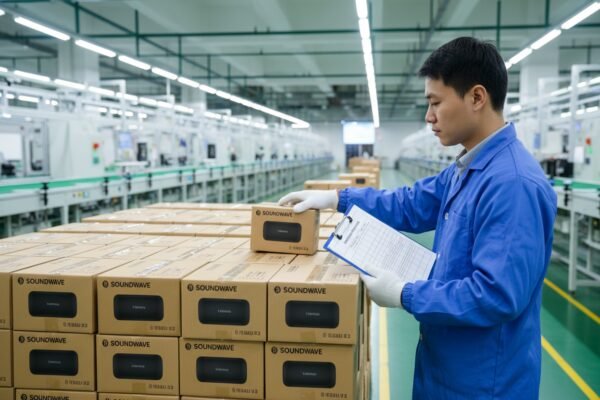
For most consumer electronics shipments, General Inspection Level II is the standard choice. It provides a balanced sample size that gives statistical confidence without excessive cost. Use Level I for trusted suppliers with proven track records, and Level III when quality history is poor or the product is new.
Understanding the Three General Inspection Levels
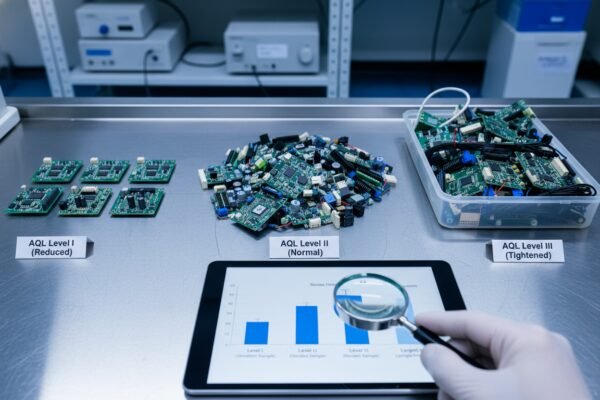
The ISO 2859-1 standard 1 defines three general inspection levels. Each level determines how many units you pull from a batch. The higher the level, the larger the sample, and the more confidence you get in your results.
Here is a quick comparison:
| Inspection Level | Sample Size (Relative) | Best Used When | Cost Impact |
|---|---|---|---|
| Level I | Smallest | Supplier has strong track record; low-risk product | Lowest |
| Level II | Standard | Default for most consumer goods and electronics | Moderate |
| Level III | Largest | New supplier; high-value product; history of quality issues | Highest |
Level II is the industry default. About 80% of the inspections our team arranges in Chinese factories use Level II. It strikes the right balance between cost and confidence.
How Sample Size Connects to Your Lot Size
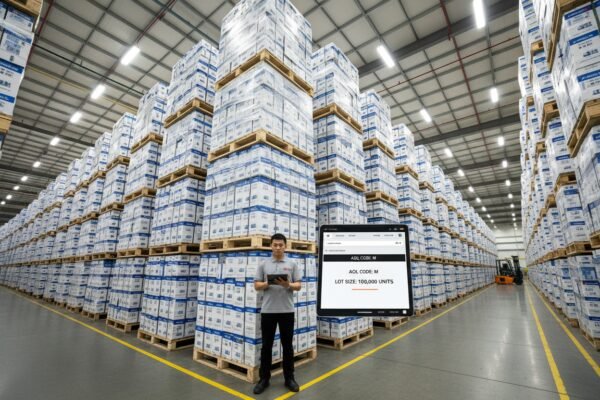
The AQL system 2 uses a two-step process. First, you match your lot size and inspection level to a "code letter" using the first AQL table. Then, you use that code letter to find your exact sample size and acceptance numbers in the second table.
For example, if you are shipping 5,000 Bluetooth earbuds and using Level II:
| Lot Size | Code Letter (Level II) | Sample Size |
|---|---|---|
| 2–8 | A | 2 |
| 281–500 | H | 50 |
| 1,201–3,200 | K | 125 |
| 3,201–10,000 | L | 200 |
| 10,001–35,000 | M | 315 |
With a lot of 5,000 units, you land on code letter L, which means 200 units get inspected. That is only 4% of the batch, but it gives you strong statistical confidence.
When to Adjust Your Inspection Level
We always advise clients to think of AQL levels as dynamic, not static. If a factory has delivered five consecutive shipments with zero major defects 3, it makes sense to drop to Level I. This saves inspection time and cost.
On the other hand, if you are launching a new product or onboarding a new supplier, start at Level II or even Level III. The extra scrutiny pays for itself. For high-value electronics — think drones, medical devices, or premium audio equipment — our recommendation is to lean toward 100% inspection for critical functional tests, even if you use AQL sampling for cosmetic checks.
Special Inspection Levels
Beyond the three general levels, the standard includes four special levels (S-1 through S-4). Special Inspection Levels 4 These use very small sample sizes and are reserved for destructive testing. If your quality check requires breaking open a battery pack or running a burn-in test, you do not want to destroy 200 units. Special levels let you test just a handful while still maintaining statistical validity.
How can I ensure my China sourcing agent and factory are actually following my AQL requirements?
From our years of managing production across hundreds of factories, we have seen a painful truth: writing AQL requirements into a contract does not guarantee they will be followed on the factory floor. The gap between paper and practice is where most quality failures happen.
To ensure compliance, require your sourcing agent to provide photo-documented inspection reports with timestamped evidence, use third-party inspectors independently from the factory, conduct surprise audits, and establish written SOPs that both the agent and factory sign before production starts.
Put Everything in Writing Before Production
Verbal agreements mean nothing in cross-border manufacturing. Before a single unit rolls off the line, you need a signed quality agreement 6. This document should spell out:
- The exact AQL levels for critical, major, and minor defects 7.
- The inspection level (I, II, or III).
- Who conducts the inspection (your agent, a third-party firm, or the factory's own QC team).
- What happens if the batch fails (rework, discount, or rejection).
- The specific product specifications, tolerances, and reference samples.
We prepare bilingual documents — English and Chinese — for every client project. This eliminates the "we didn't understand" excuse. If your sourcing agent cannot produce a bilingual quality agreement, that is a red flag.
Use Independent Third-Party Inspectors
Never rely solely on the factory's internal QC team to enforce your AQL standards. Their loyalty is to the factory, not to you. Independent inspection companies like QIMA, SGS, or Bureau Veritas follow standardized AQL protocols and report directly to you.
Our team often accompanies third-party inspectors 8 or sends our own QC staff. This double-layer approach catches issues that a single inspector might miss. We have seen cases where factory QC "passed" batches with obvious defects because they were under pressure to ship on time.
Demand Photo and Video Evidence
Every inspection report should include:
- Photos of the sampling process showing random unit selection.
- Close-up images of every defect found.
- Photos of passed units for reference.
- A clear summary table showing accept/reject numbers versus AQL thresholds.
- Timestamps and inspector identification.
If your sourcing agent sends you a one-page report that simply says "PASSED," push back. A proper AQL inspection report for a 200-unit sample should be at least 15–20 pages with visual documentation.
Conduct Surprise Audits
Scheduled inspections have a weakness: the factory knows you are coming. They clean up the line, pull their best units, and put on a show. Unannounced visits reveal the true state of quality control. We recommend at least one surprise visit per production run, especially during the first three orders with a new factory.
Monitor at Multiple Production Stages
Do not wait until pre-shipment to check quality. Schedule inspections at three stages:
- Pre-production: Verify raw materials and components meet specifications.
- During production (DUPRO): Check the first 20–30% of finished units.
- Pre-shipment: Conduct the full AQL inspection on the completed lot.
This staged approach catches problems early, when rework is still cheap and fast.
How do I define critical, major, and minor defects to avoid quality disputes with my supplier?
One of the biggest headaches we help clients resolve is the "I thought that was minor" dispute. A scratch that seems cosmetic to a factory worker might be a deal-breaker for a brand owner selling on Amazon. Without a precise defect classification 9, both sides argue from different definitions — and nobody wins.
Define critical defects as those causing safety hazards or complete product failure (AQL 0%), major defects as those affecting functionality or causing likely returns (AQL 2.5%), and minor defects as cosmetic issues not impacting use (AQL 4.0%). Document each defect type with photos and measurable criteria in a written defect classification guide shared with your supplier.
Why Clear Defect Definitions Matter
In our experience coordinating between American brand owners and Chinese factories, defect classification is the single biggest source of quality disputes. The factory sees a tiny paint bubble and calls it "minor." The buyer sees the same bubble on a premium product retailing at $89 and calls it "major." Both are right within their own context. The solution is to remove ambiguity before production starts.
The Three Defect Categories Explained
| Defect Category | Definition | Common AQL Level | Examples (Consumer Electronics) |
|---|---|---|---|
| Critical | Creates a safety hazard or makes the product completely unusable | 0% (zero tolerance) | Exposed wiring, battery overheating, electrical shock risk, sharp edges on a children's product |
| Major | Reduces usability, deviates from specs, or will likely cause a customer return | 2.5% | Button not responsive, screen flickering, Bluetooth pairing failure, wrong color delivered |
| Minor | Cosmetic imperfection that does not affect function or safety | 4.0% | Light surface scratch not visible at arm's length, slight color shade variation, minor packaging dent |
Build a Visual Defect Guide
Words alone are not enough. We always create a visual defect guide — sometimes called a "golden sample book" — that includes:
- Reference photos of acceptable units.
- Reference photos of each defect type with labels (critical, major, minor).
- Measurable thresholds: "Scratch longer than 5mm on the front panel = major. Scratch shorter than 5mm on the bottom surface = minor."
- Go/No-Go gauges for dimensional tolerances.
This guide gets printed, laminated, and placed at every inspection station on the production line. It also gets shared digitally with your sourcing agent and the third-party inspector.
Tailor Defect Classifications to Your Market
A defect that is "minor" for a wholesale tool distributor might be "major" for a luxury brand. You need to think about your end customer. If your buyers expect Apple-level finish quality, your minor defect threshold must be much tighter. If you sell industrial components where appearance does not matter, you can afford to be lenient on cosmetics but strict on function.
We helped one client selling premium LED desk lamps redefine their classification. Originally, they used generic AQL categories. After receiving complaints about uneven light diffusion — something the factory classified as "minor" — we reclassified it as "major" because it directly affected the user experience. Returns dropped by 40% after that single change.
Get Supplier Sign-Off
Once your defect guide is ready, hold a pre-production meeting with the factory and your sourcing agent. Walk through every defect example. Ask the factory QC manager to confirm understanding. Then get a written signature on the document. This creates accountability and dramatically reduces post-inspection disputes.
What should I do if my batch fails the AQL inspection during the final QC check?
A failed inspection feels like a crisis, and we have guided clients through this exact scenario more times than we can count. The factory wants to ship. The buyer needs the goods. Deadlines are tight. Emotions run high. But making the wrong decision here can cost far more than a short delay.
If your batch fails AQL inspection, do not accept shipment immediately. First, analyze the inspection report to understand defect types and quantities. Then negotiate with the factory for 100% sorting and rework of defective units, followed by a re-inspection. If defects are critical, reject the lot entirely and escalate through your sourcing agent.

Step 1: Analyze the Failure in Detail
Not all failures are equal. A batch that fails because of 12 major defects in a 200-unit sample (threshold was 10) is very different from a batch with 50 major defects. Look at the data:
- Which defect types appeared most?
- Are defects concentrated in one production run or spread across the entire lot?
- Are any critical defects 10 present?
If critical defects exist — even one — the conversation changes entirely. Critical defects mean safety risk, and you should not ship under any circumstances.
Step 2: Demand 100% Sorting and Rework
For major and minor defect failures, the standard approach is to request the factory to perform 100% sorting. This means every single unit in the lot gets checked, and defective units are pulled for rework or replacement. The factory should bear this cost because the production failed to meet the agreed AQL standard.
Here is a typical decision matrix we use with clients:
| Failure Scenario | Recommended Action | Who Bears the Cost |
|---|---|---|
| Marginal fail (just over threshold, no critical defects) | 100% sorting + rework + re-inspection | Factory |
| Significant fail (well over threshold, major defects) | 100% sorting + rework + re-inspection + root cause analysis | Factory |
| Critical defects found | Reject entire lot; demand new production run | Factory |
| Repeated failures across multiple shipments | Terminate supplier relationship; find alternative factory | Buyer absorbs transition cost |
Step 3: Conduct a Re-Inspection
After the factory completes sorting and rework, do not just take their word for it. Schedule a re-inspection using the same AQL parameters. Ideally, use the same third-party inspector or your sourcing agent's QC team. This re-inspection confirms that the rework actually fixed the problems.
We have seen factories "sort" a batch and simply repackage the same units. A proper re-inspection catches this.
Step 4: Negotiate Compensation if Needed
If the failure causes you to miss a delivery deadline, you have grounds to negotiate. Common remedies include:
- A price discount on the current order (typically 5–15% depending on severity).
- Free air freight to make up for the delay caused by rework.
- Credits applied to future orders.
Your sourcing agent should handle this negotiation. A good agent understands Chinese business culture and can push for fair compensation without destroying the supplier relationship.
Step 5: Update Your Quality Process
Every failed inspection is a learning opportunity. Ask yourself: Was the defect guide clear enough? Did we inspect at the right production stages? Should we tighten the AQL level for this supplier? Document the lessons and update your quality agreement for the next order.
For high-value products — anything with a unit cost above $30–50 — we strongly recommend moving toward 100% inspection for critical functional checks, even when AQL sampling is used for cosmetic evaluation. The math is simple: the cost of inspecting every unit is far less than the cost of returns, negative reviews, and lost customers.
Conclusion
Setting AQL standards is not a one-time task — it is an ongoing process of clear communication, documentation, and enforcement. Work closely with your sourcing agent to define defects, choose the right inspection levels, and hold factories accountable through independent verification.
Want to see this in person? AQL numbers make a lot more sense when you are holding the actual defect samples in your own hands. If you are coming to China, we run a one-day Shenzhen sourcing tour: we visit shortlisted suppliers together, check the things a report cannot capture, and you leave with a written plan.
Footnotes
1. Provides a comprehensive overview of AQL, including its definition and relation to ISO 2859-1. ↩︎
2. Provides a foundational understanding of the Acceptance Quality Limit system. ↩︎
3. Describes product flaws that significantly impact usability or customer satisfaction. ↩︎
4. Describes specific AQL levels used for destructive testing or small sample sizes. ↩︎
5. Details the most common AQL inspection level for general goods. ↩︎
6. Defines the critical document outlining quality expectations between parties in manufacturing. ↩︎
7. Defines less severe product imperfections that do not affect core function. ↩︎
8. Explains the role and importance of independent quality control services. ↩︎
9. Clarifies the process of categorizing product flaws for quality control. ↩︎
10. Explains the most severe type of product defect with zero tolerance. ↩︎