
Every week, our team in Shenzhen handles shipments bound for U.S. ports — and the one issue that keeps coming back to bite importers is labeling Wool Products Labeling Act 1. US FTC labeling compliance 2 A single wrong word, a missing disclosure, or a label that peels off in transit can trigger CBP holds 3, FTC penalties, and thousands of dollars in unexpected costs.
To ensure US FTC labeling compliance with a China sourcing agent, you must provide exact label templates with all required disclosures, contractually mandate labeling standards in your purchase orders, require photographic proof of applied labels before shipment, and conduct pre-shipment inspections that verify accuracy, permanence, and placement on every product.
This guide walks you through the specific steps, organized around the most common questions importers ask us FDA-compliant labels 4. Whether you sell textiles, electronics, or consumer goods, these practices will help you avoid costly mistakes at the border and beyond.
How can my sourcing agent help me verify specific FTC labeling requirements for my product category?
Our sourcing team works across dozens of product categories every quarter, from home textiles to consumer electronics. One thing we see repeatedly is that importers assume their agent automatically knows U.S. labeling rules. They don't. And that gap leads to rejected shipments.
Your sourcing agent can verify FTC labeling requirements by cross-referencing your product category against FTC, CPSC, and OTEXA guidelines, then creating a category-specific compliance checklist that covers country of origin, material content, care instructions, safety warnings, and manufacturer identification before production begins.

Why Product Category Matters So Much
The FTC does not apply a single labeling standard to all products. Textiles follow the Textile Fiber Products Identification Act 5. Wool products fall under the Wool Products Labeling Act. Fur items have separate rules entirely. Electronics may need CPSC or FCC markings 6. Food products require FDA-compliant labels.
Your sourcing agent needs to know which rules apply to your exact product. If they don't ask you about your product category on day one, that is a red flag.
Build a Category-Specific Checklist Together
Sit down with your agent — even if it is over a video call — and build a checklist. Here is a starting framework:
| Product Category | Key FTC/US Labeling Requirements | Additional Agency |
|---|---|---|
| Apparel & Textiles | Fiber content, care instructions, country of origin, manufacturer ID (RN number) | OTEXA, FTC Textile Act |
| Children's Products | CPSIA tracking labels 7 (manufacturer, date, batch), small parts warnings | CPSC |
| Electronics | FCC ID markings, safety warnings, country of origin | FCC, CPSC |
| Food & Supplements | Nutrition facts, ingredient lists, allergen warnings, country of origin | FDA, USDA |
| Cosmetics | Ingredient disclosure, net quantity, distributor info | FDA |
| Furniture & Home Goods | Flammability warnings, material content, country of origin | CPSC, California Prop 65 |
This table is not exhaustive. But it shows why a generic approach fails. Your agent must tailor the compliance strategy to your specific product.
Ask Your Agent These Five Questions
- Have you shipped this product category to the U.S. before?
- Can you show me a sample label from a past compliant shipment?
- Do you know the difference between CBP marking rules and FTC advertising rules?
- Will you flag any label changes the factory makes without my approval?
- Can you arrange a third-party lab test for label durability?
If your agent cannot answer these questions clearly, consider bringing in a U.S.-based compliance consultant to bridge the knowledge gap. Yes, it adds 5–10% to your costs. But a single CBP detention can cost you far more in delays, storage fees, and re-labeling expenses.
Don't Confuse CBP Rules With FTC Rules
This is a common trap. CBP enforces country-of-origin marking under 19 USC §1304 8. The FTC enforces truthfulness in marketing claims, including "Made in USA" under 16 CFR Part 323 9. They overlap but they are not the same. Your agent needs to satisfy both. CBP cares about the physical label on the product. The FTC cares about whether any claim — on the label, on your website, on your Amazon listing — misleads consumers. Make sure your agent understands this distinction.
How do I ensure my sourcing agent is physically inspecting the labels for accuracy before my order leaves China?
We learned this lesson the hard way on one of our earliest projects. A client shipped 5,000 units of a textile product to the U.S. The labels said "100% Polyester." The actual fabric was a poly-cotton blend. CBP flagged the shipment. The client lost three weeks and spent over $8,000 on re-labeling at a bonded warehouse.
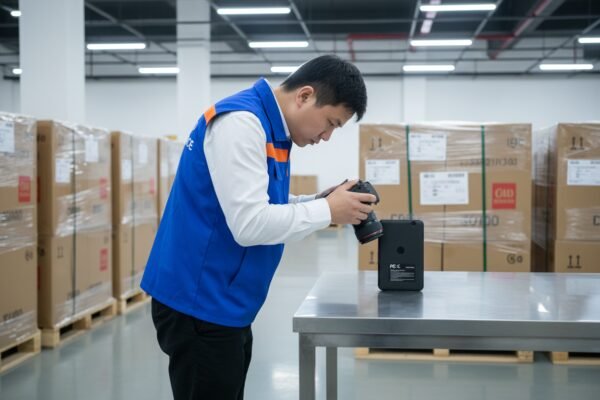
Ensure your sourcing agent physically inspects labels by requiring photographic and video evidence of applied labels during production, conducting AQL-based pre-shipment inspections with a dedicated label accuracy checklist, and mandating that label verification is a pass-or-fail gate before any shipment is released.
The Final Design File Is Your Standard — Not the Email
Here is a personal insight that has saved our clients countless headaches: always use the final label design file as the confirmation standard. Do not just send a Word document to the factory and assume they will get it right. Even if your sourcing agent speaks English fluently, the factory's graphic designer may not. A misread font size, a swapped fiber percentage, a misspelled word — these tiny errors cause real problems at U.S. customs.
Send your agent a print-ready PDF or AI file. Have them confirm receipt. Then have them send you a photo of the first printed sample next to your original file. Side by side. No exceptions.
What to Include in a Label Inspection Checklist
Your agent needs a physical checklist. Not a mental note. A printed, item-by-item checklist they carry onto the factory floor. Here is what it should cover:
| Inspection Item | What to Check | Pass/Fail Criteria |
|---|---|---|
| Text Accuracy | All words, numbers, and symbols match the approved design file | Zero tolerance — any error is a fail |
| Font Size | Minimum 1/6 inch for required disclosures | Measure with a ruler or caliper |
| Label Placement | Correct location on product (e.g., neck label, side seam, bottom of product) | Must match spec sheet |
| Label Attachment | Sewn, glued, or printed — must be permanent and secure | Label must not peel, detach, or fade with normal handling |
| Language | All required text in English | No untranslated text in required fields |
| Country of Origin | "Made in China" clearly visible | Must be legible without disassembly |
| Material Content | Fiber percentages or material descriptions match actual product composition | Cross-reference with test reports |
| Care Symbols | Correct ASTM care symbols if applicable | Must match care instruction sheet |
| RN or Company Info | Manufacturer, importer, or distributor name and address (or FTC RN number) | Must be present and accurate |
Use AQL Sampling — Don't Inspect Every Unit
For large orders, inspecting every single unit is impractical. Use AQL (Acceptable Quality Level) sampling 10. We typically use AQL 1.0 for critical defects like label errors, because a mislabeled product is not just a quality issue — it is a legal issue.
Your agent should pull random samples from finished cartons, not from a pre-arranged display the factory sets up. Real inspections happen on real production floors, not in showrooms.
Require Timestamped Photos and Video
Ask your agent to send timestamped photos of labels on at least 10–15 randomly selected units. Better yet, ask for a short video walkthrough of the inspection process. This creates a compliance record you can refer to if any dispute arises later. We store these photos in a shared cloud folder for every order. If CBP or the FTC ever questions a shipment, we have evidence.
What steps should I take with my agent to guarantee my "Made in China" markings meet US customs and FTC standards?
In our daily operations coordinating between Chinese factories and U.S. importers, "Made in China" markings seem simple. They are not. CBP rejects shipments every week because the marking is too small, placed in the wrong location, printed in a color that blends into the packaging, or applied with ink that rubs off.
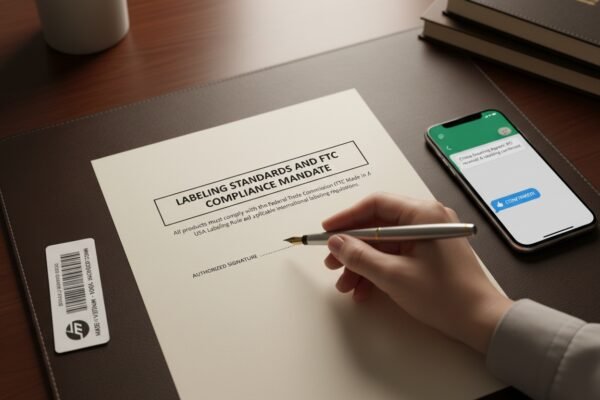
To guarantee your "Made in China" markings meet US customs and FTC standards, work with your agent to specify exact marking placement, size, contrast, and permanence in your purchase order, require the factory to use CBP-compliant methods like engraving, stamping, or permanent ink, and verify compliance through pre-shipment inspection with photographic evidence.
Understanding 19 USC §1304 Requirements
The law is clear. Nearly every article of foreign origin imported into the United States must be marked with its country of origin. The marking must be:
- In English
- Legible
- Permanent (or as permanent as the nature of the product allows)
- Located in a conspicuous place
- Visible to the ultimate purchaser without disassembly
"Conspicuous" is the word that trips people up. It means the buyer should see it without hunting for it. If you bury "Made in China" in tiny gray text on a gray background inside a fold of packaging, CBP will reject it.
Common "Made in China" Marking Failures
Here are the most frequent mistakes we see, and how to prevent them:
| Common Failure | Why It Happens | How to Prevent It |
|---|---|---|
| Text too small | Factory uses default font size without checking CBP specs | Specify minimum 1/6 inch font height in PO |
| Low contrast | Text color blends with product or packaging color | Require contrasting colors (e.g., black text on white background) |
| Label peels off | Adhesive label used instead of permanent marking | Mandate sewn-in labels, engraving, or permanent ink |
| Wrong placement | Label hidden under a flap or inside battery compartment | Specify exact placement location with a diagram |
| Abbreviated text | Factory prints "China" without "Made in" | Provide exact approved text: "Made in China" |
| Missing on inner items | Outer box marked but individual units inside are not | Require marking on each individual product |
The "Substantial Transformation" Complication
If you plan to further process or assemble the product in the U.S., the rules change. Under the substantial transformation doctrine, if a product from China undergoes enough processing in the U.S. to fundamentally change its character, name, or use, it may qualify for a different country-of-origin designation.
But be very careful here. The FTC's "Made in USA" standard is strict. The product must be "all or virtually all" made in the U.S. That means nearly all significant parts, processing, and labor must be domestic. Simply packaging a Chinese product in a U.S. box does not count. Neither does adding a U.S. power cord to a Chinese appliance.
If your product involves multi-country assembly, document everything. Get a CBP ruling if needed. And make sure your agent understands that the labels applied in China may need to reflect the intermediate origin, not the final origin.
Qualified Claims Are Your Safety Net
If your product is partially made in the U.S. and partially in China, use qualified claims. For example:
- "Assembled in USA from imported components"
- "Designed in USA, Made in China"
- "Finished in USA with Chinese materials"
These qualified claims must be truthful. They must not imply full U.S. origin. The FTC has penalized companies for using phrases like "Proudly American" on products with significant Chinese content. Since 2021, penalties can reach $50,120 per violation. In 2024 and 2025 alone, the FTC brought over 20 enforcement actions against e-commerce sellers who falsely claimed U.S. origin for China-sourced products.
Your agent should understand these nuances. If they push back or seem confused, provide them with a written brief. Or bring in a compliance advisor. The cost of a $500 consultation is nothing compared to a six-figure FTC fine.
How can I coordinate with my sourcing agent to manage material content disclosures and care instructions for my imports?
Our team recently managed a shipment of mixed-fiber blankets for a U.S. client. The factory listed the fibers in the wrong order on the label. Under FTC rules, fibers must be listed in descending order by weight. That mistake almost cost the client a CBP hold and forced re-labeling.
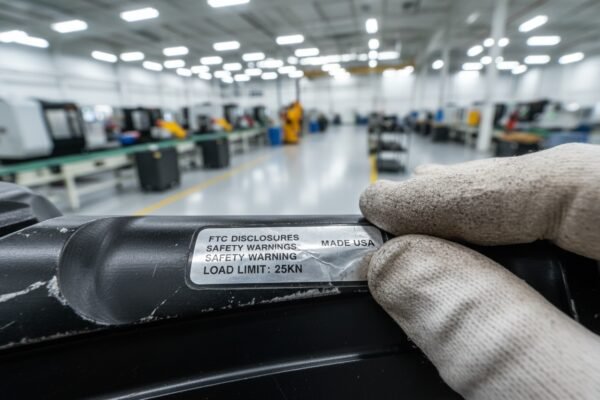
Coordinate with your sourcing agent by providing lab-tested material composition reports, sharing FTC-compliant label templates that list fibers in descending order by weight, specifying ASTM-standard care symbols with written care instructions, and requiring your agent to cross-verify label content against test results during pre-shipment inspection.
Material Content: Get It Tested, Not Guessed
Never rely on the factory's word for material composition. Factories often provide approximate percentages based on what they ordered, not what they actually used. Yarn substitutions happen. Blends shift. The only reliable way to know your material content is through independent lab testing.
Have your agent pull samples from production and send them to an accredited lab — SGS, Bureau Veritas, or Intertek all have offices in China. The lab report becomes your source of truth for the label.
FTC Textile Labeling Requirements
If your product is a textile or apparel item, the FTC requires:
- Generic fiber names listed in descending order by weight percentage
- Percentage by weight of each fiber (must be accurate within a 3% tolerance)
- Manufacturer or dealer identification — either the full company name and address or an FTC-issued RN number
- Country of origin — "Made in China"
- Care instructions — following ASTM D5489 care symbols or written instructions per 16 CFR Part 423
Fibers present at less than 5% must be labeled as "other fiber" unless they serve a specific functional purpose (like 2% spandex for stretch).
Care Instructions: Symbols and Text
The FTC's Care Labeling Rule (16 CFR Part 423) requires that most textile products include care instructions. You can use ASTM care symbols, written instructions, or both. But here is the catch: if you use symbols only, they must conform to ASTM D5489. If a consumer cannot reasonably understand the symbol, you need written text too.
Work with your agent to prepare a care instruction template before production starts. Include:
- Washing method (machine wash, hand wash, dry clean)
- Water temperature
- Drying method
- Ironing instructions
- Bleaching guidance
A Practical Coordination Workflow
Here is how we manage material content and care label coordination with our clients:
Step 1: Client provides target material composition and care requirements.
Step 2: We source fabric samples from the factory and send them to a third-party lab.
Step 3: Lab report comes back. We compare results to the client's intended composition.
Step 4: If there is a discrepancy, we work with the factory to adjust or we update the label to reflect actual composition.
Step 5: We prepare a print-ready label file with correct fiber percentages, care symbols, RN number, and "Made in China" marking.
Step 6: Client approves the label file.
Step 7: We verify the first production sample label against the approved file.
Step 8: During pre-shipment inspection, we re-verify labels on random units.
This process adds a few days to the timeline. But it eliminates the guesswork that leads to non-compliance.
What Happens When You Get Material Content Wrong
The consequences are real. CBP detained approximately 15% of flagged China import shipments in 2025 for labeling or origin issues. The textile label non-compliance rate at U.S. entry points hovers around 25%. If your material content label is wrong, you face:
- CBP detention and examination fees
- Mandatory re-labeling at a bonded warehouse (often $1–3 per unit)
- Potential FTC investigation for deceptive labeling
- Amazon listing suspension if a competitor reports you
- Loss of customer trust
None of these outcomes are worth the savings from skipping a $200 lab test.
Conclusion
Getting FTC labeling right is not glamorous work, but it protects your business from fines, shipment delays, and lost credibility. Your sourcing agent is your first line of defense — equip them with the right tools, checklists, and expectations, and you will clear U.S. customs with confidence.
Footnotes
1. Official FTC legal library entry for the Wool Products Labeling Act. ↩︎
2. FTC provides comprehensive business guidance on labeling and packaging compliance. ↩︎
3. Replaced 403 with a comprehensive article from a reputable law firm explaining CBP detentions and seizures. ↩︎
4. FDA's comprehensive guidance on labeling requirements for various regulated products. ↩︎
5. Official FTC legal library entry for the Textile Fiber Products Identification Act. ↩︎
6. FCC guidance on equipment authorization and identification (FCC ID) markings. ↩︎
7. CPSC official guidance on tracking label requirements for children's products. ↩︎
8. Cornell Law School provides the full legal text of 19 U.S. Code § 1304. ↩︎
9. Cornell Law School provides the full legal text of 16 CFR Part 323, Made in USA Labeling. ↩︎
10. Wikipedia provides a clear explanation of Acceptable Quality Limit (AQL) sampling. ↩︎