
Every week, our team in Shenzhen fields calls from buyers who received bulk shipments that looked nothing like the sample they approved — wrong colors, cheaper materials, sloppy finishing on-site inspections 1. The frustration is real, and the financial damage can be devastating.
To ensure your China sourcing agent samples match bulk order quality, you must establish a signed golden sample as the production benchmark, conduct multi-stage on-site inspections during manufacturing, include enforceable quality clauses in your purchase contract, and implement a systematic plan to prevent quality fade over time.
Below, I break down each of these steps based on what we see working — and failing — across hundreds of orders every year Pre-Production Inspection 2. Let's get into the details.
How do I establish a "Golden Sample" process to ensure my bulk production meets the approved standard?
When we manage production for overseas clients, the single biggest source of disputes is a missing or vague sample agreement. Buyers assume the factory "knows what they want," and factories assume they have flexibility.
A golden sample process starts by creating a physical, signed, and dated reference prototype that both buyer and supplier agree represents the exact standard for mass production — covering materials, dimensions, colors, finishes, and packaging — stored at the factory and with the buyer.
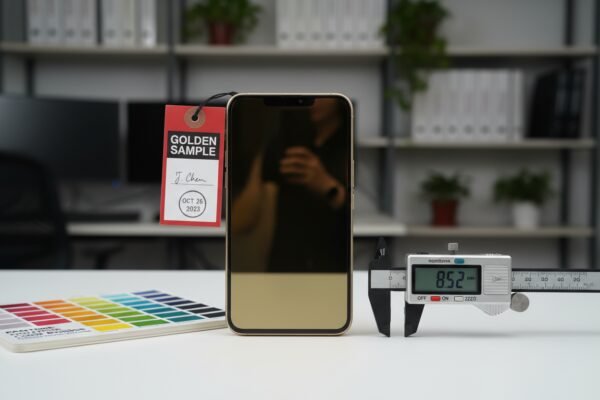
Why a Golden Sample Matters
A golden sample 3 is not just "a sample." It is the legal and operational benchmark for your entire order. Without one, every quality complaint becomes a he-said-she-said argument. The factory points to vague emails. You point to a photo on your phone. Nobody wins.
At our sourcing agency, we require every client to go through at least two rounds of sampling before we lock in the golden sample. The first round identifies gaps. The second round confirms corrections. For complex or custom products (ODM), three rounds is common.
Steps to Build a Golden Sample Process
Here is a clear workflow you can follow:
- Draft a detailed spec sheet. Include materials, Pantone color codes 4, dimensions with tolerances, weight, functionality requirements, and packaging details. One document. Not scattered emails.
- Request the first sample. Evaluate it against your spec sheet 5. Document every deviation — take photos, measure, test.
- Send written feedback. Be specific. "The blue is too dark" is vague. "The blue must match Pantone 2935 C" is actionable.
- Request a corrected sample. Repeat evaluation.
- Approve and sign the golden sample. Both parties sign and date it. Keep one at the factory, one with you, and one with your sourcing agent.
- Attach the spec sheet to your purchase order. This links the golden sample to your contract.
What to Include in Your Golden Sample Package
| Component | Details | Why It Matters |
|---|---|---|
| Physical sample | Signed and dated by buyer + supplier | Serves as the tangible benchmark |
| Spec sheet | Materials, dimensions, colors, tolerances, tests | Eliminates ambiguity |
| Photos & videos | Close-ups of finish, labels, packaging | Backup reference for remote checks |
| Test reports | Lab results for materials, safety, or compliance | Proves material grade used in sample |
| Packaging mock-up | Exact box, insert, label layout | Prevents last-minute packaging surprises |
Common Mistakes to Avoid
Many buyers approve a sample too quickly. They look at the appearance and skip the material verification. Factories know this. Some will use premium-grade material for the sample to impress you, then switch to a cheaper alternative in bulk production. That is why we always recommend requesting a material certificate or third-party lab test 6 alongside the golden sample.
Another mistake: storing only a digital reference. Photos compress colors. Screens vary. A physical golden sample stored at the factory floor — where the production manager can hold it next to a bulk unit — is irreplaceable.
What role should my sourcing agent play in performing on-site inspections against my original sample?
Our inspectors carry the golden sample — physically — onto the factory floor during every check. That simple act changes the dynamic entirely. The factory knows we are comparing, not just glancing.
Your sourcing agent should perform at minimum three on-site inspections — pre-production (material and setup verification), during production (inline checks at 20–30% completion), and pre-shipment (final random inspection using AQL standards) — each time comparing output directly against the approved golden sample.

The Three Inspection Stages
Most buyers only think about inspecting the finished goods. That is too late. If the factory used the wrong material or miscalibrated a mold, you discover the problem after 100% of the goods are already made. Now you face a painful choice: accept the defective goods, negotiate a discount, or reject and delay your timeline by weeks.
Here is what each inspection stage should cover:
Pre-Production Inspection
Your agent visits the factory before mass production begins. They check:
- Raw materials match the spec sheet and golden sample
- Production tooling and molds are correct
- The factory has the golden sample on-site and accessible
- Worker instructions match your requirements
During-Production Inspection (DUPRO)
This happens when roughly 20–30% of production is complete. Your agent pulls units off the line and compares them to the golden sample. They check dimensions, colors, functionality, and workmanship. If there is a deviation, the factory can still correct course. This is the most cost-effective inspection because catching a problem at 20% saves you from scrapping 100%.
From our experience managing orders for US-based SMEs, the during-production check is the single most underused inspection. Most importers skip it to save money. But it is precisely where the biggest saves happen.
Pre-Shipment Inspection (PSI)
When production is 100% complete and at least 80% packed, your agent conducts a final random inspection using AQL (Acceptable Quality Limit) sampling. This is the industry standard. AQL standards 7
AQL Levels Explained
| Defect Type | AQL Level | What It Means |
|---|---|---|
| Critical (safety hazards) | 0% | Zero tolerance. Any critical defect = rejection. |
| Major (functional issues) | 2.5% | Roughly 1–2% defect rate accepted in sample pulled |
| Minor (cosmetic blemishes) | 4.0% | Small imperfections that don't affect function |
When to Increase Inspection Frequency
This is something I feel strongly about: the higher the unit price and the larger the order quantity, the more inspections you need. For high-value products, you may need 100% inspection — every single unit checked. For large-volume orders, two or three inline inspections during production are better than one check at the end.
Think of it this way: a $2 phone case ordered in 5,000 units may justify one PSI. A $50 electronic device ordered in 10,000 units demands pre-production, at least two DUPRO checks, and a thorough PSI.
In-House Agent vs. Third-Party Inspector
Some buyers debate whether their sourcing agent should do inspections or whether they need an independent third party. Both have merits.
Your sourcing agent knows your product history and relationship context. But critics worry about agent-supplier collusion, especially if the agent earns commission from the factory. An independent third-party inspector (like SGS, Bureau Veritas, or a specialized China QC firm) provides unbiased reporting.
Our recommendation: use your sourcing agent for routine inline checks and bring in a third-party for the final PSI on high-value orders. That gives you both relationship continuity and objectivity.
How can I legally bind my Chinese supplier to the quality of the sample in my purchase contract?
We have seen too many importers rely on a WeChat handshake and a proforma invoice as their "contract." When something goes wrong, they have zero legal leverage. A proper purchase agreement changes that equation.
You can legally bind your Chinese supplier by including explicit quality clauses in your purchase contract that reference the signed golden sample by ID number, define measurable acceptance criteria, specify AQL defect thresholds, outline financial penalties for non-conformance, and establish a dispute resolution mechanism under Chinese or international arbitration law.
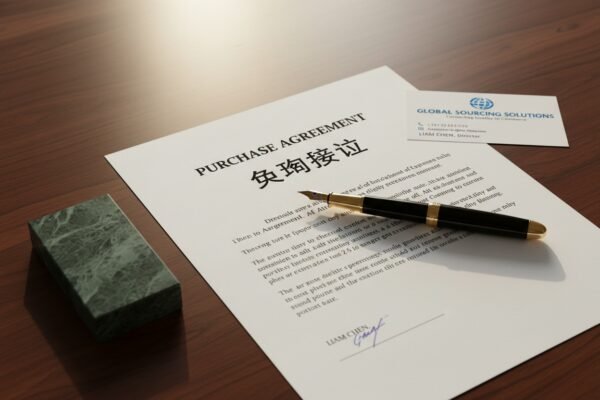
Key Contract Clauses for Quality Protection
A good sourcing agent will help you draft or review a purchase contract that protects your interests. Here are the clauses that matter most:
1. Golden Sample Reference Clause
State clearly: "All goods shall conform to the approved golden sample dated [DATE], signed by [BUYER] and [SUPPLIER], sample ID [NUMBER]." Attach a photo and the spec sheet as appendices to the contract.
2. Quality Standards Clause
Define the acceptance criteria. Do not write "good quality." Write: "AQL 2.5 for major defects, AQL 4.0 for minor defects, 0% critical defects per ANSI/ASQC Z1.4." Specify which tests must be passed (e.g., drop test, salt spray, tensile strength).
3. Penalty and Remedy Clause
State what happens if goods fail inspection. Common options:
- Supplier reworks or replaces defective units at their cost
- Buyer receives a price reduction (e.g., 5–15% discount per failed lot)
- Buyer may reject the entire shipment if defect rate exceeds a stated threshold
4. Inspection Rights Clause
The contract should explicitly grant you (or your agent or third-party inspector) the right to enter the factory and inspect at any stage of production. Some factories resist this. If they do, that is a red flag.
5. Dispute Resolution Clause
This is where many buyers make a critical mistake. If you sign a contract under Chinese law, disputes go to Chinese courts — where a foreign buyer often faces disadvantages. A better option: specify arbitration through CIETAC (China International Economic and Trade Arbitration Commission) or the Hong Kong International Arbitration Centre (HKIAC). Arbitration awards under these bodies are enforceable internationally under the New York Convention 10.
Contract Clause Summary
| Clause | What It Covers | Buyer Benefit |
|---|---|---|
| Golden sample reference | Links contract to physical benchmark | Prevents "we didn't know" defense |
| Quality standards | AQL levels, test requirements | Measurable pass/fail criteria |
| Penalty & remedy | Rework, discount, or rejection rights | Financial protection |
| Inspection rights | Factory access for buyer/agent/third party | Ongoing monitoring authority |
| Dispute resolution | Arbitration body and governing law | Enforceable legal recourse |
Practical Tips
Even the best contract is only useful if you can enforce it. In practice, enforcement in China requires:
- A contract written in both English and Chinese (the Chinese version should govern in case of conflict)
- The supplier's official company chop (red stamp) on the contract — not just a signature
- Retaining 30% of payment until after successful final inspection (this is your most powerful leverage)
Many of our clients use a 30/70 payment structure: 30% deposit before production, 70% balance after PSI passes. This payment leverage is often more effective than any legal clause, because no supplier wants to hold finished goods they cannot sell.
One more insight: do not assume a proforma invoice is a contract. It is not. Invest in a proper purchase agreement. The cost of a bilingual contract reviewed by a trade lawyer is a fraction of what you stand to lose from one bad shipment.
How do I prevent "quality fade" between the initial sample approval and my final shipment?
On our production management team, we have a saying: "The first order is always the best order." That is because factories are eager to impress you initially. By the third or fourth reorder, corners start getting cut. Quality fade is real, and it is gradual enough that you may not notice until customers start complaining.
Preventing quality fade requires continuous vigilance: conduct inspections on every order (not just the first), periodically re-test materials against original certifications, rotate third-party inspectors to prevent complacency, maintain your golden sample as the active benchmark, and never reduce oversight simply because past orders were satisfactory.

What Causes Quality Fade?
Quality fade happens when a supplier gradually reduces production costs — without telling you. Common tactics include:
- Material substitution: Switching to a cheaper grade of plastic, fabric, or metal
- Process shortcuts: Skipping a coating step, reducing curing time, or lowering heat-treatment temperature
- Labor changes: Moving your order from skilled workers to less experienced ones, or subcontracting to a cheaper facility
- Tooling wear: Molds degrade over time, producing parts with less precision
The problem is subtle. Each shipment may look "almost" the same. But over six months, the cumulative degradation becomes noticeable to your end customers — and that is when returns, negative reviews, and brand damage hit.
A Framework to Fight Quality Fade
Keep the Golden Sample Active
Do not file your golden sample in a drawer after the first order. Bring it to every inspection. Compare it side-by-side with current production units. If the golden sample degrades (colors fade, material deteriorates), create a refreshed golden sample and re-sign it with the supplier.
Randomize and Rotate Inspectors
If the same inspector visits the same factory every time, relationships form. The inspector may unconsciously (or consciously) become more lenient. Rotate inspectors periodically. Use a different third-party firm for every second or third order. This keeps the factory alert.
Re-Test Materials Periodically
Request material certificates not just for the first order, but for every order. Periodically send raw material samples to an independent lab for verification. This is especially important for orders involving safety-critical components, electronics, or food-contact materials.
Build a Quality Trend Tracker
Create a simple spreadsheet that logs defect rates, inspection results, and any deviations for each order. Over time, this data reveals patterns. If minor defects creep up from 1% to 2% to 3%, you have early warning before a major failure.
| Order # | Date | Defect Rate (Major) | Defect Rate (Minor) | Material Verified? | Notes |
|---|---|---|---|---|---|
| 1 | Jan 2025 | 0.5% | 1.2% | Yes | First order, excellent |
| 2 | Apr 2025 | 0.8% | 1.8% | Yes | Slight uptick in minor |
| 3 | Jul 2025 | 1.5% | 3.1% | No | Material cert not provided — flag |
| 4 | Oct 2025 | 2.4% | 4.2% | Yes — failed lab test | Quality fade confirmed |
This table tells a story. By Order 3, the warning signs were there. By Order 4, the buyer has data to confront the supplier with evidence, not emotion.
Never Relax Oversight After Good Orders
This is the trap. Your first three orders arrive perfect. You think, "This factory is reliable. I can skip the DUPRO on the next one." The factory notices. And that is exactly when shortcuts begin. Treat every order as if it is your first. The cost of an inspection is tiny compared to the cost of a rejected shipment or a wave of customer returns.
The Role of Your Sourcing Agent in Long-Term Quality
A good sourcing agent does not just find you a factory and disappear. They serve as your ongoing quality watchdog. At Go Source, we maintain a supplier scorecard for every factory we work with. If a factory's score drops, we escalate the issue to the buyer immediately and recommend corrective action — or a factory switch if the pattern is irreversible.
Your agent should also keep up with industry trends. In 2025, we are seeing increased use of AI-powered visual inspection tools that can catch defects human inspectors miss — inconsistencies in color, surface finish, and dimensional accuracy. While these tools are still emerging, forward-thinking sourcing agents are already integrating digital inspection reports with photo and video evidence that buyers can review remotely.
Another trend: diversification. Some buyers are moving portions of their supply chain to Southeast Asia (Vietnam, Thailand, Cambodia) as a hedge against China-specific risks. A good sourcing agent helps you evaluate whether diversification makes sense for your product category and volume.
Conclusion
Matching sample quality to bulk production is not a one-time event — it is a continuous discipline that spans golden sample creation, multi-stage inspections, enforceable contracts, and long-term quality fade prevention. Stay vigilant on every order, and your supply chain will reward you.
Want to see this in person? The gap between a sample and a bulk order is far easier to close before you place the order, on site. If you are coming to China, we run a one-day Shenzhen sourcing tour: we visit shortlisted suppliers together, check the things a report cannot capture, and you leave with a written plan.
Footnotes
1. Defines the practice of physical inspections in manufacturing and quality control. ↩︎
2. Details the purpose and checks of pre-production inspections in manufacturing. ↩︎
3. Explains the concept of a golden sample in manufacturing quality control. ↩︎
4. Offers an overview of Pantone and its widely used color matching system. ↩︎
5. Provides a definition and importance of a specification sheet in product development. ↩︎
6. Highlights the role of independent testing for material verification and product safety. ↩︎
7. Explains the Acceptable Quality Limit (AQL) sampling method for quality inspection. ↩︎
8. Clear definition of During Production Inspection (DUPRO) and its importance in manufacturing quality control. ↩︎
9. Explains the final quality check before goods are shipped to ensure compliance. ↩︎
10. Provides context for international arbitration enforcement and recognition of awards. ↩︎