
You approve a perfect gold sample, but the shipping container arrives with low-quality substitutes XRF scanners 1. We see this heartbreak often on our production lines when oversight fails. It is a costly nightmare.
A China sourcing agent ensures mass production matches your sample through multi-stage on-site inspections at 30%, 60%, and 100% completion. They physically verify raw materials, monitor assembly line consistency, and use "golden samples" as the absolute quality benchmark to prevent any material substitutions or deviations.
Detailed supervision is the only way to protect your brand Bill of Materials (BOM) 2. Let's look at how we manage these specific checks.
How can I be sure that my final mass production run matches the exact specs of my approved sample?
When we calibrate our flight controllers or test beauty tools, we know that mass production introduces variables that a single handmade sample does not face. Consistency requires constant physical presence.
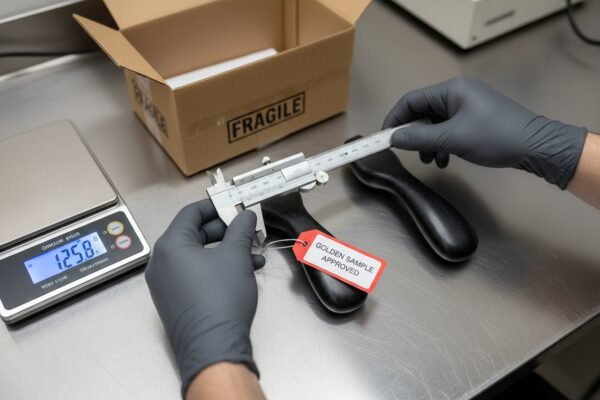
To ensure mass production matches your sample, sourcing agents use the "Golden Sample" method. They lock this approved unit in a sealed box at the factory, comparing it against random units from the line to verify dimensions, weight, and functionality.
Ensuring a match between a prototype and 5,000 units is a technical challenge. In our factory experience, the "quality fade 3" usually starts when the manufacturer tries to scale up. A sourcing agent acts as your eyes. They don't just look at the finished product; they audit the setup.
The Power of the Golden Sample
The golden sample 4 is the version you approved. Our teams ensure this sample is signed, dated, and kept on-site. During mass production, the agent pulls a unit from the assembly line and places it side-by-side with the golden sample. They check for color matching using Pantone guides 5 and verify weight using precision scales. If the mass-produced item is even 5 grams lighter, it suggests the factory used thinner plastic or cheaper internal components.
Implementation of AQL Standards
We use the Acceptable Quality Limit (AQL) 6 to determine if a batch passes. This is a statistical tool that defines how many defects are allowed before a batch is rejected.
| Inspection Level | Sample Size (for 3,000 units) | Critical Defects Allowed | Major Defects Allowed | Minor Defects Allowed |
|---|---|---|---|---|
| Level II (Standard) | 125 units | 0 | 5 | 10 |
| Level III (Strict) | 200 units | 0 | 7 | 14 |
Scaling Issues and Technical Drift
Factories often use different machines for mass production than they do for samples. A sample might be 3D printed or CNC machined, while the mass run is injection molded 7. Our agents check the molds and the cooling times. If the factory speeds up the cycle to save money, the parts might warp. On-site supervision catches these technical drifts before the whole batch is ruined.
What specific checks will my sourcing agent perform on-site to ensure material consistency?
In our experience exporting to the US, we have seen suppliers swap high-grade aluminum for cheaper alloys to save 5%. We prevent this by testing raw materials the moment they arrive.
Sourcing agents perform material consistency checks by verifying raw material invoices, conducting "drop tests" or "stress tests," and using XRF scanners to check metal purity or chemical composition against the original Bill of Materials (BOM).
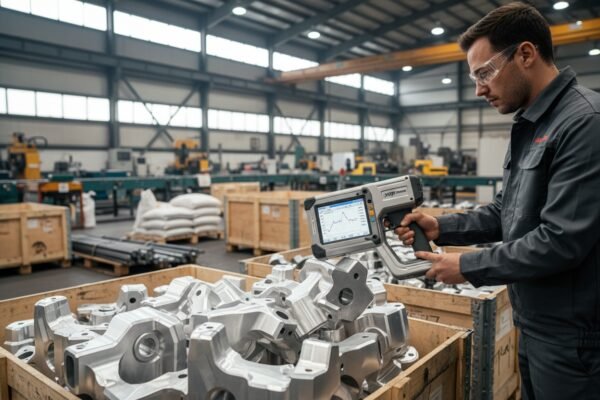
Material substitution is the most common way for a factory to increase its profit margin at your expense. If your product is a consumer electronic device, the plastic casing must be fire-retardant. If it is a toy, it must be non-toxic.
Verification of the Bill of Materials (BOM)
A professional agent starts by reviewing the factory's purchasing records. They check if the factory actually bought the brand-name components specified in your contract. For example, if we specify Samsung battery cells for a power bank, the agent checks the warehouse for those specific boxes before they are installed.
Destructive and Non-Destructive Testing
On-site, we perform several physical checks:
- The Smell Test: Cheap recycled plastics often have a strong chemical odor compared to virgin materials.
- The Burn Test: Small shavings of fabric or plastic are burned to check for specific smoke colors and smells, confirming material type.
- The Tension Test: For textiles and apparel, agents pull seams to ensure the thread strength matches the sample.
Component Comparison Table
We often use a checklist to compare the mass production inputs against the sample inputs to ensure total alignment.
| Component Category | Sample Specification | Mass Production Reality | Verification Method |
|---|---|---|---|
| Primary Material | Grade 304 Stainless Steel | Grade 304 Stainless Steel | Chemical reagent test |
| Surface Coating | Powder Coated (Matte) | Powder Coated (Matte) | Scratch and salt spray test |
| Internal Chips | Brand Name (STMicro) | Brand Name (STMicro) | Visual SKU verification |
| Packaging | 350gsm Corrugated Box | 350gsm Corrugated Box | Digital caliper thickness test |
Critical thinking is required here. A factory might use the correct material but a different "batch" that has a different moisture content or color shade. On-site agents catch these subtle shifts that a photo sent over WhatsApp would never reveal.
How does having my agent on the factory floor prevent the manufacturer from cutting corners?
Our engineers have found that production speed is the enemy of quality. When a factory falls behind schedule, they skip the "boring" steps like drying or final polishing. On-site presence stops this.
On-site agents prevent corner-cutting by performing "During Production" (DUPRO) inspections. This forces factory workers to follow the agreed-upon SOPs, as they know an external supervisor is watching the assembly line for skipped steps.

The psychology of the factory floor is simple: if no one is watching, they will take the path of least resistance. This is not necessarily malicious; it is often just a result of high-pressure production quotas.
Monitoring the Standard Operating Procedure (SOP)
In our workflow, we review the factory's own internal QC process first. Often, their internal QC is biased or rushed. An agent stands at the end of the line and performs their own independent check. If they see a worker skipping a screw or failing to clean a smudge, they stop the line immediately. This "real-time correction" is vital.
Preventing "Quality Fade"
Quality fade is the slow degradation of quality over time. The first 500 units might be great, but by unit 5,000, the tools are worn out or the workers are tired.
- 30% Production Mark: The agent checks the first batch to ensure the machinery is set up correctly.
- 60% Production Mark: The agent checks for consistency and ensures the rejected units are actually being discarded, not snuck back into the "good" pile.
- 100% Production Mark: Final count and packaging check.
Comparison of Oversight Methods
Different levels of oversight provide different levels of security for your investment.
| Feature | Remote Management | Third-Party Inspector (1 Day) | Dedicated Sourcing Agent |
|---|---|---|---|
| Cost | Low | Moderate | Commission-based |
| Depth of Relationship | None | Transactional | High / Partnership |
| Process Correction | After the fact | Post-production only | Real-time on the floor |
| Negotiation Power | Very Low | None | High (holds the payment) |
By being physically present, the agent builds a rapport with the floor manager. They can explain why a certain detail matters to the US market, which helps the workers take more pride in the output.
Can real-time supervision help me avoid the communication gaps and delays that hurt my business?
During our R&D phases, we realized that 90% of delays are caused by "silent" problems the factory is afraid to report. An agent uncovers these secrets before they become catastrophes.
Real-time supervision eliminates communication gaps by providing an instant, unbiased feedback loop. Agents identify production bottlenecks or material shortages immediately and communicate them to you via video calls, preventing the "hidden" delays factories usually hide.

Communication in international trade is often hindered by the "Yes Culture." Many factory managers will say "Yes, no problem" even when there is a major problem, simply to save face. A sourcing agent knows how to read between the lines.
Bridging the Language and Culture Gap
When a technical issue arises—for example, a circuit board failing a heat test—the factory might try to fix it using a "quick patch" that doesn't meet Western standards. An agent who speaks the local dialect can talk directly to the engineers. They can explain your specific quality requirements in a way the factory understands, ensuring nothing is "lost in translation."
Real-Time Reporting Tools
Modern sourcing agents use technology to keep you in the loop. This includes:
- Live Video Walkthroughs: You can see your products moving on the belt from your office in New York or Berlin.
- Daily Status Reports: Instead of waiting weeks, you get a daily update on how many units were completed and what the defect rate was.
- Digital Dashboards: Some agencies provide apps that track your production timeline against the original schedule.
Risk Mitigation Strategies
An agent doesn't just report problems; they solve them. If a specific component is delayed, the agent can use their network to find an alternative supplier in China immediately, rather than waiting for the factory to eventually give up and tell you three weeks later. This proactive approach saves your product launch date.
Conclusion
On-site supervision by a China sourcing agent is the only way to ensure mass production matches your sample. By catching issues early, you protect your profit and your brand's reputation.
Want to see this in person? This is exactly the kind of check that only really works in person. If you are coming to China, we run a one-day Shenzhen sourcing tour: we visit shortlisted suppliers together, check the things a report cannot capture, and you leave with a written plan.
Footnotes
1. Describes XRF analyzers and their application in non-destructive material analysis. ↩︎
2. Defines Bill of Materials and its importance in manufacturing and supply chain management. ↩︎
3. Defines quality fade in manufacturing and its causes and consequences. ↩︎
4. Explains the role and importance of a golden sample in manufacturing quality control. ↩︎
5. Official source for Pantone color standards, essential for accurate color matching. ↩︎
6. Details the AQL standard used in quality control inspections for product batches. ↩︎
7. Replaced with a Wikipedia link for a comprehensive and authoritative explanation of 'injection molding'. ↩︎