In our daily operations here in Shenzhen, we frequently encounter international clients who have been burned by "ghost" agents. Nothing is more frustrating than discovering your partner doesn't actually exist after you have sent a deposit. We treat verification as the first line of defense in our own procurement processes 1 to protect our supply chain.
To verify a China sourcing agent's business license, you must request a high-resolution scan of their "Yíng yè zhí zhào" and cross-reference the 18-digit Unified Social Credit Code (USCC) on the official National Enterprise Credit Information Publicity System (NECIPS). This confirms their legal status, registered capital, and approved business scope.
Here are the specific steps and databases you need to ensure your partner is legitimate.
Where can I find the official database to check my sourcing agent's business license?
We know how confusing Chinese government websites can be for our overseas partners. When we vet new suppliers for our own production needs, we rely on specific official portals that provide real-time data on legal standing.
The primary official database is the National Enterprise Credit Information Publicity System (NECIPS), accessible at gsxt.gov.cn. This government-run platform allows you to search using the agent's Chinese name or their Unified Social Credit Code to view their registration status, penalties, and operational anomalies directly from the State Administration for Market Regulation.
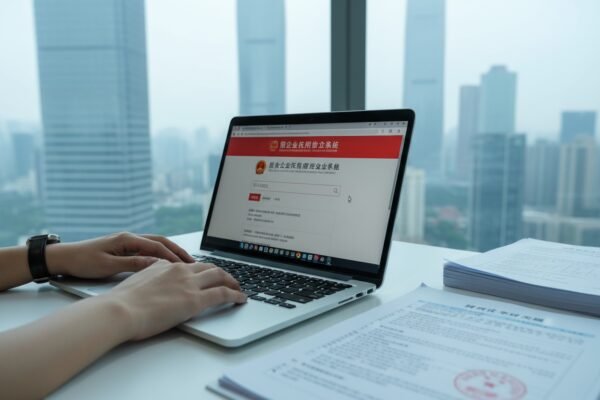
Accessing the truth about a company in China requires knowing exactly where to look. The National Enterprise Credit Information Publicity System (NECIPS) is the gold standard. It is the equivalent of the Better Business Bureau combined with a Secretary of State corporate registry in the US, but it is run directly by the Chinese government.
However, navigating this system presents challenges for non-Chinese speakers. The entire interface is in Mandarin. While browser translation tools help, they often struggle with technical legal terms. When we assist our clients, we start by obtaining the exact Chinese name of the company. The English name you see on a website is often just for marketing; the Chinese name is the only legal identifier.
If the official government site is too slow or difficult to navigate, several third-party platforms aggregate this data. These platforms pull directly from NECIPS but offer better user interfaces and sometimes English support.
Comparing Verification Platforms
Different platforms serve different needs. While NECIPS is the official source, others might offer more user-friendly insights into a company's litigation history or relationships.
| Platform Name | Type | Best For | Language Support |
|---|---|---|---|
| NECIPS (gsxt.gov.cn) | Official Government Database | The ultimate legal truth. Verifying current status and government blacklisting. | Chinese Only |
| Qichacha (QCC) | Third-Party Aggregator | detailed background checks, relationship mapping, and lawsuit history. | Chinese (some English reports paid) |
| Tianyancha | Third-Party Aggregator | Visualizing corporate structures and investment relationships. | Chinese Only |
| Global Sources / Alibaba | B2B Marketplaces | Basic verification of existence, but less detailed than government records. | English |
Steps to Perform a Search
- Get the USCC: Ask your agent for their 18-digit Unified Social Credit Code. This is unique to them.
- Access the Site: Go to
gsxt.gov.cn. - Bypass Security: You will likely face a sliding puzzle or character selection CAPTCHA. This is often the hardest part for overseas users.
- Review the Status: Look for the status "存续" (Cúnxù), which means "Existing" or "Active." If you see "注销" (Zhùxiāo), the company is deregistered.
Using these tools removes the guesswork. You are not relying on a PDF sent by email, which can be photoshopped. You are looking at the live government record.
What key details should I look for to ensure my agent's license is authentic?
Our team has reviewed hundreds of supplier documents, and we can spot a fake from a mile away. Often, the inconsistencies are subtle details that a standard background check might miss if you don't know what specific fields matter.
You must verify that the 18-digit USCC matches the database record and check that the "Legal Representative" name matches the ID of the person signing your contract. Additionally, ensure the "Registered Capital" is substantial enough to support their business claims and that the "Establishment Date" aligns with their stated experience.
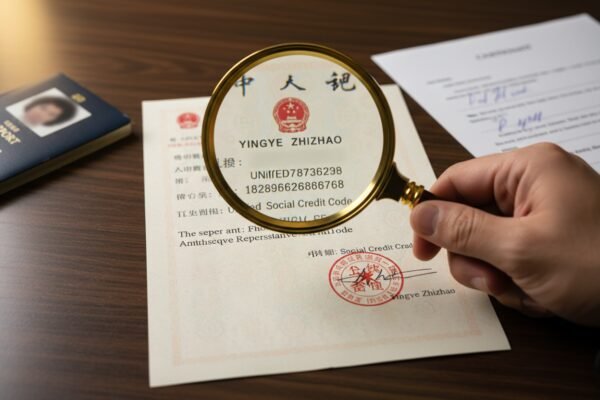
A business license in China (the Yíng yè zhí zhào) is a standardized document. It contains specific fields that tell you the story of the company. When you receive a scan from an agent, you should not just file it away. You need to read it and compare it against the data you found in the NECIPS database.
The Unified Social Credit Code (USCC)
This is the most critical number. It consists of 18 digits.
- First digit: Registration authority (usually 9 for AIC).
- Second digit: Entity type (1 for enterprise, 2 for individual, etc.).
- Digits 3-8: Region code (identifies the province and city).
- Digits 9-17: Organization code.
- Digit 18: Check digit.
If the code on the paper doesn't match the database, or if the region code doesn't match their address, you are dealing with a fraud.
Registered Capital
This figure indicates the liability the shareholders are willing to take. While China moved to a "subscribed capital" system (meaning they don't have to put all cash in immediately), a very low registered capital (e.g., 30,000 RMB) for a sourcing agent claiming to handle million-dollar orders is a massive red flag. subscribed capital system 2 It suggests they have very little to lose if they disappear with your money.
Decoding the License Fields
To help you audit the document, here is a breakdown of the fields you will see on the license.
| Field (Chinese) | Field (English) | What to Look For |
|---|---|---|
| 统一社会信用代码 | Unified Social Credit Code | Must be 18 digits. Unique identifier. |
| 名称 | Company Name | Must match the bank account name exactly. |
| 类型 | Type of Enterprise | "Limited Liability Company" is standard. Avoid "Individual Business" for large orders. |
| 法定代表人 | Legal Representative | This person has the power to sign contracts. If someone else signs, they need a Power of Attorney 3. |
| 成立日期 | Establishment Date | Older companies generally imply more stability. |
| 住所 | Address | Check this on Baidu Maps. Is it an office building or a residential apartment? |
Address Verification
We always recommend checking the address listed under "住所". Legitimate sourcing agencies operate from commercial office buildings. If the address points to a residential complex or a remote village, proceed with extreme caution. We have visited "offices" that turned out to be private apartments, which usually indicates a lack of permanent staff or infrastructure.
How do I translate and understand the business scope on a Chinese license?
We often see clients get excited about a "manufacturer" who turns out to be a trading company upon closer inspection of their documents. We believe in transparency, so we always clarify our role, but many agents hide behind translation errors.
To understand the business scope, look for the "经营范围" section on the license and use translation tools or a professional service to identify keywords like "Manufacturing" (制造/生产) versus "Wholesale/Retail" (批发/零售). A legitimate sourcing agent must have "Import and Export" (货物或技术进出口) listed to legally ship goods out of China.

The "Business Scope" (经营范围) is often the longest paragraph on the license. It strictly defines what a company is legally allowed to do. In China, a company cannot simply operate outside its registered scope. If they do, contracts involving those activities can be considered invalid in court.
Distinguishing Traders from Factories
This is the most common confusion.
- Factory: Look for words like "Production" (生产), "Manufacturing" (制造), or "Processing" (加工). If these words are absent, they are legally just a trading company, regardless of what their website says.
- Sourcing Agent: A sourcing agent should have a scope that includes "Supply Chain Management" (供应链管理), "Consulting" (咨询), and crucially, "Import and Export of Goods and Technology" (货物或技术进出口).
Why Import/Export Rights Matter
Not every company in China can export. A factory might be great at making products but lack the license to export them. In that case, they must use an export agent. If your sourcing agent claims they will handle shipping but lacks "Import/Export" in their scope, they are likely outsourcing the logistics to a third party, which adds a layer of cost and risk you might not be aware of. Import and Export 4
Keywords to Watch For
We have compiled a list of common terms found in business scopes to help you interpret the text.
| Chinese Keyword | English Meaning | Implication |
|---|---|---|
| 生产 / 制造 | Production / Manufacturing | The company is a factory with production capabilities. |
| 批发 / 零售 | Wholesale / Retail | The company is a trader or distributor. |
| 进出口 | Import / Export | The company has the right to handle customs directly. |
| 电子产品 | Electronic Products | Specifies the category of goods they can handle. |
| 商务咨询 | Business Consulting | Common for service-based sourcing agents. |
Using Technology for Translation
You don't need to learn Mandarin to do a preliminary check. Apps like Google Lens 5 or WeChat's "Scan" feature allow you to point your camera at the paper document and get an instant translation. While the grammar might be rough, the key nouns like "Production" or "Retail" will be clear. However, for high-stakes contracts, we always recommend hiring a third-party verification service to provide a certified translation.
Why should I verify my sourcing agent's legal standing before making a payment?
In our years of exporting to the US and Europe, we have seen the devastating impact of financial fraud on small businesses. We treat every transaction with the utmost care, but we know not everyone shares our standards.
Verifying legal standing is essential because it confirms the agent is a real entity subject to Chinese law, ensuring you have legal recourse in case of disputes. It filters out scammers who collect deposits and vanish, and it protects you from operational risks like customs seizures due to an agent's lack of proper export licensing.

Verification is not just about ticking a box; it is about risk management. The barrier to entry for creating a website and claiming to be a "top sourcing agent" is incredibly low. A verified business license is the first hurdle that separates legitimate businesses from opportunists.
Financial Safety
The most immediate risk is financial loss. If you send money to a personal bank account or a company that doesn't match the business license, you are effectively gifting money to a stranger. In China, strict foreign exchange controls 6 mean that legitimate B2B payments must go to a company's official USD account. This account can only be opened by a company with a valid business license. If an agent asks for Western Union or a personal PayPal transfer for a large order, they are likely trying to bypass corporate accountability.
Legal Recourse and Accountability
If a dispute arises—say, the goods are defective or never arrive—you need a legal entity to sue or file a complaint against.
- Registered Entity: You can report them to the local Administration for Market Regulation (AMR) 7 or file a lawsuit in China.
- Unregistered Entity: You have no one to sue. The police will struggle to help you because it becomes a complex fraud case rather than a commercial dispute.
Protecting Your Supply Chain
Your sourcing agent is the bridge to your products. If they are shut down by the government for illegal operations (e.g., tax evasion or smuggling), your goods could be seized, and your supply chain severed. We ensure our operations are fully compliant so our clients never face these disruptions. Verifying your agent ensures they are playing by the rules, which secures the longevity of your business.
The "Chop" Verification
Finally, verifying the license helps you verify the contract. The official company seal 8 (the red circular "chop") must match the registered Chinese name on the license exactly. If the names differ by even one character, the contract is invalid. By holding the license copy, you can audit every contract they sign.
Conclusion
Verifying a China sourcing agent's business license is the single most effective step you can take to secure your international procurement. By cross-referencing the 18-digit USCC on the official NECIPS database, auditing the business scope for relevant permissions, and confirming the consistency of their registered details, you build a foundation of trust. Don't leave your capital at risk—treat due diligence as an investment, not a cost.
Footnotes
1. Explains the definition and importance of procurement processes. ↩︎
2. Explains China's new rules and requirements for subscribed capital contributions. ↩︎
3. Defines Power of Attorney and its legal implications. ↩︎
4. Outlines China's import regulations and categories of goods. ↩︎
5. Describes Google Lens's features for visual search and translation. ↩︎
6. Replaced HTTP 404 link with an authoritative article on China's foreign exchange controls from a U.S. government source (Privacy Shield). ↩︎
7. Provides an overview of SAMR's responsibilities and functions in China. ↩︎
8. Explains the legal significance and function of China's company seal. ↩︎