
When we first started helping overseas brands source from Chinese factories, one conversation kept coming back to haunt us transparent pricing structure 1. A client discovered their previous agent had been adding a 20% hidden markup on every single product — buried inside the unit price where no one would notice. That moment of broken trust cost the agent a six-figure annual account. It taught us early on that hiding fees is a short-term game with long-term consequences.
To create a transparent pricing structure as a China sourcing agent, you should choose a clear fee model like commission-based or hybrid, provide itemized cost breakdowns with direct factory invoices, separate your service fees from product costs, and present variable expenses like shipping and inspections with real-time quotes and documented receipts.
In this guide, I'll walk you through the exact steps we use at Go Source to keep our pricing open, honest, and easy for clients to verify. Whether you're an importer evaluating agents or an agent looking to build lasting partnerships, these principles apply directly.
Which sourcing fee model should I choose to balance my profit with client transparency?
Over the years, our team has tested every fee model out there — from flat retainers to pure commission structures. Each time a new client asks us "how do you charge?", the answer has evolved based on hard-earned lessons from real projects.
The best sourcing fee model for balancing profit with transparency is typically a commission-based structure of 5–10% of order value, or a hybrid model combining a small upfront flat fee with a lower commission rate. Both allow agents to earn fairly while giving clients clear, verifiable costs.

Understanding the Four Main Fee Models
There are four common pricing models in the China sourcing industry. Each has clear strengths and weaknesses. Let me break them down.
1. Commission-Based Model. This is the most widely adopted model among professional sourcing agents. You charge a percentage of the total order value — typically between 3% and 10%. The advantage is simple: your income is directly tied to the client's purchasing activity. If the client buys more, you earn more. This aligns your interests. You are motivated to find the best factory price because your commission is calculated on that number.
2. Flat Fee Model. You charge a fixed amount — say $500 to $1,000 — for a defined scope of work. This works well for large, consistent orders where the client wants cost predictability. The downside? Once the flat fee is paid, the agent's motivation to go above and beyond can drop.
3. Hybrid Model. This combines an upfront flat fee for initial work (like supplier research and factory audits 2) with a smaller ongoing commission for production management and shipping coordination. hybrid model 3 We've found this model works best for complex projects such as custom product development.
4. "Free" Sourcing Model. Some agents claim to charge nothing. This should be a red flag. These agents typically receive kickbacks from factories — sometimes 10% to 30% added to your unit price — creating a direct conflict of interest. They will steer you to factories that pay them the highest commission, not factories that offer the best quality or price for you.
Fee Model Comparison Table
| Fee Model | Typical Rate | Best For | Transparency Level | Risk to Client |
|---|---|---|---|---|
| Commission-Based | 3–10% of order value | Small to medium ongoing orders | High | Low — if invoiced separately |
| Flat Fee | $500–$1,000 per project | Large, consistent orders | High | Medium — agent may lack motivation |
| Hybrid | Upfront fee + 3–5% commission | Complex or new product development | High | Low — balanced incentive |
| "Free" Sourcing | $0 visible | Beginners attracted by zero cost | Very Low | Very High — hidden markups |
How We Chose Our Model
At Go Source, we primarily use the commission-based model 4 with tiered rates. For a $10,000 order, our rate might be 7%. For a $100,000 order, it drops to around 4%. This rewards loyal, high-volume clients and keeps our incentives aligned. For new product development projects that require heavy upfront research, we sometimes switch to a hybrid approach — charging a small project fee to cover sourcing and sampling, then transitioning to a standard commission once production begins.
The key takeaway? Whichever model you choose, the fee must be openly stated, separately invoiced, and never hidden inside the product price. 光明正大收取服务费 — charge your service fee openly and with confidence. There is no need to bury what you rightfully earn inside the product price or logistics costs. Doing so harms your relationships with both suppliers and freight forwarder 5s.
Scaling Your Rates With Volume
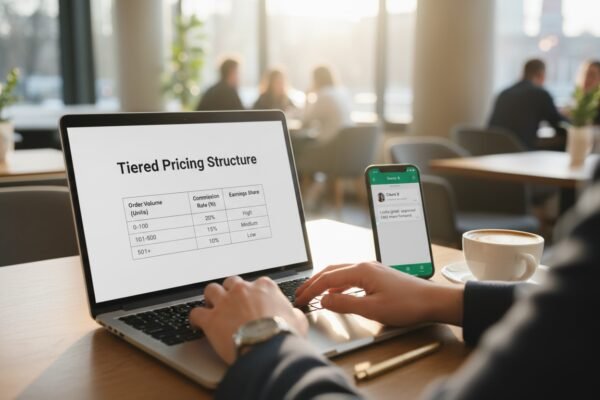
A smart approach is to publish tiered rates. This gives clients a clear path to lower costs as they grow.
| Annual Order Volume | Commission Rate |
|---|---|
| Under $10,000 | 7–10% |
| $10,000 – $50,000 | 5–7% |
| $50,000 – $100,000 | 4–5% |
| Over $100,000 | 3–4% (negotiable) |
This transparency builds trust immediately. The client can see exactly how the relationship benefits them over time.
When we prepare quotes for clients like Youssef — a CEO who values honesty and rigorous quality control — we know a vague number on a single-line invoice won't cut it. He wants to see every dollar accounted for. And frankly, every client deserves that level of detail.
To prove you're not adding hidden margins, provide an itemized cost breakdown showing the original factory price, your clearly stated service fee, and all third-party costs like inspection and shipping — backed by direct factory invoices and freight forwarder receipts that clients can independently verify.

The Open-Book Approach
The most powerful transparency tool we use is what the industry calls "open-book accounting 7." This means the client sees everything: the original factory quotation, our negotiation notes, the final agreed price, and our service fee calculated on top. Nothing is bundled. Nothing is hidden.
Here's how it works in practice. When we source a product, we share the factory's original quote directly with the client. We then show our negotiated price. The client pays the factory directly for the goods. Our service fee is invoiced separately. This separation is critical. When money flows directly from the client to the factory, there is no room for hidden markups.
What a Transparent Cost Breakdown Looks Like
Let me show you a real-world example of how we structure a cost breakdown for a $15,000 order.
| Cost Item | Amount | Paid To | Verification Method |
|---|---|---|---|
| Product cost (factory price) | $12,500 | Factory directly | Factory invoice + PI |
| Go Source service fee (6%) | $750 | Go Source | Service agreement |
| Sample costs | $150 | Factory directly | Sample invoice |
| Factory audit | $300 | Third-party inspector | Inspection report |
| Quality inspection 8 (pre-shipment) | $280 | Third-party QC firm | QC report with photos |
| Domestic freight (factory to port) | $200 | Freight forwarder | Forwarder receipt |
| Ocean freight (FOB to destination) | $650 | Freight forwarder | Bill of lading |
| Customs documentation | $170 | Customs broker | Broker invoice |
| Total | $15,000 |
Every single line item has a clear payee and a verification method. The client can cross-check any number independently.
Key Principles for Your Breakdown
Separate product cost from service fees. Never combine them. The moment you bundle your commission into the unit price, you create suspicion.
Use third-party verification. Factory audit reports, QC inspection certificates, and freight forwarder bills of lading are independent documents. They prove the costs are real.
Share original supplier quotations. Give clients access to the factory's proforma invoice. If your negotiated price is lower, show the savings. This demonstrates your value without you having to say a word.
Put it in writing. Every project should start with a written agreement that spells out the fee structure, payment terms, inclusions, and exclusions. Vague contracts are the number one red flag for importers evaluating agents. If an agent can't clearly define what's included, walk away.
What to Watch For as a Client
If you're a buyer evaluating a sourcing agent, ask these questions: Can I pay the factory directly? Will you share the original factory quote? Is your fee invoiced separately? If the answer to any of these is no, you're likely dealing with hidden margins.
One of our clients came to us after an independent audit revealed their previous agent had been overcharging by 20% on every order for two years. By switching to our open-book model, they saved 18% on their very first order. That's not a marketing claim — it's a documented case that reinforces why transparency isn't just ethical. It's profitable for both sides.
How can I explain my service value so my clients understand exactly what they are paying for?
In our daily work managing production for brands across the US, Germany, and Australia, we've noticed that the hardest part of pricing isn't setting the number — it's communicating the value behind it. Many clients initially see a 6% commission and wonder if it's worth it. Until they experience what happens without it.
To help clients understand your service value, clearly map every task you perform — supplier vetting, price negotiation, factory audits, production monitoring, quality inspection, and logistics coordination — to specific outcomes like cost savings, risk reduction, and time saved, so each dollar of your fee is tied to a measurable benefit.
Why Value Communication Matters More Than Price
Here's a truth we've learned from years of working with founders and purchasing managers: price objections almost always stem from unclear value, not from the actual cost. When a client sees "6% service fee" with no context, they compare it to zero. When they see a list of 15 tasks you perform on every order — each one preventing a specific problem — suddenly 6% looks like a bargain.
The key is to stop selling a percentage and start selling outcomes.
Breaking Down Your Service Scope
Every sourcing agent's fee covers a bundle of services. The problem is that most agents never unbundle it for their clients. Here is how we present our service scope at Go Source:
Phase 1: Supplier Identification. We search our database, attend trade fairs, and contact 20–50 potential factories for each product. We verify business licenses, export history, and production capacity. This alone can take 40–60 hours of work.
Phase 2: Negotiation. We negotiate unit price, MOQ, payment terms, and lead time. Because we work in Mandarin and understand local business culture, we often secure prices 10–20% lower than what clients could get through Alibaba chat.
Phase 3: Factory Audit. Before placing any order, we visit the factory or arrange a third-party audit. We check production lines, raw materials, certifications, and worker conditions. This protects the client from scam factories and quality disasters.
Phase 4: Production Management. During manufacturing, we monitor progress weekly. production management 9 We coordinate with the factory on specifications, packaging, labeling, and deadlines. When delays happen — and they do — we push the factory to recover schedule.
Phase 5: Quality Inspection. We arrange pre-shipment inspections using AQL standards. We document defects with photos and reports. If the batch fails, we negotiate rework or replacement at the factory's expense.
Phase 6: Logistics Coordination. We manage warehousing, domestic trucking to port, customs documentation, and handoff to the freight forwarder. logistics coordination 10 We track the shipment until it reaches the client's door.
Tying Tasks to Client Outcomes
For each phase, show the client what would happen without your involvement. Factory audit prevents choosing a scam supplier. Production monitoring prevents a 3-week delay that costs the client $10,000 in lost sales. Quality inspection prevents a 15% defect rate that triggers customer returns. When the client sees the cost of not hiring you, your fee becomes an investment rather than an expense.
Using ROI to Justify Your Fee
One effective method is to calculate the return on investment for the client. If your negotiation saves them 12% on a $50,000 order, that's $6,000 saved. Your 6% fee on that order is $3,000. The client is net positive $3,000 just from the negotiation alone — before counting the value of quality control, logistics management, and time saved. When you present it this way, the conversation shifts from "is 6% too much?" to "how do I get started?"
How should I present variable costs like shipping and inspections to maintain my client's trust?
Shipping rates from Shenzhen to Los Angeles can swing by 40% in a single quarter. Inspection fees depend on the number of units, the location of the factory, and whether it's a weekend visit. When we first started quoting these variable costs, we realized that estimates without context breed suspicion. Clients would ask: "Why was shipping $200 more than last time? Are you padding the number?"
To maintain client trust on variable costs, present shipping and inspection fees separately from your service fee, provide real-time quotes from freight forwarders and QC firms, share the original third-party invoices, and explain the specific factors — like fuel surcharges, container availability, or factory location — that cause price fluctuations.

Why Variable Costs Are the Trust Killer
Fixed fees are easy to understand. Variable costs are where trust breaks down. A client sees a different shipping cost on every order and starts to wonder if you're skimming off the top. The solution is not to absorb these costs into a flat rate — that just hides the problem. The solution is radical transparency.
How We Handle Shipping Cost Transparency
At Go Source, we never quote shipping ourselves. Instead, we obtain quotes from two or three freight forwarders and present all of them to the client. The client picks the one they prefer. The freight forwarder invoices the client directly — or we pay on the client's behalf and forward the exact receipt.
We also explain the factors that affect shipping costs on each order:
- Shipment volume and weight. Heavier or bulkier shipments cost more per unit.
- Shipping method. Sea freight is cheapest but slowest. Air freight can be 5–8x more expensive.
- Fuel surcharges. These change monthly based on global oil prices.
- Peak season. Rates spike during September through November due to holiday inventory rushes.
- Container availability. Tight container supply pushes rates higher.
By educating the client on these factors, they stop suspecting you and start understanding the market.
How We Handle Inspection Cost Transparency
Quality inspections are typically performed by third-party firms like SGS, Bureau Veritas, or Asia Inspection. We always use independent inspectors — never the factory's own QC team. The inspection company sends their invoice and report directly to both us and the client.
Here's how inspection costs typically break down:
| Inspection Type | Typical Cost | When It's Used |
|---|---|---|
| Pre-production inspection | $250–$350 per visit | Before mass production starts |
| During-production inspection | $250–$350 per visit | At 30–50% production completion |
| Pre-shipment inspection (PSI) | $250–$350 per visit | When 80–100% of goods are packed |
| Container loading supervision | $300–$400 per visit | During container loading at factory |
| Factory audit | $400–$600 per visit | Before first order with a new factory |
These costs are passed through at the exact amount the inspection firm charges. We do not add any markup. The client receives the original invoice from the inspection company as proof.
Building a Living Cost Document
One practice that has worked well for us is maintaining a shared cost tracking sheet for each client. It's a simple spreadsheet — updated in real time — that logs every cost as it occurs. The client can access it anytime. Every entry includes the date, the vendor, the amount, and a link to the supporting document (invoice, receipt, or bill of lading).
This approach eliminates end-of-project surprises. The client watches costs accumulate in real time and can raise questions immediately rather than discovering discrepancies weeks later.
The Role of Technology in Cost Transparency
Some forward-thinking agents are now using project management platforms and even blockchain-based ledgers to create immutable cost records. While we haven't gone as far as blockchain, we do use cloud-based tools that timestamp every document upload and cost entry. This gives clients confidence that records haven't been altered after the fact.
The bottom line is simple. Variable costs should never be a black box. Show the source, share the invoice, explain the fluctuation, and let the client verify independently. That's how you turn a potential trust killer into a trust builder.
Conclusion
Transparent pricing is not just an ethical choice — it's a competitive advantage. Choose a clear fee model, show every cost with documentation, explain your value in measurable terms, and present variable expenses with third-party proof. Trust is built one honest invoice at a time.
Footnotes
- Explains the concept and benefits of transparent pricing. ↩︎
- Explains the process of evaluating supplier compliance and capability. ↩︎
- Explains a pricing model combining fixed and variable fees. ↩︎
- Defines a popular revenue model based on sales percentage. ↩︎
- Explains the role of an intermediary in shipping. ↩︎
- Defines the role and function of a sourcing agent. ↩︎
- Defines a business practice of financial transparency. ↩︎
- Defines the process of examining products against standards. ↩︎
- Defines the process of transforming resources into products. ↩︎
- Explains the planning and execution of goods movement. ↩︎