
Every week, I see startup founders burn through cash because they skipped one critical step before placing their first factory order.
Chinese sourcing agents help startups with feasibility studies by conducting supplier research, factory audits, cost modeling, and prototype evaluation to validate whether a product can be manufactured in China at the right price, quality, and timeline before any mass production commitment is made.
In this article, I will walk you through the exact ways a sourcing agent adds value during the feasibility phase feasibility studies 1. Each section below tackles a real question startup founders ask me regularly. Let's dig in.
How can a sourcing agent help me determine if my custom product design is actually manufacturable in China?
When our team receives a new product concept from a founder, the first thing we do is pull apart the design file and check every component against real factory capabilities in China AQL standards 2.
A sourcing agent determines manufacturability by reviewing your product design, matching each component to verified factory processes, sourcing prototype samples, and identifying design modifications needed to align your concept with actual Chinese manufacturing capabilities and tooling limitations.
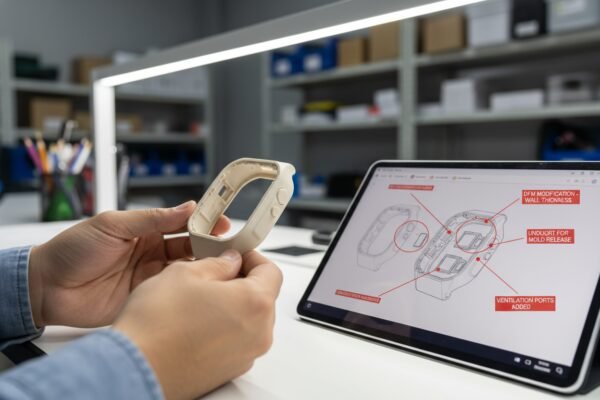
Most startup founders design products in a vacuum. They work with industrial designers in the US or Europe CE Marking 3. The designs look great on screen. But nobody checks if a factory in Shenzhen or Dongguan can actually produce them at scale. This is where a sourcing agent steps in.
Breaking Down the Design Review Process
A good sourcing agent does not just forward your CAD file to a factory and wait FCC Certification 4. The process is much more hands-on. Here is what it typically looks like:
- Material Check. The agent reviews every material in your BOM (Bill of Materials 5). Some materials are easy to source in China. Others are rare or require import. This affects cost and lead time.
- Process Mapping. The agent maps each manufacturing process — injection molding 6, CNC machining, PCB assembly, surface finishing — and matches it to factories with proven capability.
- Tooling Assessment. Custom molds and tooling are a major upfront investment. The agent evaluates whether your design requires simple or complex tooling, and estimates cost accordingly.
- Design-for-Manufacturing (DFM) Feedback. Experienced agents provide DFM suggestions. For example, a wall thickness that works for 3D printing may not work for injection molding. Design-for-Manufacturing 7 The agent flags these issues early.
What Agents Look For vs. What Founders Assume
| What Founders Assume | What Agents Actually Check |
|---|---|
| "Any factory can make this." | Only 2-3 factories in the region have the right equipment. |
| "My design is final." | 60% of designs need DFM modifications before production. |
| "Tooling is cheap." | Complex molds can cost $5,000–$50,000 depending on cavities and material. |
| "I just need one factory." | Most products require 2-4 sub-suppliers for different components. |
| "Lead time is 30 days." | Realistic lead time with tooling is often 45-90 days. |
The Cross-Industry Advantage
Here is a personal insight I want to share. If you hire someone who only spent a few years as a salesperson or quotation clerk at a trading company, they cannot give you useful manufacturability advice. They are order-takers. They know how to process a PO, not how to evaluate a product design.
The real value comes from agents with cross-industry experience. I, Allen Zeng, have 19 years of multi-industry experience. Beyond sourcing, I have built my own branded products, worked deeply with multiple Chinese factories, and have hands-on experience in brand marketing, online and offline operations. An agent at this level can offer advice far beyond just buying and shipping. They can help you avoid design pitfalls, suggest alternative materials, and identify risks that a junior sourcing clerk would never see.
When to Walk Away
Sometimes the honest answer is: your product is not manufacturable in China — at least not at your target price. A good agent tells you this early. A bad agent strings you along. The feasibility study exists to save you from expensive mistakes.
What steps should I take to accurately estimate my total landed costs before I commit to a factory?
One of the biggest shocks for first-time importers happens when the invoice from the freight forwarder arrives and the total is 30% higher than expected.
To accurately estimate total landed costs, you should work with a sourcing agent to calculate unit pricing, tooling amortization, packaging, inland freight, ocean or air shipping, customs duties, tariffs, insurance, and last-mile delivery — then add a 5-10% contingency buffer for unexpected charges.
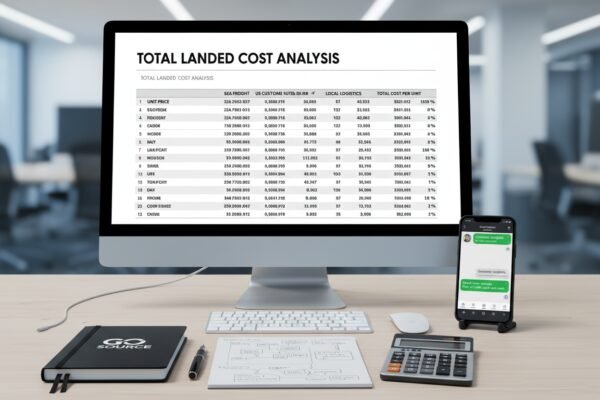
When we help startups with cost modeling, we build a full cost stack. Not just the factory price. The factory price — also called the FOB price — is only one piece of the puzzle. Many founders focus entirely on negotiating the unit price down by a few cents. Meanwhile, they overlook shipping costs, duties, and handling fees that can add 20-40% on top.
The Full Landed Cost Stack
Here is a breakdown of every cost element a startup should account for:
| Cost Element | Description | Typical Range |
|---|---|---|
| Unit Price (FOB) | Factory gate price per unit | Varies by product |
| Tooling / Mold Cost | Amortized across first order or paid upfront | $1,000–$50,000 |
| Packaging | Custom boxes, inserts, labels, barcodes | $0.30–$3.00/unit |
| Inland Freight | Factory to port in China | $50–$500/shipment |
| Ocean Freight (FCL/LCL) | Port to port shipping | $1,500–$8,000/container |
| Air Freight | For urgent or small shipments | $4–$10/kg |
| Customs Duties & Tariffs | Based on HS code 8 and destination country | 0%–25%+ |
| Customs Broker Fee | Handling import paperwork | $100–$300/shipment |
| Insurance | Cargo insurance during transit | 0.3%–0.5% of cargo value |
| Last-Mile Delivery | Port/warehouse to your door or Amazon FBA | $200–$1,000 |
| Inspection Fees | Pre-shipment QC inspection | $200–$400/inspection |
| Contingency Buffer | Unexpected costs and currency fluctuation | 5%–10% of total |
Common Mistakes in Cost Estimation
Many startup founders make these errors:
- Ignoring tariff codes. The HS code determines your duty rate. A wrong classification can cost thousands.
- Forgetting VAT or sales tax. Depending on your country, import VAT applies at customs.
- Underestimating packaging costs. Retail-ready packaging with inserts and printing adds up fast.
- Skipping insurance. One lost container can bankrupt a startup. Insurance is cheap. Losses are not.
How a Sourcing Agent Adds Value Here
A sourcing agent with deep supply chain knowledge does more than get you a quote. They challenge the quote. They know the real cost of raw materials. They know when a factory is padding margins. They can run an "apples-to-apples" comparison across three or four qualified suppliers, normalizing for packaging, MOQ, and payment terms.
At Go Source, we build a landed cost model for every client before they commit. We include shipping estimates from our logistics partners, current duty rates, and even Amazon FBA inbound fees when relevant. This way, the founder sees the true cost of putting one unit on a shelf in the US. No surprises.
Project-Based vs. Commission-Based Pricing
It is also worth noting how agent pricing affects your cost model. Some agents charge a flat fee for the feasibility study phase, then a small commission on production orders. Others charge a percentage from day one. For bootstrapped startups, a hybrid model — modest flat fee plus 2-5% commission — often makes the most sense. It aligns incentives without draining cash before you even have a product.
How do I verify if a supplier can meet my strict quality standards during the prototyping phase?
During the early days of developing our own branded products, we learned a painful lesson: a factory that sends a perfect sample can still deliver a terrible bulk order.
You verify a supplier's quality capability during prototyping by requesting multiple sample iterations, conducting on-site factory audits, defining clear quality specifications with AQL standards, testing samples in accredited labs, and having your sourcing agent physically inspect production processes and equipment.
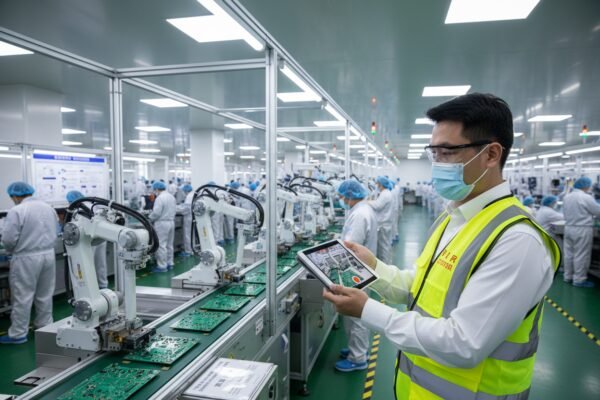
The prototyping phase is your best opportunity to stress-test a supplier. It is far cheaper to discover problems now than after you have 5,000 units sitting in a warehouse. But here is the catch: many factories put their best workers on samples. The A-team makes your prototype. The B-team runs your production. A sourcing agent who knows this game can protect you.
The Prototype Evaluation Framework
Here is a step-by-step approach to quality verification during prototyping:
Define Specifications First. Before you request a sample, create a detailed product specification sheet. Include dimensions with tolerances, material grades, color codes (Pantone), surface finish requirements, and functional test criteria. If the factory does not have clear specs, they will guess. And guesses lead to rejects.
Request Multiple Iterations. Never approve the first sample. Request at least two rounds. The first round reveals the factory's baseline capability. The second round shows whether they can follow correction instructions.
Conduct a Factory Audit. This is non-negotiable for any product above $5 per unit. Your sourcing agent should visit the factory and check equipment condition, worker skill level, raw material storage, and existing QC processes. Desk research alone misses production realities.
Send Samples to an Independent Lab. For electronics, this means safety testing (CE, FCC, UL). For consumer goods, it may mean material composition testing or drop tests. Do not rely on the factory's own test reports.
Set AQL Standards Early. AQL (Acceptable Quality Level) defines how many defects you will tolerate per batch. Set this during prototyping, not after production starts.
Red Flags During Prototyping
Watch for these warning signs:
- The factory refuses to share raw material sources.
- Sample lead time keeps slipping with vague excuses.
- The factory cannot explain their internal QC process.
- Surface finish or color consistency varies between samples.
- They push back on your specification sheet as "too detailed."
Why Your Agent Must Be On the Ground
A sourcing agent in China can visit the factory within days. They can hold the sample in their hands. They can compare it side-by-side with your reference. They can watch the production line and spot issues that photos and video calls miss. This is one of the biggest advantages of working with a China-based agent versus trying to manage quality remotely from the US or Europe.
At Go Source, we treat the prototyping phase as a qualifying exam for the factory. If they fail here, they do not get the production order. Period. We document every issue, photograph every defect, and provide transparency reports so the founder can make an informed decision.
Certifications to Verify During Prototyping
Do not wait until mass production to check certifications. Ask during the prototype phase:
- CE Marking — Required for products sold in the EU.
- FCC Certification — Required for electronic devices in the US.
- FDA Compliance — Required for food-contact or medical products.
- RoHS / REACH — Restrictions on hazardous substances.
- UL Listing — Safety certification for electrical products.
If the factory cannot provide evidence of relevant certifications — or has never worked with them — that is a serious red flag.
Can a sourcing partner help me identify potential supply chain bottlenecks that might delay my product launch?
When we managed a consumer electronics project last year, everything was on track until a single chip supplier went on a two-week holiday shutdown that nobody had planned for.
Yes, a sourcing partner identifies supply chain bottlenecks by mapping your entire supplier network, evaluating lead times for every component, flagging seasonal factory closures, assessing logistics risks, and developing contingency plans for material shortages, port congestion, and geopolitical disruptions.

Supply chain bottlenecks 10 do not announce themselves. They hide in the details. A sub-supplier running low on a specific resin. A port backed up due to typhoon season. A national holiday that shuts down all factories for two weeks. These are the things that push your launch date back by a month. A skilled sourcing agent anticipates them.
Common Bottlenecks That Delay Startup Launches
| Bottleneck Type | Example | Typical Delay |
|---|---|---|
| Raw Material Shortage | Specific resin or chip out of stock | 2–6 weeks |
| Factory Holiday Shutdown | Chinese New Year (Jan/Feb) | 2–4 weeks |
| Tooling Delays | Mold modifications take longer than quoted | 1–3 weeks |
| Port Congestion | Peak season or weather disruptions | 1–2 weeks |
| Certification Delays | Lab testing backlog for CE/FCC | 2–4 weeks |
| Customs Holds | Incorrect documentation or HS code issues | 1–2 weeks |
| Quality Failures | Failed pre-shipment inspection, rework needed | 2–4 weeks |
How a Sourcing Agent Maps Your Risk
A good sourcing agent does not just find you a factory. They map the entire supply chain behind that factory. Who supplies the raw materials? Who makes the sub-components? Where are the single points of failure?
For example, if your product uses a custom IC chip sourced from a single supplier, that is a bottleneck. If your factory relies on one surface treatment vendor with a two-week backlog, that is a bottleneck. The agent identifies these risks upfront and either finds alternatives or builds buffer time into the project plan.
Seasonal and Geopolitical Risks
China's manufacturing calendar has predictable slowdowns. Chinese New Year is the biggest one — factories close for 15-30 days, and productivity drops for weeks before and after. A sourcing agent plans your production schedule around these dates.
Geopolitical risks are harder to predict but equally important. Tariff changes, trade restrictions, and shipping route disruptions can all impact your timeline. In 2025 and 2026, we have seen more startups ask us about backup suppliers in Vietnam or India. A well-connected agent can assess whether diversification makes sense for your specific product — or whether China remains the best option due to technology and infrastructure advantages.
Building a Contingency Plan
Here is what a practical contingency plan looks like:
- Dual-source critical components. Do not rely on a single sub-supplier for any key material.
- Order materials early. Place material orders 2-3 weeks before production starts.
- Build buffer into timelines. Add 10-15 days to every quoted lead time.
- Pre-book shipping. Especially during peak season (August-October), book freight early.
- Have a Plan B factory. Your agent should have at least one qualified backup factory.
IP Protection as a Launch Risk
One bottleneck that founders rarely think about: intellectual property theft. If your design leaks before launch, a competitor can beat you to market. A sourcing agent helps you file NDAs, register patents in China (which has its own IP system), and control information flow between suppliers. This is not just about protecting your idea. It is about protecting your launch timeline.
At Go Source, we treat supply chain mapping as a core part of every feasibility study. We do not just find a factory and hand you a quote. We trace the supply chain three levels deep, identify risks, and build timelines that account for reality — not just factory promises.
Conclusion
A feasibility study is not a luxury. It is the cheapest insurance a startup can buy before committing real money to manufacturing in China. Work with the right sourcing agent, and you avoid the mistakes that sink most first-time importers.
Footnotes
- Replaced HTTP 403 link with an authoritative Wikipedia page on feasibility studies. ↩︎
- Describes Acceptable Quality Level (AQL) standards used in quality control inspections. ↩︎
- Provides information on CE Marking requirements for products in the European Union. ↩︎
- Explains FCC Certification for electronic devices sold in the United States. ↩︎
- Defines and explains the importance of a Bill of Materials in manufacturing. ↩︎
- Provides detailed information on the injection molding manufacturing process. ↩︎
- Explains the principles and benefits of Design for Manufacturing (DFM). ↩︎
- Replaced HTTP unknown link with the official World Customs Organization (WCO) page explaining HS codes, as WCO administers the system. ↩︎
- Details the components and calculation of total landed costs in international trade. ↩︎
- Discusses common causes and impacts of supply chain bottlenecks. ↩︎